
Gaokao Pronunciation: How to Say It Correctly 2026
Learn exactly how to pronounce gaokao — 📗 the correct tones, common mistakes, and why it matters for anyone studying China's national college entrance exam.
What Gaokao Means — and Why the Name Matters
If you've ever stumbled over the word gaokao in conversation, you're not alone. Most English speakers hear it and end up somewhere between "gow-kow" and "gay-oh-kow" — neither of which is quite right. Getting it correct isn't just a nicety. When you're discussing the gaokao exam with colleagues, tutors, or students from China, mispronouncing the word signals unfamiliarity with the subject. That costs credibility.
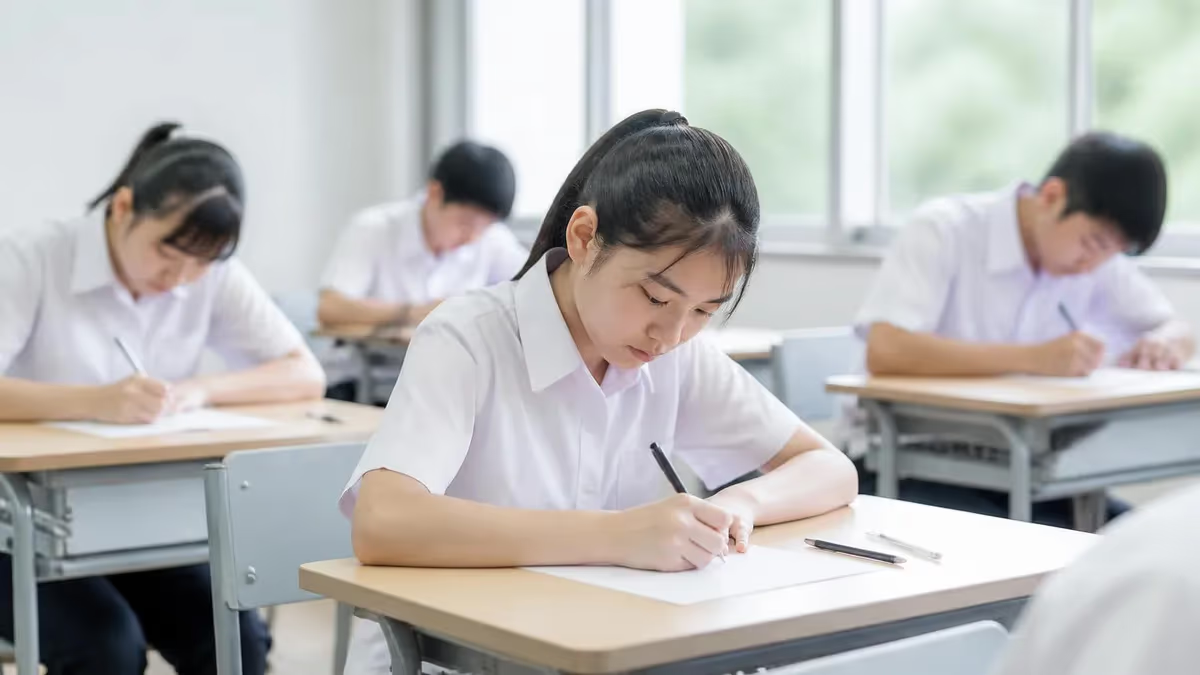
Gaokao (高考) is a Mandarin Chinese compound word built from two characters: gāo (高), meaning "high" or "advanced," and kǎo (考), meaning "exam" or "test." Together they mean "high-level examination." The name captures the weight of the event: roughly 12 million students sit for it each year, and gaokao scores determine university placement for an entire generation. The exam runs over two consecutive days in early June — typically June 7 and 8 — with all students across mainland China sitting simultaneously. It's a genuinely national event.
Understanding the etymology matters for pronunciation, too. When you know that gāo means "high" and kǎo means "exam," the word stops feeling arbitrary. You're saying "the high exam" — and once that mental model is in place, the two-syllable structure feels natural. There's no hidden third syllable, no silent letter, no irregular English-style exception. Two syllables, both short, both clear.
How to Say Gaokao: The Core Formula
Strip away the Mandarin tonal system for a moment and focus purely on the vowels. Both syllables in gaokao use the same vowel sound — the "ao" combination in Mandarin Pinyin, which closely approximates the English "ow" in "cow" or "now." It's an open vowel that comes from the back of your mouth: your jaw drops, your lips round slightly, and the sound is full and low. It's not the "o" in "go," not the "a" in "far," and not the "ow" in "glow."
If you can say "cow-cow" clearly and evenly, you're roughly 80% of the way to a correct gaokao pronunciation. The remaining 20% is the initial "g" consonant on the first syllable (which "cow" doesn't have) and the tonal variation on the second syllable. Add the "g" and you get "gow-kow." That's the working approximation most English-language journalists and educators use — and it's close enough that any Mandarin speaker will understand you immediately.
The key insight most guides miss: both syllables should carry equal weight. English is a stress-timed language, which means we naturally squash unstressed syllables and extend stressed ones. Gaokao resists that. Both syllables are roughly equal in duration and volume. Think of a steady knock: gow-kow. Even, brisk, two beats. That rhythm is more important than perfect tones.
Tonal Breakdown: Each Syllable in Detail
Mandarin is a tonal language — the part that trips up most non-native speakers. In Mandarin, the pitch contour of a syllable changes its meaning entirely, independent of the vowel and consonant sounds. Get the tones wrong and you've technically said a different word, even if the syllables sound otherwise correct.
The first syllable, gāo, uses Tone 1: a high, flat pitch held steady without rising or falling. Think of a musical note at the top of your comfortable vocal range, held even. It doesn't climb, doesn't fall — it just sits there, constant and level. English speakers tend to manage Tone 1 well because English does use high, flat intonation at the start of declarative sentences.
The second syllable, kǎo, uses Tone 3: the pitch dips downward and then rises back up, like the inflection you might use when you're genuinely surprised — "oh?" or "really?" It's a valley shape: start mid-range, go down, come back up. That dipping quality is what most English speakers miss. They either flatten it into Tone 1 (making both syllables high and level) or let the whole word blur into unstressed English syllables.
Practical guidance for each syllable:
- Gāo (高): High pitch, flat, held steady. Short duration. Vowel is "ow" as in "cow" — open, rounded, from the back of the mouth. Don't let the pitch drop at the end.
- Kǎo (考): Mid pitch, dip down, rise slightly. Short duration. Same vowel: "ow" as in "cow." The initial consonant is a hard "k" — in Mandarin it's technically unaspirated (no burst of air), though the English-speaker aspirated version is fully understandable.
If you nail both vowels and the dip on the second syllable, any Mandarin speaker will recognize the word immediately and appreciate the effort. If you can only change one thing — fix the vowel. Getting both syllables to the "ow" in "cow" is far more recognizable than perfect tones over the wrong vowel sounds.
For those with formal Mandarin training: gaokao is transcribed in Pinyin as gāo kǎo. The diacritical marks indicate tones — Tone 1 (macron, straight line) over the "a" in "gao," Tone 3 (caron, inverted circumflex) over the "a" in "kao." If you read Pinyin fluently, the tones are fully specified in that spelling.
Common Mispronunciations — and What Causes Them
These are the errors English speakers make most consistently, along with what drives each mistake:
- "Gay-oh-kow" — splits the first syllable into two. "Gao" is one syllable in Mandarin, not "gay" plus "oh." This error comes from treating "ao" as two separate English vowels. In Mandarin, "ao" is a single vowel unit — a diphthong that glides smoothly from the open "a" position to the rounded "o" position without a break.
- "Gow-koh" — wrong vowel on the second syllable. "Kǎo" ends in the same "ow" as "cow," not the "o" of "go." English speakers default to "oh" for syllables ending in a vowel sound because it's more common in English words. Resist that default.
- "Gah-kow" — wrong vowel on the first syllable. The "ao" in Mandarin is not the "a" in "father." It opens with something close to "a" but immediately rounds into "ow." Saying "gah" stays too far back and flat.
- "Cow-cow" — drops the initial "g" entirely. Usually happens when someone catches the word only partially in fast speech, hears the vowel, and reconstructs from there.
- "GOW-kow" or "gow-KOW" — heavy English stress on one syllable. Both syllables in gaokao should be roughly equal in weight. The stress-timing of English wants to squash one syllable, but in Mandarin they're co-equal.
If you've been mispronouncing gaokao for years, change one thing at a time. Fix the vowels first — get both to "ow" as in "cow" — then work on the dip in the second syllable. That sequence produces the fastest audible improvement for the least effort.
Context shapes which mistake is most likely. If you learned the word by reading it, you probably say "gay-oh-kow" because English spelling rules push that interpretation. If you learned it by ear from someone who also learned it by reading, you've inherited their version of the error. Either way, the fix is the same: correct the vowel, shorten both syllables, add the dip on the second.
You'll encounter gaokao in several compound phrases if you follow Chinese education at all. Each phrase uses the same pronunciation for the gaokao portion:
- Gaokao scores — the numerical results released roughly two weeks after the exam ends
- Gaokao preparation — the multi-year study program most students begin in junior high school
- Gaokao reform — policy changes affecting subject requirements, exam structure, and scoring formulas
- Post-gaokao — the period when students await results and submit university preferences through a centralized placement system
- Gaokao season — the weeks surrounding the June exam, when Chinese media coverage intensifies and test-related content dominates social platforms
In English-language journalism you'll see "Gao Kao" (two words), "Gao-Kao" (hyphenated), or "gaokao" (single word). Contemporary usage favors the single-word form. Pronunciation is identical regardless of the spacing. You'll also see it capitalized as "Gaokao" when used as a proper noun for the specific exam — that's the most precise form.
One practical exercise: search "gaokao" on any major video platform. English-language news segments from BBC, NPR, or Al Jazeera English will let you hear both Mandarin speakers and English-language journalists say the word. Chinese state media's English-language broadcasts (CGTN) are especially useful — you'll often hear the word said in both languages back to back, which gives you an immediate before-and-after comparison.
For language enthusiasts: Mandarin's four-tone system means mispronouncing kǎo as kào (Tone 4, falling) shifts the meaning slightly. Kào means "to lean on" or "to rely on," not "to test." In context, no one's going to think you're saying "high leaning" instead of "high exam." But it illustrates why tones matter in Mandarin and why improving pronunciation — even incrementally — changes how clearly you communicate across languages.
The mental model that works best for English speakers: think of gaokao as two short drum beats, not an English word. Gow-kow. Quick and even, like a knock on a door. That rhythm — equal weight, short duration, consistent vowel — is closer to the real thing than any elongated, stressed English version.
- ✓Both syllables use the "ow" vowel from "cow" — not "oh" as in "go"
- ✓First syllable (gāo): high, flat pitch — doesn't rise or fall
- ✓Second syllable (kǎo): dips down then rises slightly at the end
- ✓Two syllables only — never split "gao" into "gay-oh"
- ✓Equal weight on both syllables — no heavy English stress on either
- ✓Hard "g" consonant at the very start — don't drop it
- ✓Short, crisp duration on both — not drawn out like an English word
Quick reference: The pronunciation "gow-kow" (both rhyming with "cow") is your working approximation. For more context on what this exam covers, the gaokao exam overview details subjects, scoring, and how universities use results to determine admissions.
Why Pronunciation Reflects Preparation
Knowing how to say gaokao correctly carries a subtle signal. When you say it wrong — especially by splitting it into three syllables or using the wrong vowel — it suggests you encountered the word only in text, not in conversation with people who know the exam firsthand. That impression matters in professional or academic contexts: talking with Chinese students or their families, conducting research interviews, reporting on Chinese education policy, or advising students considering programs in China.
Nobody expects an English speaker to have flawless Mandarin tones. But the basics — the two-syllable structure, the "ow" vowel, the roughly equal weight on both syllables — are achievable in about five minutes of practice. And once they click, they stay. You won't forget "gow-kow" the way you forget a vocabulary word, because you've connected it to a physical memory: the open-mouthed vowel, the even two-beat rhythm.
There's also broader value in understanding how the word is built. Once you know that Mandarin is tonal and that "gao" means "high" while "kao" means "exam," you've opened a small window into how Chinese builds meaning from compound characters. That pattern appears constantly in Mandarin: zhongkao (中考, middle school exam), liankaokao (联考, joint exam). Gaokao is a useful entry point into the language's logic — and knowing it well starts with saying the name right.
For anyone building deeper familiarity with the exam, check out resources on gaokao math and gaokao English questions — two of the core subjects tested. The more you engage with the content, the more natural the word becomes.
- +Mandarin syllables are short and equal in weight — easier to remember the rhythm
- +Only two syllables — less to memorize than most English words
- +The "ow" vowel in both syllables creates a consistent pattern
- +Once correct, the pronunciation is very stable — you'll say it right every time
- −English stress-timing fights against the equal-syllable rhythm of Mandarin
- −The "ao" vowel combination doesn't exist in standard English
- −Tonal distinctions require active practice — they don't come naturally to English speakers
- −Most written guides in English use phonetic spelling that can mislead readers
Pros and Cons at a Glance
| Pros | Cons |
|---|---|
| Mandarin syllables are short and equal in weight — easier to remember the rhythm | English stress-timing fights against the equal-syllable rhythm of Mandarin |
| Only two syllables — less to memorize than most English words | The "ao" vowel combination doesn't exist in standard English |
| The "ow" vowel in both syllables creates a consistent pattern | Tonal distinctions require active practice — they don't come naturally to English speakers |
| Once correct, the pronunciation is very stable — you'll say it right every time | Most written guides in English use phonetic spelling that can mislead readers |

Sample Gaokao Exam Practice Questions
Try these questions from our free Gaokao Exam practice tests. The correct answer and an explanation follow each question.
Which word correctly completes the cloze: 'The charity relies entirely on _____ from the public to fund its programs.'
- A. donations
- B. demands
- C. criticisms
- D. competitions
Answer: A. donations
'Donations' are voluntary financial contributions from the public, which charities depend on. The context ('relies entirely on... from the public') clearly indicates funding through giving.
In the framework of Gaokao argumentative essays, what is '论据' (lùnjù)?
- A. The central claim or thesis the essay argues for
- B. The evidence, examples, or reasoning used to support the thesis
- C. The concluding paragraph that restates the main argument
- D. The topic sentence that opens each body paragraph
Answer: B. The evidence, examples, or reasoning used to support the thesis
'论据' means 'argument evidence' — it encompasses the facts, historical examples, logical reasoning, or literary allusions a writer deploys to substantiate the '论点' (thesis). Strong Gaokao essays are expected to feature varied and well-chosen '论据' to earn high marks in the content dimension.
In the Gaokao admissions process, how does the '投档线' (tóudàng xiàn, filing threshold) relate to the '录取线' (lùqǔ xiàn, final admission cutoff)?
- A. They are always identical, both set in advance by provincial education authorities
- B. The 投档线 is typically higher because universities pre-screen applicants before filing
- C. Universities request files at roughly 100–105% of planned enrollment, so the 投档线 may be slightly lower than the final 录取线
- D. The 投档线 applies only to out-of-province applicants while 录取线 applies to all students
Answer: C. Universities request files at roughly 100–105% of planned enrollment, so the 投档线 may be slightly lower than the final 录取线
Universities instruct the provincial admissions office to send files for approximately 100–105% of their planned intake. This means students at the margin of the 投档线 (where files are forwarded) may still be rejected after the university reviews their specific major preferences, and the lowest score among actually admitted students — the 录取线 — often ends up slightly higher than the 投档线.
The Gaokao essay prompt '改变,从那一刻开始' ('Change Began at That Moment') most directly asks students to demonstrate which narrative skill?
- A. Arguing a philosophical thesis through logical deduction
- B. Anchoring a personal transformation to a specific pivotal incident
- C. Comparing two historical figures whose lives changed society
- D. Summarising the plot of a canonical Chinese novel
Answer: B. Anchoring a personal transformation to a specific pivotal incident
The prompt centres on a singular turning-point moment, so the essay must ground a broader personal or emotional transformation in one concrete, well-rendered scene — the hallmark of incident-anchored narrative writing.
What the Name Teaches You About the Exam
There's a useful exercise in tracing what the two characters in gaokao actually represent. 高 (gāo) appears in dozens of Mandarin words related to height, elevation, and excellence: 高中 (gāozhōng, high school), 高速 (gāosù, high-speed), 高质量 (gāo zhìliàng, high quality). The character carries a consistent connotation of being above average, reaching upward, exceeding the ordinary. When Chinese students and parents talk about the gaokao, they're not speaking about it clinically — the name itself carries aspiration and pressure built into its characters.
The second character, 考 (kǎo), appears in words like 考试 (kǎoshì, exam or test), 考虑 (kǎolǜ, to consider or think through), and 考察 (kǎochá, investigation or inspection). Its core meaning involves careful assessment — measuring something precisely, examining it thoroughly. Together, 高考 isn't just "big test." It's "thorough assessment at the highest level." That's a different emotional register than "college entrance exam," and it helps explain why the event carries such cultural weight in China.
For students who've grown up in China, the word gaokao doesn't need explaining any more than "SAT" needs explaining to an American high schooler. It's embedded in the texture of childhood and adolescence — in the conversations parents have, in the way teachers frame every subject, in the social pressure that builds through the school years. Saying the word correctly, with the right vowel and the right rhythm, is a small acknowledgment that you're engaging with the word on its own terms rather than treating it as an abstract foreign phrase.
That engagement matters. Whether you're helping a student prepare, researching Chinese education systems, or just curious about one of the world's most consequential tests, accuracy in how you talk about it signals genuine interest. And genuine interest — in the name, in the structure, in what the exam actually demands — is the starting point for any useful understanding.
Getting comfortable with the word gaokao takes less effort than you'd expect. Two short syllables, both with the "ow" vowel from "cow," with a slight dip on the second: gow-kow. That's the whole formula. You don't need to master Mandarin tones to get this right — just the correct vowel and the discipline not to treat the word like an English compound.
Whether you're a student researching Chinese higher education, an educator working with students who've sat the exam, a journalist covering China, or someone simply curious about one of the world's most consequential tests — saying the name correctly is a small form of respect for the subject. It signals you've done even a little of the work.
For deeper context on the exam itself — its structure, subjects, scoring, and what students actually experience — the gaokao exam overview and the gaokao exam practice questions available here are a solid starting point. And if you want to dig into how how hard is the gaokao, that's worth reading too. Knowing how to say the word is the beginning. Understanding what's behind it is the real work.
How this page was made: written with AI tools and published by Nathan Beja, founder of Practice Test Geeks, who is responsible for its content. Exam facts are checked against the official sources listed below. Not reviewed by a subject-matter expert. Editorial policy
Sources & references
Exam facts on this page (fees, format, dates, passing scores) are checked against these official sources; the date is our last check. Editorial policy
- moe.gov.cn — Test delivery, score release · verified Oct 2026
- sdzk.cn — Fees · verified Oct 2026