
G1 License in Ontario: Everything You Need to Pass the Written Test 2026
Free G1 License in Ontario: Everything You practice test with questions and answer explanations. Prepare for the 2026 exam with instant scoring.
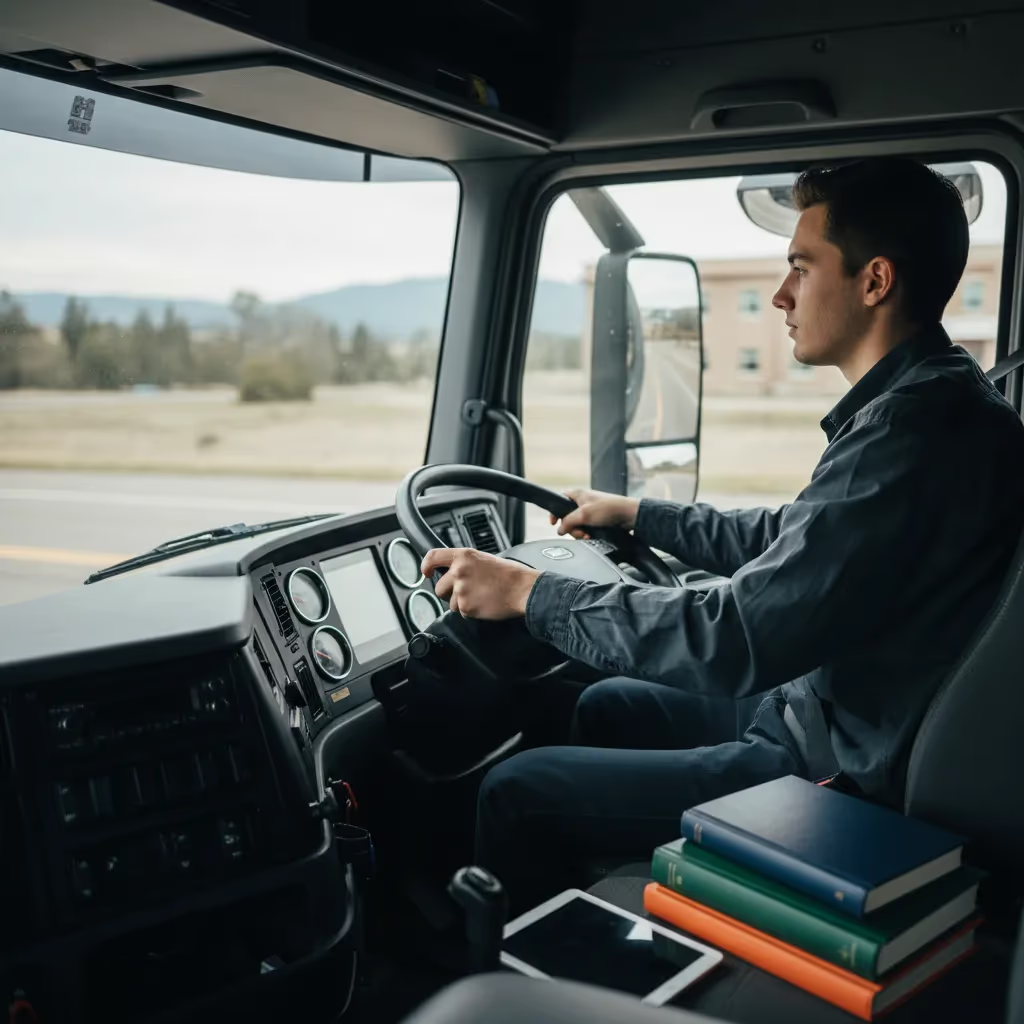
Getting your G1 license is the first real step toward driving in Ontario. You're looking at a written knowledge test — 40 questions total, split evenly between road rules and traffic signs. Score at least 16 out of 20 on each section and you're in. Fail either half? You retake the whole thing. That's the deal. Practice with the free CDL practice test on PracticeTestGeeks (32 questions with answer explanations).
The G1 is a learner's permit, not a full license. You can't drive alone with it, can't take highways, and your blood alcohol level must sit at exactly zero. Think of it as the training-wheels phase. Ontario's graduated licensing system requires you to hold a G1 for at least 12 months before you're eligible to move up — unless you complete an approved driving course, which knocks that down to 8 months. The minimum age is 16, and there's no upper limit. People get their G1 at 40, 50, even 60.
If you're coming from a different province or country, the process might look different. Some license holders qualify for partial exemptions. But for most first-time drivers in Ontario, the G1 written test is where everything starts. Before diving into specifics, it's worth understanding how this compares to licensing structures elsewhere.
In the United States, a class c license covers standard passenger vehicles, while a what is a commercial driver's license applies to trucks and large vehicles. The class d license in many US states is roughly equivalent to Ontario's full G license — it lets you operate a regular car without commercial endorsements.
Whether you're studying for the G1 or curious about licensing frameworks across North America, this page breaks down requirements, restrictions, costs, and test strategies. No fluff. Just what you actually need to know.
Free CDL Study Tools
Interactive CDL resources on PracticeTestGeeks, free to start:
- Class A Driver's License Practice Test -2 — 32 questions with instant scoring and answer explanations
- CDL flashcards — review key terms and concepts card by card
- CDL study guide — topic-by-topic overview of what the exam covers
- CDL cheat sheet — one-page printable summary for last-minute review
Ontario groups its driver licenses into classes, and the G1 sits at the very bottom of the passenger vehicle ladder. Once you pass the written test, you hold a G1 — a learner's permit with serious restrictions. After 8 to 12 months and a road test, you move to G2. Another road test after that? Full G license. Three stages total.
How does this compare to other jurisdictions? In the US, license classes work differently depending on the state. A class d license typically covers standard passenger vehicles — that's your everyday car. A class a license lets you operate combination vehicles like tractor-trailers, which require specialized testing and endorsements. Ontario doesn't use letter-based classes for passenger vehicles the same way — it uses G1, G2, and G in a graduated system.
The graduated approach exists for a reason. New drivers crash more often. Full stop. Ontario's data shows that drivers in the graduated system have significantly lower collision rates than those who received full licenses immediately. The 12-month waiting period (or 8 months with a course) isn't bureaucratic padding — it's based on actual crash statistics.
You'll need a valid piece of identification to apply. An Ontario health card alone won't cut it. Bring your passport, birth certificate, or citizenship card. Two pieces of ID minimum. DriveTest centres handle the applications and administer both the written and road tests.
So what is a CDL license? It's a commercial driver's license — the credential you need to operate large or heavy vehicles in the United States. Trucks, buses, vehicles carrying hazardous materials. If the vehicle weighs over 26,001 pounds or carries 16+ passengers, you need a CDL. Period. Ontario has its own commercial license classes (A, B, C, D, and others), but the American CDL system is the most widely discussed because of the sheer volume of trucking jobs south of the border.
Understanding what is a commercial driver's license matters even if you're focused on getting a G1 right now. Why? Because career drivers often start with a basic license and upgrade later. In Ontario, upgrading from G to a Class A or D license requires additional testing — both written and practical. In the US, the CDL path involves a separate knowledge test, skills test, and sometimes endorsements for specific cargo types.
The immigrant commercial driver's license lawsuit in the United States highlighted how licensing requirements can create barriers for newcomers — a situation that resonates with Ontario's own immigrant population navigating the G1 process. Different countries have different driving standards, and converting a foreign license isn't always straightforward in either country.
For the G1 specifically, your test will cover Ontario's Highway Traffic Act, road signs that are specific to Canadian standards, and rules about right-of-way, speed limits, and emergency vehicles. The sign recognition section trips people up more than the road rules section. Study the shapes — octagon means stop, diamond means warning, rectangle gives information. Colour matters too. Red means prohibition or stop. Yellow means caution. Green means go or information about direction.
G1 Test Format & Structure
20 multiple-choice questions covering Ontario's Highway Traffic Act. Topics include right-of-way rules, speed limits in school zones and residential areas, safe following distances, passing rules, and what to do when emergency vehicles approach. You need 80 correct answers to pass this section. Questions are scenario-based — they describe a situation and ask what the correct action would be.
The immigrant commercial driver's license lawsuit raised important questions about testing accessibility — and Ontario has its own version of this conversation. The G1 test is available in over 20 languages, which helps. But the reading level of some translations has been criticized. If English or French isn't your first language, you can request a different language version at the DriveTest centre. No extra charge.
When it comes to vehicle classes, a class c driver license in the United States covers vehicles not included in Class A or Class B — think smaller trucks, passenger vans, and vehicles carrying hazardous materials. It's a specific CDL designation. Ontario's Class C license is completely different — it covers ambulances and buses carrying fewer passengers. Same letter, different meaning. Don't get them confused if you're comparing jurisdictions.
One thing both systems share: graduated progression. You don't jump straight into driving a tractor-trailer. In Ontario, you work through G1, G2, G, and then potentially upgrade to commercial classes. In the US, you might start with a regular driver's license, then add a CDL with endorsements. Both approaches recognize that complex vehicles demand more training and experience.
The G1 restrictions exist because new drivers are statistically dangerous. Zero alcohol. No highway driving. A fully licensed driver must sit in the front passenger seat at all times. After 11 PM? Only one passenger under 19 (unless they're immediate family). These rules aren't suggestions — they're legally enforceable.
Let's talk money. The G1 license package in Ontario costs $159.75 as of 2026. That covers your written test, your G2 road test (when you're ready), and a five-year license validity period. If you fail the written test, you can retake it by paying a smaller fee — typically around $16. Not terrible, but it adds up if you keep failing.
Compare that to CDL license cost in the United States, and the G1 looks like a bargain. Getting a CDL can run anywhere from $3,000 to $7,000 if you attend a training school. Some trucking companies sponsor the training, meaning you pay nothing upfront but commit to working for them for a set period — usually one to two years. CDL license no experience jobs do exist, especially with companies desperate for drivers. The trucking industry has a chronic shortage. That shortage doesn't apply to G1 holders, obviously — but it does illustrate how different the career economics are.
Driving schools in Ontario are optional for G1 holders but strongly recommended. An MTO-approved beginner driver education course costs between $500 and $1,000 and reduces your mandatory G1 holding period from 12 months to 8 months. The course also typically reduces your insurance premiums — sometimes by 10% to 15%. Worth it financially even before you factor in the better training.
Insurance is the hidden cost nobody warns you about. A new G2 driver (just promoted from G1) pays astronomical insurance rates in Ontario — often $3,000 to $6,000 annually for basic coverage. That's not a typo. Young drivers in the Greater Toronto Area pay even more. Shopping around helps. Some insurers specialize in new drivers and offer better rates.
G1 License: Advantages and Limitations
- +Legal to drive accompanied — starts building your driving record immediately
- +Valid for 5 years — plenty of time to complete the graduated licensing process
- +Available in 20+ languages at DriveTest centres across Ontario
- +Approved driving course cuts your wait time from 12 months to 8 months
- +No age limit — you can start the process at 16 or 60
- +Lower initial cost than US commercial licensing — $159.75 covers written test and first road test
- −Zero blood alcohol — can't have even one drink before driving
- −No highway or expressway driving under any circumstances
- −Must have a fully licensed driver (4+ years) in the front passenger seat
- −Passenger restrictions after 11 PM for drivers under 19
- −Insurance premiums for new drivers are extremely high in Ontario
- −Written test trips up many candidates — plenty fail on their first attempt
Preparing for a class a commercial driver's license test is a fundamentally different experience than studying for a G1 — but some strategies overlap. Both tests reward methodical study over cramming. Both test recognition and scenario-based thinking rather than pure memorization. And both have surprisingly high first-attempt failure rates. The class a drivers license practice test format in the US mirrors Ontario's approach: multiple choice, computer-based, with a minimum passing score.
For the G1, the most effective study method is practice tests. Not reading the handbook cover to cover — though you should do that once. Practice tests. Take them repeatedly until you're scoring 90% or higher consistently. The Ontario Driver's Handbook is free online, but it's 180 pages of dense material. Practice tests let you identify weak spots fast.
Focus extra time on the signs section. Road rules are somewhat intuitive if you've been a passenger in a car your whole life — you know red means stop, you know what a speed limit is. Signs are different. You might not know the difference between a regulatory sign (white background, black text) and a warning sign (yellow diamond). You might not recognize a construction zone sign versus a school zone sign. These details matter.
Timing is another consideration. The G1 written test isn't strictly timed, but DriveTest centres do close at specific hours. If you arrive at 4:30 PM and the centre closes at 5:00 PM, they might not let you start. Arrive early. Weekdays are less crowded than Saturdays — especially Tuesday through Thursday mornings. Some centres let you book online. Others are walk-in only.
Exam Preparation Checklist
- ✓Read the Ontario Driver's Handbook completely — at least once cover to cover
- ✓Take 10+ practice tests and score 90%+ consistently before booking your test
- ✓Memorize all regulatory signs (white background) and warning signs (yellow diamond)
- ✓Learn the specific speed limits: 50 km/h in urban areas, 80 km/h on highways, 100 km/h on expressways
- ✓Study right-of-way rules — especially at uncontrolled intersections and roundabouts
- ✓Prepare two valid pieces of government-issued identification
- ✓Confirm your nearest DriveTest centre location and operating hours
- ✓Bring $159.75 for the licensing package fee (cash, debit, or credit)
- ✓If you wear glasses or contacts, bring them — a vision test is included
- ✓Review emergency vehicle rules: pull right, stop, and wait for all emergency vehicles to pass
Across the continent, licensing frameworks serve the same purpose but use different structures. The california driver license system, for instance, uses Class C as the default passenger vehicle license — which confuses people who associate "Class C" with commercial vehicles. A non CDL class c license in California lets you drive a standard car, a housecar under 40 feet, or a three-axle vehicle under 6,000 lbs. No commercial endorsement needed. It's roughly equivalent to Ontario's full G license, despite the different naming convention.
Ontario's G1 holders can't drive any of those vehicles, of course. You're limited to passenger vehicles with a supervising driver present. But understanding the broader landscape helps if you're planning to drive in multiple jurisdictions — or if you're an immigrant who held a license in another country and is trying to figure out where your credentials fit.
The reciprocity agreements between provinces and states vary wildly. Ontario has agreements with several US states that allow direct license exchanges — no retesting required. But these typically apply to full licenses, not learner's permits. A G1 holder can't exchange their permit for a US learner's permit. You'd need to start the process fresh in whatever state you move to.
For anyone considering commercial driving as a career path, the G1 is just the starting line. Ontario's Class A (AZ) license — the one you need for tractor-trailers — requires you to hold a full G license first, then pass additional written and road tests. The US CDL pathway is similar but not identical. Both systems demand significant training investment.
A non-cdl class c license in many US states covers vehicles that don't meet the weight or passenger thresholds for a CDL. Think smaller delivery trucks, passenger vans with fewer than 16 people, or specialized equipment vehicles. It's a useful credential for people who want to drive professionally without going through full CDL training — which, as we covered, can cost thousands of dollars and weeks of training time.
The california license system is worth examining because California has more registered vehicles than any other state — and its licensing structure influences how other states design theirs. California's Class C is the default. Class A and B require additional testing, fees, and in most cases, professional training programs. The state also has unique requirements around teen drivers, including a provisional license phase that mirrors Ontario's graduated system in some ways.
Ontario's system is more rigid than California's in certain respects. California's provisional license (for drivers under 18) restricts night driving and passengers but doesn't ban highway driving outright. Ontario's G1 does. California doesn't require zero BAC for provisional license holders — the standard 0.01% applies. Ontario's zero BAC rule is stricter. On the flip side, Ontario's graduated system arguably produces safer new drivers. The collision data supports it.
If you hold a california license and move to Ontario, you may be able to exchange it directly — but only if you've held the full license for at least two years and your jurisdiction has a reciprocity agreement with Ontario. G1 and G2 holders? No exchange. You start from the beginning.
Many test-takers fail the G1 written test on their first attempt. The most common mistakes: confusing warning signs with regulatory signs, misunderstanding right-of-way at roundabouts, and not knowing specific speed limits for school zones (40 km/h when lights flash) and construction zones (posted speed, fines doubled). Study the signs section harder than you think you need to.
Beyond passenger vehicles, the world of commercial licensing opens up entirely different career possibilities. A CDL B license — the US Class B commercial driver's license — covers straight trucks, large passenger buses, and segmented buses. It's the middle tier between Class C (smaller commercial vehicles) and Class A (tractor-trailers and heavy combinations). In Ontario, the closest equivalent is the Class B or C license, depending on the specific vehicle type.
So what is CDL license in practical terms? It's your ticket to a career in transportation. Long-haul trucking, local delivery, bus driving, tanker transport, moving hazmat — all CDL territory. The demand is massive. The American Trucking Associations estimates a shortage of over 80,000 drivers as of 2026, with that number projected to grow. That shortage creates opportunities for people willing to invest in training.
For G1 holders in Ontario who are thinking long-term about commercial driving, the pathway is clear but long. G1 → G2 (road test) → G (second road test) → Class A or D written test → Class A or D road test. Minimum timeline? About three years from G1 to a commercial license, assuming you pass everything on the first attempt and don't wait longer than necessary between stages. Most people take four to five years.
The investment pays off for many drivers. Commercial truck drivers in Ontario earn between $50,000 and $85,000 annually, depending on the type of hauling, distance, and experience level. Long-haul drivers who cross into the US regularly tend to earn more. Owner-operators can clear six figures — but they also cover their own fuel, insurance, maintenance, and equipment costs.
CDL Practice Test Questions
Prepare for the CDL - Commercial Driver's License exam with our free practice test modules. Each quiz covers key topics to help you pass on your first try.
CDL Alabama CDL Combination Vehicles Pract...
CDL Exam Questions covering Alabama CDL Combination Vehicles Practice Test. Master CDL Test concepts for certification prep.
CDL Alabama General Knowledge CDL Practice...
CDL Mock Exam on Alabama General Knowledge CDL Practice Test. CDL Study Guide questions to pass on your first try.
CDL Airbrakes Practice Test
CDL Test Prep for Airbrakes Practice Test. Practice CDL Quiz questions and boost your score.
CDL CLASS A COMMERCIAL DRIVER'S LICENSE PR...
CDL Mock Test covering CLASS A COMMERCIAL DRIVER'S LICENSE PRACTICE TEST. Online CDL Test practice with instant feedback.
CDL Hazmat Practice Test
CDL Test Prep for Hazmat Practice Test. Practice CDL Quiz questions and boost your score.
CDL Tanker Practice Test
CDL Test Online for Tanker Practice Test. Free practice with instant results and feedback.
CDL Class A Commercial Driver's License Pr...
CDL Study Material on Class A Commercial Driver's License Practice Test -1. Prepare effectively with real exam-style questions.
There's a what is a non CDL class c license question that comes up constantly in driving forums — and it matters because the terminology is genuinely confusing. In short, a non-CDL Class C license lets you drive smaller commercial vehicles that don't hit the weight or passenger thresholds requiring a full CDL. Think airport shuttles, small delivery vans, or vehicles carrying small amounts of hazardous materials. You don't need the extensive training or testing that a full CDL demands.
When people ask about CDL license Florida, they're usually looking at one of the largest CDL markets in the country. Florida processes tens of thousands of CDL applications annually, driven by the state's massive logistics and tourism industries. The testing process mirrors the federal FMCSA standards — general knowledge test, air brakes test (if applicable), and a skills test with three parts: pre-trip inspection, basic vehicle control, and an on-road driving test.
None of this applies directly to Ontario's G1, of course. But if you're a new driver researching your options — especially if you're planning to work in transportation eventually — understanding the CDL landscape gives you a broader picture. The G1 is step one. Everything else builds from there.
One final note on the G1 test itself. The questions are pulled from a question bank, so no two tests are identical. You might get a question about parking on a hill that your friend didn't get. You might not see a single question about roundabouts when your friend got three. The randomness means you need to study everything. Cherry-picking topics is a gamble — and with so many candidates failing on their first attempt, those odds aren't great.
Sample CDL Practice Questions
Try these questions from our free CDL practice tests. The correct answer and an explanation follow each question.
You will need to pass the pre-trip vehicle inspection test ________.
- A. Before you complete the general knowledge test.
- B. Before you can proceed to the basic vehicle control skills test.
- C. After the basic vehicle control skills test.
- D. During the winter.
Answer: B. Before you can proceed to the basic vehicle control skills test.
The CDL skills test is structured in a specific sequence. You must first successfully pass the pre-trip vehicle inspection test, which assesses your ability to identify and explain vehicle components and their safe operating condition. Only after demonstrating this foundational knowledge are you permitted to proceed to the basic vehicle control skills test, followed by the on-road driving test.
To perform a proper inspection of suspension mounts, you need to ______.
- A. Look for cracked spring hangers.
- B. Inspect the mounts at each point where they are secured to the vehicle frame and axle[s].
- C. All of the listed answers.
- D. Check for missing bolts.
Answer: C. All of the listed answers.
To perform a proper inspection of suspension mounts, you need to examine them comprehensively. This includes looking for cracked spring hangers, checking for any missing bolts, and inspecting the mounts at each point where they are secured to the vehicle frame and axles. A thorough inspection ensures the suspension system is structurally sound and safe for operation, preventing potential failures that could compromise vehicle control.
What determines the amount of brake pressure you need to stop the vehicle?
- A. The speed of your vehicle.
- B. How quickly you need to stop.
- C. How full your gas tank is and how quickly you need to stop.
- D. The speed of your vehicle and how quickly you need to stop.
- E. Your state of mind.
Answer: D. The speed of your vehicle and how quickly you need to stop.
The amount of brake pressure needed to stop a vehicle is directly related to its kinetic energy and the desired stopping time. Higher vehicle speed means more kinetic energy, requiring greater force to dissipate. Additionally, if you need to stop quickly, more pressure must be applied to achieve a faster deceleration rate, making both speed and urgency critical factors.
If you are transporting a load that is over-length, over-width or overweight, you may need to ________.
- A. Special transit permits.
- B. Special equipment i.e. "wide load" signs and/or flashing lights.
- C. Drive and transport your vehicle at specified times of day.
- D. All of the listed answers.
Answer: D. All of the listed answers.
Transporting oversized or overweight loads requires strict adherence to regulations to ensure safety. This often includes obtaining special transit permits, using special equipment like 'wide load' signs and flashing lights for visibility, and driving at specified times of day to minimize traffic disruption. All these measures are necessary for safe and legal transport of such loads.
CDL Questions and Answers
How this page was made: written with AI tools. Exam facts are checked against the official sources listed below. Not reviewed by a subject-matter expert. Editorial policy
Sources & references
Exam facts on this page (fees, format, dates, passing scores) are checked against these official sources; the date is our last check. Editorial policy