
California Firearm Safety Certificate: Requirements, Test, and How to Get Your FSC
Prepare for the California Firearm Safety Certificate: certification. Practice questions with answer explanations covering all exam domains. 🎓
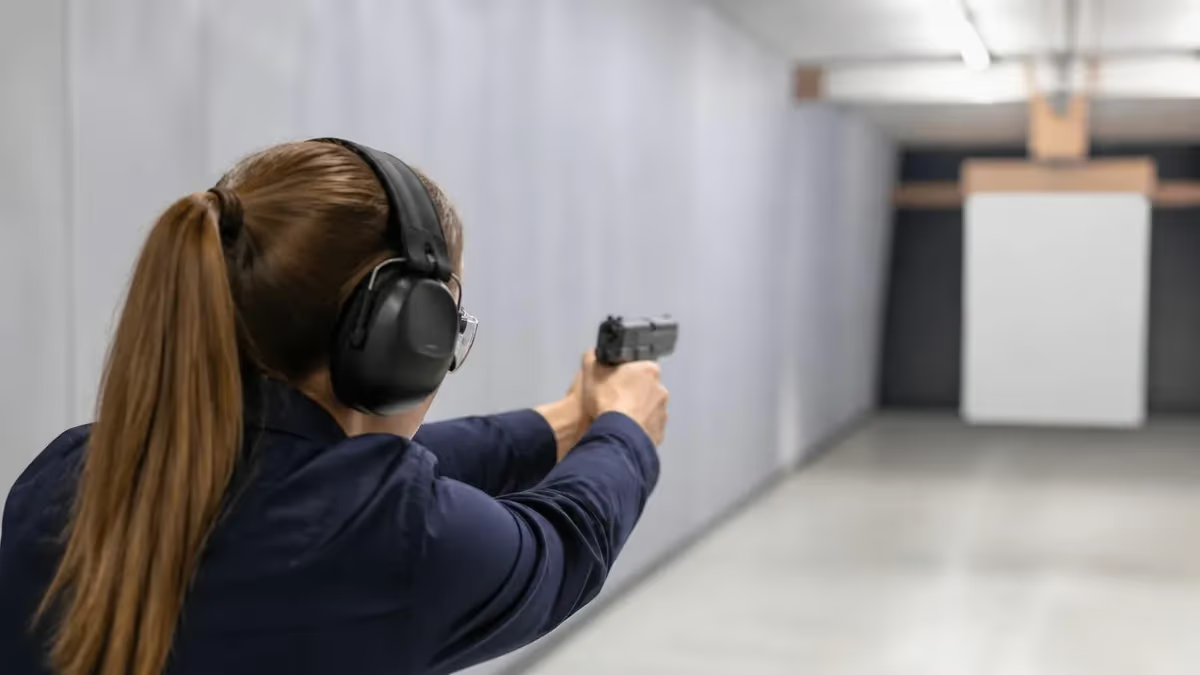
The California Firearm Safety Certificate — the FSC — is a mandatory requirement for purchasing any firearm from a licensed dealer in California. Before you can complete a firearm purchase at any California firearms retailer, you need to present a valid FSC to the dealer. The certificate demonstrates that you've passed a 30-question test on basic firearm safety, California gun laws, and safe storage practices — and it costs $25 and takes about 30 minutes to obtain.
The FSC requirement has been in place for handgun purchases since 2015. In 2023, California expanded the requirement to cover all firearms — rifles, shotguns, and handguns alike. If your FSC was issued before the 2023 change, it remains valid for its full five-year term and covers any firearm purchase, not just the handgun category it was originally issued under. The expansion means that long-gun buyers who previously didn't need the certificate now do.
Getting your FSC is straightforward but requires preparation if you want to pass the 30-question test on your first attempt. The test covers specific California laws, safe storage requirements, and the four fundamental rules of firearm safety. Some questions are direct recall of facts; others require applying rules to scenario-based situations. Candidates who review the material beforehand pass comfortably — candidates who walk in cold sometimes don't.
This guide covers every aspect of the California FSC: who needs it, eligibility requirements, where to take the test, what topics appear on the exam, how to prepare, and what happens when your certificate is about to expire. Whether you're buying your first firearm or renewing an expired FSC, the information here gives you a complete picture of what the process actually involves.
One important practical note: the FSC is required at the point of purchase, not at the point of taking possession. California's 10-day waiting period means you'll complete the FSC test and the background check on the purchase date, but you won't pick up the firearm until 10 days later. Having your FSC in hand before you walk into the dealer means the purchase process can move forward without delay.
Starting the process is easier than most people expect. You don't need to schedule an appointment at most locations — walk in, ask for the FSC test, pay the fee, take the test, and walk out with your certificate if you pass. The whole process from arrival to certificate in hand takes about 30-45 minutes for a prepared candidate. The informality of the process surprises some first-time purchasers who expected a more formal or bureaucratic experience.
You take the FSC test at a licensed firearms dealer that is also a DOJ-certified FSC testing location. Not every dealer in California offers FSC testing, so call ahead before visiting. The California DOJ maintains a searchable online list of authorized testing locations, which is the most reliable way to find a testing site near you. Larger gun stores typically offer walk-in testing; smaller stores may require an appointment.
The test itself is administered on paper or occasionally via tablet at the dealer's location. The dealer provides a copy of the DOJ's FSC study booklet beforehand if you haven't reviewed it. You'll answer 30 multiple-choice questions in a quiet area of the store. There's no formal time limit, though the test typically takes 15-20 minutes for candidates who've prepared. If you score 23 or higher out of 30, you pass and receive your FSC card on the spot.
The FSC card is a laminated wallet-size certificate issued by the testing dealer on behalf of the California DOJ. It shows your name, the issue date, and the expiration date (five years from the test date). Keep it in a safe place — you'll need to present it when purchasing a firearm for as long as it remains valid. If you lose your FSC, you can contact the dealer who administered the test or the California DOJ to explore replacement options, though the process varies.
Understanding what the fsc firearm safety certificate requires before you walk in to take the test saves you time and the cost of a retake if you fail. The what is fsc certification guide covers the full legal context — the specific California Penal Code sections that govern FSC issuance and the purchase requirements that flow from it. Reviewing that background is useful if you want to understand the legal framework behind the test, not just the test content itself.
If you fail the test, most dealers allow an immediate retake for an additional $25 fee. There's no mandatory waiting period before retaking, and the retest covers the same 30-question format on the same topics. A targeted 15-minute review of your missed areas between attempts is usually enough for candidates who narrowly failed — particularly if most errors were concentrated in a specific topic area like storage laws or California-specific firearm regulations.
One practical tip that saves time: if you're going to the dealer specifically to purchase a firearm the same day, have your FSC certificate ready before you arrive or expect to take the test before the DROS paperwork begins. Dealers can process the FSC test and the purchase in one visit, but the FSC needs to be in hand before the sale can be completed. Most dealers handle this sequentially without inconvenience, but knowing the order of operations makes the visit smoother.
FSC Test Topic Areas
Safe Storage and Transportation Rules
The FSC test covers two distinct storage scenarios: firearms in the home and firearms in transit. At home, California law requires that firearms be stored in a manner that prevents access by prohibited persons and minors. Acceptable storage options include a DOJ-approved gun safe, a trigger lock, a cable lock, or any other locking device that prevents the gun from functioning. Loaded firearms in a home with children present trigger additional legal requirements under the Child Access Prevention law.
Transportation rules in California are specific and strictly enforced. Firearms must be unloaded and in a locked container — a case with a key or combination lock, not just a zipper bag. They cannot be in the passenger compartment of a vehicle unless stored in a locked container; the trunk is the preferred location. Ammunition can be transported in the same locked container in most cases. Long guns and handguns follow the same transportation rules. The FSC test includes questions on exact vehicle transport requirements that catch candidates who know the general principle but not the specific legal conditions.
The four fundamental safety rules are also tested directly: treat every firearm as if it's loaded; never point a firearm at anything you don't intend to shoot; keep your finger off the trigger until ready to fire; and know your target and what's beyond it. The test phrases these rules in ways that test whether you know the exact wording, not just the general idea. Read them from the DOJ study guide rather than paraphrasing them from memory during review.
The FSC test covers content from four topic areas, but the questions aren't evenly distributed in difficulty. California-specific laws and storage requirements tend to trip up candidates the most — primarily because the specific statutes (Child Access Prevention law, storage requirements, prohibited carry locations) require memorization of exact legal rules rather than application of common sense. A candidate who knows the four safety rules instinctively but hasn't reviewed California Penal Code specifics may score unexpectedly low.
The California DOJ publishes an official FSC study guide booklet — the Firearm Safety Certificate Study Guide — that covers every topic area tested on the exam. Reading through it once before your test date is the minimum preparation. Candidates who want to go further can find the how to study for fsc guide helpful for identifying which sections of the booklet to focus on most carefully. The booklet is available at testing locations and as a downloadable PDF from the DOJ website.
Safe storage rules deserve particular attention in your review. California's storage requirements distinguish between households with children and those without, between loaded and unloaded firearms, and between different types of locking devices. The Child Access Prevention law creates criminal liability for adults who leave firearms accessible to children in specific circumstances — the test includes scenario-based questions on when that liability applies. Getting those questions right requires knowing the specific triggering conditions, not just the general principle that you should store firearms safely.
For candidates who prefer to practice before taking the real test, the where to get a fsc in california resource includes test location info alongside practice question sets. Working through the can you take the fsc test online in california FAQs is also useful for understanding what the testing process looks like before you walk in — the test is administered in person, not online, but understanding the logistics reduces uncertainty on the day of your appointment.
Questions about California firearm transportation require specific attention. The rules for transporting firearms in a vehicle — unloaded, in a locked container in the trunk or a separate locked container, not in the passenger compartment — appear on the test and are enforced strictly. Many firearm owners who are generally safety-conscious still miss transportation questions because vehicle transport rules are more specific than everyday handling guidelines. Reviewing that section of the DOJ study guide thoroughly is worth the five extra minutes it takes.
California periodically updates its firearm laws, and the FSC test content reflects current law at the time of your test. Changes to waiting periods, prohibited persons categories, or storage requirements may be incorporated into updated versions of the DOJ study guide. If you're retaking after a long gap since your last FSC, download a current copy of the study guide rather than relying on notes from a previous attempt — the test content may have evolved.
Steps to Get Your California FSC
- ✓Find a DOJ-certified FSC testing location near you (search the CA DOJ website or call dealers)
- ✓Download and review the California DOJ's official FSC Study Guide before your visit
- ✓Work through FSC practice questions on safe storage, safety rules, CA laws, and children's access
- ✓Bring your valid California driver's license or state-issued ID on test day
- ✓Bring $25 in cash or card (confirm accepted payment with the dealer ahead of time)
- ✓Take the 30-question test at the dealer's location — score 23/30 or higher to pass
- ✓Receive your FSC card from the dealer upon passing — keep it in your wallet
- ✓Present your FSC card at point of purchase whenever buying a firearm from a CA dealer
- ✓Track your FSC expiration date and renew before it expires to avoid gaps in purchasing eligibility
California FSC Requirement: Reality Check
- +Simple and accessible — any eligible adult can obtain an FSC in under an hour
- +Affordable at $25, with no recurring costs until renewal in five years
- +Tests knowledge most responsible firearm owners should have regardless of law
- +Widely available at licensed dealers throughout California
- +Covers child access prevention rules that could prevent tragedies in homes with children
- −Not every dealer offers FSC testing — some research may be needed to find a testing site
- −The test requires specific knowledge of California law that's easy to fail without preparation
- −California-specific certificate — not recognized in other states
- −Must be renewed every five years, even if nothing in your situation has changed
- −Out-of-state residents can't purchase from California dealers without first obtaining an FSC
Your FSC is valid for five years from the date it was issued. Before it expires, you'll need to retake the 30-question test to obtain a new certificate — there's no abbreviated renewal test for existing certificate holders. The renewal process is identical to the initial FSC process: find a testing location, pay the $25 fee, take the 30 questions, pass with 75%, receive your new card. The five-year requirement is fixed; there's no option to extend or grandfather an existing certificate.
California's storage laws don't end with the FSC test. State law requires that firearms be stored in a way that prevents access by prohibited persons and minors, with specific requirements for households with children. A DOJ-approved gun safe, a trigger lock, or a cable lock are all acceptable storage options under different circumstances. Civil and criminal liability for improper storage can follow a firearm owner even when they weren't directly responsible for an incident — which is why the storage laws on the FSC test reflect real legal exposure, not abstract policy.
The FSC doesn't authorize carrying a firearm outside your home. Carrying a concealed firearm in California requires a separate Carry Concealed Weapon (CCW) permit issued by your county sheriff or local police chief. Open carry is generally prohibited in most California contexts. The FSC is purely a purchase authorization document; it says nothing about your right to carry or transport a firearm beyond the basic transportation rules covered in the test.
For gun owners who bought firearms before the FSC requirement applied, the certificate isn't retroactively required for ownership. You only need an FSC to purchase a new firearm from a California dealer. Private-party transfers in California run through a licensed dealer for the background check, and those transactions also require the FSC. So if you're buying a firearm from a private seller and using a dealer as the transfer agent (as required by California law for virtually all private transfers), you'll need a valid FSC for that purchase as well.
FSC holders moving out of California should be aware that the certificate has no legal standing outside of the state. If you later return to California and want to purchase a firearm, you'll need to obtain a new FSC if your original certificate has expired. If it's still within the five-year validity period, it remains valid for California purchases regardless of where you currently reside — the FSC is tied to the certificate date, not ongoing California residency.
The question of whether to purchase a gun safe before or after getting your FSC is worth thinking through early. California's storage requirements are legally binding once you own a firearm, and a quality gun safe can run from $150 to several hundred dollars depending on capacity and features. Some gun stores bundle safe recommendations with FSC testing. Planning your storage solution before your purchase date means you can have it in place by the time your 10-day waiting period ends.
FSC Practice Test Questions
Prepare for the FSC - Firearm Safety Certificate exam with our free practice test modules. Each quiz covers key topics to help you pass on your first try.
FSC Firearm Safety Certificate (FSC) Firea...
FSC Exam Questions covering Firearm Safety Certificate (FSC) Firearms and Children. Master FSC Test concepts for certification prep.
FSC Firearm Safety Certificate (FSC) Gun a...
Free FSC Practice Test featuring Firearm Safety Certificate (FSC) Gun and Safety Rules. Improve your FSC Exam score with mock test prep.
FSC Firearm Safety Certificate (FSC) Quest...
FSC Mock Exam on Firearm Safety Certificate (FSC) Questions and Answers Part. FSC Study Guide questions to pass on your first try.
FSC Fire Prevention and Safety
FSC Test Prep for Fire Prevention and Safety. Practice FSC Quiz questions and boost your score.
FSC Firearm Safety Certificate (FSC) General
FSC Questions and Answers on Firearm Safety Certificate (FSC) General. Free FSC practice for exam readiness.
FSC Firearm Safety Certificate (FSC) Gener...
FSC Mock Test covering Firearm Safety Certificate (FSC) General Questions and Answers. Online FSC Test practice with instant feedback.
FSC - Firearm Safety Certificate Ammunitio...
Free FSC Quiz on - Firearm Safety Certificate Ammunition and Malfunctions. FSC Exam prep questions with detailed explanations.
FSC - Firearm Safety Certificate Ammunitio...
FSC Practice Questions for - Firearm Safety Certificate Ammunition and Malfunctions Questions and Answers. Build confidence for your FSC certification exam.
FSC - Firearm Safety Certificate Californi...
FSC Test Online for - Firearm Safety Certificate California Sales and Transfers. Free practice with instant results and feedback.
FSC - Firearm Safety Certificate Californi...
FSC Study Material on - Firearm Safety Certificate California Sales and Transfers Questions and Answers. Prepare effectively with real exam-style questions.
FSC - Firearm Safety Certificate Firearm H...
Free FSC Test covering - Firearm Safety Certificate Firearm Handling and Operation. Practice and track your FSC exam readiness.
FSC - Firearm Safety Certificate Firearm H...
FSC Exam Questions covering - Firearm Safety Certificate Firearm Handling and Operation Questions and Answers. Master FSC Test concepts for certification prep.
FSC - Firearm Safety Certificate Fundament...
Free FSC Practice Test featuring - Firearm Safety Certificate Fundamental Firearm Safety Rules. Improve your FSC Exam score with mock test prep.
FSC - Firearm Safety Certificate Fundament...
FSC Mock Exam on - Firearm Safety Certificate Fundamental Firearm Safety Rules Questions and Answers. FSC Study Guide questions to pass on your first try.
FSC - Firearm Safety Certificate Safe Stor...
FSC Test Prep for - Firearm Safety Certificate Safe Storage and Childproofing. Practice FSC Quiz questions and boost your score.
FSC - Firearm Safety Certificate Safe Stor...
FSC Questions and Answers on - Firearm Safety Certificate Safe Storage and Childproofing Questions and Answers. Free FSC practice for exam readiness.
FSC - Firearm Safety Certificate Californi...
FSC Mock Test covering FSC - Firearm Safety Certificate California Firearm Laws and Regulations. Online FSC Test practice with instant feedback.
FSC - Firearm Safety Certificate Californi...
Free FSC Quiz on FSC - Firearm Safety Certificate California Firearm Laws and Regulations Questions and Answers. FSC Exam prep questions with detailed explanations.
FSC - Firearm Safety Certificate Firearm T...
FSC Practice Questions for FSC - Firearm Safety Certificate Firearm Transportation and Carrying Laws. Build confidence for your FSC certification exam.
FSC - Firearm Safety Certificate Firearm T...
FSC Test Online for FSC - Firearm Safety Certificate Firearm Transportation and Carrying Laws Questions and Answers. Free practice with instant results and feedback.
FSC - Firearm Safety Certificate Legal Res...
FSC Study Material on FSC - Firearm Safety Certificate Legal Responsibilities and Use of Force. Prepare effectively with real exam-style questions.
FSC - Firearm Safety Certificate Legal Res...
Free FSC Test covering FSC - Firearm Safety Certificate Legal Responsibilities and Use of Force Questions and Answers. Practice and track your FSC exam readiness.
Passing the FSC test comfortably — not just squeaking by — is achievable with 30-60 minutes of preparation. The key is targeted review, not comprehensive rereading of the entire DOJ booklet. Focus most of your preparation time on the two areas where candidates most often lose points: California-specific storage and transportation laws, and the Child Access Prevention liability rules. The four safety rules and general handling questions are easier to answer correctly without study for people with any prior firearm experience.
If you've never handled a firearm before, the general safety rule questions are also worth reviewing carefully because the DOJ test phrases them in a specific way that emphasizes the word "always" and "never" in the rules. The rules themselves are logically intuitive — treat every firearm as if it's loaded, never point at anything you don't intend to shoot — but the multiple-choice format sometimes presents near-correct options that restate the rules with important words changed. Knowing the exact phrasing from the DOJ study guide helps you recognize and reject those trap options.
After passing, your FSC card is your ticket to the purchasing process but not the end of it. A California dealer will still run a background check (Dealer Record of Sale, or DROS) for every firearm transfer, and the state's 10-day waiting period begins on the date of purchase, not the date you receive the firearm. Your FSC gets you to the starting line — the full purchase process continues after you leave the store that day.
Candidates sometimes ask whether online practice is useful given that the real test is paper-based and in-person. The answer is yes — the topic areas are identical, the question format is multiple-choice in both settings, and practicing on any platform that covers the FSC topic areas builds the pattern recognition and recall that the real test requires. Doing 30-40 practice questions across the four topic areas before your test date is more preparation than most people do and puts you well above the 75% threshold.
The California FSC is one of the more straightforward firearm-related requirements in the state, despite how intimidating it can seem before you understand what it actually involves. Thirty questions, a study guide published by the state, and $25 — it's a manageable process. Approach it as you would any short skills test: review the material, practice a few questions, and walk in confident. You'll have your FSC in hand within the hour.
California FSC Questions and Answers
About the Author

Educational Psychologist & Academic Test Preparation Expert
Columbia University Teachers CollegeDr. Lisa Patel holds a Doctorate in Education from Columbia University Teachers College and has spent 17 years researching standardized test design and academic assessment. She has developed preparation programs for SAT, ACT, GRE, LSAT, UCAT, and numerous professional licensing exams, helping students of all backgrounds achieve their target scores.
Join the Discussion
Connect with other students preparing for this exam. Share tips, ask questions, and get advice from people who have been there.
View discussion (7 replies)