
Can You Retake the FCLE? Florida Civic Literacy Exam Retake Policy Explained (2026 September)
Can you retake the FCLE? Yes — most Florida schools allow unlimited attempts. See waiting periods, cost, and how to prep before your next try. 🎓
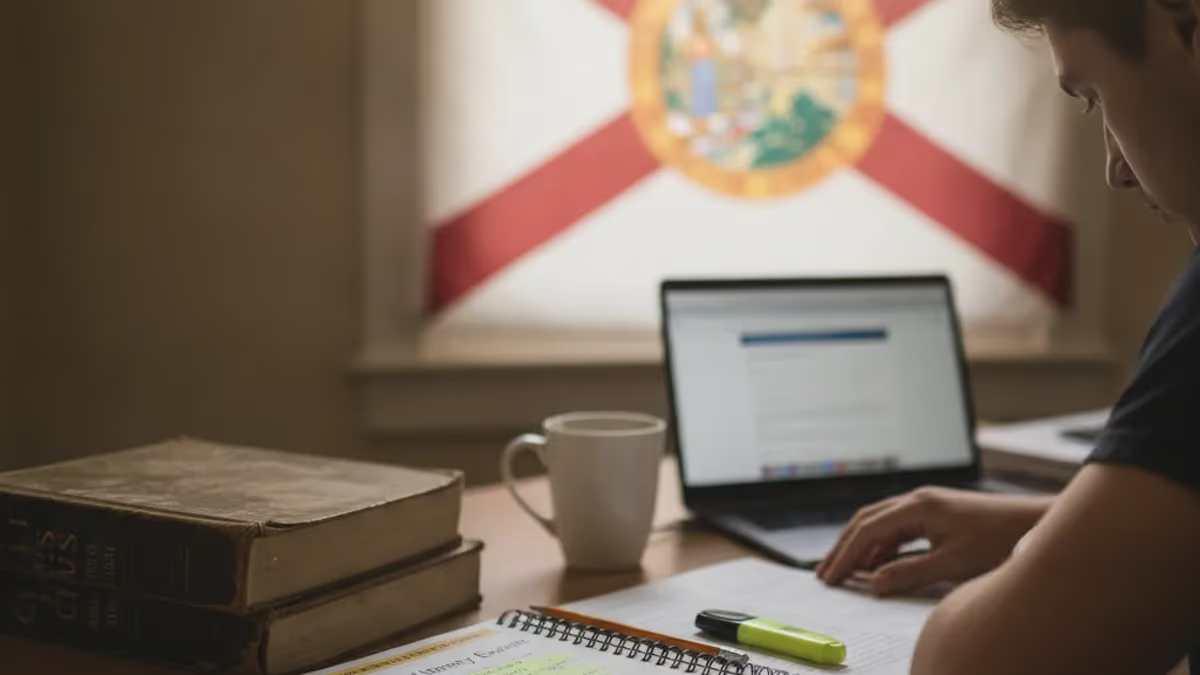
FCLE Retake Policy by the Numbers
Yes, you can retake the FCLE. Florida's Board of Governors and the Department of Education designed the civic literacy assessment requirement to be a pass/fail competency check, not a one-shot gatekeeper, so a non-passing score simply means you'll test again rather than repeat a course or lose credit hours.
Every public university and Florida College System institution is required to offer a retake pathway, though the exact scheduling system, testing vendor, and number of free attempts differ from campus to campus. Most schools do not cap the total number of attempts, which means a student can keep testing, spacing attempts out while working through a fcle passing score strategy, until they clear the bar.
What does change between attempts is often the exam form itself — many testing platforms rotate item banks or draw from a larger pool of civics and government questions, so memorizing a leaked answer key from a friend rarely transfers cleanly to a second sitting.
It also helps to understand why the requirement exists in the first place. Florida added the civic literacy assessment to make sure every graduate of a public college or university has demonstrated a baseline understanding of American government, founding documents, and the structure of the Constitution, regardless of major. Because the goal is competency rather than ranking, there's no curve, no class rank penalty, and no reason a retake should feel higher-stakes than the first attempt — if anything, most students find the second sitting easier once they know the format.
It's also worth noting that Florida isn't unique in requiring a civics competency check — several other states have adopted similar assessments in recent years, and Florida's version is generally considered straightforward once you know the exact content outline, since it draws from a defined, publicly available set of founding documents, constitutional principles, and government-structure topics rather than open-ended current-events material.
Whether you're a first-time test taker researching this policy ahead of your original attempt or you just received a non-passing score and need next steps, the process described below applies the same way across Florida's public university and college system, and none of it involves a penalty beyond the short wait and, occasionally, a small fee.
Most students who don't clear the FCLE on the first attempt aren't missing broad general knowledge — they're tripped up by a handful of dense content clusters: the structure and powers of the three branches, landmark Supreme Court cases, and the mechanics of how a bill becomes law. These topics reward precise recall rather than intuition, so guessing costs points fast.
A second common cause is simply treating the FCLE like a formality. Because it's often bundled into general education requirements, some students walk in without reviewing at all, assuming civics knowledge from high school will carry them through. It sometimes does — but the exam draws on specific vocabulary and case names that fade quickly without a refresher, which is where a targeted fcle quizlet or a short fcle exam orientation read genuinely helps.
Time pressure is the third factor. Students who don't practice under timed conditions tend to second-guess themselves on borderline questions, burning minutes they need for the back third of the test.
Finally, some students simply underestimate how specific the questions get. It's one thing to know that the judicial branch interprets laws in broad terms; it's another to correctly identify which landmark case established judicial review, or to match a constitutional amendment to the right decade. The FCLE tests that level of precision, which is exactly why a diagnostic review after a first attempt is so much more useful than blind re-reading of a textbook chapter.
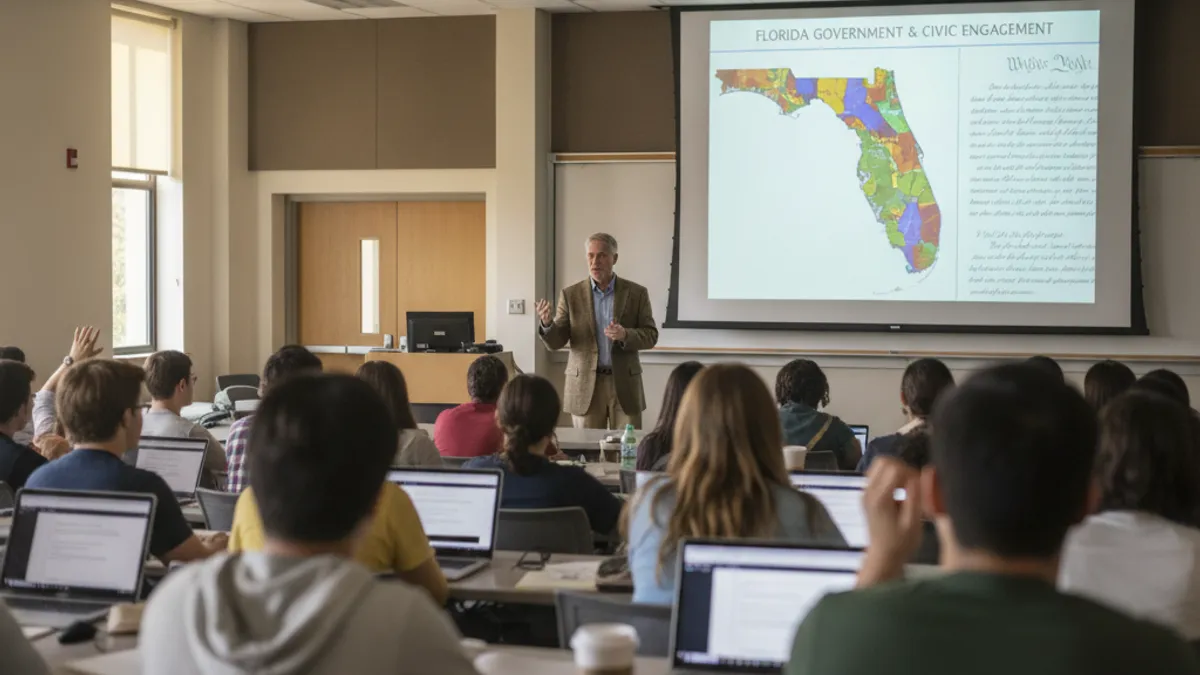
How Retakes Work at Different School Types
Florida's 12 public universities administer the FCLE through their testing centers or an online proctoring platform, usually alongside general education advising. A non-passing score triggers an automatic hold notice in the student portal explaining the retake window.
Retakes are typically self-scheduled once the mandatory waiting period clears, and academic advisors will flag the requirement again at every registration cycle until it's satisfied, so it rarely gets forgotten by accident.
Waiting periods exist mainly so students actually study between attempts instead of guessing twice in the same afternoon. Most institutions enforce a modest cooling-off window — commonly one to several days — before a new session can be booked, though a handful of testing centers allow same-week rescheduling if capacity permits.
Eligibility to retake is rarely restrictive: as long as you're an enrolled degree-seeking student at a Florida public institution and haven't already passed, you can test again. There's no GPA threshold, no advisor sign-off required in most cases, and no penalty transcript notation for a non-passing attempt — it simply doesn't appear on your academic record the way a failed course would.
Students who want to test remotely rather than on campus should confirm their school still lets them take fcle online, since not every campus offers a remote option for retakes. If you're unsure whether your first score actually posted, it's worth learning score reporting timelines before you assume you need to reschedule at all.
International and transfer students sometimes assume special exemptions apply to them, but eligibility to retake works the same way across the board — the requirement and the retake process follow the degree program, not residency status or transfer credits. If you transferred in with prior coursework, check with your new registrar early, since some previously earned credits can satisfy the requirement outright without any testing at all.
Students with documented accommodations should also know that retakes are covered by the same accommodation process as the original attempt — extended time, alternate formats, or assistive technology approved through the disability services office carries over automatically and doesn't need to be re-requested from scratch for a second sitting.
Your Retake Checklist, Step by Step
Log into your student portal to verify the official non-passing result before assuming a retake is needed — some scores take 24-72 hours to post.
Your testing center or registrar's office will list the earliest date you're eligible to reschedule; note it on your calendar immediately.
Most score reports break results down by content category so you can target weak spots instead of re-reading everything.
Reserve your new session, then spend at least a few focused study sessions on timed practice questions before test day.
Cost is usually the smallest obstacle in the whole process. A large majority of Florida public institutions absorb the first retake fee entirely, treating the assessment as a standard part of enrollment rather than an extra charge. Where a fee does apply, it tends to be modest — generally in the single digits to around ten dollars — and is billed the same way as other minor administrative fees rather than requiring a separate payment portal.
Financial aid does not typically cover FCLE retake fees directly since the exam itself isn't a credit-bearing course, but the amounts involved are small enough that they rarely create a real barrier. If cost is a genuine concern, contact your registrar or testing center before your first attempt — some schools waive retake fees entirely for students who can demonstrate hardship, and understanding the fcle passing score requirement up front can help you avoid a second fee altogether by preparing more thoroughly the first time.
Beyond the direct fee, the real cost of a retake is time — the scheduling gap, the commute to a testing center if remote testing isn't offered, and the study hours themselves. Budgeting a realistic week or two for review, rather than cramming the night before a rescheduled slot, tends to produce far better results than treating the retake as a quick formality to clear off a to-do list.
It is also reasonable to ask whether a fee, when one applies, is refundable if you need to reschedule again due to illness or an emergency. Most testing centers offer at least one free reschedule with sufficient notice, so a documented conflict rarely means paying twice for the same attempt.
FCLE Retake Policy: Pros and Cons
- +No cap on the number of attempts at most schools
- +Non-passing scores don't appear on your academic transcript
- +Low or zero retake fees at the majority of institutions
- +Score reports show exactly which content areas to review
- +Retake scheduling is usually self-service through the student portal
- +A passing score transfers with you across Florida public institutions
- −Mandatory waiting periods can delay a retake by several days
- −Rotating item banks mean you can't rely on memorized answers
- −Remote/TSC retakes require re-booking a proctored session
- −Degree conferral can be held up if retakes are left too late
- −Financial aid doesn't directly cover any retake fee that applies
- −Some campuses limit retake slots during peak registration weeks
The fastest way to turn a non-passing score into a pass is to treat your first attempt as diagnostic data rather than a failure. Pull up your category breakdown, identify the two or three weakest areas, and spend your prep time there instead of re-reviewing everything you already know cold. A short daily review beats one long cram session for retention on an fcle exam that draws from a rotating item bank.
Timed practice matters just as much as content review. Sit for full-length practice sets under exam-like time limits so pacing feels automatic on retake day, and mix in primary-source material — actual excerpts from founding documents and landmark rulings — since several FCLE questions test comprehension of short passages rather than pure memorization. Reviewing fcle court cases case summaries alongside the constitutional text they reference tends to stick better than studying either in isolation.
Spacing your review sessions across the waiting period — rather than compressing everything into the day before — also improves recall meaningfully. Three or four shorter sessions spread across a week beat one marathon study block, especially for material like case names and amendment numbers that rely on repeated retrieval rather than one-time exposure.
It's also worth reviewing the exam's overall structure before diving into content, since knowing roughly how many questions cover each topic area helps you allocate study time proportionally instead of guessing at what matters most. A quick look at the fcle question format alongside your category breakdown gives you a much clearer roadmap than starting from scratch.
Before Your FCLE Retake: Final Checklist
- ✓Verify your non-passing score has officially posted
- ✓Confirm the earliest date you're eligible to reschedule
- ✓Check whether any retake fee applies and how it's billed
- ✓Pull your category-level score breakdown if available
- ✓Rebuild a short study plan around your two weakest categories
- ✓Complete at least two full-length timed practice sessions
- ✓Review key Supreme Court cases and constitutional provisions
- ✓Confirm your testing format — in-person, TSC, or remote
- ✓Bring valid photo ID and confirm technical requirements in advance
- ✓Arrive or log in early to avoid last-minute check-in stress
One mistake worth avoiding on a retake is over-correcting into a completely different study method that doesn't match how you actually learn. If flashcards worked for the material you did remember, keep using them for the gaps — just narrow the scope. Students often waste retake prep time switching strategies entirely instead of simply doing more of what already partially worked.
It also helps to study with someone else preparing for the same requirement, even informally. Explaining why a specific check-and-balance example applies, out loud, exposes gaps that silent reading tends to hide, and it keeps momentum up during what can otherwise feel like a repetitive second round of prep.
Another common misstep is skipping the practice questions entirely in favor of passive reading. Recognizing a fact on a page feels like knowledge, but recalling it cold under a timer is a different skill — and it's the skill the actual exam measures. Working through timed question sets, even in short 15-minute bursts, closes that gap far faster than another pass through a study guide.
Group study sessions with classmates who also need to retake the exam can be another effective option, since comparing notes on which questions felt hardest often reveals blind spots you didn't know you had. Many students find that a mix of solo timed practice and one or two group review sessions covers both the recall and the reasoning side of the exam more completely than either approach alone.
Because the FCLE is a graduation requirement rather than a course grade, it doesn't affect your GPA no matter how many attempts it takes to pass. That said, procrastinating on retakes does create real risk: institutions typically won't confer a degree until the requirement is cleared, so students who leave their retake until the final semester can face an unexpected delay to walking at commencement.
Reviewing FCLE landmark decisions early — rather than waiting for a second non-passing score to force the issue — is the simplest way to make sure this requirement never becomes a graduation bottleneck.
Academic advisors typically flag an unmet FCLE requirement during every degree-audit review, so it's unusual for a student to reach their final semester without at least one warning. Still, warnings only help if they're acted on — treating the very first advising notice as the moment to schedule your original attempt, rather than the final semester itself, removes nearly all of the risk described above.
If a degree audit flags the FCLE as outstanding and you're unsure whether a prior test attempt at another Florida institution already counts, ask the registrar to check the statewide reporting system before assuming you need to test again from scratch — duplicate testing is one of the most common avoidable delays students run into during their final year.
There's no attempt limit at most Florida schools
The single most important fact in the FCLE retake policy is that almost no Florida public institution caps how many times you can test. A non-passing score costs you a short wait and, at most, a small fee — not your graduation timeline, as long as you don't leave retakes until your final term.
Advisors see this every term: students who put off the FCLE assume they can retake it right before graduation if needed. Waiting periods, testing center capacity during peak weeks, and degree-audit processing time can combine to push a late retake past your conferral deadline. Clear it at least one full semester before your intended graduation date.
Registration for a retake almost always happens through the same student portal or testing center booking system used for your original attempt — there's no separate application. If your campus outsources testing to a third-party center, check whether they require a small non-refundable booking hold that's distinct from any FCLE fee itself.
Students who want a head start before locking in a new date should look at their specific campus requirements, since a handful of schools — including SPC, MDC, FAU, Valencia, FSW, UCF, and IRSC — publish slightly different retake windows and vendor platforms, all summarized on a per-campus fcle practice test tsc breakdown.
If you can't find your school's specific retake page, the registrar's office and the general education advising office are the two most reliable sources — both handle FCLE questions daily and can typically confirm your exact waiting period, fee status, and next available session within a single email or short call.
Keep a copy of any confirmation email you receive when you book a retake slot, especially if you're testing through a third-party TSC vendor. It's a small habit, but it saves a genuine headache if a scheduling system glitch ever puts your session in question close to a registration deadline.
A non-passing FCLE score is a setback measured in days, not semesters. Confirm your score, note your eligible retake date, target the categories that actually tripped you up, and put in a few sessions of timed practice before you sit again. The policy is built to let you keep trying, so the only real risk is letting the requirement sit unresolved too close to graduation.
If you're still building foundational knowledge before scheduling anything, start with a broader fcle practice test review of the exam's format and timing, then move into full-length practice sets once the retake window opens. Most students who fail once and prepare deliberately pass comfortably on their second attempt, and many report the second sitting felt noticeably calmer once they knew what to expect.
Treat the retake as a normal part of the process rather than an exception, because for a meaningful share of students, it is exactly that. With a clear plan, a short study window, and a handful of timed practice sets behind you, there's no reason the FCLE requirement should stand between you and your intended graduation date.
Whether this is your first attempt or your second, the underlying advice stays the same: know the content outline, practice under real time pressure, and use your school's official channels for scheduling and score questions rather than relying on secondhand information. That combination clears the requirement for the overwhelming majority of students well before it ever becomes a graduation-timeline problem.
FCLE Retake Questions and Answers
FCLE Score Explained: Passing Score, Retakes & Exemptions
Do You Have to Pass the FCLE to Graduate? Florida's Civic Literacy Graduation Requirement Explained
How to Pass the Florida Civic Literacy Exam: Complete FCLE Study Guide 2026
FCLE Questions and Answers: Florida Civic Literacy Exam Practice Test 2026
Florida Civic Literacy Exam Practice Test: Free FCLE Prep with Real Questions (2026)
About the Author

Educational Psychologist & Academic Test Preparation Expert
Columbia University Teachers CollegeDr. Lisa Patel holds a Doctorate in Education from Columbia University Teachers College and has spent 17 years researching standardized test design and academic assessment. She has developed preparation programs for SAT, ACT, GRE, LSAT, UCAT, and numerous professional licensing exams, helping students of all backgrounds achieve their target scores.
Join the Discussion
Connect with other students preparing for this exam. Share tips, ask questions, and get advice from people who have been there.
View discussion (7 replies)