
FBLA Fall Rally: Complete Guide to Events, Competition, and How to Prepare 2026
Master the FBLA Fall Rally 🎯 — events, competition tips, eligibility rules, and study strategies to help you place at your state's fall conference.
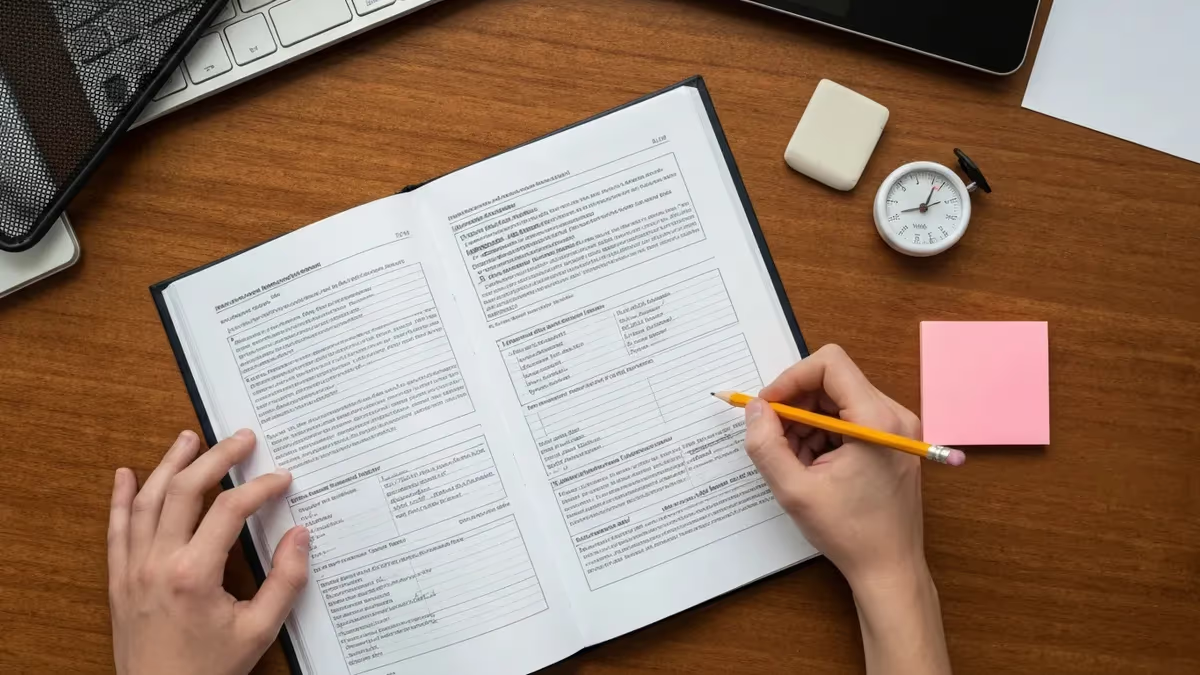
The FBLA Fall Rally is one of the most anticipated events on the FBLA calendar, giving students across the country an early-season opportunity to compete, network, and sharpen the business skills they will need for state and national competitions.
Unlike the high-stakes pressure of state leadership conferences held in spring, the fall rally functions as a developmental milestone — a chance for first-year members to get their feet wet and for veteran competitors to test new strategies before the bigger stages arrive. Understanding what the fbla fall rally involves from registration to awards can make the difference between walking away inspired and walking away unprepared.
Fall rallies are typically organized at the state or regional level by each state's FBLA affiliate, which means the exact schedule, competitive events offered, and deadlines vary considerably depending on where you live. In some states, the fall rally is a single-day event held at a central venue, while in others it spans an entire weekend and includes keynote speakers, workshops, officer elections, and a full slate of preliminary competitive events. The common thread across all of them is the emphasis on early skill-building and community within the business education world.
Competitive events at fall rallies usually mirror a subset of the events offered at the state leadership conference in the spring. You might find written examinations covering topics like business communications, economics, and business law, alongside performance events such as public speaking, impromptu speaking, or client service presentations. Many states also use the fall rally to introduce newly chartered chapters to the FBLA community and to recognize chapters that have met membership benchmarks or community service goals during the previous school year.
Preparation is the single biggest factor that separates medalists from participants who leave without placing. Students who arrive having studied their competitive event's official guidelines, practiced their presentations multiple times, and reviewed sample exam questions consistently outperform those who show up assuming their classroom knowledge is sufficient. Business knowledge matters enormously, but knowing the FBLA-specific format, time limits, and judging criteria for each event is an entirely separate layer of preparation that you cannot skip.
Beyond competition, the fall rally offers a rich set of networking opportunities that students often undervalue. Sharing a breakout session with chapter officers from across your state, attending a workshop run by a professional from the local business community, or simply eating lunch next to a student who has already competed at nationals can open doors and provide perspective that no textbook can replicate. FBLA alumni frequently credit fall rally relationships as some of the most professionally formative connections of their high school careers.
Chapter advisers play a pivotal role in shaping how productive a fall rally experience is for their students. Advisers who register early, communicate event rules clearly, arrange transportation and lodging well in advance, and help students simulate competition conditions through mock events tend to produce chapters with significantly higher placement rates. If your adviser is newer to FBLA or stretched thin by other responsibilities, consider reaching out to your state FBLA office directly for guidance on event formats and preparation resources.
This guide covers everything you need to know about the FBLA Fall Rally — from understanding the event structure and competitive categories to building a study plan, avoiding common mistakes, and using every resource available to maximize your performance. Whether you are attending your first fall rally or looking to improve on last year's results, the strategies and information ahead will help you walk into the venue with confidence and walk out with a clearer picture of your path forward in FBLA.
FBLA Fall Rally by the Numbers

How the FBLA Fall Rally Is Structured
Chapters register through their state FBLA portal weeks in advance, selecting competitive events for each member. On the day of the rally, advisers check in the chapter, collect membership verification, and receive the day's official schedule and event room assignments.
Most fall rallies begin with an opening general session featuring state officer speeches, a keynote address from a business or education professional, recognition of milestone chapters, and an overview of the day's agenda. This session sets the tone for the entire conference.
Written tests, performance events, and preliminary presentations run in parallel throughout the day. Students receive assigned rooms and time slots. Advisers must ensure each member reports to the correct location on time, as late arrivals are typically disqualified.
Between competitive rounds, fall rallies often offer professional development workshops covering topics like resume writing, interview skills, entrepreneurship, and financial literacy. These sessions count toward FBLA's community and professional development activity requirements.
The rally concludes with an awards ceremony recognizing top finishers in each competitive category. State officers lead the closing session, and chapters that placed receive certificates, trophies, or medals they can display and reference in their chapter's annual record of activities.
The competitive events offered at a typical FBLA Fall Rally span three broad categories: objective tests, performance events, and production or portfolio-based events. Objective tests are written multiple-choice examinations covering subjects like business communications, accounting, economics, business law and ethics, personal finance, and management concepts. These tests usually run between 45 and 60 minutes and consist of anywhere from 50 to 100 questions. Scoring is based purely on the number of correct answers, with no penalty for guessing in most state formats, so time management and educated guessing are both valuable skills to develop.
Performance events are arguably the most visible and memorable competitive format at a fall rally. Events like Impromptu Speaking, Public Speaking, and Business Presentation require students to demonstrate communication skills under pressure and in front of a panel of judges drawn from the local business community. Each of these events has a strict time limit, a defined topic scope, and a detailed rubric that judges use to score content, delivery, organization, and professionalism. Competitors who have studied the rubric in advance are at a measurable advantage over those who simply trust their natural speaking ability.
Chapter-based competitive events add a collaborative dimension to the fall rally experience. Events like Community Service Projects, Local Chapter Annual Business Report, and American Enterprise Project require teams of students to prepare materials over weeks or months and then present their work to a panel of evaluators. These chapter events teach students to divide responsibilities, meet internal deadlines, synthesize data into coherent narratives, and defend their work under questioning — skills that translate directly to the professional world.
Some states use the fall rally to offer a preliminary round for events that will continue through the spring state leadership conference. In these cases, fall rally results may determine which students advance to the next round or may factor into a cumulative point total that shapes spring seeding. Understanding your specific state's progression rules is critical — in some states, the fall rally is entirely standalone with no carry-forward implications, while in others a strong fall performance can give you a meaningful competitive edge heading into the spring.
First-year FBLA members are frequently encouraged to choose objective test events for their first fall rally because these events are lower-stakes from a performance-anxiety standpoint and provide clear, immediate feedback in the form of a numeric score. After seeing where their score falls relative to the top finishers, new members gain concrete information about which content areas they need to study more intensively before the spring conference. This data-driven approach to event selection is one of the most effective ways for newer members to build their competitive development plan across the full school year.
Experienced members, on the other hand, often use the fall rally to stretch into unfamiliar event categories or to experiment with presentation structures they have not tried before. A junior who has placed in objective tests the last two years might enter an impromptu speaking event at the fall rally specifically because it challenges a weakness — knowing that a suboptimal fall rally result carries fewer consequences than a poor showing at the state leadership conference. This deliberate growth mindset is one of the hallmarks of FBLA members who go on to compete successfully at the national level.
Regardless of which events you enter, familiarizing yourself with the FBLA Competitive Events Guidelines document published on the national FBLA website is non-negotiable. This document specifies, for every event, the eligibility requirements, topic scope, time limits, required materials, prohibited resources, and detailed scoring rubric. Many students lose points not because they lack knowledge but because they were unaware of a formatting requirement or a time-limit rule. Downloading and studying the guidelines for your specific events — and discussing them with your adviser before competition day — eliminates the most preventable sources of point deductions.
FBLA Fall Rally Preparation Strategies by Event Type
Preparing for objective tests at the FBLA Fall Rally requires a systematic content review combined with timed practice. Start by downloading the official topic outline for your event from the FBLA national website, then map each topic to a reliable study resource such as a textbook chapter, an online business course, or FBLA-published study guides. Spend the first two to three weeks building broad content knowledge before shifting to timed practice sets in the final week before the rally. Aim to simulate real exam conditions — 60 questions in 60 minutes — so that pacing becomes automatic on competition day.
One frequently overlooked preparation strategy for objective tests is reviewing prior-year winner profiles and the topic areas that appear most frequently in official practice materials. Business communications questions, for example, heavily emphasize professional writing conventions, memo formats, and email etiquette, while economics questions often focus on supply-and-demand curves, market structures, and basic macroeconomic indicators. Building a targeted flashcard deck organized by topic area and reviewing it daily in the two weeks before the fall rally is one of the most time-efficient preparation methods available to FBLA competitors.
Pros and Cons of Competing at the FBLA Fall Rally
- +Provides early-season competition experience before the higher-stakes spring state conference
- +Builds chapter morale and gives new members an immediate sense of belonging and purpose
- +Delivers concrete data on knowledge gaps so students can target their spring preparation more precisely
- +Offers networking opportunities with peers, business professionals, and state FBLA officers
- +Allows veteran members to experiment with new event categories in a lower-consequences environment
- +Helps advisers identify which students show the most competitive potential for state and national levels
- −Travel and registration costs can be a barrier for chapters with limited budgets or rural locations
- −Event availability varies widely by state — some states offer far fewer categories than the spring conference
- −Results are sometimes not transferable, meaning strong fall performers gain no direct spring seeding advantage
- −Fall rally schedules can conflict with other school activities, AP exams, or fall sports championships
- −Preparation time competes with early-year academic demands when students are still adjusting to coursework
- −Winning at the fall rally can create overconfidence if students do not continue studying for the spring
Pros and Cons at a Glance
| Pros | Cons |
|---|---|
| Provides early-season competition experience before the higher-stakes spring state conference | Travel and registration costs can be a barrier for chapters with limited budgets or rural locations |
| Builds chapter morale and gives new members an immediate sense of belonging and purpose | Event availability varies widely by state — some states offer far fewer categories than the spring conference |
| Delivers concrete data on knowledge gaps so students can target their spring preparation more precisely | Results are sometimes not transferable, meaning strong fall performers gain no direct spring seeding advantage |
| Offers networking opportunities with peers, business professionals, and state FBLA officers | Fall rally schedules can conflict with other school activities, AP exams, or fall sports championships |
| Allows veteran members to experiment with new event categories in a lower-consequences environment | Preparation time competes with early-year academic demands when students are still adjusting to coursework |
| Helps advisers identify which students show the most competitive potential for state and national levels | Winning at the fall rally can create overconfidence if students do not continue studying for the spring |
FBLA Fall Rally Preparation Checklist
- ✓Download and read the official FBLA Competitive Events Guidelines for every event you plan to enter.
- ✓Confirm your state's fall rally registration deadline and submit all entries before it closes.
- ✓Create a study schedule that allocates at least 30 minutes per day to your competitive event topics.
- ✓Complete at least three full-length timed practice tests for each objective test event you have entered.
- ✓Record yourself delivering your performance event presentation and review the footage critically.
- ✓Request a mock judging session from your adviser or a business teacher at least one week before the rally.
- ✓Prepare and pack all required materials — printed notes, portfolios, permission forms — the night before.
- ✓Research the venue location, parking, and schedule so you arrive on time for check-in and your event slots.
- ✓Review the FBLA dress code and lay out your professional attire in advance to avoid morning-of stress.
- ✓Plan post-rally reflection with your chapter to document what worked, what to improve, and next steps for spring.
The Rubric Is Your Roadmap
Students who study the official FBLA judging rubric for their event before walking into the room consistently outperform those who rely on general business knowledge alone. Every point on the rubric represents a specific skill the judges are looking for. If you can check every box on that rubric during your preparation, you are already in the top tier of competitors at most fall rally venues.
Scoring and judging at the FBLA Fall Rally follow the same framework used at state and national competitions, which means understanding how judges evaluate performance events is just as important as knowing the content itself. For objective tests, scoring is straightforward — your raw score is the number of correct answers, which is then converted to a percentage and ranked against all other competitors in your event category.
Ties are broken using secondary criteria specified in the event guidelines, often by comparing scores on specific subsections of the test. Knowing this can influence your strategy: if you are stronger in one topic area than another, spending extra time ensuring mastery in that area can serve as a tiebreaker advantage.
For performance events, judges use a standardized FBLA rating sheet that assigns point values to categories such as organization and coherence, content accuracy and depth, communication skills, professionalism and appearance, and adherence to time limits. Each category is typically scored on a scale of one to five or one to ten, with detailed descriptors explaining what each score level looks like.
A student who receives a three in every category will likely not place, while a student who earns fours and fives across the board is a strong medal contender. The gap between a two and a four in any single category often comes down to preparation depth rather than innate talent.
One nuance that trips up many competitors, especially those new to performance events, is the professionalism and appearance category. FBLA has a specific dress code — business professional attire — and judges are instructed to deduct points for attire that does not meet this standard. This means visible athletic wear, casual footwear, untucked shirts, or accessories that are overly casual can cost you points before you say a single word. Reviewing the FBLA dress code guidelines and erring on the side of formal is always the safer choice when you are uncertain about a specific item of clothing.
Time limits in performance events are enforced strictly at most fall rallies. Competitors who exceed the allotted time receive automatic point deductions, and in some event formats the judges are instructed to cut off the presentation at the time limit regardless of whether the student has finished. This makes pacing practice — timing your presentation with a stopwatch during rehearsals — an absolutely essential preparation step. Building a presentation that runs 10 to 15 seconds under the time limit gives you a comfortable buffer for the inevitable slight variations in speaking speed that come with competition-day adrenaline.
The awards ceremony format at fall rallies varies by state, but most present awards for the top three to five finishers in each competitive event category. Some states also present chapter achievement awards recognizing milestones like highest membership growth, most community service hours logged, or most new members recruited during the recruitment period. These chapter-level awards are worth pursuing because they contribute to a chapter's cumulative record, which factors into national Chapter of Merit and National Gold Seal Chapter of Merit designations at the end of the school year.
Feedback forms are one of the most underutilized resources available after a fall rally. Many state FBLA affiliates provide written or verbal feedback from judges to competitors upon request, and some automatically distribute scoring sheets to all participants after the event concludes. If your state offers this, request feedback for every event you entered — even ones where you placed well.
Understanding specifically why you received a particular score in a particular category gives you actionable information you can use to improve before the spring state leadership conference. Students who actively seek and study judge feedback year over year are the ones who consistently climb in the rankings.
Finally, it is worth noting that the competitive atmosphere at a fall rally, while serious, is generally more supportive and mentorship-oriented than at the spring conference. Judges at fall rallies are often more willing to offer spontaneous encouragement alongside their evaluations, and the chapter advisers present tend to share strategies openly with one another in ways that create a collegial environment.
Taking advantage of this relative openness — asking questions, introducing yourself to judges after the results are posted, and connecting with students from high-performing chapters — can accelerate your development as a FBLA competitor far more quickly than solo study ever could.
For a fuller set of questions on this topic, see our middle level fbla competitions resource.

Most state FBLA affiliates set fall rally registration deadlines four to six weeks before the event date, and late entries are rarely accepted regardless of the reason. Missing the deadline means your chapter loses the opportunity to compete entirely, even if the adviser is willing to pay a late fee. Set a calendar reminder the day your state posts the fall rally dates and complete registration within the first week — event slots in popular categories like Public Speaking and Business Communications fill quickly.
For students attending their first FBLA Fall Rally, the experience can feel overwhelming at first glance — a large venue, dozens of simultaneous events, hundreds of students in professional attire, and a schedule packed from morning until late afternoon.
The single most effective thing you can do to manage this experience productively is to arrive with a personal schedule that maps every hour of the day. Know exactly when your events start, where your event rooms are located in the venue, how long it takes to walk between them, and when you have free time that you can dedicate to workshops or networking.
Connecting with your chapter's veteran members before the fall rally is another strategy that pays dividends for first-time attendees. Students who have competed in the same events one or two years earlier can offer perspective on what the judging panel tends to emphasize, which content areas appear most frequently in the objective tests, and what the common mistakes are that cost competitors points. This peer mentorship is informal but remarkably effective — often more immediately practical than any study guide because it is grounded in direct experience with your specific state's version of the event.
Managing competition-day nerves is a skill that does not develop automatically — it has to be practiced deliberately. In the days leading up to the fall rally, practice your events under simulated competition conditions: stand up to deliver your speech rather than sitting, time yourself strictly, and ask someone to watch and judge you rather than practicing alone in your bedroom.
The more you normalize the experience of performing under observation, the less the actual competition environment will trigger anxiety. Controlled breathing exercises performed in the five minutes before your event begins can also significantly reduce physical symptoms of nervousness like a racing heart or shaking hands.
Nutrition and sleep are two logistical factors that students routinely underestimate in the lead-up to a fall rally. Arriving at a full-day conference on four hours of sleep and a skipped breakfast puts you at a measurable cognitive disadvantage — processing speed, recall accuracy, and emotional regulation all degrade with sleep deprivation. Prioritize eight hours of sleep the night before the rally and eat a protein-rich breakfast the morning of. Bring a small snack and a water bottle to sustain your energy through a long afternoon of competing and attending sessions.
Your chapter adviser is your most important logistical ally on fall rally day. If you have a question about your event room, a scheduling conflict, a concern about your attire, or any other issue that arises on the day, bring it to your adviser immediately rather than trying to resolve it alone.
Advisers have access to the event organizers and the official event handbook in ways that individual students typically do not, and a good adviser can often resolve a logistical problem in minutes that might otherwise derail an entire morning of preparation. Maintaining clear communication with your adviser throughout the day is not a sign of dependence — it is smart competitive strategy.
One of the most commonly overlooked post-rally tasks is documenting the experience for the chapter's FBLA records. The activities, competitive results, and attendance numbers from the fall rally contribute to the chapter's official record of activities, which is submitted as part of the Chapter of Merit application at the end of the school year.
Advisers should collect all event score sheets, photograph the awards ceremony, and log the names and placements of every member who competed. This documentation takes less than an hour after the rally ends but can make a significant difference in the chapter's eligibility for national recognition programs.
Whether you place in the top three or leave without a medal, the FBLA Fall Rally is a net positive for your development as a business student and future professional. The skills reinforced through competition preparation — research, synthesis, time management, communication, and performance under pressure — are exactly the skills that employers and college admissions officers are looking for.
Every fall rally you attend builds a layer of experience that compounds over your FBLA career, and the students who take each rally seriously, reflect on their results honestly, and adjust their approach accordingly are the ones who ultimately represent their chapters at nationals.
Building a comprehensive study plan for the FBLA Fall Rally is best approached by working backwards from the event date. If your fall rally is eight weeks away, you have enough time for four distinct preparation phases: orientation, content mastery, application and practice, and final simulation. During the orientation phase — weeks one and two — focus entirely on understanding the event format, downloading all official materials, and identifying your current knowledge baseline by taking an untimed diagnostic practice test. Do not worry about your score at this stage; the goal is simply to see where the gaps are.
During the content mastery phase — weeks three through five — work systematically through the topic areas where your diagnostic revealed the greatest gaps. Use a combination of reading, note-taking, and spaced repetition flashcards to build durable knowledge rather than surface-level familiarity. For events like Business Law and Ethics, this means understanding not just the definitions of legal concepts but also how they apply in realistic business scenarios — the types of application questions that consistently appear in FBLA objective tests. For communications-focused events, practice drafting professional emails, memos, and business letters using correct format templates.
The application and practice phase — weeks six and seven — is where you shift from learning to testing yourself under increasingly realistic conditions. Complete at least two full-length timed practice tests per week, review every incorrect answer in detail, and track your score progression on a simple spreadsheet.
If you are preparing for a performance event, this is when you transition from practicing in private to practicing in front of an audience. Schedule at least one formal mock presentation with your adviser as judge, use the official rubric to score yourself afterward, and revise your presentation based on the feedback you receive.
The final simulation phase — the last few days before the rally — is not the time to learn new material. Instead, focus on consolidating what you have already learned, reviewing your highest-frequency flashcards, and performing one final timed run-through of your performance event. Avoid the temptation to cram new content in the 48 hours before the rally — cognitive science research consistently shows that new information learned under time pressure immediately before a high-stakes event is retained poorly and can actually interfere with retrieval of better-consolidated earlier learning.
Practice tests deserve special emphasis as a preparation tool because they replicate the cognitive conditions of competition more faithfully than passive review does. When you take a practice test, you are not just checking whether you know information — you are training your brain to retrieve information quickly and accurately under time pressure, which is a distinct skill from simply knowing the material. Students who rely solely on re-reading their notes or reviewing vocabulary lists often find that they know the content but cannot access it efficiently during the actual 60-minute exam window. Regular timed practice solves this problem systematically.
For chapters competing in multiple events across the same rally, coordinating individual preparation schedules so that no single member is over-committed is an important adviser responsibility. A student who is entered in three objective tests and two performance events simultaneously needs a realistic time budget for preparing all five — and if that budget is not feasible given their other academic commitments, it is better to focus deeply on two or three events than to spread thin across five and perform poorly in all of them. Quality beats quantity in FBLA competition strategy almost every time.
Finally, remember that your performance at the FBLA Fall Rally is one data point in a multi-year development arc. The most successful FBLA competitors at the national level did not win their first fall rally — they learned from it, adjusted, and improved steadily over multiple conferences. The goal of your first several fall rallies is not necessarily a first-place medal, though that is a wonderful outcome when it happens.
The real goal is to leave each rally knowing more about the competitive landscape, your own strengths and weaknesses, and the specific actions you will take to perform better next time. That mindset, sustained consistently over your FBLA career, is what ultimately builds the skill set that wins at nationals.
Sample FBLA - Future Business Leaders of America Practice Questions
Try these questions from our free FBLA - Future Business Leaders of America practice tests. The correct answer and an explanation follow each question.
Which competition is a brand-new offering for 2017–2018?
- A. Red tie / scarf
- B. Alumni division
- C. Look at competitive events list
- D. Blue and gold
Answer: C. Look at competitive events list
The correct answer is "Look at competitive events list." This event was introduced as a new competitive event for the 2017-2018 period. It seems to be related to a competition or event where participants are required to examine or review a list of competitive events.
In FBLA competitive events, what does 'parliamentary procedure' primarily govern?
- A. Financial auditing processes
- B. The conduct of meetings and group decision-making
- C. Marketing campaign approvals
- D. Corporate governance structures
Answer: B. The conduct of meetings and group decision-making
Parliamentary procedure is a set of rules for conducting orderly meetings and making group decisions democratically and efficiently.
The debt-to-equity ratio is used to measure a company's:
- A. Profitability relative to sales
- B. Liquidity in the short term
- C. Financial leverage and use of debt financing
- D. Efficiency in collecting receivables
Answer: C. Financial leverage and use of debt financing
The debt-to-equity ratio compares total liabilities to shareholders' equity, indicating how much debt is used relative to equity.
Which type of market research collects new data specifically for the research purpose at hand?
- A. Secondary research
- B. Quantitative research
- C. Primary research
- D. Archival research
Answer: C. Primary research
Primary research involves collecting original data directly from sources (e.g., surveys, interviews, focus groups) for a specific research purpose.
Take the full FBLA - Future Business Leaders of America practice test
FBLA Questions and Answers

FBLA Event Planning: Complete Career Overview, Duties, and Competition Guide

FBLA Cyber Security: Complete Training Guide, Requirements, and Exam Prep

FBLA Agribusiness Practice Test: Complete Study Guide and Exam Prep

FBLA Nationals 2026: Complete Guide to Schedule, Events & Awards

FBLA Entrepreneurship: Complete Training Guide, Requirements, and Exam Prep
How this page was made: written with AI tools and published by Nathan Beja, founder of Practice Test Geeks, who is responsible for its content. Exam facts are checked against the official sources listed below. Not reviewed by a subject-matter expert. Editorial policy
Sources & references
Exam facts on this page (fees, format, dates, passing scores) are checked against these official sources; the date is our last check. Editorial policy
- connect.fbla.org — Test delivery, eligibility, exam format, passing score, retake policy, score release, time limit · verified Oct 2026