
FBLA Banking and Financial Systems: Complete Study Guide and Quizlet Prep
Master banking and financial systems FBLA quizlet prep with our complete study guide. Practice tests, key topics, and tips to ace your competition. 📚
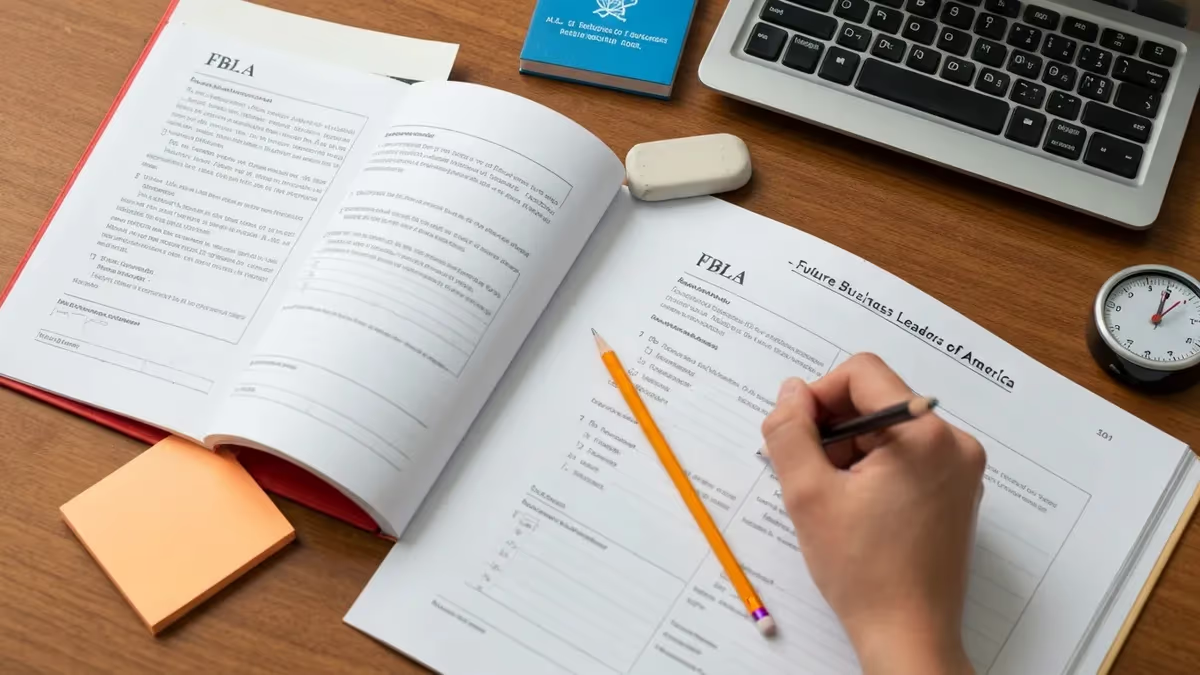
If you are searching for the best banking and financial systems fbla quizlet resources to prepare for your upcoming competition, you have landed in exactly the right place. FBLA's Banking and Financial Systems event tests competitors on a wide range of topics spanning commercial banking operations, monetary policy, investment vehicles, credit analysis, and regulatory frameworks.
Understanding these subjects deeply — not just memorizing flashcard definitions — is what separates students who place at the chapter level from those who advance to state and national competitions. This guide is designed to give you that deeper understanding while also pointing you toward the most effective study tools available.
Banking and Financial Systems is one of FBLA's most technically demanding competitive events, requiring students to demonstrate mastery over concepts that working professionals spend years learning on the job. The event covers everything from how the Federal Reserve sets interest rates to how commercial banks evaluate loan applications, how investment portfolios are diversified, and how global financial crises ripple through domestic markets. Competitors must be able to apply these concepts to real-world scenarios and multiple-choice questions that test both recall and analytical thinking.
One of the most effective study strategies for this event is using structured flashcard systems like Quizlet alongside full-length practice tests. Quizlet allows you to build spaced-repetition decks around the specific terminology and formulas that appear most frequently in FBLA Banking and Financial Systems exams. When you combine those flashcard sessions with timed practice tests that mirror the actual exam format, your retention improves dramatically compared to passive reading alone. The combination of active recall and test simulation is the gold standard for competitive event prep.
Many students underestimate the breadth of content covered in this event. Banking and Financial Systems is not simply about knowing what a checking account is — it demands fluency with concepts like fractional reserve banking, the money multiplier effect, yield curves, credit default swaps, Basel III capital requirements, and the mechanics of quantitative easing. Each of these topics can appear as a standalone question or as part of a scenario-based problem set, so your preparation must be comprehensive and systematic rather than last-minute and haphazard.
One advantage of studying for this FBLA event is the sheer volume of high-quality free resources available. The Federal Reserve publishes extensive educational materials, the FDIC maintains consumer guides that explain regulatory structures clearly, and Khan Academy offers free video lessons on virtually every banking concept tested in this event. Supplementing your Quizlet decks with these primary and secondary sources ensures that you understand the why behind each concept, not just the what. That deeper comprehension is exactly what the harder questions on the exam will probe.
Throughout this guide, you will find study schedules, exam format breakdowns, checklist items, and links to practice quizzes that will help you build confidence before competition day. If you are also preparing for related FBLA events, check out our resource on fbla banking and financial systems quizlet strategies that apply across multiple competitive events, helping you organize your prep calendar efficiently. Whether you are a first-time competitor or a returning student aiming for nationals, the structure and resources in this guide will help you reach your highest possible score.
The financial services industry is one of the largest and most influential sectors of the global economy, employing millions of professionals across commercial banking, investment management, insurance, fintech, and regulatory agencies. FBLA's Banking and Financial Systems event is designed to give high school students a rigorous introduction to this world, making it not just a competition but a genuine career development opportunity. Students who excel in this event often go on to study finance, economics, or accounting in college, and many cite their FBLA preparation as the moment they first became serious about a career in financial services.
FBLA Banking and Financial Systems by the Numbers

FBLA Banking and Financial Systems Exam Format
| Section | Questions | Time | Weight | Notes |
|---|---|---|---|---|
| Banking Operations & Services | 25 | 15 min | 25% | Deposit products, loans, payment systems |
| Monetary Policy & Federal Reserve | 20 | 12 min | 20% | Fed tools, inflation, interest rates |
| Financial Markets & Investments | 20 | 12 min | 20% | Stocks, bonds, mutual funds, derivatives |
| Credit, Risk & Regulation | 20 | 12 min | 20% | Credit analysis, Basel III, FDIC, CFPB |
| Personal Finance & Ethics | 15 | 9 min | 15% | Budgeting, ethics, consumer protection |
| Total | 100 | 60 minutes | 100% |
The foundation of success in FBLA Banking and Financial Systems lies in mastering the core topic areas that appear with the highest frequency on competition exams. Banking operations form the backbone of the subject matter, covering everything from how commercial banks accept deposits and create money through the lending process to how payment systems like ACH transfers, wire transfers, and card networks function in practice. Students must understand the mechanics of fractional reserve banking and be able to calculate reserve requirements and money multipliers from basic inputs, as these numerical concepts appear regularly in the more challenging question sets.
Monetary policy represents the second major pillar of this event and demands careful study. The Federal Reserve System operates through three primary tools: open market operations, the discount rate, and reserve requirements. However, modern monetary policy has evolved far beyond these traditional instruments. Since the 2008 financial crisis, the Fed has deployed unconventional tools including quantitative easing, forward guidance, and interest on excess reserves.
Competitors who understand these tools only at a surface level will struggle with scenario-based questions that ask how a specific policy action would affect inflation, employment, or the yield curve. Developing genuine fluency with these mechanisms requires studying real historical examples, not just textbook definitions.
Financial markets and investment vehicles constitute another heavily tested domain. Students need to understand how primary and secondary markets function, the difference between equity and debt instruments, how bond prices move inversely to interest rates, and how derivatives like options and futures are used for both hedging and speculation.
The concept of portfolio diversification, the capital asset pricing model, and the efficient market hypothesis all appear in this event, and competitors should be comfortable explaining these concepts in plain language as well as applying them to numerical problems. Understanding how mutual funds, ETFs, and index funds differ from individual securities is also essential.
Credit analysis and risk management form a critical subset of banking knowledge that tests students on how financial institutions evaluate borrower creditworthiness. The five Cs of credit — character, capacity, capital, collateral, and conditions — provide a classic framework, but modern credit analysis incorporates quantitative models, credit scoring algorithms, and stress-testing methodologies.
Students should also understand different categories of banking risk including credit risk, market risk, liquidity risk, and operational risk, as well as the regulatory responses to these risks embodied in frameworks like Basel III and Dodd-Frank. Questions in this area often involve realistic lending scenarios that require students to evaluate which applicant should receive a loan and why.
The regulatory environment for banking is both complex and frequently tested in this event. Students must understand the roles of multiple regulatory agencies including the Federal Reserve, the Office of the Comptroller of the Currency (OCC), the Federal Deposit Insurance Corporation (FDIC), the Consumer Financial Protection Bureau (CFPB), and state banking regulators.
Key pieces of legislation including the Bank Secrecy Act, the Community Reinvestment Act, the Gramm-Leach-Bliley Act, and the Dodd-Frank Act each created significant changes to how banks operate and are supervised. Knowing not just what these laws say but why they were enacted — and what banking problems they were designed to solve — gives competitors a decisive advantage on regulatory questions.
Personal finance concepts round out the content universe for this event, though they are weighted less heavily than institutional banking topics. Competitors should understand how to construct and evaluate a personal budget, how compound interest works in both savings and debt contexts, how different retirement savings vehicles like 401(k) plans and IRAs function, and how insurance products like life insurance and property-casualty coverage fit into a comprehensive financial plan.
Ethics in financial services is also a tested area, covering fiduciary duties, conflicts of interest, fair lending laws, and the professional standards that guide bankers and financial advisors. These topics connect the institutional world of banking to the personal decisions that millions of Americans face every day.
Building your Quizlet study decks around these specific topic areas — rather than using generic finance flashcard sets — will dramatically improve your competition results. Organize your decks by category, create cards that require you to explain concepts in your own words rather than just recognizing definitions, and include numerical practice problems that force you to work through calculations under time pressure.
The most effective competitors treat their Quizlet prep as a daily habit in the weeks leading up to competition, spending fifteen to twenty minutes each morning reviewing cards and identifying gaps in their knowledge that they then fill through targeted reading and practice testing.
Banking and Financial Systems FBLA Study Strategies
Building effective Quizlet decks for Banking and Financial Systems requires more than copying glossary terms. Start by identifying the five major topic categories — banking operations, monetary policy, financial markets, credit and regulation, and personal finance — and create a separate deck for each. Include calculation-based cards that show the formula on the front and the worked example on the back, such as the money multiplier formula (1 / reserve requirement ratio) with a sample problem demonstrating how a $1,000 deposit can generate $10,000 in broad money supply at a 10% reserve rate.
Use Quizlet's Learn mode and spaced-repetition features rather than simply flipping cards in order. Set a daily goal of reviewing at least 30 cards per session, cycling through difficult cards more frequently. Add image diagrams where helpful, such as the Federal Reserve's dual mandate framework or a yield curve shape diagram. Competitors who study with well-organized Quizlet decks for three to four weeks before competition consistently outperform those who cram in the final days. Pair your Quizlet sessions with short reading blocks from FDIC or Federal Reserve educational materials to reinforce the context behind each term.

Quizlet vs. Traditional Study Methods for FBLA Banking Prep
- +Spaced repetition algorithm ensures you review hard concepts more frequently than easy ones
- +Mobile-friendly format lets you study during commutes, lunch breaks, and any spare moment
- +Shareable deck feature allows study groups to pool flashcard creation effort
- +Learn mode adapts to your performance, prioritizing your weakest cards automatically
- +Audio pronunciation feature helps with complex financial terminology and acronyms
- +Progress tracking shows exactly which topic areas need more attention before competition
- −Flashcard format can encourage passive recognition over active recall if not used strategically
- −User-created public decks vary widely in accuracy and may contain outdated or incorrect information
- −Quizlet alone does not replicate the timed, full-length exam experience needed for competition
- −Heavy reliance on text-based cards misses visual learners who benefit from diagrams and charts
- −Premium features like offline access and advanced stats require a paid subscription
- −Without a structured study plan, students may over-study familiar topics and neglect weak areas
Pros and Cons at a Glance
| Pros | Cons |
|---|---|
| Spaced repetition algorithm ensures you review hard concepts more frequently than easy ones | Flashcard format can encourage passive recognition over active recall if not used strategically |
| Mobile-friendly format lets you study during commutes, lunch breaks, and any spare moment | User-created public decks vary widely in accuracy and may contain outdated or incorrect information |
| Shareable deck feature allows study groups to pool flashcard creation effort | Quizlet alone does not replicate the timed, full-length exam experience needed for competition |
| Learn mode adapts to your performance, prioritizing your weakest cards automatically | Heavy reliance on text-based cards misses visual learners who benefit from diagrams and charts |
| Audio pronunciation feature helps with complex financial terminology and acronyms | Premium features like offline access and advanced stats require a paid subscription |
| Progress tracking shows exactly which topic areas need more attention before competition | Without a structured study plan, students may over-study familiar topics and neglect weak areas |
FBLA Banking and Financial Systems Pre-Competition Checklist
- ✓Complete a full review of all five major topic categories at least two weeks before competition day
- ✓Build or download Quizlet decks covering banking terminology, monetary policy tools, and investment instruments
- ✓Take a minimum of four timed full-length practice tests and analyze every incorrect answer
- ✓Study the Federal Reserve's structure, tools, and dual mandate in depth using Fed educational resources
- ✓Memorize key formulas including money multiplier, debt-to-income ratio, and return on equity calculations
- ✓Review major banking legislation including Glass-Steagall, Dodd-Frank, and the Community Reinvestment Act
- ✓Practice scenario-based questions involving credit analysis using the five Cs of credit framework
- ✓Study the roles and jurisdictions of all major banking regulatory agencies including FDIC, OCC, and CFPB
- ✓Review personal finance topics including compound interest, retirement accounts, and insurance product basics
- ✓Confirm your competition registration, arrival time, exam room location, and any required identification

Monetary Policy Questions Carry Outsized Weight
Analysis of past FBLA Banking and Financial Systems exams shows that Federal Reserve monetary policy questions — covering open market operations, the federal funds rate, quantitative easing, and the dual mandate — appear more frequently than any other single subtopic. Students who can confidently explain how each Fed tool affects inflation, employment, and the money supply gain a measurable edge on competition day. Dedicate at least 30% of your total study time to monetary policy concepts alone.
Advancing from chapter-level competition to state and ultimately national competition in FBLA Banking and Financial Systems requires a qualitative shift in your preparation strategy. At the chapter level, a strong understanding of core definitions and basic formulas is often sufficient to place well. But at state and national competitions, the exam questions grow significantly more nuanced, scenario-based, and analytically demanding. The students who consistently place in the top three at nationals are those who have gone beyond memorization to develop genuine conceptual fluency with banking and finance topics.
One of the most effective advanced preparation techniques is studying real-world banking events through a financial systems lens. The 2008 global financial crisis, for example, illustrates virtually every major concept in this event: fractional reserve banking failures, mortgage-backed securities and derivative markets, the Fed's emergency policy responses, FDIC's role in protecting depositors, and the subsequent regulatory overhaul embodied in Dodd-Frank. Reading a thorough account of the 2008 crisis — even a well-written news retrospective — teaches you more about interconnected financial systems than weeks of isolated flashcard study, because it shows how all the concepts work together under real-world stress.
Similarly, studying the COVID-19 pandemic's financial impact demonstrates modern monetary policy in action. When the Fed cut interest rates to near zero in March 2020, launched massive quantitative easing programs, and established emergency lending facilities, it was applying every major tool in its arsenal simultaneously.
Understanding why it took these specific actions, how they affected financial markets, and what the inflation consequences were in subsequent years gives you the analytical framework to answer even the most challenging policy scenario questions on a competition exam. Real events are better teachers than hypothetical textbook examples because they carry all the messy complexity of actual financial systems.
Building a strong command of financial mathematics is another differentiator at advanced competition levels. Beyond the basic money multiplier, top competitors can calculate present and future values of cash flows, determine the yield to maturity on a bond, compute weighted average cost of capital, and evaluate the return on equity and return on assets for a bank's income statement and balance sheet.
These calculations do not require advanced mathematics — they are all based on formulas accessible to high school students — but they do require practice under timed conditions so that you can execute them accurately and efficiently during the exam without wasting precious minutes on arithmetic.
Connecting your Banking and Financial Systems preparation to a broader understanding of macroeconomics also pays dividends at higher competition levels. The relationship between fiscal policy and monetary policy, the impact of budget deficits on interest rates through crowding-out effects, the mechanics of international currency markets, and the way trade balances affect domestic banking conditions all appear in the more sophisticated question sets at state and national competition. The FBLA Banking and Financial Systems event is ultimately testing whether students can think like financial professionals who understand the economy as an interconnected system, not just a collection of isolated facts.
Peer study groups are an underutilized resource for advanced preparation. Organizing a weekly study group with two or three other competitors preparing for the same event creates accountability, exposes you to explanations and examples that you would not have generated alone, and simulates the kind of collaborative problem-solving that characterizes real banking careers.
In a well-run study group, members take turns teaching specific topics to the group, quiz each other with challenging scenario questions, and debate the correct answers to ambiguous practice test items. Teaching a concept to another person is one of the most reliable ways to identify and fill gaps in your own understanding.
Finally, do not neglect the ethical dimension of banking and financial services in your preparation. Financial ethics — including fiduciary duty, fair lending obligations, anti-money laundering requirements, and conflicts of interest — are tested in this event and represent a values component that FBLA takes seriously across all its events.
Understanding why financial ethics matter, not just what the rules are, positions you to answer these questions thoughtfully and to speak about them credibly if your competition includes any interview or presentation component. The best banking professionals are not only technically skilled but deeply committed to the ethical responsibilities that come with managing other people's money.
FBLA competition registration deadlines vary by chapter and state, and missing them can prevent you from competing entirely regardless of your preparation level. Confirm your chapter's local competition date, the state conference registration cutoff, and any required membership verification steps well in advance. Some states also have specific eligibility requirements tied to chapter membership hours or GPA thresholds that must be met before your competition entry is officially accepted.
The week before your FBLA Banking and Financial Systems competition should be characterized by review and consolidation rather than aggressive new learning. By this point, you should have completed your major study push, worked through multiple practice tests, and identified the topic areas where you are strongest and where gaps remain. The final week is about cementing what you already know, reviewing your most frequently missed question categories, and mentally preparing to perform under competition conditions. Cramming new material in the final days often backfires by creating confusion and undermining the confidence you have built through weeks of systematic preparation.
Focus your final-week review sessions on your error logs from practice tests. Every wrong answer you recorded during your practice sessions is a data point telling you exactly where to direct your attention. Sort these errors by category, identify the two or three topic areas with the most errors, and spend targeted thirty-minute review sessions on those specific areas using both your Quizlet decks and primary source reading.
Avoid the temptation to re-read entire chapters or re-take full-length practice tests in the final two or three days — at that point, short targeted reviews are more efficient and less exhausting than marathon sessions.
Mental preparation is a legitimate and important part of competition readiness that many students neglect entirely. Visualization techniques — spending five minutes each night before competition imagining yourself moving through the exam calmly, reading each question carefully, and selecting answers with confidence — have measurable positive effects on actual performance. Competitive athletes use visualization routinely, and the psychological research supporting it applies equally to academic competitions. Combine visualization with a consistent sleep schedule in the week before competition: sleep deprivation dramatically impairs memory retrieval, analytical reasoning, and sustained attention, all of which are essential for a sixty-minute finance exam.
On competition day itself, arrive early enough to settle into the exam environment without rushing. Bring any permitted materials, verify the exam start time, and use the few minutes before the exam begins to review your highest-priority flashcards or formula sheet rather than trying to absorb entirely new information. During the exam, pace yourself by spending approximately thirty-five seconds per question on average, flagging difficult questions to return to rather than getting stuck. The most common mistake competitors make is spending too long on hard questions and running out of time before reaching easier questions later in the exam.
Reading each question completely before looking at the answer choices is another discipline that pays off significantly in multiple-choice competitions. Financial systems questions often include carefully chosen distractors — wrong answers that are plausible and partially correct — that trap students who jump to answer choices before fully processing the question stem.
Train yourself during practice tests to read the complete question, form your own answer in your mind before looking at the choices, and then select the option that most closely matches your formulated answer. This technique reduces the impact of well-crafted distractors and keeps you anchored to your genuine understanding rather than being led astray by appealing but incorrect options.
After your competition, regardless of your result, conduct a thorough debrief to maximize your learning for future rounds. If you advance, identify the topic areas where you felt least confident and prioritize those for your continued preparation. If you do not advance, treat the result as valuable diagnostic data rather than a reflection of your ultimate potential.
Many students who underperform at chapter-level competitions go on to place at state level after understanding where their preparation fell short and addressing those gaps systematically. FBLA Banking and Financial Systems is a challenging event that rewards persistent, structured preparation over natural aptitude alone.
The long-term value of mastering FBLA Banking and Financial Systems content extends well beyond any single competition. Students who thoroughly prepare for this event emerge with a level of financial literacy that most college students — and even many working adults — never achieve. They understand how banks work, how monetary policy shapes the economy, how investment markets function, and how to evaluate financial decisions with genuine sophistication.
These skills apply directly to personal financial decisions, to college coursework in economics and finance, and to early career opportunities in financial services. The hours you invest in competition prep are simultaneously an investment in your own financial knowledge and future professional capabilities.
Building a long-term study habit rather than relying on short-term cramming is the single most important practical tip for FBLA Banking and Financial Systems success. Research in cognitive science consistently shows that information studied in multiple short sessions spread over days and weeks is retained far more durably than the same information absorbed in a single long session.
For a content-heavy event like Banking and Financial Systems, this means starting your preparation at least six weeks before your competition date and scheduling daily or near-daily study sessions of thirty to sixty minutes rather than all-day weekend marathons in the final week.
Use the first two weeks of your study period to survey all five major topic areas and identify your baseline knowledge level in each. Complete one practice test without any preparation to establish a baseline score and pinpoint your strongest and weakest categories. This diagnostic approach prevents the common mistake of over-studying familiar material while neglecting areas of genuine weakness. Students who enter competition well-prepared in four out of five content areas but have a significant gap in the fifth often score lower than students with more even preparation across all categories, because exam questions are distributed across all topics.
In weeks three and four of your study schedule, focus intensively on your identified weak areas while maintaining your stronger areas through lighter review sessions. This is the phase where your Quizlet decks are most valuable — use them for daily quick-review sessions on strong topics while dedicating your main study time to deep reading, worked examples, and practice problems in your weak areas.
If monetary policy is your weak point, spend time reading Federal Reserve educational publications and watching explainer videos from the Kansas City Fed's educational portal. If financial markets are your challenge, work through bond pricing calculations and options payoff diagrams until they feel intuitive.
In weeks five and six, shift to full-length timed practice tests and comprehensive review. By this point, you should be taking at least two full practice tests per week, analyzing your results carefully, and doing targeted review based on your error patterns.
This is also the time to focus on speed and pacing, since even students with strong knowledge sometimes underperform because they cannot complete all 100 questions in sixty minutes. Track your time per question during practice tests and work to reduce it gradually — aim for under forty seconds per question on straightforward recall items so you have buffer time for the harder analytical questions.
Study group dynamics can make or break advanced preparation for this event. The ideal FBLA Banking and Financial Systems study group meets weekly, assigns different members to become the group expert on specific topic areas, and structures sessions around teaching and quizzing rather than passive review.
Each week, one or two members present a fifteen-minute deep-dive on their assigned topic, then the group runs a mini-quiz on that topic using questions they have each written in advance. This format ensures active engagement from every participant, distributes the research burden across the group, and creates accountability for showing up prepared each week.
One often-overlooked resource for FBLA Banking and Financial Systems preparation is the FBLA competitive event guidelines and study materials published on the official FBLA-PBL website. These documents outline the specific competencies tested in each event, provide suggested reading lists, and in some cases include sample questions.
Reviewing these official materials early in your preparation ensures that you are studying the right content rather than developing comprehensive knowledge of topics that are not actually tested. Many students spend significant time on highly technical topics like derivatives pricing that are peripheral to the event, while underinvesting in more heavily tested areas like basic monetary policy and FDIC deposit insurance rules.
Ultimately, the competitors who perform best in FBLA Banking and Financial Systems are those who treat their preparation as a genuine educational pursuit rather than a box to check before competition day. When you approach banking and finance with authentic curiosity — asking not just what the federal funds rate is but why it matters, not just what a credit default swap is but why it nearly brought down the global financial system in 2008 — your preparation becomes more engaging, more memorable, and more effective.
The depth of understanding that comes from genuine intellectual engagement is exactly what the hardest exam questions are designed to reward, and it is the foundation on which a successful career in financial services is ultimately built.
Sample FBLA - Future Business Leaders of America Practice Questions
Try these questions from our free FBLA - Future Business Leaders of America practice tests. The correct answer and an explanation follow each question.
Which of the following is NOT one of the four financial statements?
- A. Income Statement
- B. Balance Sheet
- C. General Ledger
- D. Statement of Cash Flows
Answer: C. General Ledger
The general ledger is an accounting record, not one of the four primary financial statements.
Which financial statement shows a company's revenues and expenses over a specific period?
- A. Balance sheet
- B. Income statement
- C. Cash flow statement
- D. Statement of retained earnings
Answer: B. Income statement
The income statement (also called profit and loss statement) reports revenues, expenses, and net income over a reporting period.
Which financial document shows a person's assets, liabilities, and net worth at a specific point in time?
- A. Income statement
- B. Cash flow statement
- C. Balance sheet (net worth statement)
- D. Tax return
Answer: C. Balance sheet (net worth statement)
A personal balance sheet, or net worth statement, captures assets minus liabilities to show financial health at a given date.
Take the full FBLA - Future Business Leaders of America practice test
FBLA Questions and Answers

FBLA Event Planning: Complete Career Overview, Duties, and Competition Guide

FBLA Cyber Security: Complete Training Guide, Requirements, and Exam Prep

FBLA Agribusiness Practice Test: Complete Study Guide and Exam Prep

FBLA Nationals 2026: Complete Guide to Schedule, Events & Awards

FBLA Entrepreneurship: Complete Training Guide, Requirements, and Exam Prep
About the Author

Educational Psychologist & Academic Test Preparation Expert
Columbia University Teachers CollegeDr. Lisa Patel holds a Doctorate in Education from Columbia University Teachers College and has spent 17 years researching standardized test design and academic assessment. She has developed preparation programs for SAT, ACT, GRE, LSAT, UCAT, and numerous professional licensing exams, helping students of all backgrounds achieve their target scores.
Join the Discussion
Connect with other students preparing for this exam. Share tips, ask questions, and get advice from people who have been there.
View discussion (8 replies)