
FAA Pilot Training: Complete Guide to Certifications and Pathways 2026 October
FAA pilot training explained: Sport, Recreational, Private, Commercial, ATP certs, Part 61 vs 141, hour rules, exams, and CFI ratings. 🧠
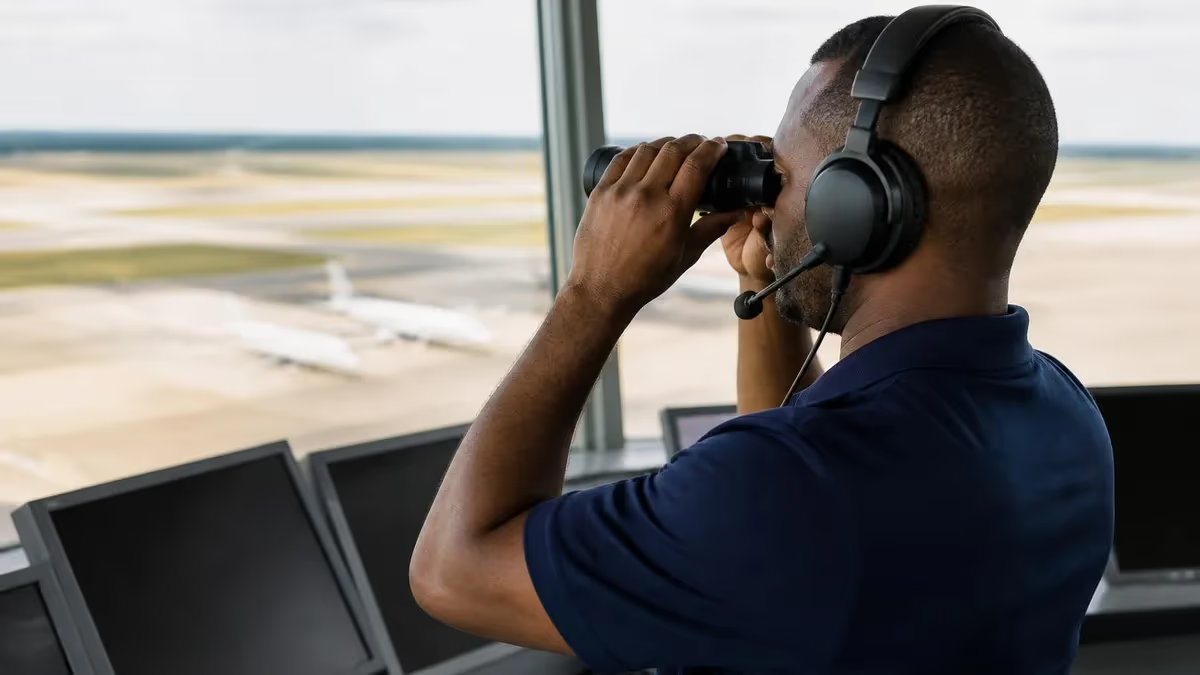
So you want to fly. Maybe you've watched a Cessna lift off a grass strip and felt that pull, or maybe you're eyeing a career in an airline cockpit. Either way, the path runs through the Federal Aviation Administration — and FAA pilot training isn't one single program. It's a tiered system of certificates, ratings, and endorsements that you stack over time, starting with your very first lesson and continuing for as long as you fly.
The good news? You don't need a college degree, a military background, or perfect 20/20 vision to start. What you do need is a medical certificate (or in some cases just a driver's license), a willingness to study, and roughly 40 to 1,500 hours of flight time depending on how far you want to go. The bad news — and let's be honest here — it's not cheap, and the learning curve is steep. Weather, regulations, aerodynamics, navigation, radio work, emergency procedures. You'll touch all of it. Every lesson. Every checkride. Forever.
This guide walks you through every major FAA pilot certificate, the hour requirements behind each one, the difference between Part 61 and Part 141 schools, what to expect during ground school and checkrides, and how instructor ratings open additional doors. We'll cover Sport, Recreational, Private, Commercial, and ATP. We'll talk about Instrument and Multi-Engine add-ons.
We'll dig into the medical certificate maze, the realistic costs in 2026, and the career paths that branch off each rung of the ladder. Whether you're chasing a weekend hobby or a left-seat job at a major carrier, here's how the system actually works — minus the marketing fluff most flight schools spray at prospective students.

FAA Pilot Training by the Numbers
Key Facts at a Glance
| Item | Value | Details |
|---|---|---|
| Minimum for Private Pilot Certificate | 40 hrs | |
| Minimum for Commercial Pilot Certificate | 250 hrs | |
| Required for ATP Certificate | 1,500 hrs | |
| Passing score on FAA written knowledge test | 70% |
Those numbers above? They're the floor — not the ceiling. The FAA publishes minimum hour requirements in 14 CFR Part 61, but the national average for a Private Pilot Certificate sits closer to 60-75 hours. Why the gap? Because real-world weather cancels lessons, students take breaks between flights, and proficiency doesn't always track neatly with hours logged. Plan for the minimum, budget for the average. Some students nail the Private at 45 hours. Others need 90. Neither says much about how you'll fly once certified — what matters is solid decision-making, not the size of your logbook.
The FAA structures pilot certificates as a ladder. Each rung unlocks new privileges — what you can fly, who you can carry, whether you can charge for it, and what airspace you can operate in. You move up by logging hours, passing exams, and demonstrating skills to a Designated Pilot Examiner during what's called a checkride.
Skip a rung and you'll find yourself grounded. The ladder isn't strictly linear, though. Ratings like Instrument and Multi-Engine attach to existing certificates rather than replacing them, so most working pilots end up holding a stack of credentials that together define what they're legally allowed to do.
The Medical Certificate Question
Before your first solo flight, you'll need an FAA medical certificate from an Aviation Medical Examiner — unless you're going the Sport Pilot route, which accepts a valid US driver's license as proof of medical fitness. Third-class medicals cover Private and Recreational pilots. Second-class is required for Commercial work. First-class is mandatory for Airline Transport Pilots. BasicMed, introduced in 2017, lets many private pilots fly with a one-time AME exam plus periodic checkups by any state-licensed physician.
Let's start at the entry level. The Sport Pilot Certificate is the cheapest, fastest way into FAA-regulated flying. You'll need just 20 hours of flight time, restricted to Light Sport Aircraft — small, simple planes with a max takeoff weight of 1,320 pounds, fixed landing gear, and a single passenger limit.
No medical certificate required if you hold a valid driver's license. The trade-off? You can't fly at night, can't enter Class B airspace without endorsements, and you're capped at 10,000 feet MSL. For someone who wants to bore holes in the sky on weekends without the hassle of medical paperwork, it's a legitimate option.
One step up is the Recreational Pilot Certificate, which sits in a strange middle ground. It requires 30 hours of training and a third-class medical, but limits you to aircraft with 180 horsepower or less, daytime VFR conditions, and flights within 50 nautical miles of your home airport unless you grab additional endorsements. Honestly, most students skip it. The hour gap to a full Private certificate is small, and the privileges are significantly more useful. The Recreational category exists more as a historical artifact than a current best-fit recommendation.
The Private Pilot Certificate — PPL for short — is where most pilots land. With 40 hours minimum (35 if you train under Part 141), you can fly almost any single-engine piston aircraft, carry passengers, cross-country during the day or night, and operate in nearly all classes of airspace once you've added the right endorsements.
You can't get paid to fly, but you can split costs equally with passengers under the FAA's pro-rata rules. The PPL is also the gateway to nearly every advanced rating in the FAA system — instrument, multi-engine, seaplane, glider, complex aircraft, high-performance, tailwheel, and more. It's the certificate that opens doors.
Above the PPL sits the Commercial Pilot Certificate. This one shifts you from amateur to professional in the FAA's eyes. You'll need 250 total flight hours including 100 hours of pilot-in-command time, 50 hours of cross-country flying, 10 hours of instrument training, and 10 hours in a complex or technically advanced airplane. The maneuvers are more demanding — chandelles, lazy eights, eights-on-pylons, steep spirals — and the tolerances tighten. Once you hold a Commercial certificate, the law lets you accept money for flying, which changes the whole conversation.
Advanced FAA Certificates and Ratings
Requires 250 hours total flight time, complex aircraft training, and a second-class medical. This is the first certificate that lets you fly for compensation — think aerial photography, banner towing, flight instruction, and entry-level charter work.
An add-on rating, not a standalone certificate. Typically 10-15 hours of additional training. Required for nearly all professional flying paths, since most turboprops and jets have more than one engine. Tests engine-out procedures rigorously.
Lets you legally fly in clouds and reduced visibility using cockpit instruments and ATC clearances. Demands 50 hours of cross-country PIC time and 40 hours of simulated or actual instrument flight. Considered the toughest add-on rating.
The top certificate. 1,500 hours total time, age 23 minimum (or 21 for restricted-ATP), first-class medical required. This is what you need to act as Pilot-in-Command of a scheduled airliner under Part 121.

Here's where the hour-building grind begins. Between your Private Pilot Certificate and that 1,500-hour ATP requirement is a long, expensive stretch of flying. Most career pilots fill those hours by becoming a Certified Flight Instructor — more on that shortly — and teaching new students. Others tow banners over beaches, fly skydivers, ferry small charter clients, or work for pipeline patrol companies.
None of it pays particularly well in the early years. A first-year CFI at a busy school might clear $35,000 to $45,000. A regional first officer in 2026 starts around $90,000 to $110,000 thanks to recent industry pay raises, but you can't sit in that seat until you hit ATP minimums.
The Restricted-ATP shortcut deserves a mention. If you've completed an aviation degree at an FAA-approved Part 141 school, you can sit for the ATP checkride at 1,000 or 1,250 hours instead of 1,500. Military pilots get an even better deal — 750 hours.
These reductions reflect the structured nature of those training environments, which the FAA considers higher-quality than ad-hoc Part 61 flying. Worth noting: the Restricted-ATP only lets you serve as a first officer at a Part 121 airline. To upgrade to captain, you still need the full 1,500 hours and the unrestricted ATP. It's a foot in the door, not a finish line.
FAA Training Pathways Compared
Ground school is the classroom half of FAA pilot training. You'll cover aerodynamics, weather theory, federal aviation regulations, aircraft systems, navigation, weight and balance calculations, radio communications, airspace classifications, and aeronautical decision-making. It culminates in a computer-based knowledge test — 60 to 80 multiple-choice questions, depending on the certificate, with a 70% passing score required. You sit it at a PSI testing center under proctored conditions, no notes, no phone, no calculator beyond the FAA-approved E6B or electronic equivalent.
Don't underestimate the written exam. Yes, it's multiple choice. Yes, there are study guides. But examiners use the topics you missed as conversation starters during your oral exam. Bomb a section on weather and your Designated Pilot Examiner will spend the first 30 minutes of your checkride grilling you on METARs, TAFs, and frontal systems. The written is a filter — your oral is the real test. Aim for 90% or higher on the knowledge exam, even though 70% passes. Your future self will thank you.
The practical test, or checkride, has two halves. First comes the oral, where the DPE peppers you with scenario-based questions for two to four hours. Then you fly. Maneuvers, emergencies, navigation, landings. You'll be expected to demonstrate every skill listed in the Airman Certification Standards (ACS) document for your certificate.
The bar isn't perfection — it's safety, judgment, and adherence to published tolerances. If you bust a maneuver, the examiner gives you one chance to re-fly it. Bust it again and the ride ends with a notice of disapproval. You'll go home, train the deficient area, and return for a partial retest.
The Airman Certification Standards replaced the older Practical Test Standards in 2016 and are the single most important document for any FAA checkride. They list every task you'll be tested on, the tolerances expected (altitude within +/- 100 feet, heading within +/- 10 degrees, etc.), and the underlying knowledge areas. Download the ACS for your certificate from the FAA website and treat it as your study Bible. If a task is in the ACS, expect it on the checkride.
Picking a flight school is the single biggest financial decision you'll make in your aviation journey. A Private certificate ranges from roughly $10,000 at a small Part 61 school using rental Cessna 152s to over $20,000 at a large university with newer aircraft and dedicated dispatch staff. Commercial training adds another $30,000-$50,000. Full ATP-track programs at integrated academies routinely run $80,000-$100,000 from zero hours to first officer-ready. And those numbers assume things go smoothly. They rarely do.
Before you write a check, visit. Sit in on a ground school. Meet the instructors. Look at the maintenance records on the aircraft you'll be flying. Ask how often planes go down for unscheduled maintenance and how that affects the flight schedule. Talk to current students — not the ones the school introduces you to, but the ones you grab in the parking lot. Ask about instructor turnover, since most CFIs leave the moment they hit airline minimums, which means your training continuity depends on how well the school replaces departing instructors.
Location matters too. Coastal schools deal with marine-layer fog. Mountain schools deal with density altitude. Midwest schools deal with thunderstorms and tornado warnings. There's no perfect climate for flight training, but knowing your local hazards upfront helps you set realistic expectations about lesson cancellation rates. A school in Phoenix loses maybe 5% of lessons to weather. A school in Buffalo can lose 30% in February.

First Steps Before Flight School
- ✓Schedule an introductory flight ($100-$200) to confirm you actually enjoy being in the cockpit before committing thousands
- ✓Apply for an FAA Medical Certificate from an Aviation Medical Examiner — disqualifying conditions are better caught early
- ✓Get a Student Pilot Certificate through IACRA, the FAA's online airman certification system
- ✓Buy a quality headset (David Clark, Lightspeed, or Bose) — comfortable hearing protection makes long lessons survivable
- ✓Pick a written-exam test prep platform (Sporty's, King Schools, or Sheppard Air) and complete all chapter quizzes
- ✓Track all flight hours, endorsements, and instructor signoffs in a paper or digital logbook from day one
- ✓Build a weather-watching habit using ForeFlight or aviationweather.gov — pilots who can't read METARs don't pass checkrides
Once you're past Commercial, the question becomes: what do I actually want to do with this thing? Career options branch dramatically. Airline pilots (regional and major), corporate flight departments, fractional ownership programs like NetJets, cargo operators including FedEx and UPS, government roles with NOAA or the Forest Service, agricultural aviation, banner towing, aerial firefighting, EMS helicopter or fixed-wing, flight instruction, and overseas contract work all hire from the same general pool.
Each has its own quirks. Corporate pays well but the schedule is unpredictable. Cargo pilots fly mostly at night. Ag pilots work seasonal sprays. EMS demands instant decision-making for patient transport.
For most career-track pilots, the path runs: PPL → Instrument → Commercial → Multi-Engine → CFI → CFII → MEI → hour-build by instructing → regional airline first officer → captain → major airline. That progression typically takes five to seven years from first flight to a major airline interview. Faster if you're aggressive. Slower if life intervenes.
The last two years of that journey — regional first officer to major airline candidate — are often the toughest. You're flying full schedules, away from home four nights a week, banking experience while waiting for a major to call. Plenty of pilots stay at the regionals longer than planned because the lifestyle settles into something tolerable and the seniority list pays decent money.
FAA Pilot Training Pros and Cons
- +Tangible skill that opens doors to one of the highest-paid trades in the country (major airline captains earn $300k-$500k+)
- +Self-paced progression — you can pause, change schools, or switch career goals without losing certifications already earned
- +Strong job market with airline retirements driving demand through the 2030s, especially at regional carriers
- +Federal certificates are recognized nationwide and convert reasonably well to ICAO licenses for international flying
- +Flight instructor route lets you earn while building hours toward higher certificates
- −Significant upfront cost — $80k-$120k from zero hours to airline-ready, with most students financing through specialty lenders
- −Weather, mechanical issues, and instructor availability cause unpredictable delays that stretch timelines beyond original plans
- −Medical certificate revocation due to age-related conditions can end careers without warning — disability insurance is essential
- −Entry-level wages (CFI, regional first officer) are notoriously low compared to other professions requiring similar training investment
- −Lifestyle disruption — early mornings, overnight trips, holidays away from family — wears on relationships over time
Instructor ratings deserve their own paragraph because they shape both your training and your potential career. The Certified Flight Instructor (CFI) rating qualifies you to teach Private and Commercial students in single-engine aircraft. It's the first rating that pays — typical CFIs earn $30-$60 per flight hour in 2026 — and most career pilots use CFI work to build the time required for the airlines. Some pilots discover they actually love teaching and never leave instruction.
Add Certified Flight Instructor – Instrument (CFII) and you can teach instrument students, which expands your pool dramatically. Multi-Engine Instructor (MEI) qualifies you for twin-engine instruction, where rates run higher and demand is steady. Holding all three — CFI, CFII, MEI — makes you nearly bulletproof in the flight school job market. The combined ratings package usually adds another $15,000 to $20,000 onto your training bill, but it pays for itself within a year of full-time instruction.
The catch? The Initial CFI checkride is famously brutal. The FAA pass rate hovers around 50% on the first attempt because you're being tested not just on your own flying but on your ability to teach. Expect an eight-hour day, an oral that runs four-plus hours, and a flight portion where you instruct the DPE while flying. Most students take a dedicated CFI prep course before attempting it. Treat the Initial CFI ride like a college oral exam — they'll ask you to teach principles, not just demonstrate them, and shallow understanding gets exposed instantly.
One last reality check before you call a flight school. FAA pilot training rewards consistency over intensity. Two lessons per week, every week, will get you to your Private certificate faster than five lessons one week followed by three weeks off.
Aviation knowledge is perishable — skip too long and you'll spend the first 20 minutes of every lesson re-learning what you already knew. Build the habit early. Treat it like a part-time job. Show up even when you don't feel like it, because the lessons where you don't feel like it are often the ones where the most learning happens.
Budget for the long haul. Plan to fly at least twice weekly. Keep your study materials open between lessons. Talk aviation with other students. Find a mentor — someone two or three rungs above you on the certificate ladder who remembers what it felt like to be where you are. Aviation has one of the strongest peer-mentorship cultures of any profession, and pilots are almost universally happy to help newcomers. Join your local AOPA chapter. Volunteer at fly-ins. Listen to the EAA podcasts on your commute. The community is the secret weapon nobody talks about in the cost breakdowns.
And one final note — flying is genuinely fun. Underneath the regulations, the exams, and the costs, there's a reason millions of people have pursued this path since the Wright brothers. The view from 3,000 feet over your hometown at sunset doesn't quite resemble anything else. The first time you solo, the first cross-country, the first night flight, the first checkride pass — each one earns a memory you'll never lose. Treat the training as the price of admission to a lifelong relationship with the sky. Then go file your first flight plan.
Sample FAA Practice Questions
Try these questions from our free FAA practice tests. The correct answer and an explanation follow each question.
Before passengers can be carried in an aircraft that has been altered in a manner that may have appreciably changed its flight characteristics, it must be flight tested by an appropriately-rated pilot who holds at least a
- A. Commercial Pilot Certificate with an instrument rating.
- B. Private Pilot Certificate.
- C. Commercial Pilot Certificate and a mechanic's certificate.
Answer: B. Private Pilot Certificate.
According to 14 CFR Part 91.407(b), if an aircraft has undergone an alteration that may have appreciably changed its flight characteristics, it must be flight tested by an appropriately-rated pilot before passengers can be carried. This pilot must hold at least a Private Pilot Certificate and operate the aircraft without passengers until its airworthiness is established. This ensures the aircraft is safe to fly with passengers after significant modifications.
A steady green light signal directed from the control tower to an aircraft in flight is a signal that the pilot
- A. is cleared to land.
- B. should give way to other aircraft and continue circling.
- C. should return for landing.
Answer: A. is cleared to land.
According to the Aeronautical Information Manual (AIM 4-3-13), a steady green light signal directed from the control tower to an aircraft in flight is the signal for 'Cleared to land.' This is part of the standardized light gun signals used by air traffic control when radio communication is either unavailable or impractical.
Under the general BasicMed rules a pilot can fly
- A. carrying passengers or cargo for compensation or hire.
- B. without restrictions outside of the United States.
- C. in furtherance of a business.
Answer: C. in furtherance of a business.
Under the general BasicMed rules (14 CFR Part 61.113(i) and 68), a pilot can fly in furtherance of a business, provided they are not flying for compensation or hire. This means a pilot can use an aircraft for business travel or activities, as long as they are not being paid specifically for the flight itself. This expands the utility of BasicMed beyond purely recreational flying.
When must a pilot obtain a specific ATC clearance before crossing a runway at a controlled airport?
- A. Only when operating IFR
- B. Only during night operations or low visibility
- C. Always, regardless of conditions or weather
- D. Only when instructed by the ground controller
Answer: C. Always, regardless of conditions or weather
Pilots must always obtain a specific ATC clearance before crossing any runway at a controlled airport, as this is a critical runway incursion prevention measure.
FAA Questions and Answers
About the Author
Commercial Pilot & FAA Certification Specialist
Embry-Riddle Aeronautical UniversityCaptain Jennifer Walsh graduated with honors in Aerospace Engineering from Embry-Riddle Aeronautical University and holds FAA Airframe & Powerplant and Airline Transport Pilot certificates. With 11 years of commercial aviation experience and 6 years as a ground school instructor, she guides aviation mechanics and student pilots through FAA written exams and practical tests.
Join the Discussion
Connect with other students preparing for this exam. Share tips, ask questions, and get advice from people who have been there.
View discussion (9 replies)