
What Is the Ribbon in Excel? Complete Guide to Tabs, Groups, and Customization (2026 September)
What is an Excel ribbon? Master every tab — File, Home, Insert, Formulas, Data, Developer — plus customization, QAT, and keyboard shortcuts in this 🆕

If you have ever opened Microsoft Excel and wondered what that wide band of icons and tabs across the top of the window actually is, you are looking at the Ribbon. It is the command center of the application, replacing the old drop-down menus and toolbars that Excel 2003 and earlier versions relied on.
Introduced in Excel 2007, the Ribbon groups related commands into tabs — File, Home, Insert, Page Layout, Formulas, Data, Review, View, Developer and Help — so you can find what you need without hunting through nested menus. Yes, it took some getting used to back in 2007. But two decades later, almost every modern Microsoft Office app, plus a long list of third-party tools, has adopted the same Ribbon idea.
So what is an Excel ribbon doing for you under the hood? It surfaces the most common spreadsheet tasks visually, with icons, dropdowns, galleries and live previews. Pick a chart from the Insert tab, change cell formatting from the Home tab, or run Power Query from the Data tab — every action lives behind a single click. That visual organization is a huge productivity win once you know where each command lives.
The Ribbon is not static. It adapts. Click a chart and a contextual Chart Tools tab appears. Insert a picture and Picture Tools shows up. Open a PivotTable and PivotTable Analyze and Design tabs slide into view, ready for the job at hand.
The Ribbon is also customizable. You can hide tabs you never touch, add new ones with command groups, and move buttons around to match how you work.
The Quick Access Toolbar (QAT) sits just above the Ribbon and gives you a permanent home for the commands you use most — Save, Undo, Redo and anything else you want one click away no matter which tab is active. Add to all of that the touch mode for tablets, full keyboard navigation through the Alt key, and a brand new simplified Ribbon design in Office 2024 and Microsoft 365, and it becomes clear the Ribbon is far more than a fancy menu bar.
This guide breaks down everything you need to know about the Excel Ribbon in 2026. We will walk through every default tab, what each tab contains, when to use it, and how to find commands fast. You will see how contextual tabs appear and disappear, how the Developer tab unlocks VBA and Form Controls, and how the File tab opens the Backstage view for Save, Open, Print and account settings.
By the end you will understand not only what the Ribbon is, but how to bend it to your workflow. We will cover how to hide and show it with Ctrl+F1, how to back up and restore your customizations, how to enable touch mode and what to do when the Ribbon seems to disappear. You will also learn keyboard shortcuts that let power users navigate the entire Ribbon without ever touching the mouse — a habit that can shave hours off a spreadsheet-heavy week.
By the way, if you are training for a job that requires Microsoft Office fluency, mastering Ribbon navigation is one of the fastest paths to looking competent in any Excel interview or skills test. The core Ribbon concepts have been remarkably stable since 2007 — what has changed is mostly the visual polish, a few renamed tabs, and the addition of newer features like Power Query and dynamic arrays.
Whether you came to Excel 2007 from Excel 2003 and never quite forgave Microsoft for moving your cheese, or you are brand new to spreadsheets in 2026 and the Ribbon is all you have ever known, the same principles apply. Learn the tabs, learn the groups, learn the keyboard shortcuts, and customize what does not fit your workflow.
Throughout this guide we will reference the Microsoft 365 version of Excel because that is what most readers will be running in 2026. We will flag the differences for Excel 2021, Excel 2019 and the legacy perpetual licenses where they matter. If you can navigate the Ribbon in one version, you can navigate it in nearly any version released since.
The Excel Ribbon by the Numbers
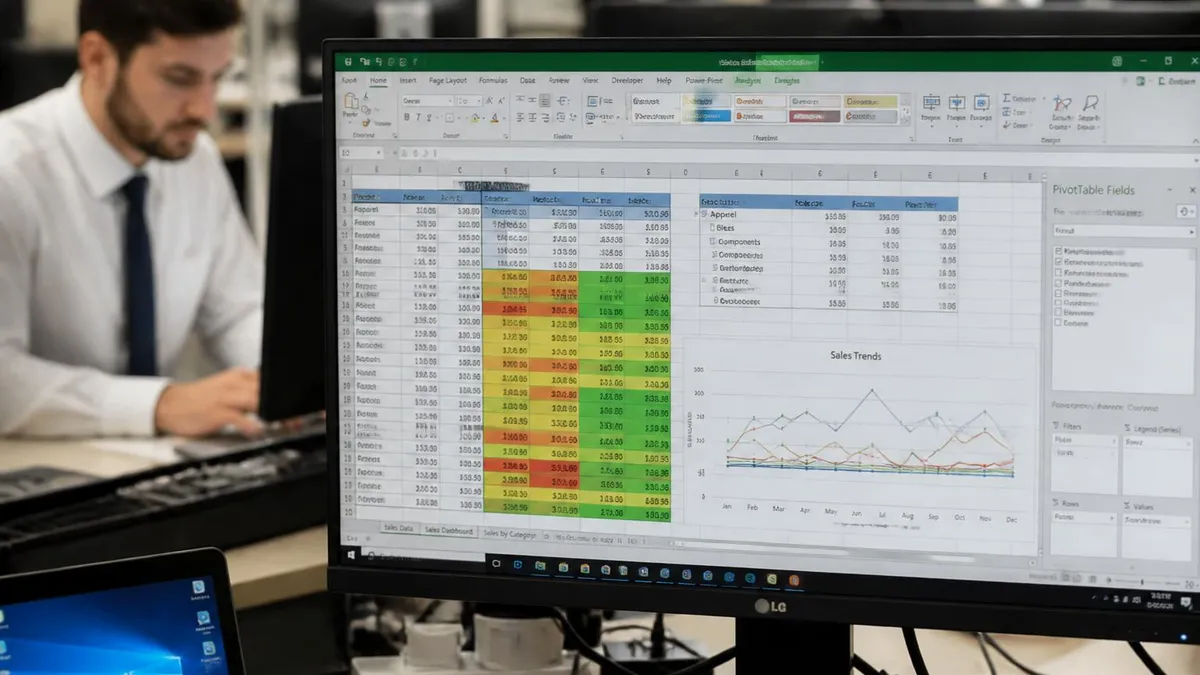
How the Excel Ribbon Is Organized
The horizontal labels across the top — File, Home, Insert, Page Layout, Formulas, Data, Review, View, Developer and Help. Each tab opens a different set of related commands. Click a tab to switch the visible groups underneath without losing your active worksheet selection.
Within every tab, commands are clustered into labeled groups. The Home tab contains Clipboard, Font, Alignment, Number, Styles, Cells and Editing. Groups keep related buttons together so you can scan the Ribbon visually and find the right tool without reading every label individually.
The actual buttons, dropdowns, galleries and live-preview controls inside each group. Some commands are single-click buttons like Bold. Others open dialog boxes, galleries or task panes. A small arrow in the lower-right of a group opens a related dialog for advanced options.
A small customizable button bar sitting at the very top of the Excel window (or below the Ribbon if you prefer). Add the commands you use most — Save, Undo, Redo, Print, New — so they stay one click away no matter which tab is currently active.
Let's walk through every default tab on the Ribbon, what it contains, and the situations where you will reach for it most. The Ribbon's strength is that related commands cluster on the same tab, so once you learn the layout, you stop hunting and start working.
The first tab — File — is unusual because it does not behave like the others. Clicking File opens the Backstage view, a full-screen interface for managing the entire workbook rather than the cells inside it. From Backstage you Save, Save As, Open, see Recent files, Print, Share, manage your Account, view document Info, and reach the Excel Options dialog where most settings live.
Next comes Home, which is the most-used tab and the default landing tab whenever Excel opens a new workbook. Home contains seven groups packed with the everyday commands you reach for constantly.
Clipboard handles cut, copy, paste and format painter. Font sets typeface, size, bold, italic, underline, fill color and border. Alignment controls horizontal and vertical alignment, wrap text, merge and orientation. Number formats cells as currency, percentage, date, time, fraction or custom. Styles applies cell styles, conditional formatting and format as table. Cells inserts, deletes and formats rows, columns and sheets. Editing offers AutoSum, fill, clear, sort and filter, plus the powerful Find & Select dropdown for navigation.
The Insert tab is where you add objects to the worksheet. Tables turns a range into a structured table for sorting and filtering. Illustrations adds pictures, shapes, icons, 3D models and SmartArt. Charts handles every chart type from column and line through PivotChart and Map.
Sparklines creates tiny in-cell trend lines. Filters offers Slicer and Timeline. Links inserts hyperlinks. Text drops in text boxes, headers, footers, WordArt and signature lines. Symbols adds equations and special characters. If you ever need to put something into a worksheet that is not a value or formula, the Insert tab is your starting point.
Page Layout governs how the workbook looks when printed or viewed at scale. Themes applies coordinated color, font and effect schemes across the entire file. Page Setup controls margins, orientation, paper size, print area and breaks. Scale to Fit shrinks or enlarges output to fit a target page count.
The Formulas tab is where formula authors live. Function Library breaks down every built-in function by category — Financial, Logical, Text, Date & Time, Lookup & Reference, Math & Trig, More Functions. Defined Names manages named ranges. Formula Auditing visualizes precedents and dependents with tracer arrows.
Microsoft Excel Practice Test Questions
Prepare for the Microsoft Excel exam with our free practice test modules. Each quiz covers key topics to help you pass on your first try.
Microsoft Excel Excel Basic and Advance
Microsoft Excel Exam Questions covering Excel Basic and Advance. Master Microsoft Excel Test concepts for certification prep.
Microsoft Excel Excel Formulas
Free Microsoft Excel Practice Test featuring Excel Formulas. Improve your Microsoft Excel Exam score with mock test prep.
Microsoft Excel Excel Functions
Microsoft Excel Mock Exam on Excel Functions. Microsoft Excel Study Guide questions to pass on your first try.
Microsoft Excel Excel MCQ
Microsoft Excel Test Prep for Excel MCQ. Practice Microsoft Excel Quiz questions and boost your score.
Microsoft Excel Excel
Microsoft Excel Questions and Answers on Excel. Free Microsoft Excel practice for exam readiness.
Microsoft Excel Excel Trivia
Microsoft Excel Mock Test covering Excel Trivia. Online Microsoft Excel Test practice with instant feedback.
Microsoft Excel Advanced Data Analysis Tools
Free Microsoft Excel Quiz on Advanced Data Analysis Tools. Microsoft Excel Exam prep questions with detailed explanations.
Microsoft Excel Advanced Formula and Macro...
Microsoft Excel Practice Questions for Advanced Formula and Macro Creation. Build confidence for your Microsoft Excel certification exam.
Microsoft Excel Advanced Formulas and Macros
Microsoft Excel Test Online for Advanced Formulas and Macros. Free practice with instant results and feedback.
Microsoft Excel Basic and Advance Question...
Microsoft Excel Study Material on Basic and Advance Questions and Answers. Prepare effectively with real exam-style questions.
Microsoft Excel Creating and Managing Charts
Free Microsoft Excel Test covering Creating and Managing Charts. Practice and track your Microsoft Excel exam readiness.
Microsoft Excel Data Visualization with Ch...
Microsoft Excel Exam Questions covering Data Visualization with Charts. Master Microsoft Excel Test concepts for certification prep.
Microsoft Excel Formulas and Functions
Free Microsoft Excel Practice Test featuring Formulas and Functions. Improve your Microsoft Excel Exam score with mock test prep.
Microsoft Excel Formulas and Functions App...
Microsoft Excel Mock Exam on Formulas and Functions Application. Microsoft Excel Study Guide questions to pass on your first try.
Microsoft Excel Formulas Questions and Ans...
Microsoft Excel Test Prep for Formulas Questions and Answers. Practice Microsoft Excel Quiz questions and boost your score.
Microsoft Excel Functions Questions and An...
Microsoft Excel Questions and Answers on Functions Questions and Answers. Free Microsoft Excel practice for exam readiness.
Microsoft Excel Managing Data Cells and Ra...
Microsoft Excel Mock Test covering Managing Data Cells and Ranges. Online Microsoft Excel Test practice with instant feedback.
Microsoft Excel Managing Tables and Data
Free Microsoft Excel Quiz on Managing Tables and Data. Microsoft Excel Exam prep questions with detailed explanations.
Microsoft Excel Managing Tables and Table ...
Microsoft Excel Practice Questions for Managing Tables and Table Data. Build confidence for your Microsoft Excel certification exam.
Microsoft Excel Managing Worksheets and Wo...
Microsoft Excel Test Online for Managing Worksheets and Workbooks. Free practice with instant results and feedback.
Microsoft Excel MCQ Questions and Answers
Microsoft Excel Study Material on MCQ Questions and Answers. Prepare effectively with real exam-style questions.
Microsoft Excel Questions and Answers
Free Microsoft Excel Test covering Questions and Answers. Practice and track your Microsoft Excel exam readiness.
Data is where modern Excel shows its analytics roots. Get & Transform Data is Power Query, the data preparation engine that connects to files, databases, web pages and APIs and reshapes the results before they hit your sheet. Queries & Connections manages those connections.
Sort & Filter handles single-column and multi-column sorts plus the AutoFilter dropdown. Data Tools holds Text to Columns, Flash Fill, Remove Duplicates, Data Validation and Consolidate. Forecast offers Forecast Sheet and What-If Analysis (Scenario Manager, Goal Seek, Data Table). Outline groups and ungroups rows and columns, plus subtotal management for grouped data.
The Review tab supports collaboration and quality control. Proofing runs Spell Check, Thesaurus and Workbook Statistics. Accessibility checks for screen-reader compatibility issues. Insights offers Smart Lookup. Comments inserts modern threaded comments and toggles Notes, which are the older non-threaded annotations.
Protect locks sheets, workbooks and ranges, including the password-based Protect Sheet and Protect Workbook commands. If you have ever shared a workbook with reviewers, Review is the home of the tools that keep that collaboration smooth.
View controls how the worksheet appears on screen rather than on paper. Workbook Views toggles Normal, Page Break Preview, Page Layout and Custom Views. Show or hides gridlines, the formula bar, headings and ruler. Zoom adjusts magnification and zooms to selection.
Window arranges multiple workbooks side by side, splits the active sheet, freezes panes and switches between open files. Macros records and runs VBA macros, although serious macro work happens on the Developer tab.

Contextual Tabs and the Developer Tab
Contextual tabs are Ribbon tabs that appear only when a specific object is selected. Click a chart and you get Chart Tools, which in modern Excel splits into the Chart Design and Format tabs. Insert a PivotTable and the PivotTable Analyze and Design tabs appear. Format a table and Table Design shows up. Select a picture for Picture Format. Select a drawn shape for Shape Format (Drawing Tools in older versions). Click into a Header or Footer in Page Layout view and Header & Footer Tools (Design) slides in.
The pattern is consistent. Pick an object, get tools specific to that object. The Ribbon updates dynamically so the relevant commands always travel with the active selection.
The Ribbon vs the Old Excel 2003 Menu System
- +Visual organization makes commands easier to discover than nested menus
- +Contextual tabs surface object-specific tools only when needed
- +Live preview shows formatting and chart changes before you commit
- +Customizable tabs and groups adapt the Ribbon to your workflow
- +Quick Access Toolbar keeps top commands one click away on every tab
- +Full keyboard navigation through Alt-based KeyTips speeds up power users
- +Consistent design across every modern Microsoft Office application
- −Takes vertical screen space that toolbars used more efficiently
- −Long-time Excel 2003 users had to relearn command locations after 2007
- −Some commands require more clicks than the old menu shortcuts
- −The Ribbon can disappear unexpectedly if collapsed by accident
- −Touch mode adds spacing but interrupts mouse-driven workflows
- −Customization syncs are limited across machines without manual export
- −Beginners can be overwhelmed by the number of visible commands
Customize and Restore the Excel Ribbon
- ✓Open File then Options then Customize Ribbon to start customizing — this is the central control panel
- ✓Check the Developer box on the right to enable the Developer tab for VBA and Form Controls
- ✓Click New Tab to create a custom tab, then New Group inside it to organize your favorite commands
- ✓Drag commands from the left pane into your custom groups — built-in groups cannot be modified directly
- ✓Use the dropdown above the left list to filter by All Commands, Popular Commands or Macros for faster searching
- ✓Click Rename to give your tab and groups custom labels that match how you think about Excel
- ✓Use the Reset button at the bottom right to restore only the selected tab or the entire Ribbon to defaults
- ✓Click Import/Export to back up your Customizations.exportedUI file before reinstalling Office or moving machines
- ✓Right-click any command on the Ribbon and choose Add to Quick Access Toolbar for one-click access from any tab
- ✓Press Ctrl+F1 to toggle the Ribbon between full and minimized — useful when you need more vertical space

Export before you reinstall Office
If you spend an afternoon customizing the Ribbon with your own tabs, groups and Quick Access Toolbar commands, those settings live inside Excel's configuration. Reinstalling Office, moving to a new computer or resetting Windows will wipe everything unless you export first. In Customize Ribbon, click the Import/Export dropdown and choose Export all customizations. Save the .exportedUI file somewhere safe. To restore on another machine, open the same dialog and choose Import customization file.
Keyboard shortcuts are where the Ribbon truly shines for power users. Press the Alt key once and Excel displays small KeyTips — single letters or letter pairs that float over every tab, command and Quick Access Toolbar button.
Press Alt then H to jump to the Home tab. Press Alt then N for Insert. Press Alt then P for Page Layout. Once on a tab, more KeyTips appear over each group and command, letting you complete any Ribbon action without lifting your hand to the mouse.
Alt+H+B+A applies all borders. Alt+H+F+C opens font color. Alt+A+S+S opens sort settings. With practice, KeyTips become muscle memory and turn into one of the fastest ways to drive Excel.
Beyond the Alt sequences, Excel preserves the legacy Ctrl-based shortcuts that predate the Ribbon. Ctrl+S saves. Ctrl+Z undoes. Ctrl+Y redoes. Ctrl+C, Ctrl+X and Ctrl+V handle copy, cut and paste. Ctrl+1 opens Format Cells. Ctrl+F opens Find. Ctrl+H opens Replace.
F2 enters edit mode for the active cell. F4 toggles absolute and relative references inside a formula. F9 calculates the workbook. Shift+F11 inserts a new worksheet. These shortcuts are universal across Ribbon versions and bypass the Ribbon entirely when you already know what you want to do.
The Ribbon itself can be collapsed and expanded several different ways. Press Ctrl+F1 to toggle between the full Ribbon and the minimized version where only the tab labels stay visible until you click one. Click the small caret in the lower-right of the Ribbon to collapse.
Click any tab when collapsed to temporarily expand it, or double-click a tab to lock it expanded again. Right-click any Ribbon area for a context menu offering Collapse the Ribbon and Hide the Ribbon options.
Touch mode is built into the Ribbon for tablet users running Excel on Surface devices, Windows tablets or iPad through Microsoft 365. Click the Touch/Mouse Mode button on the Quick Access Toolbar and choose Touch. The Ribbon expands its spacing, making every button a larger touch target so fingers and styluses do not trigger the wrong command.
If the Ribbon disappears entirely — tabs are gone, commands are gone, everything except the formula bar is missing — there are a few quick fixes. Press Ctrl+F1 first to see if you accidentally collapsed it. Check the Ribbon display options icon at the top-right of the window and switch from Auto-Hide Ribbon to Show Tabs and Commands.
The newest Ribbon display option, Auto-Hide Ribbon, hides the entire Ribbon and even the tab labels by default. Click the top of the Excel window to make tabs reappear temporarily, then click a tab to access commands. It is great for maximizing screen space on small laptops but confusing if you switch into it accidentally. If your Ribbon vanishes entirely, click the Ribbon Display Options icon at the top-right of the window and switch back to Show Tabs and Commands.
The Excel Ribbon looks slightly different across platforms and versions, and knowing those differences saves frustration when you switch machines. On Mac, the Ribbon largely mirrors the Windows version with the same tabs (File, Home, Insert, Draw, Page Layout, Formulas, Data, Review, View).
However, the macOS conventions move some commands. The File menu lives in the Mac menu bar at the very top of the screen rather than as a Ribbon tab — so on Mac the File tab opens the Backstage view but the macOS application menu still provides Save, Open, Close and Quit through standard system shortcuts.
Some Windows-only features like certain Power Pivot integrations and a few legacy add-ins remain Windows-exclusive, although Microsoft has been steadily closing that gap with every Microsoft 365 update.
Excel for the Web is the browser-based version and ships with a simplified Ribbon by default. The tabs you see are File, Home, Insert, Draw, Page Layout, Formulas, Data, Review, View and Help, but each tab contains fewer commands than its desktop counterpart.
You still get the core formatting, formula, and pivot capabilities, plus modern collaboration features like coauthoring and chat. However, certain advanced features — Power Query connections to non-cloud sources, full VBA support, some chart types — are not available in Excel for the Web.
Office 2024 and current Microsoft 365 builds introduced a refreshed Ribbon design with subtle visual changes. The colors are softer, the icons are slightly more modern, and Microsoft added a density toggle (Standard or Compact) that lets you choose between the traditional full-height Ribbon and a tighter low-density layout that saves vertical space.
Backing up your Ribbon customizations is straightforward but easy to forget. Open File > Options > Customize Ribbon, click the Import/Export dropdown at the bottom-right of the dialog, and choose Export all customizations.
Excel saves a single .exportedUI file that contains every custom tab, custom group, Quick Access Toolbar button and command rearrangement you have made. Store this file in OneDrive or another cloud location so it survives reinstalls and machine moves.
If your Ribbon ever stops behaving correctly — buttons gray out unexpectedly, custom tabs disappear, the Developer tab refuses to show even when checked — try resetting to defaults. In Customize Ribbon, click the Reset dropdown at the bottom-right and choose either Reset only selected Ribbon tab or Reset all customizations.
The Excel Ribbon has survived nearly twenty years of redesigns, new features, platform expansion and competing UI philosophies. It is the single most important navigation surface in the application, and learning it well is one of the highest-leverage Excel skills you can develop.
One subtle Ribbon behavior worth knowing involves the Tell Me box (Microsoft 365 calls it Search now) — the small lightbulb-icon field at the top of the window. Type what you want to do in plain English and Excel shows matching commands plus a one-click launch.
Type 'merge cells' and the merge command appears. Type 'remove duplicates' and Data Tools opens its dialog. Search bypasses the Ribbon entirely and is genuinely useful when you remember what a command does but not which tab it lives on. It also surfaces actions across the application that you might not have known existed.
The mobile Excel apps on iOS and Android use a heavily condensed Ribbon optimized for small screens. The same tab structure appears but with far fewer commands per tab and larger touch targets throughout. Commands that do not translate well to mobile are simply absent on mobile rather than shown as disabled.
For organizations standardizing the Excel experience across teams, Microsoft offers Group Policy and Cloud Policy controls that lock down Ribbon customizations or push standardized layouts to every machine. IT admins can deliver a unified Ribbon configuration including custom tabs that surface in-house tools, hide tabs that the business does not use, and pre-populate the Quick Access Toolbar with company-specific commands.
Excel Questions and Answers

Excel Formulas: VLOOKUP, IF, SUMIF & Top Functions Guide

How to Create a Pivot Table in Excel (Step-by-Step)

Pivot Tables in Excel: Complete Guide for Beginners

Excel IF Condition Formula: The Complete Guide to Logical Functions, Nested IFs, and Real-World Examples

Insert Drop Down List in Excel: The Complete 2026 Guide to Data Validation Lists, Dependent Menus, and Dynamic Drop-Downs
About the Author

Business Consultant & Professional Certification Advisor
Wharton School, University of PennsylvaniaKatherine Lee earned her MBA from the Wharton School at the University of Pennsylvania and holds CPA, PHR, and PMP certifications. With a background spanning corporate finance, human resources, and project management, she has coached professionals preparing for CPA, CMA, PHR/SPHR, PMP, and financial services licensing exams.