
Automatic Driving Schools Near Me: Complete UK Guide to Finding the Best Instructor in 2026 October
⏳ Find the best automatic driving schools near me with our 2026 October UK guide — lessons, costs, instructors, and DVSA test prep tips.
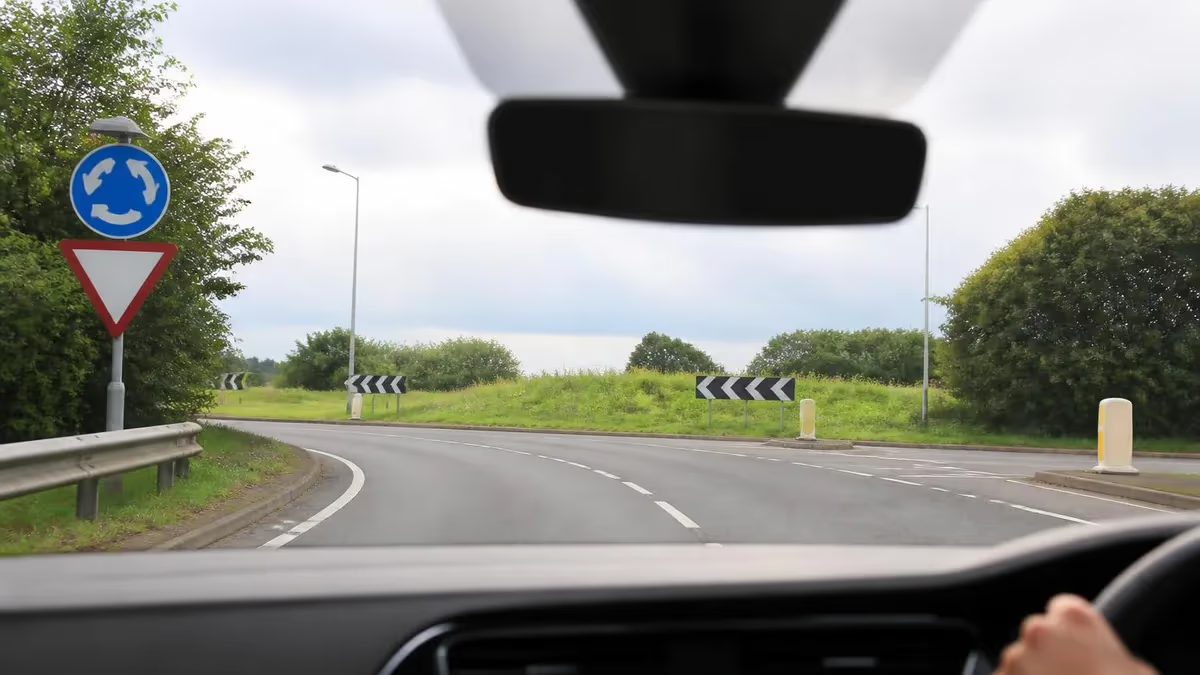
Searching for automatic driving schools near me has become one of the fastest-growing learner queries in the UK, and for very good reason. Automatic cars now make up more than a third of all new vehicle sales, and learners increasingly want lessons in the type of car they will actually drive after passing. With electric and hybrid vehicles dominating new registrations, the case for choosing an automatic instructor has never been stronger, especially in busy urban areas where stop-start traffic makes a manual gearbox more stressful than it needs to be.
This guide walks you through every practical detail you need before booking a single lesson, from how to vet an instructor's DVSA Approved Driving Instructor (ADI) badge to the average cost of an automatic block booking in your region. We will also explain how an automatic licence differs legally from a manual one, what the test looks like in an electric vehicle, and how the theory test still applies in exactly the same way regardless of transmission type.
Automatic lessons typically cost between £35 and £55 per hour in 2026, with London and the South East at the upper end and the North East, Wales and Northern Ireland often £10 cheaper. The hidden upside is that learners usually need fewer hours overall because there is no clutch, no gear changes and no biting-point anxiety to slow them down on hills and at junctions.
Choosing the right school is about much more than price. You want an instructor who teaches in the model of car you intend to drive, who has strong local pass-rate data at your nearest test centre, and who is comfortable adapting lessons to nervous learners, neurodiverse drivers, and those returning to driving after years off the road. A good automatic instructor will also prepare you thoroughly for the independent driving section and the show-me-tell-me questions.
If you are still revising for your theory exam, build that into your timeline before you start practical lessons. Most learners find that a few weeks of focused theory revision pairs beautifully with the first block of automatic lessons. You can sharpen recall using free practice theory test resources that mirror the real DVSA question bank and hazard perception clips.
Throughout this article you will find checklists, comparison tables, cost breakdowns, and frequently asked questions answered by reference to current DVSA guidance. Whether you are an 17-year-old picking your first instructor, a parent funding lessons, or an adult returning after a long break, the goal is the same — pass safely, pass quickly, and choose a school that genuinely fits your learning style rather than the one with the loudest billboard.
By the end you will know exactly what questions to ask, what red flags to avoid, and how to spot the genuinely outstanding automatic schools hiding behind ordinary-looking websites. Let us begin with the numbers that shape the modern automatic learner market.
Automatic Driving in the UK by the Numbers

How Automatic Driving Lessons Actually Work
Automatic cars handle gear changes electronically, so learners focus purely on steering, observation and hazard awareness. This removes the most common early-lesson stress point and accelerates confidence building, especially at busy junctions and on hill starts.
You operate only an accelerator and a brake. Left-foot braking is discouraged for learners — the DVSA expects right-foot use for both pedals. Instructors spend the first hour on smooth pedal control rather than coordination drills.
P-R-N-D-S is standard, with some EVs adding B for regenerative braking. Your instructor will explain when to use S for overtaking, D for normal driving and the safe routine for moving between Drive and Reverse without rolling.
If your school uses an electric automatic, expect to learn one-pedal driving, regen levels, and charging etiquette. The practical test itself does not change, but smooth pedal lifts become an examined skill under eco-driving observation.
Passing in an automatic gives you category B-auto only. You cannot legally drive a manual until you take an additional test. Many learners accept this trade-off given the speed-to-licence advantage automatics now offer.
Finding good automatic driving schools near me starts with mapping out the local test centres around you, not the schools themselves. The single biggest predictor of your pass chance is familiarity with the test routes used by your nearest centre, so begin by identifying the two or three centres within sensible driving distance and then look for instructors whose pupils sit at those centres regularly. Google Maps reviews and the DVSA's official ADI register are both far more useful than glossy school websites that hide instructor identities behind stock photography.
Once you have a shortlist, telephone each school personally rather than booking through a form. A two-minute conversation reveals enormous amounts of information. Ask how many automatic cars the school operates, whether you will have the same instructor every lesson, and what the school's most recent pass rate is for automatic candidates at your chosen test centre. Hesitation or vague answers on any of these questions is a polite signal to move on to the next school.
Reputable schools will happily share their ADI grade — instructors are graded A or B by the DVSA, with Grade A representing the top tier. Around 16 per cent of ADIs hold Grade A status, and they typically charge slightly more per hour but tend to produce noticeably shorter lesson totals overall. The maths usually favours paying the small premium for a Grade A instructor, especially in automatic where there are fewer of them and bookings can fill weeks in advance.
Location convenience matters more than learners realise. An instructor who picks you up from home, work or college will save you both time and the cognitive load of getting to the lesson. However, do not let proximity override quality — a fifteen-minute drive to meet an outstanding instructor will still beat a five-minute walk to an average one over the course of 30 lessons. Be ruthless about quality, especially for your first ten hours when habits are forming.
The car the school provides matters too. A small hatchback such as a Toyota Yaris, Vauxhall Corsa-e or Hyundai i10 is generally easier to learn in than a larger SUV, particularly during the reversing manoeuvre on test day. Ask to see a photo of the actual car you will be learning in. Modern dual-control fittings should be obvious in the passenger footwell, and the car should display L plates front and rear and a clearly marked school roof sign or magnetic decal.
Finally, do not ignore intensive driving course with test options if you are time-poor. Many automatic schools offer week-long crash courses with a guaranteed test slot at the end, which can be ideal if you have already completed your theory and have flexible time off work. Compare these honestly against weekly lessons before committing.
Take your time with this stage. The hour you spend phoning four or five schools is the single highest-return hour of your entire learning journey, and it sets the tone for everything that follows.
DVSA Practice Test Questions
Prepare for the DVSA - UK Driving Theory Test exam with our free practice test modules. Each quiz covers key topics to help you pass on your first try.
DVSA Eco-Friendly Driving and Vehicle Loading
DVSA Exam Questions covering Eco-Friendly Driving and Vehicle Loading. Master DVSA Test concepts for certification prep.
DVSA Hazard Awareness
Free DVSA Practice Test featuring Hazard Awareness. Improve your DVSA Exam score with mock test prep.
DVSA Incidents, Accidents and First Aid
DVSA Mock Exam on Incidents, Accidents and First Aid. DVSA Study Guide questions to pass on your first try.
DVSA Motorway Rules and Smart Motorways
DVSA Test Prep for Motorway Rules and Smart Motorways. Practice DVSA Quiz questions and boost your score.
DVSA Rules of the Road (Highway Code)
DVSA Questions and Answers on Rules of the Road (Highway Code). Free DVSA practice for exam readiness.
DVSA - UK Driving Theory Hazard Awareness ...
DVSA Mock Test covering - UK Driving Theory Hazard Awareness and Perception. Online DVSA Test practice with instant feedback.
DVSA - UK Driving Theory Motorway Rules an...
Free DVSA Quiz on - UK Driving Theory Motorway Rules and Regulations. DVSA Exam prep questions with detailed explanations.
DVSA - UK Driving Theory Road and Traffic ...
DVSA Practice Questions for - UK Driving Theory Road and Traffic Signs. Build confidence for your DVSA certification exam.
DVSA - UK Driving Theory Rules of the Road
DVSA Test Online for - UK Driving Theory Rules of the Road. Free practice with instant results and feedback.
Automatic Driving Schools: Costs, Packages and What You Actually Pay
Single-hour automatic lessons in 2026 typically range from £38 in smaller towns to £58 in central London. Most instructors require a minimum two-hour booking once you progress past the first three lessons, because two-hour blocks are far more productive than back-to-back single hours. Expect to pay extra for evening and weekend slots, where demand is highest among working learners.
Watch out for hidden fuel surcharges advertised by some larger schools. A reputable independent ADI rolls fuel into the hourly rate. If a quote looks unusually cheap, ask exactly what is included, whether there is a test-day fee for use of the car, and whether you are charged for cancellations within 48 hours. These small print details easily add £100 across a course.
Automatic Driving Schools: Pros and Cons Before You Commit
- +Easier to learn — no clutch control, no stalling, no hill-start panic
- +Fewer average lesson hours needed, reducing total cost despite higher hourly rates
- +Ideal for nervous learners, returners, and drivers with mobility or coordination challenges
- +Future-proofed for the electric vehicle transition and 2030 petrol/diesel deadlines
- +Lower stress in city traffic, school runs, and stop-start commuter routes
- +Cars typically newer, cleaner, and quieter — better learning environment overall
- −Higher hourly lesson rate than manual — usually £4 to £8 per hour more
- −Licence restricts you to automatic cars only until you take a manual test
- −Fewer automatic instructors available, so booking lead times are longer
- −Smaller selection of used automatic cars to buy as a new driver
- −Hire-car and rental excess fees often higher for automatic-only licence holders
- −Some employers driving roles still require a manual licence to be considered
Pros and Cons at a Glance
| Pros | Cons |
|---|---|
| Easier to learn — no clutch control, no stalling, no hill-start panic | Licence restricts you to automatic cars only until you take a manual test |
| Fewer average lesson hours needed, reducing total cost despite higher hourly rates | Fewer automatic instructors available, so booking lead times are longer |
| Ideal for nervous learners, returners, and drivers with mobility or coordination challenges | Smaller selection of used automatic cars to buy as a new driver |
| Lower stress in city traffic, school runs, and stop-start commuter routes | Hire-car and rental excess fees often higher for automatic-only licence holders |
| Cars typically newer, cleaner, and quieter — better learning environment overall | Some employers driving roles still require a manual licence to be considered |
Vetting Checklist: 10 Questions to Ask Every Automatic Driving School
- ✓Is the instructor a fully qualified DVSA ADI, and can I see the green octagonal badge on the windscreen?
- ✓What grade did the instructor achieve at their most recent DVSA Standards Check (Grade A or Grade B)?
- ✓What is your school's first-time pass rate for automatic pupils at my nearest test centre?
- ✓Will I have the same instructor every lesson, or are pupils rotated between staff?
- ✓What make and model of automatic car will I learn in, and is it fully dual-controlled?
- ✓Are lesson hours, fuel, pick-up from home, and test-day car use all included in the quoted price?
- ✓What is your written cancellation, refund and unused-hours policy?
- ✓Do you offer mock tests on real test routes before my practical test date?
- ✓Can you accommodate evening, weekend and intensive course schedules if I need them?
- ✓Do you provide post-test motorway lessons or Pass Plus courses for newly qualified drivers?
Book your theory test before your first lesson
Instructors consistently report that learners who sit their theory test within the first three weeks of starting practical lessons end up passing their practical test up to five lessons sooner. The reason is simple: hazard perception knowledge improves real-world observation, and getting the theory done early removes the deadline anxiety that often slows learners down. Book your theory the day you book your first lesson.
Once you have chosen an automatic driving school and started lessons, the next milestone is the practical test itself. The driving test is identical for automatic and manual candidates — same length, same routes, same examiner marking sheet — except that the show-me-tell-me questions exclude anything gearbox-specific. You will still complete the eyesight check, two safety questions, around 20 minutes of independent driving following sat-nav or signs, and one of four standard manoeuvres chosen by the examiner.
Pass rates for automatic candidates are typically two to four percentage points lower than for manual candidates, partly because automatic learners often have less total seat time. Closing this gap is straightforward: aim for at least 35 hours of professional tuition plus 20 hours of private practice with a qualified driver before booking your test. Private practice in a family member's automatic is gold dust, provided the supervising driver has held their full licence for three years and is over 21.
Mock tests are non-negotiable in the final two weeks. A proper mock follows the full 40-minute format, on a genuine test route, with your instructor sitting silently and marking faults on a real DVSA sheet. If you cannot collect more than four driver faults across two consecutive mocks, you are test-ready. If you collect more, postpone — rebooking a failed test costs more in time and money than waiting an extra fortnight.
Pay close attention to the independent driving section, which now accounts for around half of the test. Most candidates lose marks here not because they take a wrong turn — that is allowed — but because they panic, brake suddenly, or stop checking mirrors when concentrating on the sat-nav. Your instructor should run several sat-nav-led lessons specifically targeting this section, ideally on unfamiliar roads to simulate exam pressure.
Manoeuvres are sometimes harder in automatic cars because creep makes precise low-speed control trickier. Practise parallel parking, bay parking forwards and reverse, and pull-up-on-the-right with reverse two car lengths until they become automatic muscle memory. Use the brake gently against the creep to control speed rather than lifting your foot completely off the brake, which will make the car lurch forward in modern automatics.
If your nerves are a concern, ask your instructor about practical desensitisation techniques — running a fake test on a non-test day, doing a lesson at the actual test centre, or simply parking up and walking around the building before your real test. Familiarity with the building, the waiting room, and the car park exit dramatically lowers first-test anxiety and is consistently rated by examiners as a hidden factor in calmer drives.
Above all, do not book your practical until your instructor explicitly says you are ready. Going early because of impatience or peer pressure is the single biggest cause of unnecessary fails. Trust the professional opinion you are paying for.
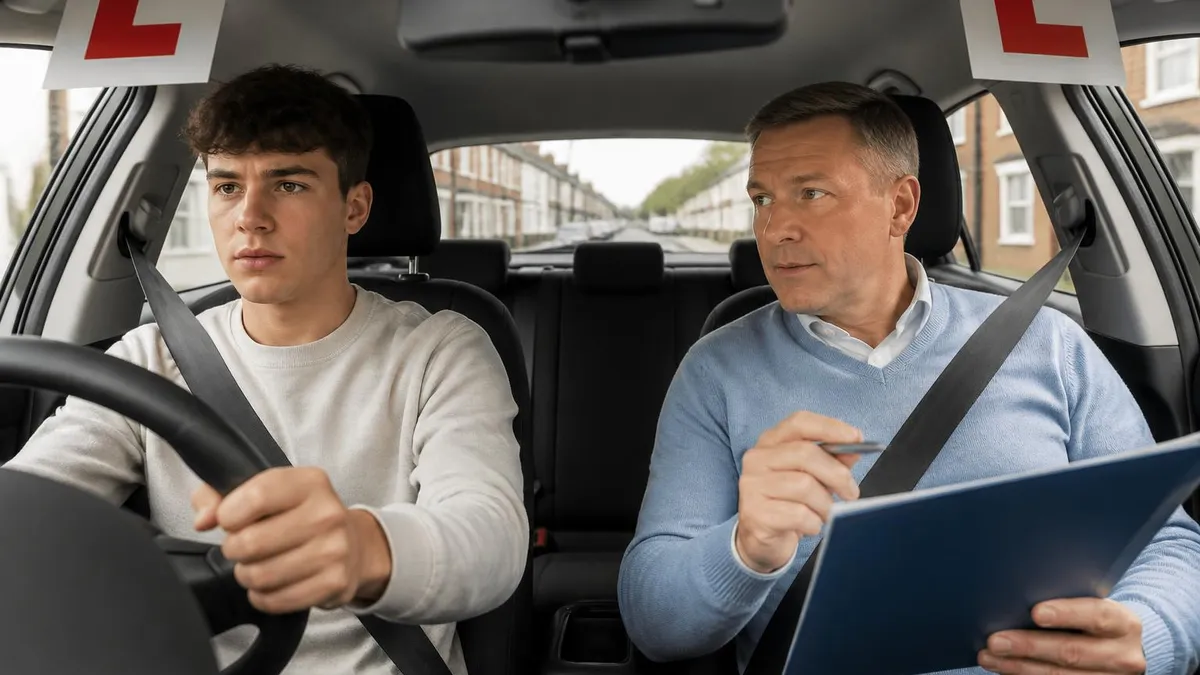
If you pass your driving test in an automatic, your full licence will be restricted to automatic vehicles only (category B-auto). You cannot legally drive a manual car under any circumstances until you sit and pass another full practical test in a manual. Consider this carefully if you ever expect to need a manual licence for work, hire cars abroad, or family vehicles.
The biggest mistake learners make when choosing automatic driving schools near me is treating price as the deciding factor. Cheap lessons routinely cost more in the long run because lower-rated instructors usually need more hours to get pupils to test standard. A £35-an-hour instructor who needs 50 hours costs £1,750. A £45-an-hour instructor who needs 35 hours costs £1,575 — and gets you onto the road eight weeks sooner. Always do the total-cost maths, not the hourly-rate maths.
The second most common mistake is failing to verify the instructor's credentials. Anyone teaching paid driving lessons in the UK must be a fully qualified ADI displaying a green octagonal badge on the windscreen during every lesson. A pink triangular badge indicates a trainee instructor — the PDI grade — which is legal but usually charged at a discount. Never accept lessons from someone with no badge displayed, regardless of how cheap or how friendly they seem on the phone.
A third pitfall is over-relying on online reviews without reading them critically. Look specifically for reviews that mention the test centre you will be sitting at, the make of car the school uses, and the actual learner journey from first lesson to test pass. Generic five-star reviews saying only "great instructor" tell you very little. Detailed three or four star reviews are often more informative than gushing five-star ones.
Watch carefully for instructors who teach to the test rather than teaching to drive. The former might get you through the practical, but you will lack the real-world skills to handle motorways, night driving, heavy rain, and city centres safely in your first year as a solo driver. A good school covers all weather conditions, dual carriageways, multi-storey car parks, and at least one supervised evening lesson before test day.
If your circumstances change — moving house, a difficult instructor relationship, or simply not progressing — switch schools sooner rather than later. Many learners stay too long with a poor fit because they feel awkward about leaving. Driving instructors are professionals running businesses, and they fully expect a small percentage of pupils to move on. A brief, polite email is all that is needed, and you will recover any unused block-booking hours under consumer protection law.
If you are also figuring out test logistics, the official DVSA system lets you reschedule both theory and practical exams without losing your full fee provided you give enough notice. Many learners find the process unclear at first, but our step-by-step change theory test guide walks through the exact buttons to click and the deadlines that apply, which can save a wasted £23 fee and several weeks of waiting.
Finally, treat your first six months as a new driver as part of the learning journey, not the end of it. Statistically, one in five new drivers crashes within their first year on the road. Booking a Pass Plus course or a few motorway lessons within the first three months after passing pays back many times over in confidence, insurance premiums, and long-term safety.
By the time you reach test day, every minute you have invested in finding the right automatic driving school should pay back in calm, competent driving. The final two weeks before your practical test deserve the same care you put into choosing your instructor. Sleep, hydration, and routine matter more than last-minute cramming. Most candidates who fail describe the night before as a poor sleep followed by a rushed breakfast — small details that visibly affect concentration during the 40-minute drive.
Arrive at the test centre 15 minutes early, not 30. Too much waiting time creates anxiety spikes; too little creates rushed parking and forgotten paperwork. Bring your provisional licence, your theory pass certificate, and a sealed bottle of water. Use the toilet before you go in, regardless of whether you feel you need to. Examiners legitimately note rushed body language during the introduction, and a calm walk to the car sets a noticeably better tone.
During the test itself, treat the examiner as a normal passenger. Acknowledge instructions clearly with a brief verbal confirmation if you wish, but do not make small talk unless they initiate it. They are professionals who conduct between six and eight tests per day and they are not trying to trick you. Every fault they mark has a clear definition in the DVSA examiner guidance, and you can absolutely commit a few driver faults — up to 15 — and still pass.
If something goes wrong mid-test, keep driving. The most common cause of unnecessary fails is the candidate giving up mentally after one mistake. Examiners regularly pass candidates who stall a hill start, scrape a kerb during parallel parking, or take a wrong turn — provided the remainder of the drive is competent and safe. The test is cumulative, not pass-fail on each individual move.
After your test, regardless of outcome, take a moment to read the examiner's marking sheet carefully. Even a pass usually has one or two driver faults marked, and these are gold-dust feedback for your first six months as a solo driver. Your instructor will go through the sheet with you on the way home and translate any unfamiliar terminology into plain English.
If you do not pass first time, do not panic. The national first-time pass rate hovers around 48 per cent, meaning more than half of all candidates need at least two attempts. Rebook within 48 hours while your faults are fresh, take three or four targeted lessons addressing exactly what was marked, and avoid the temptation to take a long break — momentum matters more than rest at this stage. Many learners pass second time within three weeks of a first-attempt fail.
And once you do pass — and you will — the real learning begins. Drive with caution but also with intent during your first year, build motorway and night experience deliberately, and consider keeping a brief log of any near-misses or surprises. Reflective practice in the first six months is what separates safe lifetime drivers from those who normalise risky habits early. Welcome to the road.
Sample DVSA UK Driving Theory Practice Questions
Try these questions from our free DVSA UK Driving Theory practice tests. The correct answer and an explanation follow each question.
You are driving on a single carriageway road with double white lines in the centre. The line on your side is broken. When is it permissible to cross these lines?
- A. To overtake a vehicle travelling at 15 mph.
- B. To turn into a side road on the right.
- C. To overtake if you can complete the manoeuvre before the line on your side becomes solid.
- D. To park on the right-hand side of the road.
Answer: C. To overtake if you can complete the manoeuvre before the line on your side becomes solid.
According to the Highway Code (Rule 128), if the white line nearest to you is broken, you may cross the lines to overtake, but only if it is safe and you can complete the manoeuvre before reaching a solid white line on your side. Turning into a side road is also permitted, but overtaking is the more comprehensive correct action described. You must not park on the opposite side of the road, and the speed for overtaking slow-moving vehicles is specified as 10 mph or less.
When driving in the left-hand lane on a three-lane motorway, you see a vehicle broken down on the hard shoulder. What should you do?
- A. Stop on the hard shoulder to help
- B. Move to the middle lane if it is safe to do so
- C. Flash your headlights to warn other drivers
- D. Continue in the left lane at the same speed
Answer: B. Move to the middle lane if it is safe to do so
If you see a vehicle on the hard shoulder, you should move over to the next lane if it is safe, to give them more space. This follows the principle of creating a safety buffer and is recommended in the Highway Code.
You are driving on a 'smart motorway' and see a red 'X' displayed on the overhead gantry above your lane. What does this mean?
- A. The national speed limit applies to this lane.
- B. You should move into another open lane as soon as it is safe to do so.
- C. A temporary speed limit is in force for this lane.
- D. You should stop and wait for further instructions.
Answer: B. You should move into another open lane as soon as it is safe to do so.
A red 'X' shown on an overhead gantry on a motorway indicates that the lane is closed. You MUST NOT drive in a lane that is closed by a red 'X'. You should move into an open lane safely and promptly. Ignoring this sign is dangerous and illegal.
You are driving on a country road at 50 mph. How much distance should you allow for thinking distance alone?
- A. 9 metres (30 feet)
- B. 12 metres (40 feet)
- C. 15 metres (50 feet)
- D. 18 metres (60 feet)
Answer: C. 15 metres (50 feet)
At 50 mph, the thinking distance is approximately 15 metres (50 feet). A useful rule of thumb is that thinking distance in feet roughly equals your speed in mph — so at 50 mph, thinking distance is about 50 feet (15 metres).
DVSA Questions and Answers
Change Theory Test Booking: Step-by-Step DVSA Guide

DVSA Car Practical Test: Complete Guide to Passing First Time
How to Change Theory Test Date: Complete DVSA Rebooking Guide for 2026
Practice Theory Test: Free UK Driving Practice (2026)
Intensive Driving Course With Test: Complete UK Guide to Fast-Track Your Licence in 2026
About the Author

Licensed Driving Instructor & DMV Test Specialist
Penn State UniversityRobert J. Williams graduated from Penn State University with a degree in Transportation Management and has spent 20 years as a certified driving instructor and DMV examiner consultant. He has personally coached thousands of applicants through written knowledge tests, skills assessments, and commercial driver licensing programs across more than 30 states.