
Change Address DMV California: Complete State-by-State Update Guide 2026 October
⏳ Change address DMV California in 4 minutes online. State-by-state windows, REAL ID rules, in-person requirements, and what proof of address you need.

Why Your DMV Address Has to Match the Box You Sleep In Tonight
You moved last weekend. The boxes are still stacked behind the couch, the wifi finally works, and somewhere on the kitchen counter sits a stack of mail that should not be there. That mail is the warning shot. Your state DMV expects the address on your driver's license to match the address on your utility bill, and the clock started ticking the day the moving truck pulled away.
Most drivers think of a license as ID. The state thinks of it as a tracking record. Court summons, jury duty notices, registration dmv license renewal stickers, license renewal reminders, traffic camera tickets, suspension warnings — every one of those mailings goes to the address printed on your license.
Miss one, and the consequences arrive long after the envelope did. A driver in Sacramento learned this in 2024 when she lost her license over a citation she never knew she had. The court mailed the hearing notice to her old apartment. She moved seventeen months earlier and never updated her record.
Different states give you different windows. california dmv — ten days. New York — ten days. Florida — thirty days. Texas — thirty days. Illinois — ten days. Pennsylvania — fifteen days. Most northeastern states cluster around the ten-day mark; Sun Belt states tend to stretch to thirty. Hawaii gives you a generous thirty days, while Massachusetts demands the change within ten of the move. The penalty for missing the window varies too — usually a misdemeanor traffic infraction with a fine between fifteen and two hundred dollars, but in a handful of states it climbs to a court appearance.
And there's a second clock. Vehicle registration. Some states bundle the two: change your license address, and your registration updates the same day. Others treat them as independent records. California is one of the split states. So is Texas. So is Florida. If you only update the license and skip the registration, your vehicle's title and insurance documents start drifting out of sync, and that drift creates problems at exactly the wrong time — a traffic stop, a fender bender, the moment you try to sell the car.
California, New York, Illinois, and Massachusetts — ten days. Texas, Florida, Hawaii, Virginia — thirty days. Pennsylvania — fifteen. Operating a vehicle with an outdated license address is a misdemeanor traffic infraction in nearly every state, with fines ranging from fifteen to two hundred fifty dollars. Update the moment the boxes are unloaded.
The good news is that almost every state now offers online address changes. The form takes about four minutes. No dmv appointment, no parking, no line. The bad news is that "almost" hides a few traps. dmv real id upgrades, license expirations within sixty days, and any change that triggers a physical card reprint usually push you into the office.
So does any record with a hold on it — unpaid tickets, child support flags, organ donor changes in some states, and any address change for a commercial driver's license. The online portal will look like it works, then quietly reject the submission at the final step.
If you're standing in your kitchen reading this on day three of your new lease, here's what to do tonight. Pull up your state's DMV website. Search "change of address" with your state name. Bookmark the official .gov page. Find a utility bill, lease, or mortgage statement showing your new address. Save it as a PDF. Then walk through the next sections in order — they're built around the exact path the form will take you down.

DMV Address Change by the Numbers
The Online Path: What Works, What Doesn't, and the Five Minutes That Save You a Trip
California runs MyDMV at dmv.ca.gov. New York uses dmv.ny.gov. Texas operates TexasOnlineDMV through the Department of Public Safety portal. Florida hosts the change of address on flhsmv.gov under the GoRenew tab. Pennsylvania uses dmv.pa.gov. Most state portals look the same once you sign in — a dashboard with tiles for "Change Address," "Renew License," "Vehicle Services," and "Driver Record." Click the address tile. Confirm your identity with the last four of your Social Security number and your driver's license number. Enter the new address. Hit submit. Print the confirmation.
The four-minute version assumes everything aligns. Often it doesn't. The system rejects PO boxes in most states — you need a physical residential address. It rejects military post addresses unless you flag yourself as active-duty in the form. It rejects addresses that don't match USPS standardization, which means writing "St" instead of "Street" or skipping the apartment number can throw a soft error. The cleanest move is to copy the address exactly as it appears on the USPS look-up tool before you start.
Then there's the verification screen. Most states ask you to confirm an old address from your record — not the current one on file, but a previous one. The screen pulls from your historical record, and people who've moved a lot occasionally fail this check because the system shows a building they barely remember. If you fail twice, the portal locks you out for twenty-four hours. Save yourself the frustration: gather two old addresses you've used in the last decade before you start. The system usually only asks about one, but you want both handy.
REAL ID Address Changes Almost Always Require an In-Person Visit
If your current license carries the federal REAL ID gold star, many states require physical document verification any time a core identity field changes — and address counts as a core field in roughly a quarter of jurisdictions. The online portal may accept the submission and then quietly leave the federal compliance flag un-checked. The fix is a single trip to the DMV counter with the proof-of-address document in hand. Plan thirty minutes including the wait.
A small detail that catches people: the online address change updates your driver record immediately, but the physical card with the new address printed on it doesn't arrive for four to eight weeks. Many states no longer mail a new card at all for a simple address change — they update the record and tell you to write the new address on the back of your existing card, or carry a printed confirmation as proof.
If you need an updated physical card right away (closing on a house, traveling internationally, applying for a TWIC card), you usually have to request a duplicate license through a separate transaction, which carries a fee of twenty-five to forty dollars. Address changes themselves are free in nearly every state.
How Top States Handle the DMV Address Change
Online via dmv.ca.gov MyDMV. Free. License and registration are separate — update both. REAL ID upgrades require an in-person trip.
- ▸Sign into MyDMV portal
- ▸Verify identity with SSN last 4 + DL number
- ▸Enter new physical address
- ▸Submit and print confirmation
- ▸File separate vehicle registration change
Online at dmv.ny.gov or mail-in form MV-232. Free for license; registration updates together. New card not mailed for address-only changes.
- ▸Use dmv.ny.gov MyDMV
- ▸Confirm prior address from record
- ▸Submit license + registration in one flow
- ▸Write new address on back of card
- ▸Print confirmation page
License at dps.texas.gov; registration at txdmv.gov — two separate agencies. Both must be updated independently.
- ▸Update license via DPS portal
- ▸Update registration via TxDMV portal
- ▸Upload utility bill or lease
- ▸No fee for either change
- ▸Pay $11 for replacement card if needed
All transactions at flhsmv.gov GoRenew. License free; small registration convenience fee. Plates do not need replacement.
- ▸Open GoRenew account
- ▸Process license change first
- ▸Process vehicle registration second
- ▸Confirm convenience fee
- ▸Save digital confirmation
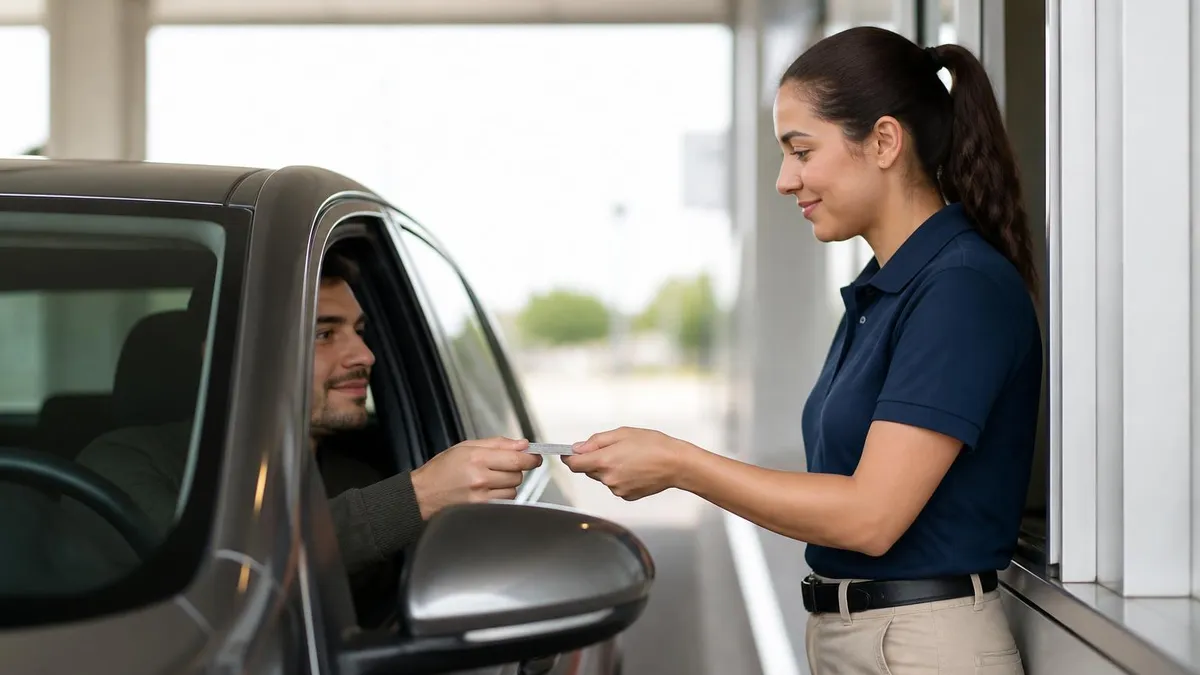
When the Portal Sends You to the Counter
You'll need an in-person visit if your last renewal was the federal REAL ID — the gold-star license required to board domestic flights starting May 7, 2025. REAL ID rules require physical document verification when any core identity field changes, and "address" qualifies in roughly a quarter of states. Even if the online portal accepts your submission, the federal compliance flag may stay un-checked until you walk it through in person.
You'll also need to visit if your name changed at the same time — marriage, divorce, court order — or if your existing license is within sixty days of expiring. Combining the two events at the counter is faster than chaining them online. Commercial driver's license holders (Class A, B, or C CDL) almost always need to update in person because the federal Drug & Alcohol Clearinghouse is tied to the address on record and updates differently than a regular license.
Bring three things every time. One: your current license or state ID, even if it's expired within the last year. Two: proof of new address — a recent utility bill (gas, electric, water, internet, not cell phone in most states), a signed lease, a mortgage statement, or a current property tax bill.
Three: your Social Security card or a W-2 if the state asks for SSN verification at the counter. Most offices accept a printed PDF for the proof of address; a few still want an original or a paper copy. Check the office's specific document list before you drive over — the lists differ between branches in some states.
Four Paths to Update Your DMV Address
Most state DMV websites complete the address change in four to six minutes once your documents are open. Sign into your account using your driver's license number and the last four of your Social Security number. The system pulls your record, asks you to verify a previous address, then displays the address fields. Enter the new address using USPS-standardized format — spell out "Street," use "Apt" not "#," and skip the comma after the city. Submit, then print the confirmation. The driver record updates within twenty-four hours, but a physical new-address card — if your state still mails one — takes four to eight weeks.
The online path fails for REAL ID-upgraded licenses in many states, for licenses within sixty days of expiration, and for any record with a hold (unpaid tickets, child support flags, suspension warnings). It also rejects PO boxes, military post addresses without an active-duty flag, and apartment numbers entered with a pound sign instead of "Apt." When the system errors at the final submit screen, the only fix is the in-person path.
Vehicle Registration: The Forgotten Half
Roughly half the states tie license and registration addresses together. The other half don't. If you live in California, Texas, Florida, Pennsylvania, Ohio, or several other split-record states, changing the license address does not change the registration address on your vehicle. Updating the registration is a separate form, often on the same portal, but you have to click into it deliberately.
This matters because dmv registration renewal renewal notices, smog reminders, and recall recall safety mailings all go to the registration address — not the license address. A skipped registration renewal triggers a suspended registration after thirty to ninety days depending on the state, and a suspended registration during a traffic stop usually means an impounded vehicle. The fix takes ten minutes; the consequence takes weeks to unwind. Update both fields the same evening.
Multi-vehicle households should pull every title and update them all. Boat trailers, motorcycles, RVs, and small-business work trucks all carry separate registration records. Some states — Michigan is one — even require you to update the address on every license plate sticker stored as a digital record, not just the vehicles you actively drive.
Beyond the DMV: The Other Records That Move With You
An address change ripples through more government records than most drivers realize. Voter registration is one. Most states now auto-update voter rolls when you change your DMV record — the federal Motor Voter Act requires the offer, and the digital integration handles the rest. But "most states" isn't all states. North Dakota has no voter registration at all. New Hampshire requires a separate step. Verify your voter status thirty days before the next election using your secretary of state's lookup tool.
Jury duty notices follow the voter roll in roughly two-thirds of states and follow the DMV record in the rest. Either way, the address update flows through eventually. If you skip the update, you may receive a summons at the old address, fail to appear because you never saw it, and face a bench warrant for contempt of court. This is one of the most common ways drivers end up with a missed-court warrant they never knew existed.
Selective Service registration auto-syncs for men between eighteen and twenty-six in most states. Concealed carry permits, hunting licenses, fishing licenses, professional licenses (medical, legal, real estate), and any state-issued credential tied to your driver record — all need separate updates in most states. The DMV doesn't talk to the other state agencies in real time. Treat each one as its own checklist item.
And don't forget the postal side. File a USPS Change of Address at moversguide.usps.com or in person at any post office. The standard form is free if you do it online with a credit card identity verification (one-dollar charge), or one-dollar-fifteen at the counter. Forwarding lasts twelve months for first-class mail and sixty days for periodicals. Stack the USPS forward on top of the DMV update so the gap between "old mail still arriving" and "everyone has my new address" gets bridged.

Complete DMV Address Change Checklist
- ✓Confirm your state's window for the update (10–30 days)
- ✓Pull current license or state ID — it must be valid or expired within the last year
- ✓Find proof of new address: utility bill, lease, mortgage statement, or property tax bill dated within 60 days
- ✓Save the proof-of-address document as a PDF on your phone and laptop
- ✓Standardize the new address against the USPS look-up tool before entering it
- ✓Sign into the state DMV portal at the official .gov URL (never click a search ad)
- ✓Verify identity with DL number and last four of Social Security number
- ✓Update license address — submit and print confirmation
- ✓Update vehicle registration address (separate transaction in split-record states)
- ✓Update every additional vehicle, trailer, motorcycle, or RV title
- ✓File USPS Change of Address at moversguide.usps.com
- ✓Call your auto insurer to update the zip code on the policy
- ✓Check voter registration via your secretary of state's lookup tool
- ✓Update concealed carry, hunting, fishing, and any professional license addresses separately
- ✓Write the new address on the back of the physical license until the new card arrives
- ✓Save confirmation emails and printouts in a dedicated folder for 12 months
The Hidden Cost of Not Updating
Operating a vehicle with an outdated address on the license is a misdemeanor in most states. Fines range from fifteen dollars in Iowa to two hundred fifty in Massachusetts. A few states — Virginia is one — will dismiss the citation if you provide proof of update within ten days of the ticket. Most won't.
Insurance is where the real money lives. Auto insurance premiums are zip-code-rated. If you moved to a lower-risk zip code and never told your insurer (or the DMV), you may be overpaying by ten to thirty percent. If you moved to a higher-risk zip code and didn't update, the insurer can deny a claim on the grounds of misrepresentation — a single denied claim on a totaled car wipes out years of premium savings. Call the insurer the same week you change the license.
Background checks, employment verifications, and security clearances all pull from current address on file at the DMV. An outdated record can flag you as a "skip" in a background check report, which slows down hiring decisions and rental applications. Mortgage closings sometimes require a license that matches the property being purchased — lenders use it as a fraud check — and a non-matching license has stalled closings into the next week more than once.
Updating Your DMV Address Pros and Cons
- +Free in 48 states — only the optional replacement card carries a fee
- +Online submission takes 4 to 6 minutes once documents are ready
- +Auto-syncs voter registration in most states under the federal Motor Voter Act
- +Keeps insurance premiums correctly rated to the new zip code
- +Prevents missed court summons, jury duty notices, and registration renewals
- +Required for REAL ID compliance to board domestic flights after May 7, 2025
- +Driver record updates within 24 hours of online submission
- −Physical card with new address takes 4 to 8 weeks to arrive
- −Split-record states require separate license and registration transactions
- −REAL ID changes often require an in-person visit despite an online option
- −PO boxes and military post addresses trip up the online portal
- −Failure to verify a previous address locks the portal for 24 hours
- −Operating with outdated address is a misdemeanor in nearly every state ($15–$250 fine)
- −Concealed carry, hunting, and professional licenses each require a separate update
Pros and Cons at a Glance
| Pros | Cons |
|---|---|
| Auto-syncs voter registration in most states under the federal Motor Voter Act | Split-record states require separate license and registration transactions |
| Keeps insurance premiums correctly rated to the new zip code | REAL ID changes often require an in-person visit despite an online option |
| Prevents missed court summons, jury duty notices, and registration renewals | PO boxes and military post addresses trip up the online portal |
Common Mistakes and How to Avoid Them
Wrong address format is the single most common rejection. Use "Apt 4B" not "#4B." Spell out the street name in full unless your state's portal accepts abbreviations — check the USPS standardized format with their look-up tool before you submit. Skip the comma after the city; the system rarely accepts it.
Using a PO box trips up most online portals. State law generally requires a physical residential address for the license, even if you receive mail at a PO box. Use the residential address for the form, then list the PO box separately in the "mailing address" field if your state offers one (most do).
Forgetting to print the confirmation page is a small but painful mistake. If the email confirmation hits your spam folder and gets purged, you have no proof the change went through. Always print, save as PDF, or screenshot. If the DMV later claims they have no record of the submission, your printout is the only evidence on your side.
What to Do Tonight, Step by Step
Pour a glass of water, sit down at the kitchen table, and give yourself thirty uninterrupted minutes. Open your laptop. Pull up your state's official DMV website — type the URL directly, don't click a search ad, because phishing sites mimic these portals every spring. Confirm the URL ends in .gov before you sign in.
Have your current license, your Social Security card, and the proof-of-address PDF ready. Sign into the portal, navigate to "Change of Address," and walk through the screens. The verification step takes the longest — budget five minutes for it. Confirm the submission, print the confirmation page, and email a copy to yourself so it lives in your archive forever.
Then do the registration. Then file the USPS forward. Then call the insurance company. Then check voter registration. The whole stack takes about forty-five minutes if you've prepped your documents. Done in one sitting, it's a small evening's work. Spread across three months of "I'll do it Saturday," it becomes a problem.
State-by-State Quirks Worth Knowing
California's online portal at dmv.ca.gov requires a one-time email-verified account before you can submit any change. Set the account up before you need it — the verification email sometimes takes thirty minutes to arrive.
New York at dmv.ny.gov offers both online and mail-in forms. The mail-in path uses form MV-232 and processes in about two weeks. Online finishes the same day.
Florida's flhsmv.gov requires you to update both the license and registration in separate transactions, and the system charges a small convenience fee for the registration update. The license change itself is free.
Texas runs license updates through the Department of Public Safety at dps.texas.gov, but registration updates go through the Department of Motor Vehicles at txdmv.gov — two separate agencies in Texas. Confusing, but each portal is straightforward once you know which is which.
Illinois requires you to surrender the old card if you request a new physical license with the updated address. Hawaii processes updates by county — the Honolulu portal and the Maui portal are separate websites. Massachusetts at mass.gov/rmv runs the cleanest interface in the country, with the change of address typically completed in under three minutes.
Sample DMV - Representative Exam Practice Questions
Try these questions from our free DMV - Representative Exam practice tests. The correct answer and an explanation follow each question.
Notice: 'Drivers must report any change of address to the DMV within 10 days of moving. Failure to do so may result in a fine. Your license remains valid during this period.' What happens to your license if you fail to report an address change within 10 days?
- A. It is immediately suspended
- B. It becomes invalid after 10 days
- C. A fine may be issued but the license remains valid
- D. The DMV will revoke driving privileges
Answer: C. A fine may be issued but the license remains valid
The notice states the license remains valid but a fine may result from failing to report within 10 days.
A new resident moves to California and begins using their out-of-state vehicle for their commute. How many days do they have to register the vehicle with the California DMV?
- A. 10 days
- B. 30 days
- C. 60 days
- D. 20 days
Answer: D. 20 days
A nonresident vehicle brought into California must be registered with the DMV within 20 days of the date it is first operated in the state.
If a vehicle is registered in one state and then permanently moved to another state, what must the owner do regarding registration?
- A. Keep the old state registration until it expires, then switch
- B. Register the vehicle in the new state within the required timeframe and pay new state fees
- C. Pay only a transfer fee to the new state with no other costs
- D. Apply for a federal interstate transfer exemption
Answer: B. Register the vehicle in the new state within the required timeframe and pay new state fees
Most states require new residents to register their vehicle locally within 30–90 days and pay all applicable new-state registration fees.
When you move to a new state, how long do you typically have to register your vehicle in the new state?
- A. 30 days
- B. 60 days
- C. 90 days
- D. 6 months
Answer: A. 30 days
Most states require new residents to register their vehicle within 30 days of establishing residency.
DMV Questions and Answers
About the Author

Licensed Driving Instructor & DMV Test Specialist
Penn State UniversityRobert J. Williams graduated from Penn State University with a degree in Transportation Management and has spent 20 years as a certified driving instructor and DMV examiner consultant. He has personally coached thousands of applicants through written knowledge tests, skills assessments, and commercial driver licensing programs across more than 30 states.
Join the Discussion
Connect with other students preparing for this exam. Share tips, ask questions, and get advice from people who have been there.
View discussion (8 replies)