
Washington State Driver Knowledge Test Experience: Complete Exam Tips & Study Guide
Ace the washington state driver knowledge test experience with proven exam tips, study strategies, and free practice quizzes. ✅ Pass on your first try.
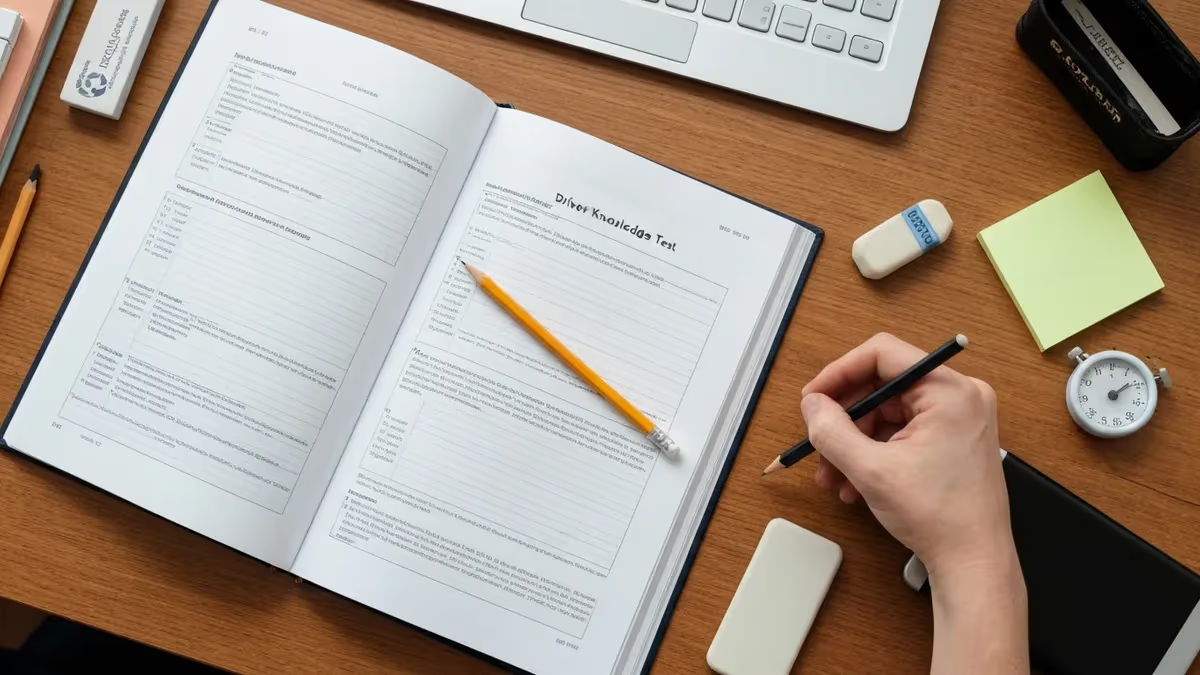
The washington state driver knowledge test experience can feel overwhelming for first-time applicants, but with the right preparation strategy, passing on your first attempt is entirely achievable. Washington's Department of Licensing (DOL) written knowledge test covers traffic laws, road signs, right-of-way rules, and safe driving practices drawn directly from the Washington Driver Guide. Understanding exactly what to expect before you walk into the testing center is the single most powerful advantage you can give yourself.
Most test-takers underestimate how much the exam tests nuance rather than basic recall. You might know that you should stop at a red light, but do you know precisely when a flashing yellow arrow permits a left turn, or what the exact blood alcohol concentration limit is for drivers under 21? These edge-case details are where many candidates lose points. A focused, systematic review that covers both the fundamentals and the finer legal distinctions separates first-time passers from those who have to make a second trip to the DOL office.
Washington requires applicants to correctly answer at least 20 of 25 questions — an 80 percent passing threshold. The questions are drawn from a pool that covers five primary categories: traffic laws, road signs, safe driving practices, sharing the road, and vehicle equipment. While 25 questions may seem manageable, the randomized nature of the pool means you genuinely need broad coverage of the entire Driver Guide rather than memorizing a handful of likely questions. Skimming is not a viable strategy for this test.
One of the most effective preparation methods is taking timed practice tests that mimic the real exam conditions. When you work through questions under a time constraint, you train your brain to retrieve information quickly and avoid second-guessing answers you actually know. Our exam tips resource walks through the most commonly tested intersection scenarios, which account for a significant percentage of real test questions across every version of the Washington knowledge exam.
Beyond memorizing rules, successful candidates develop an understanding of the reasoning behind traffic laws. When you understand why a particular rule exists — for example, why you must yield to pedestrians in a crosswalk even when no signal is present — you can apply that principle to unfamiliar phrasing on exam questions you have never seen before. This conceptual understanding is far more durable than rote memorization and dramatically reduces test anxiety because you know you can reason through novel scenarios.
Timing your study sessions matters as much as the content you review. Research in cognitive science consistently shows that spaced repetition — reviewing material across multiple shorter sessions spread over several days — produces stronger long-term retention than a single marathon cramming session the night before the exam. Scheduling three to five dedicated study sessions across one to two weeks, each lasting 45 to 60 minutes, gives your memory time to consolidate the rules and sign meanings you need for test day.
This guide compiles every practical insight you need to optimize your washington state driver knowledge test experience. From understanding the exact exam format and question distribution to building a day-by-day study schedule, identifying the trickiest question types, and knowing what to bring to the DOL office, the sections below cover everything that matters. Read through each section, take the linked practice quizzes, and you will walk into test day with genuine confidence backed by thorough preparation.
Washington Driver Knowledge Test by the Numbers
Key Facts at a Glance
| Item | Value | Details |
|---|---|---|
| Total Questions | 25 | Drawn from large randomized pool |
| Questions to Pass | 20/25 | 80% passing threshold required |
| Time Per Attempt | No limit | Most finish in under 30 minutes |
| License Application Fee | $20–$35 | Varies by license class and age |
| Attempts Before Waiting Period | 3 tries | Must wait before a 4th attempt |

Washington DOL Knowledge Test Format
| Section | Questions | Time | Weight | Notes |
|---|---|---|---|---|
| Traffic Laws & Rules | 8 | ~8 min | 32% | Speed limits, right-of-way, signals |
| Road Signs & Signals | 7 | ~7 min | 28% | Shape, color, and meaning of signs |
| Safe Driving Practices | 5 | ~5 min | 20% | Following distance, merging, hazards |
| Sharing the Road | 3 | ~3 min | 12% | Pedestrians, cyclists, large trucks |
| Vehicle Equipment & DUI Laws | 2 | ~2 min | 8% | Lights, BAC limits, implied consent |
| Total | 25 | No fixed time limit | 100% |
Building an effective study plan for the Washington driver knowledge test starts with reading the official Washington Driver Guide from cover to cover at least once. The guide is published by the Department of Licensing and contains every topic that can appear on the exam.
While reading a government manual might not sound exciting, the Washington Driver Guide is well organized and readable, and spending two to three hours working through it systematically ensures you have no major blind spots when you sit down for the real test. Highlight or bookmark sections that cover material you find confusing, because those are the areas you will need to revisit.
After your first read-through, shift your focus to active recall rather than passive re-reading. Active recall means testing yourself on the material rather than simply looking at it again. Flash cards, practice quizzes, and self-quizzing from memory all engage active recall. Studies comparing active recall to re-reading consistently find that active recall produces retention rates two to three times higher. Given that the Washington exam requires an 80 percent score, building strong recall rather than vague familiarity is essential.
Road signs deserve special attention because they represent roughly 28 percent of the exam and are among the most straightforward points to earn. Washington uses the same federally standardized sign system as every other state, meaning sign shapes and colors carry consistent meanings. Octagon always means stop. A triangle pointing downward means yield. Yellow diamond shapes indicate warnings. Knowing these shape-and-color rules lets you make educated guesses about signs you have never specifically studied, which is a useful test-taking skill when you encounter an unfamiliar sign on the actual exam.
Understanding how many questions are on the permit test — and how the scoring threshold works — helps you prioritize study time strategically. With 25 questions and a passing threshold of 20 correct, you can afford to miss only five. This means your weakest subject areas deserve proportionally more study time. If you consistently miss questions about right-of-way at four-way stops during practice, dedicate a full session to reviewing every right-of-way scenario in the Driver Guide and then quiz yourself until you answer them correctly five times in a row before moving on.
Practice tests are the single most efficient preparation tool available to you, provided you use them correctly. Simply scrolling through answer keys does not build retrieval strength. Instead, set a timer, answer all questions without looking anything up, then review every question — both the ones you got wrong and the ones you guessed on correctly. For wrong answers, identify why your initial reasoning was incorrect and write down the rule in your own words. This error-analysis step converts each mistake into a durable memory rather than a repeated stumbling block.
A testosterone test of your knowledge — checking which subject areas are actually solid versus which ones only feel solid — is an underrated but powerful study technique. Many test-takers have a false sense of confidence in areas where they actually have gaps. This happens because passive reading feels familiar, and familiarity is easily confused with mastery. You can use our subject-specific practice quizzes to isolate each category and get an objective score before test day rather than discovering the gap when it counts.
In the final 48 hours before your appointment, avoid introducing new material. At this stage, you want to consolidate and reinforce what you already know rather than trying to absorb additional content that may create confusion. A light review session covering road signs, the BAC limits, and right-of-way rules the evening before — combined with a full night of sleep — will leave you sharper than staying up late reviewing chapters you have already studied. Mental freshness on test day is a genuine performance factor that many candidates underestimate until they experience the cognitive fog of a sleep-deprived testing session.
Road Signs, DMV Permit Test Topics & Traffic Laws Explained
Road signs on the Washington knowledge test fall into three categories: regulatory signs (white rectangles with black text, like speed limit signs), warning signs (yellow diamonds), and guide signs (green rectangles with white lettering). Knowing which category a sign belongs to tells you its purpose before you even read the text. Shape alone — octagon for stop, inverted triangle for yield, pentagon for school zones — often provides enough information to answer a test question correctly even when you have not memorized a specific sign's exact wording.
Color is equally important. Red signals prohibition or a mandatory stop. Yellow signals caution or a general warning. Orange indicates construction or road work zones where fines are typically doubled. Blue signs provide motorist services information such as hospital or fuel locations. Fluorescent yellow-green is used specifically for pedestrian and school crossing warnings. Memorizing these color-meaning associations takes less than one study session and can rescue you on sign questions where the image is unfamiliar but the color gives away the correct answer category.

Taking the Washington Knowledge Test Now vs. Waiting to Study More
- +Passing sooner gets your learner's permit in hand, allowing supervised driving practice to begin
- +Washington's test has no strict minimum study requirement, so well-prepared candidates can test anytime
- +Early testing reveals actual knowledge gaps that targeted study can then fix before reattempting
- +No fee penalty for failing — you pay only the license application fee, not a separate retest fee
- +Testing while material is fresh from a recent study session maximizes short-term recall performance
- +Getting the permit early extends your supervised driving hours before applying for a full license
- −Failing wastes a trip to the DOL office and requires a minimum one-business-day wait before retesting
- −Three consecutive failures trigger a 7-day waiting period that delays your driving privileges significantly
- −Underprepared candidates reinforce wrong answers through unsuccessful test attempts, forming bad habits
- −Test anxiety increases after a failed attempt, making subsequent tries harder without structured recovery
- −Rushing to test before mastering road signs risks losing easy points on the most predictable question category
- −Going in without simulated practice means the touchscreen test format itself feels unfamiliar on the real day
Test-Day Checklist for the Washington Driver Knowledge Test
- ✓Bring a primary identity document (U.S. passport, birth certificate, or permanent resident card).
- ✓Carry your Social Security card or a document showing your full SSN.
- ✓Bring two proofs of Washington state residency dated within the past 60 days.
- ✓Arrive at least 15 minutes early to complete paperwork and avoid rushing to the terminal.
- ✓Review road sign shapes and colors one final time the morning of your appointment.
- ✓Eat a balanced meal before the exam — low blood sugar increases errors and mental fatigue.
- ✓Get at least 7–8 hours of sleep the night before to maximize cognitive performance.
- ✓Leave your phone on silent or in your bag — you cannot use it during the test.
- ✓Read every question on the terminal completely before selecting an answer.
- ✓Flag uncertain questions using the review feature and return to them after completing the full set.
You Only Need to Miss 5 — Plan Accordingly
Washington's 80 percent passing threshold means you can answer five questions incorrectly and still earn your permit. Knowing this, prioritize eliminating mistakes in the categories where you are most confident first — locking in guaranteed points on road signs and speed limits before worrying about edge-case right-of-way scenarios. Test-takers who try to master every single topic equally often run out of study time; those who secure their strongest categories first and then shore up weaknesses consistently outperform their peers on exam day.
The most common mistakes on the Washington driver knowledge test fall into predictable patterns, and recognizing them in advance is one of the most valuable things this guide can offer. The first category is misreading questions. Many exam questions are intentionally worded to test whether you read carefully or rely on pattern recognition.
A question asking what you should do when a traffic light is not working might seem to call for the same answer as a question about a green light, but an inoperative signal requires you to treat the intersection as a four-way stop — a rule that catches candidates who skim rather than read every word.
The second common mistake is confusing speed limits for different zone types. Washington uses several default speed limits that apply when no posted sign is present: 25 mph in most urban districts, 20 mph in school zones when children are present, and 50 mph on unposted county roads. Many candidates incorrectly apply the highway speed limit of 60 mph to unposted rural county roads, losing a straightforward point. Memorizing these default limits explicitly, rather than assuming they follow logical patterns, prevents this type of avoidable error.
Right-of-way at four-way stops is perhaps the single most tested scenario and the one where the largest number of candidates make mistakes. The rules in sequence are: the driver who arrives first proceeds first; when two vehicles arrive simultaneously, the driver on the right has the right of way; when two vehicles arrive simultaneously facing each other, the driver going straight has right of way over the driver turning left. Practicing these three rules with concrete mental images — visualizing yourself as each driver in the scenario — builds the kind of rapid automatic recall the test requires.
A less obvious mistake is over-relying on common sense rather than specific legal rules. Many test questions are designed to test whether you know the law rather than whether you know how most people actually drive. Following distance provides a clear example: common practice among experienced drivers is to maintain one or two seconds of following distance, but Washington law recommends a three-second following distance under ideal conditions and more under adverse conditions. Answering based on what you personally do when driving rather than what the Driver Guide specifies costs candidates points on questions that have clear legal answers.
Another frequent error involves questions about alcohol impairment. Washington law sets the legal BAC limit at 0.08 percent for drivers 21 and over, but 0.04 percent for commercial license holders, and zero tolerance (0.02 percent threshold for violation) for drivers under 21. Candidates who only memorize the 0.08 number often miss questions about the other thresholds.
Similarly, the implied consent law — which states that any licensed driver has legally consented to a breathalyzer test simply by driving on Washington roads — has specific consequences for refusal that appear on the exam and that many first-time applicants are unaware of before studying.
A herpes test of your preparation — checking whether what you think you know actually holds up under exam conditions — is the most honest pre-test assessment you can run. Many candidates discover through their first practice quiz session that subjects they felt confident about actually had significant gaps once they faced specific scenario-based questions. This kind of diagnostic self-testing, done at least three to five days before your real appointment, gives you actionable feedback while there is still time to adjust your preparation strategy.
Finally, test-day anxiety causes candidates to second-guess correct answers they knew before sitting down. If your first instinct on a question is backed by a clear rule you studied, trust it. Research on test performance consistently finds that first answers are more likely to be correct than changed answers when the test-taker actually knows the material.
Change an answer only when you can clearly identify why your first choice was wrong — not because a second reading of the question made it feel ambiguous. Anxiety-driven answer changes are one of the most preventable sources of lost points on the Washington knowledge exam.
Washington's Intermediate Driver License (IDL) for drivers under 18 carries restrictions that remain in effect even after you pass the knowledge test and road skills test. For the first six months, you may not drive between 1:00 a.m. and 5:00 a.m., and you may not carry passengers under 20 years old unless a licensed adult 25 or older is in the vehicle. Violating these restrictions can result in license suspension, so review them carefully — they are also tested on the knowledge exam itself.
With your study foundation built and your common pitfalls identified, the final preparation phase focuses on consolidation and confidence-building. This is the week before your exam appointment, and the goal is not to learn new material — it is to reinforce everything you have already learned until retrieval feels automatic rather than effortful. Automatic retrieval is what allows you to read a question on the exam terminal, immediately recognize the applicable rule, and select the correct answer without burning time and mental energy on deliberation.
The most effective way to build automatic retrieval in the final week is to run through complete 25-question practice tests under realistic conditions. Sit at a desk, set your phone face down, start a timer, and answer all 25 questions without stopping to look anything up.
The simulated pressure of a complete timed test is qualitatively different from answering individual questions casually on your phone while multitasking, and that difference matters when you are sitting at the DOL terminal. Candidates who have completed five or more full practice tests under realistic conditions report dramatically lower anxiety on the real test because the experience feels familiar rather than foreign.
Review your practice test errors with the same analytical process each time. For each wrong answer, identify the specific rule or sign you misremembered or confused, locate it in the Driver Guide, read the relevant section, and write the rule in your own words in a notes document. This notes document becomes a personalized cheat sheet of your specific weak areas that you can review in the final 24 hours before your appointment. Because it is based entirely on your own mistakes rather than a generic study guide, it addresses your actual gaps rather than topics you already know.
Understanding how many questions are on the permit test and exactly how the passing threshold works empowers you to make strategic decisions during the exam itself. If you encounter a question you genuinely cannot answer after careful reading, make your best educated guess using sign-color logic or the most conservative, safety-oriented option among the choices.
The Washington exam does not penalize wrong answers beyond simply not counting them as correct, so leaving any question unanswered is never the right choice. An educated guess on a question you find difficult gives you a reasonable chance of earning that point; a blank answer guarantees zero.
Sleep is a non-negotiable part of final preparation. The night before your knowledge test, aim for seven to eight hours of sleep. Sleep is when your brain consolidates the information you have been studying into long-term memory, and cutting it short means some of the material you reviewed most recently may not be as accessible during the exam as it would be after a full night's rest.
This is especially important for candidates who tend to cram, because cramming without adequate sleep produces familiarity without reliable retrieval — you may feel like you know the material but struggle to recall specific details under exam pressure.
Eat a balanced breakfast or lunch before your appointment. Glucose is the primary fuel for cognitive function, and testing on an empty stomach measurably impairs concentration and working memory. You do not need an elaborate meal — a combination of complex carbohydrates and protein (whole grain toast with eggs, or oatmeal with yogurt) provides sustained mental energy without the blood sugar crash that comes from sugary snacks. Candidates who dismiss nutrition as irrelevant to test performance often discover on exam day that it matters more than they expected.
Arrive at the DOL office early enough to complete your paperwork without rushing. The administrative process — presenting your documents, having your photo taken, and being directed to a testing terminal — takes time that many first-time applicants underestimate. Rushing through paperwork raises your stress level before you even start the exam.
Arriving fifteen minutes early, on the other hand, gives you a few minutes to sit quietly, take several slow deep breaths, and mentally review the key rules and sign colors one final time. This brief centering period before the test consistently improves performance by reducing the cognitive interference that anxiety creates.
Practical test-taking strategies during the exam itself can be the difference between passing with a comfortable margin and failing by one question. The most important strategy is to read each question completely before looking at the answer choices.
Many questions are designed to test reading comprehension as much as knowledge, and jumping to the answer choices before finishing the question sets up a pattern-matching trap where you select the answer that seems right based on keywords rather than the actual question being asked. Full question comprehension first, answer evaluation second — this sequence should be automatic by the time you sit down for the real exam.
When you encounter a question about a scenario you are not certain about, eliminate obviously wrong answers first. The Washington exam, like most multiple-choice tests, typically includes at least one or two clearly incorrect options that can be ruled out immediately, narrowing your choice from four options to two.
Selecting from two remaining options is a 50 percent chance rather than a 25 percent chance, which meaningfully improves your expected outcome on questions where you lack full certainty. Combined with any partial knowledge you have about the topic, this elimination approach frequently points clearly to the correct answer even when you initially felt unsure.
Time management on the Washington knowledge test is rarely a concern — the test has no enforced time limit — but candidates who rush through questions to finish quickly make avoidable errors. A deliberate, steady pace that gives each question 45 to 60 seconds of consideration is optimal. At this pace, you complete all 25 questions in about 20 to 25 minutes, leaving a few minutes to review flagged questions. Use the terminal's flag-and-review feature for any question where you selected an answer but felt uncertain, so you can return to those specific questions rather than having to re-read everything.
For road sign questions that include an image, use the shape and color before attempting to read any text. If the sign is a yellow diamond, you know before reading a single word that it is a warning sign about a road condition or hazard ahead. This primes your brain with the correct category and makes the specific text much easier to interpret correctly. Candidates who look directly at the text first and try to recognize the sign from its words alone miss the categorical information that the sign's physical properties communicate instantly.
After completing the exam and receiving your results, take a moment to review your score printout regardless of whether you passed or need to retest. The DOL provides a category-level breakdown of your performance that identifies which subject areas you answered correctly and which ones need more work.
If you passed, this breakdown helps you understand which topics deserved more credit than you gave them in your study plan — useful knowledge if you ever need to help someone else prepare. If you did not pass, the breakdown is an actionable roadmap for your next study session, showing you exactly where to focus rather than requiring you to review everything equally.
Candidates who need to retest should not simply repeat the same study methods that did not produce a passing score on the first attempt. If you failed because of road sign questions, spend your study time on sign drills using flashcard apps or printed sign charts.
If you failed because of traffic law scenarios, work through every right-of-way scenario in the Driver Guide with a focus on the specific rule that applies in each situation. Changing your study method rather than just increasing study time is the key distinction between candidates who pass on their second attempt and those who struggle through multiple retests.
The washington state driver knowledge test experience, properly prepared for, is genuinely manageable. The exam is designed to confirm that you understand the rules needed to drive safely — not to trick you or cover obscure regulations you could never reasonably know. Every answer on the test comes directly from the Washington Driver Guide. Candidates who read that guide, test themselves repeatedly, and show up rested and organized consistently pass. Use the practice quizzes throughout this site, review the Driver Guide sections you find challenging, and trust the preparation you have done. You are more ready than you feel.
DKT Questions and Answers


About the Author

Educational Psychologist & Academic Test Preparation Expert
Columbia University Teachers CollegeDr. Lisa Patel holds a Doctorate in Education from Columbia University Teachers College and has spent 17 years researching standardized test design and academic assessment. She has developed preparation programs for SAT, ACT, GRE, LSAT, UCAT, and numerous professional licensing exams, helping students of all backgrounds achieve their target scores.
Join the Discussion
Connect with other students preparing for this exam. Share tips, ask questions, and get advice from people who have been there.
View discussion (8 replies)