
Dmv appointment nyc: State-specific driver & More (2026 September)
Pass the Dmv appointment nyc: 🆕 State exam with confidence. Practice questions with detailed explanations and instant feedback on every answer.

Driver's License Requirements Across the U.S.
Getting a driver's license in the United States follows a general framework — written knowledge test, supervised driving, road skills test — but the details vary widely by state. Fees, document requirements, supervised-hour minimums, and appointment systems all differ. Knowing your state's rules before you show up saves time and prevents costly repeat trips.
Applicants who combine handbook reading with timed practice exams pass on the first attempt at nearly twice the rate of those who only study passively. Start with a quality driver knowledge test resource that mirrors your state's actual format, then layer in state-specific practice questions as your exam date approaches.
Booking a DMV Appointment in New York
DMV Appointment NYC
New York City has some of the busiest DMV offices in the country. Scheduling ahead is essential — walk-ins are not accepted for written tests or road tests. The NYC DMV operates offices in all five boroughs: Manhattan (34th Street), Brooklyn (Atlantic Avenue), Queens (Jamaica), the Bronx (Tremont Avenue), and Staten Island (Richmond Terrace).
To book a DMV appointment NYC, go to dmv.ny.gov and navigate to "Schedule an Appointment." Choose your service type (written test, road test, license renewal, REAL ID), select a borough location, and pick an available slot. Appointments open 90 days in advance, and popular times fill within hours — especially in Manhattan and downtown Brooklyn. Check the portal at 8:00–9:00 AM; overnight cancellations free up slots that get grabbed quickly.
If all NYC boroughs are booked, check offices in Nassau County or Westchester. Both are accessible via commuter rail and routinely have availability within days when the five boroughs are packed weeks out.
DMV Appointment NY
Beyond New York City, the state operates over 170 county DMV offices. In upstate regions — the Adirondacks, Hudson Valley, Southern Tier — appointments are often available within days rather than weeks. A DMV appointment NY anywhere in the state uses the same online scheduling portal. Choose your county office, select the service, and pick your slot.
New York uses a 6-point ID verification system. A U.S. passport (4 points) plus a Social Security card (2 points) is the most common combination. A certified birth certificate (3 points), a permanent resident card (4 points), and utility bills or bank statements (1 point each) are also accepted. Verify the current document list on the DMV website the day before your appointment — point values are updated periodically.
DMV Appointment New York — What to Expect on the Day
Arrive 10–15 minutes early for your DMV appointment New York with all documents in a folder. Staff verify your paperwork, photograph you, and direct you to a computer terminal. The written exam is self-paced and takes most applicants 20–30 minutes. Pass, and you receive a temporary paper permit on the spot; the physical card arrives by mail within two weeks.
After your permit arrives, log your supervised driving hours, then schedule your road test. Use our practice driver knowledge test resources to prepare — they match the format and difficulty of the actual NY DMV exam closely.
You can continue preparing with the dkt practice test, which includes answer explanations for every question.
State-Specific Permit Practice Tests
Each state bases its knowledge test on its own driver's manual, so question formats and topics vary. Targeted, state-specific practice is the most reliable way to pass on your first attempt.
Practice Permit Test NY
The practice permit test NY mirrors the 20-question NY DMV exam drawn from the New York State Driver's Manual. Core topics include traffic control signals, pavement markings, right-of-way at intersections, speed limits in school and work zones, and rules for sharing the road with cyclists. Questions are deliberately tricky — they test your understanding of the reasoning behind rules, not just rote memorization. Focus especially on stopping distances, following distance in adverse weather, and when to yield versus stop. Pair your study sessions with our dkt practice test to work through challenging general knowledge questions.
NJ Permit Practice Test
The nj permit practice test is built around New Jersey's 50-question exam, which requires an 80% passing score — stricter than most states. NJ places extra emphasis on state-specific rules: the Move Over law, regulations for the Garden State Parkway and NJ Turnpike, and cell phone restrictions. New Jersey's GDL system is among the strictest in the nation; teens hold a permit for at least 6 months and must log 47 supervised hours before a road test. Strengthen intersection knowledge with our driver knowledge test — a topic NJ examiners test heavily.
Georgia Permit Practice Test
The georgia permit practice test reflects the 40-question exam from Georgia's Department of Driver Services (DDS), requiring 75% to pass. To earn a drivers licence in Georgia, you must hold a Class CP instructional permit, log 40 supervised hours (6 at night), and wait a full 12 months before your road test — one of the longest holding periods in the country. Georgia's three-stage GDL system (Class CP at 15 → Class D restricted at 16 → full Class C at 18) means the permit phase is longer than in most states. Practice tests should cover DUI laws, texting-while-driving statutes, and Georgia-specific speed regulations, all of which appear frequently on the actual exam.
What to Bring to Your DMV Appointment
- ✓Primary identity document (passport, birth certificate, or permanent resident card)
- ✓Social Security card or official proof of Social Security number
- ✓Two proofs of current state residency (utility bills, bank statements, or lease)
- ✓Completed DMV application form — fill it out online before arriving to save time
- ✓Payment for applicable fees (check, money order, or credit/debit card)
- ✓Corrective lenses if you need them for the vision screening
- ✓Name-change documents if your name differs across IDs (marriage certificate, court order)
- ✓Parent or guardian with valid ID if applicant is under 18
- ✓5-hour pre-licensing course certificate (New York only, required before road test)
- ✓Signed supervised driving log if required by your state's GDL program
Ohio, Kentucky & HazMat Permit Tests
Ohio Permit Practice Test
The ohio permit practice test mirrors the Ohio BMV exam: 40 questions, 75% passing score (30 correct). Ohio also administers a separate 20-question road sign section requiring 15 correct answers — making sign identification especially important to study. Teens can apply for a TIPIC (Temporary Instruction Permit Identification Card) at age 15½ and must hold it at least 6 months before a road test.
Ohio's 2026 hands-free driving law, rules about agricultural vehicles, and Ohio Turnpike regulations appear on the exam. Visual learners benefit from our dkt video question format, which is ideal for the sign-identification portion of Ohio's exam.
Kentucky Permit Test
The kentucky permit test is a 40-question exam administered by the Kentucky Transportation Cabinet, requiring 75% (30 correct) to pass. Kentucky has one of the highest supervised-hour requirements in the country — 60 hours including 10 at night — and the permit must be held for 180 days before a road test. The exam heavily tests DUI law, BAC limits, implied consent, and the state's Move Over law. Build your sign recognition skills using our driver's license knowledge test resources, which cover the sign categories tested most often on Kentucky's exam. For commercial license pathways, our driver knowledge test online guide covers endorsement and CDL upgrade options.
Hazmat Practice Test
The hazmat practice test is required for CDL holders seeking a Hazardous Materials endorsement, which permits transporting explosives, flammable liquids, radioactive materials, and corrosive substances. The HazMat knowledge exam contains 30 questions with an 80% passing threshold. Topics include the nine hazmat classes, placarding and labeling requirements, shipping paper rules, safe routing, and emergency response procedures under FMCSA 49 CFR Parts 171–180.
Beyond passing the knowledge test, obtaining a HazMat endorsement requires a TSA security threat assessment — fingerprinting and a full background check — which typically takes 30–60 days. Factor this into your timeline if you're working toward the endorsement for a new trucking role. Use our driver licence knowledge test materials as a complement to HazMat prep, since road sign rules are tested across all CDL endorsement exams.
Road Test Results and What Happens Next
Road Test Results
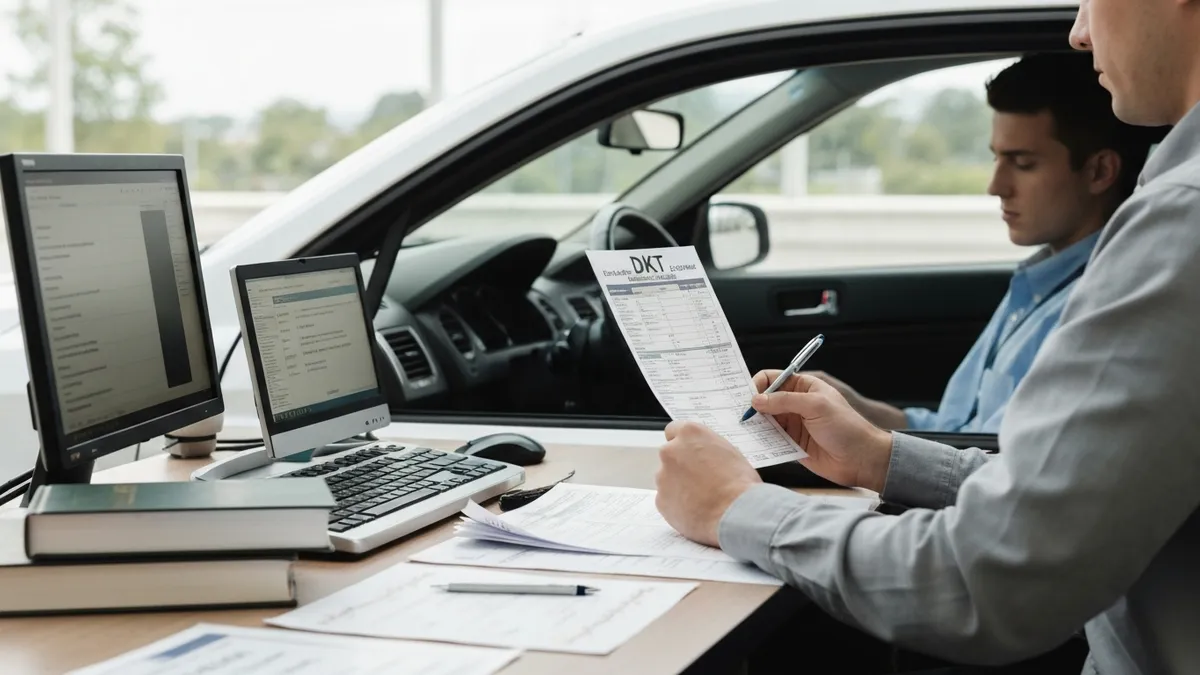
After completing your road test, road test results are delivered by the examiner on the spot — before you exit the vehicle in most states. The examiner fills out a standardized score sheet during the drive and verbally announces whether you passed or failed. You receive a written copy detailing every error and its point value.
If you pass, the examiner takes your learner's permit and issues either a temporary paper license (valid 30–60 days) or authorizes you to drive using your existing permit while the permanent license is mailed. If you fail, the score sheet becomes your study guide: examiners note the exact maneuver that cost you points, so your next practice session can be surgical rather than general.
How Do I Know If I Passed My Road Test
The most common answer to how do i know if i passed my road test is simple: the examiner tells you before you step out of the car. However, many applicants want a second confirmation, especially for follow-up steps like ordering a new vehicle or updating their insurance.
In New York, you can verify road test results by logging into your NY DMV online account — results typically appear within 24–48 hours of your test. New Jersey's MVC portal works the same way. Georgia, Ohio, and Kentucky all offer online account portals where you can track license status and test history. If there's any ambiguity about your result, call the office where you tested with your appointment confirmation number. They can confirm the outcome and explain the next steps, including how to schedule a retest if needed.
Once you pass, keep your temporary paper license with you whenever you drive. Law enforcement in all states accepts it as valid documentation during the 2–3 week window while your permanent card is in the mail.
Online vs. In-Person DMV Services
- +Schedule appointments 24/7 without waiting on hold
- +Renew licenses and vehicle registrations from home
- +Complete paperwork in advance to reduce office time
- +Receive digital appointment confirmations and reminders
- +Access driving record and test history anytime
- +Avoid peak-hour wait lines at busy DMV locations
- −First-time license applicants must always appear in person
- −Written knowledge tests and road tests cannot be taken online
- −Identity verification requires physical document review
- −System outages can delay scheduling during high-demand periods
- −Not all transactions are available online in every state
- −Photo updates and vision screenings always require an in-person visit
DMV Questions and Answers
Related Resources
DKT - Driver Knowledge Test: Complete Study Guide 2026

DKT Test (Traffic Signs) #2
Road Signs Interpretation: Everything You Need to Know in 2026
DKT Test (General Knowledge) #6
DKT Test
DKT - Driver Knowledge Test: Career Paths, Salary, and Requirements 2026
DKT Car Driver Knowledge Test – Intersections 1
About the Author

Educational Psychologist & Academic Test Preparation Expert
Columbia University Teachers CollegeDr. Lisa Patel holds a Doctorate in Education from Columbia University Teachers College and has spent 17 years researching standardized test design and academic assessment. She has developed preparation programs for SAT, ACT, GRE, LSAT, UCAT, and numerous professional licensing exams, helping students of all backgrounds achieve their target scores.
Join the Discussion
Connect with other students preparing for this exam. Share tips, ask questions, and get advice from people who have been there.
View discussion (8 replies)