
CWI Training Programs: What to Expect and How to Prepare 2026 September
Get ready for your CWI Training Programs: What to Expect certification. Practice questions with step-by-step answer explanations and instant scoring. 📚
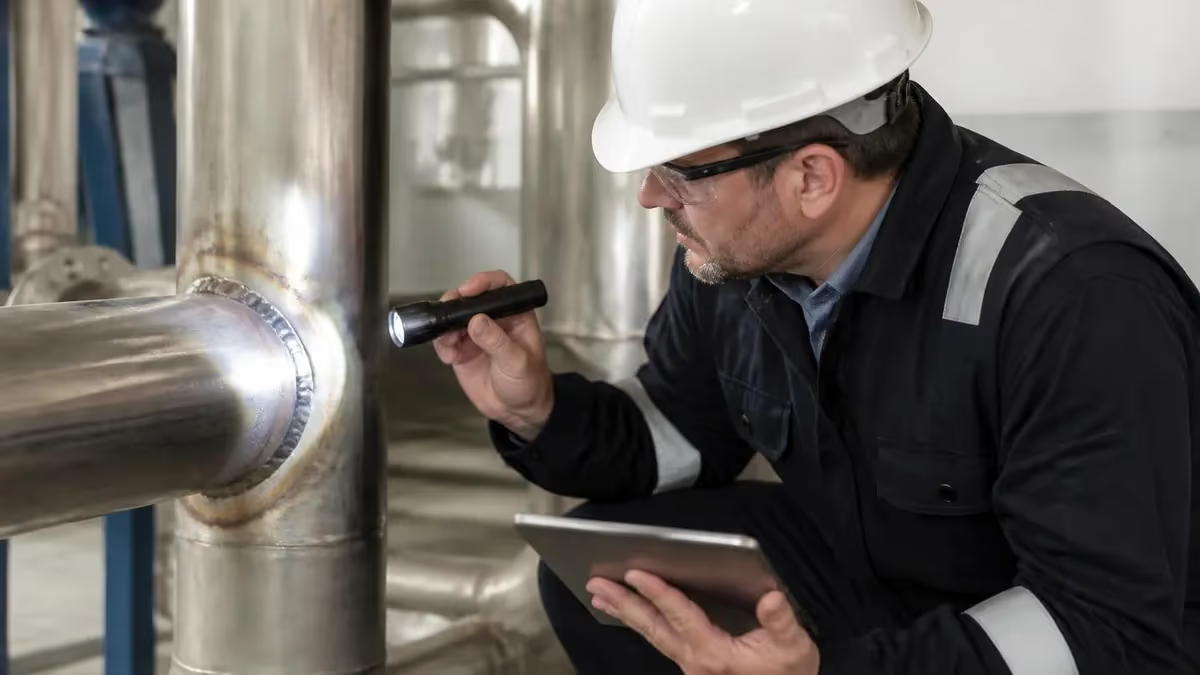
Becoming a Certified Welding Inspector (CWI) is one of the most recognized credentials in the welding industry. The American Welding Society (AWS) administers the certification, and it's required or strongly preferred for quality control roles in manufacturing, construction, pipeline, and aerospace welding environments. But the path to certification isn't just about signing up for a test—it involves meeting specific experience requirements, choosing the right training program, and preparing for a three-part exam that tests code knowledge, visual inspection skills, and practical judgment.
This guide breaks down what CWI training actually involves, what your options are, and what it takes to pass.
What Is the CWI Certification?
The AWS Certified Welding Inspector credential certifies that the holder can evaluate welds, interpret welding codes and drawings, and ensure compliance with quality standards. CWIs work in industries where weld quality is safety-critical—bridges, pipelines, pressure vessels, nuclear facilities, aerospace components, and more.
The CWI certification is internationally recognized, and in many jurisdictions it's a regulatory requirement for welding inspection roles on public infrastructure or code-compliance projects. It's not the only welding credential, but it's the most widely accepted in North America.
AWS CWI Eligibility Requirements
You can't just walk in and take the CWI exam. AWS requires candidates to meet specific education and experience thresholds before they're eligible to test. The requirements work on a sliding scale—more education means less required experience:
- High school diploma or equivalent: 5 years of welding-related work experience
- Associate degree or 2-year technical diploma in welding or related field: 3 years of experience
- Bachelor's degree in welding or related engineering: 1 year of experience
AWS defines "welding-related experience" broadly—it includes welding, welding inspection, welding supervision, welding engineering, or related QC/NDT work. You'll document your experience on the application, and AWS may request verification.
There's also a vision test requirement. You need near-distance visual acuity (with correction if needed) to pass. AWS specifies the Jaeger J2 chart at 12 inches minimum for near vision.
The Three-Part CWI Exam
The CWI exam is divided into three sections, taken on a single day. Understanding what each section tests is essential for building an effective study plan.
Part A: Fundamentals (150 questions, 2 hours)
Part A tests broad welding knowledge: welding processes, metallurgy, welding symbols, joint design, discontinuities, and quality control principles. It's the most content-heavy section and requires genuine understanding—not just memorization—of how welds form and fail.
Part B: Practical (46 questions, 2 hours)
Part B is the code application section. Candidates use the AWS D1.1 Structural Welding Code (Steel) as an open-book reference during this section. You'll answer questions requiring you to look up specific code provisions, interpret prequalified joint details, and apply acceptance criteria. Speed matters here—you need to navigate D1.1 efficiently to answer 46 questions in 2 hours.
Part C: Book of Specifications (variable, 1 hour)
Part C tests your ability to read and apply a specific welding code, specification, or standard. The document varies by candidate—AWS publishes an annual list of eligible reference documents. Most candidates choose D1.1, but options include D1.5 (bridge), D9.1 (sheet metal), API 1104 (pipeline), and others. Like Part B, this is open-book.
CWI Training Program Options
There's no single mandatory training path for the CWI exam. You have several legitimate options, each with different tradeoffs in cost, time, and effectiveness.
AWS Seminar + Examination Packages
AWS offers official 5-day preparation seminars at locations around the country, combined with the exam administered at the end of the week. The seminar covers all three exam parts with instruction from AWS-certified educators. Cost runs $2,000–$3,000 for the seminar package including exam fees.
The seminar format works well for candidates who learn better in structured classroom environments and want immersive, focused prep. The downside is intensity—5 days of dense material is a lot to absorb, and candidates who haven't reviewed fundamentals beforehand often struggle.
AWS Online Training
AWS offers online self-paced modules through the AWS Learning platform. These cover fundamentals, code use, and practical applications at your own pace. Online training is significantly cheaper than seminar attendance and allows you to study around a work schedule. Many candidates use online modules as supplemental preparation before an in-person seminar or exam attempt.
Third-Party CWI Prep Courses
Several training companies offer CWI prep programs independent of AWS. Companies like EPRI, TWI, Lincoln Electric, and others run multi-day courses specifically focused on the CWI exam. Quality varies, but the best programs closely mirror the exam structure and include hands-on weld inspection practice with physical specimens.
Third-party courses are often more affordable than official AWS seminars and can be scheduled more flexibly. Look for instructors who are actively certified CWIs with real inspection experience—not just trainers.
Self-Study
A significant portion of CWI candidates study independently, using the AWS CWI Study Guide, the D1.1 code, supplemental textbooks, and practice exams. Self-study requires strong self-discipline and is generally best suited to candidates with extensive hands-on welding or inspection experience who mainly need to learn the exam format and code navigation.
Pure self-study is harder for candidates newer to code work, but pairing it with practice tests and targeted review of weak areas is highly effective once you understand the exam structure.
What to Study: Key Content Areas
Regardless of which training format you choose, certain content areas are consistently high-yield for the CWI exam:
- Welding processes: SMAW, GMAW, FCAW, GTAW, SAW, and their characteristics, parameters, and typical applications
- Weld discontinuities: Porosity, undercut, overlap, incomplete fusion, incomplete joint penetration, cracks (types and causes)—and which are rejectable under D1.1
- D1.1 code structure: How the code is organized, where to find prequalified joint details, how to look up acceptance criteria quickly
- Welding symbols: AWS A2.4 standard. Reading and interpreting complete weld symbols including supplementary and finish symbols
- Metallurgy basics: Carbon content and weldability, heat affected zone, preheat requirements, post-weld heat treatment
- Visual inspection: Measurement of weld profile (reinforcement, undercut depth), how to use a weld gauge properly
- NDE methods overview: RT, UT, MT, PT—what each detects, surface vs. volumetric, basic principles
Preparing for Part B: Code Navigation Is a Skill
Part B is where many candidates lose time. The D1.1 code is 600+ pages, and 2 hours to answer 46 code-based questions is tight if you don't know where things are.
The most effective way to prepare is to practice navigating the code, not just read it. Work through practice problems that require you to look up specific table entries, clause numbers, and figure details. Time yourself. Build a tab system or index in your code book—AWS allows you to mark up your personal copy with tabs and annotations.
Common high-frequency code sections to know well:
- Table 4.5 (prequalified complete joint penetration groove weld details)
- Table 6.1 and 6.2 (visual inspection acceptance criteria)
- Section 5 (design of welded connections)
- Section 8 (stud welding)
First-Time Pass Rates and What They Mean for Your Prep
The AWS CWI first-time pass rate is roughly 50–60%. That's lower than many candidates expect. The most common reason for failure isn't insufficient welding knowledge—it's inadequate code preparation, particularly Part B.
Candidates who fail most often report that they underestimated the time pressure of Part B and C. If you haven't practiced working through code questions under a timer, the actual exam pace will catch you off guard.
Plan to take at least one timed, full-length practice exam before your test date. Identify which code sections are slowest for you to navigate and target those specifically.
After Certification: Maintaining Your CWI
CWI certification requires renewal every three years through AWS. You have two options:
- Retest: Take the full exam again
- Recertification by endorsement: Document 80 professional development hours (PDHs) over the three-year period, covering welding education, conferences, committee work, or publications
Most working CWIs renew by endorsement. If you're actively employed in inspection or QC roles, accumulating 80 PDHs over three years is manageable through normal professional activities—AWS conferences, employer training, seminars.
Senior Certified Welding Inspector (SCWI) status is also available for CWIs with at least 6 years of post-CWI experience. It involves a separate exam and is recognized as the highest level of AWS welding inspection certification.
Is CWI Training Worth the Investment?
Yes—for the right person. CWI-certified inspectors earn significantly more than non-certified welders in QC roles. Median salaries for CWIs in the US run $60,000–$90,000, with experienced inspectors in high-demand sectors like pipeline or nuclear earning well above that. Many CWIs work as independent contractors, charging $50–$100+ per hour for code-compliance inspections.
The certification also opens doors to roles that are simply unavailable without it—code compliance inspector on federal projects, QC manager at an AWS-certified fabrication facility, third-party auditor for insurance and regulatory agencies.
The investment—typically $1,500–$3,000 in training and exam fees—pays back quickly in most career paths. The real investment is time: the study hours, the experience years required for eligibility, and the discipline to prepare thoroughly for an exam that catches overconfident candidates off guard.
Important: The CWI exam covers multiple domains. Allocate more study time to unfamiliar topics while maintaining review of strong areas.

| Section | Questions | Time |
|---|---|---|
| Part A: Fundamentals | 150 | — |
| Part B: Practical (Code Application) | 46 | — |
| Part C: Book of Specifications | Variable | — |
| Total | ~230 | — |
- ✓Verify you meet AWS eligibility requirements (education + experience combination)
- ✓Pass the AWS vision test (Jaeger J2 near acuity at 12 inches)
- ✓Obtain a current copy of AWS D1.1 Structural Welding Code
- ✓Select your Part C reference document from the AWS approved list
- ✓Choose a training format: AWS seminar, online modules, or third-party course
- ✓Complete a timed full-length practice exam before test day
- ✓Practice Part B code navigation with a timer — know where key tables are
- ✓Tab and annotate your D1.1 code (permitted in exam)
- ✓Register through AWS and confirm your exam site and date
- ✓Renew every 3 years via 80 PDHs or retesting
CWI: Pros and Cons
- +Structured CWI training builds a solid foundation of skills
- +Multiple training formats available: online, in-person, and hybrid
- +Hands-on practice prepares you for real-world job scenarios
- +Training programs often include job placement assistance
- +Continuing education keeps your skills current with industry changes
- −Training programs can be time-intensive (weeks to months)
- −Quality varies significantly between training providers
- −Costs for comprehensive programs can be substantial
- −Hands-on components may require travel or in-person attendance
- −Self-paced learning requires strong discipline and motivation
About the Author

Attorney & Bar Exam Preparation Specialist
Yale Law SchoolJames R. Hargrove is a practicing attorney and legal educator with a Juris Doctor from Yale Law School and an LLM in Constitutional Law. With over a decade of experience coaching bar exam candidates across multiple jurisdictions, he specializes in MBE strategy, state-specific essay preparation, and multistate performance test techniques.
Join the Discussion
Connect with other students preparing for this exam. Share tips, ask questions, and get advice from people who have been there.
View discussion (8 replies)