
CWI Florida: State Training Requirements & Certification Guide for Welding Inspectors
CWI Florida training requirements explained. Learn eligibility, prep steps, exam format & state-specific tips to pass your certification. ✅

If you are pursuing your Certified Welding Inspector credential in the Sunshine State, understanding CWI Florida training requirements is the essential first step toward a rewarding career. Florida has emerged as one of the busiest states for welding inspection work, driven by massive infrastructure investment, thriving shipbuilding operations in Jacksonville and Tampa, and a booming construction sector that demands qualified third-party inspectors on virtually every major project site.
Knowing exactly what training pathways are recognized, which documentation you need, and how to align your preparation with AWS D1.1 structural welding code standards gives you a decisive competitive edge before you ever sit down for the exam.
The AWS CWI certification is nationally recognized, but the practical reality is that training resources, employer expectations, and industry concentration vary significantly by state. Florida's construction industry, petrochemical sector around the Gulf Coast, and extensive aerospace manufacturing presence create a demand for welding inspectors that outpaces supply in many metro areas. Candidates who complete structured state training programs before their AWS exam date consistently report higher first-attempt pass rates and faster job placement after certification, making the investment in a quality preparatory course well worth the time and money.
This guide covers every major dimension of the CWI training and certification process with a Florida-specific lens. You will find information on AWS eligibility requirements, approved training formats, the structure of the three-part examination, cost breakdowns, and a strategic study schedule designed to help you reach exam-ready confidence within 10 to 14 weeks. Whether you are a seasoned welder transitioning into an inspection role or an engineering technician expanding your credentials, the path to CWI certification is clearly defined and entirely achievable with the right preparation.
One question candidates frequently ask is whether Florida mandates specific state-level CWI licensure on top of the AWS credential. The short answer is no — Florida does not issue a separate state welding inspector license. The AWS CWI certification, issued by the American Welding Society and governed by AWS QC1, serves as the de facto professional standard recognized by state agencies, private employers, and project owners throughout Florida. However, some government contracting work and nuclear or pressure-vessel projects may require additional ASME or API endorsements, which you can add to your AWS CWI credential after initial certification.
Florida's geographic diversity also means training opportunities are widely available. Miami-Dade, Orlando, Jacksonville, Tampa Bay, and the Space Coast all host AWS Section chapters that organize periodic seminar-style CWI prep courses, sometimes offered in partnership with local community colleges or trade associations. Online and hybrid training programs have expanded dramatically since 2020, meaning a candidate in rural North Florida or the Panhandle can access the same quality instruction as someone in a major metro. When evaluating training providers, always confirm that the curriculum covers all three exam parts: Fundamentals, Practical, and Code Book Application.
The financial investment in CWI training varies by format, but candidates should budget between $800 and $2,500 for a comprehensive preparatory course, in addition to AWS application fees. Many Florida employers — particularly those in the oil, gas, and heavy construction sectors — offer tuition reimbursement or direct sponsorship for employees pursuing the CWI credential. Researching employer sponsorship options before enrolling in a training program can dramatically reduce your out-of-pocket costs and, in some cases, employers will schedule your exam date and pay all associated fees in exchange for a post-certification employment commitment.
Throughout this article you will find practical tools including a week-by-week study schedule, a comprehensive checklist of tasks to complete before exam day, an honest look at the pros and cons of different training formats, and a detailed FAQ addressing the questions Florida CWI candidates ask most often. Combined with the practice quizzes available on this site, this resource is designed to serve as your single most comprehensive reference for navigating the CWI certification process in Florida from start to finish.
CWI Florida Certification by the Numbers

10-Week CWI Florida Study Schedule
- ▸Download and read AWS QC1 Standard in full
- ▸Gather all education and work experience documentation
- ▸Submit online CWI application and pay AWS fee
- ▸Order your copy of AWS D1.1 Structural Welding Code
- ▸Study SMAW, GMAW, FCAW, GTAW, and SAW processes
- ▸Memorize AWS welding symbol conventions
- ▸Complete a 50-question fundamentals practice quiz
- ▸Review heat input formulas and preheat requirements
- ▸Study carbon equivalent formulas and hardenability
- ▸Review tensile, yield, and impact test concepts
- ▸Learn weld discontinuity types and causes
- ▸Complete destructive testing flashcard deck
- ▸Study groove, fillet, plug, and slot weld geometry
- ▸Review VT, PT, MT, UT, and RT inspection methods
- ▸Practice reading weld procedure specifications (WPS)
- ▸Complete joint design practice questions
- ▸Tab Clauses 1–4 of D1.1 with sticky flags
- ▸Study prequalified joint details (Clause 3)
- ▸Learn qualification requirements for WPS and PQR
- ▸Practice open-book code look-up timed drills
- ▸Tab Clauses 5–8 of D1.1
- ▸Study acceptance criteria for statically and dynamically loaded structures
- ▸Review inspection requirements in Clause 6
- ▸Complete a full 60-question code book practice test
- ▸Practice weld visual inspection on sample coupons
- ▸Review fillet weld gauge usage and measurement technique
- ▸Study undercut, overlap, porosity, and crack identification
- ▸Complete practical measurement exercises timed
- ▸Take a full 150-question simulated Part 1 Fundamentals exam
- ▸Score and review every missed question
- ▸Identify weak topic areas and schedule focused review
- ▸Begin daily 30-minute code book navigation drills
- ▸Dedicate 3 hours each to your two lowest-scoring topic areas
- ▸Re-take practice quizzes on metallurgy and NDE
- ▸Review AWS errata and code interpretations
- ▸Practice explaining acceptance criteria aloud
- ▸Take a final full-length simulated exam under timed conditions
- ▸Confirm exam date, location, and required identification
- ▸Pack approved materials: tabbed D1.1, calculator, gauges
- ▸Rest 48 hours before exam — avoid cramming the night before
Florida hosts a robust ecosystem of CWI training providers, ranging from nationally recognized AWS-approved seminar programs to community college continuing education courses and fully online platforms. The AWS Welding Inspection Technology (WIT) seminar, offered periodically at locations across the country and sometimes hosted at Florida venues by the Florida West Coast, Space Coast, and South Florida AWS Sections, remains one of the most respected intensive preparation formats available. This five-day course covers welding processes, metallurgy, NDE methods, and code application in a structured classroom environment, and many candidates credit it with bridging the gap between field experience and exam-level knowledge.
Community colleges and technical institutes throughout Florida have also expanded their welding inspection training offerings in response to regional workforce demand. Broward College, Valencia College, and Tallahassee Community College have all offered welding-related continuing education programs that can supplement your independent study. While these institutional programs vary in depth and may not be specifically designed around the AWS CWI exam blueprint, they provide valuable hands-on exposure to weld inspection techniques, code interpretation exercises, and supervised practical work that can strengthen your performance on the Practical examination section.
Online training has become an increasingly popular and cost-effective option for Florida candidates, particularly those balancing full-time employment with exam preparation. Several dedicated CWI prep platforms offer self-paced video lecture series, downloadable workbooks, and extensive practice question banks that mirror the actual exam format. When evaluating online providers, look for programs that explicitly map their content to the AWS CWI Part A (Fundamentals), Part B (Practical), and Part C (Code Book) examination blueprint, offer timed practice exams with detailed answer explanations, and provide instructor access for technical questions about code interpretation scenarios.
Regardless of which training format you choose, the single most impactful preparation activity for the code book portion of the CWI exam is consistent, timed open-book practice with a properly tabbed copy of AWS D1.1. Many candidates underestimate how critical the physical organization of their code book is to exam performance.
The Part C Code Book Application exam allows you to use your D1.1 reference, but with only three hours to answer 46 questions that require precise code look-ups, candidates who cannot rapidly navigate to the correct clause are at a severe disadvantage. Develop a systematic tabbing strategy during your study period and rehearse it daily until finding any major clause takes under 20 seconds.
Employer-sponsored training is another pathway worth exploring early in your preparation process. Many of Florida's largest welding contractors, shipbuilders, and engineering firms actively invest in developing internal CWI candidates because the credential directly expands the services they can offer clients and satisfies quality management system requirements under ISO 3834 and similar standards. If your employer offers tuition assistance, confirm whether they have a preferred training provider relationship, as some firms negotiate group pricing on AWS seminar seats or maintain institutional subscriptions to online CWI prep platforms that employees can access at no personal cost.
The AWS also offers a CWI Certification Preparation Guide that serves as an essential free resource regardless of which supplementary training you pursue. This document, available through the AWS bookstore, outlines the knowledge domains tested on each exam part, provides suggested reference materials, and includes sample questions representative of the actual examination. Pairing this guide with a comprehensive set of practice questions — particularly for the code book application section — gives you a clear picture of what the exam expects and where your current knowledge has gaps that need targeted attention.
Mentorship from a currently certified CWI is an underutilized but highly effective supplement to formal training. Experienced inspectors can share practical code interpretation strategies, explain nuances in acceptance criteria that textbooks often gloss over, and provide realistic feedback on your visual inspection technique before you sit for the Practical exam. Reach out to your local AWS Section or welding industry professional associations in Florida to identify potential mentors, or consider joining online CWI study communities where active candidates and credentialed inspectors regularly discuss difficult exam topics and share preparation resources.
CWI Exam Parts: Florida Candidate Breakdown
Part A of the CWI examination is a 150-question multiple-choice test covering welding processes, metallurgy, mechanical testing, weld inspection methods, and nondestructive evaluation theory. You have three hours to complete it, which works out to roughly 72 seconds per question. The Fundamentals exam does not allow reference materials, so everything you answer must come from memory. AWS publishes the exact knowledge domain breakdown in their Body of Knowledge document, and the largest single category — welding processes and equipment — accounts for approximately 30 percent of the total questions.
Florida candidates consistently report that the metallurgy and mechanical testing sections of Part A are the most challenging, particularly questions about carbon equivalent calculations, heat-affected zone behavior, and the relationship between preheat temperature and hydrogen-induced cracking. Allocating at least three dedicated study sessions to these topics before your exam date dramatically improves your probability of achieving a passing score of 72 percent or higher on this section. Using spaced repetition flashcard systems for formulas and terminology is especially effective for retaining the dense factual content tested on Part A.
CWI Certification in Florida: Is It Worth It?
- +Florida's construction and infrastructure boom creates consistent high demand for credentialed inspectors
- +CWI credential opens doors to significantly higher pay — often $15–$25 per hour more than uncertified welders
- +AWS CWI is nationally portable — Florida-certified inspectors work across all 50 states
- +No separate Florida state license required — AWS credential alone satisfies most employer and project owner requirements
- +Strong employer sponsorship culture in Florida's shipbuilding and petrochemical industries reduces out-of-pocket training costs
- +Credential opens pathways to specialized endorsements (D1.5, API 1104, nuclear) and senior quality roles
- −First-attempt pass rate is only around 54% — candidates who underestimate the difficulty often fail and pay to retake
- −AWS application fees, training costs, and code book purchase total $1,500–$3,500 before you take the exam
- −Strict eligibility requirements mean candidates without sufficient documented work experience cannot apply
- −The Practical exam requires hands-on gauge skills that are difficult to develop without physical practice on real weldments
- −Five-year renewal requires documented inspection work experience — career gaps can complicate recertification
- −Florida's hurricane season and outdoor project conditions create challenging inspection environments not covered in standard training
CWI Florida Pre-Exam Action Checklist
- ✓Verify you meet AWS QC1 eligibility requirements and calculate your education-to-experience points total
- ✓Submit your AWS CWI application online and receive your Authorization to Test (ATT) letter
- ✓Purchase the correct edition of AWS D1.1 Structural Welding Code specified for your exam cycle
- ✓Tab your D1.1 systematically with 30–40 precision tabs covering high-frequency exam clauses
- ✓Complete at least two full-length simulated Part A (Fundamentals) exams under timed, closed-book conditions
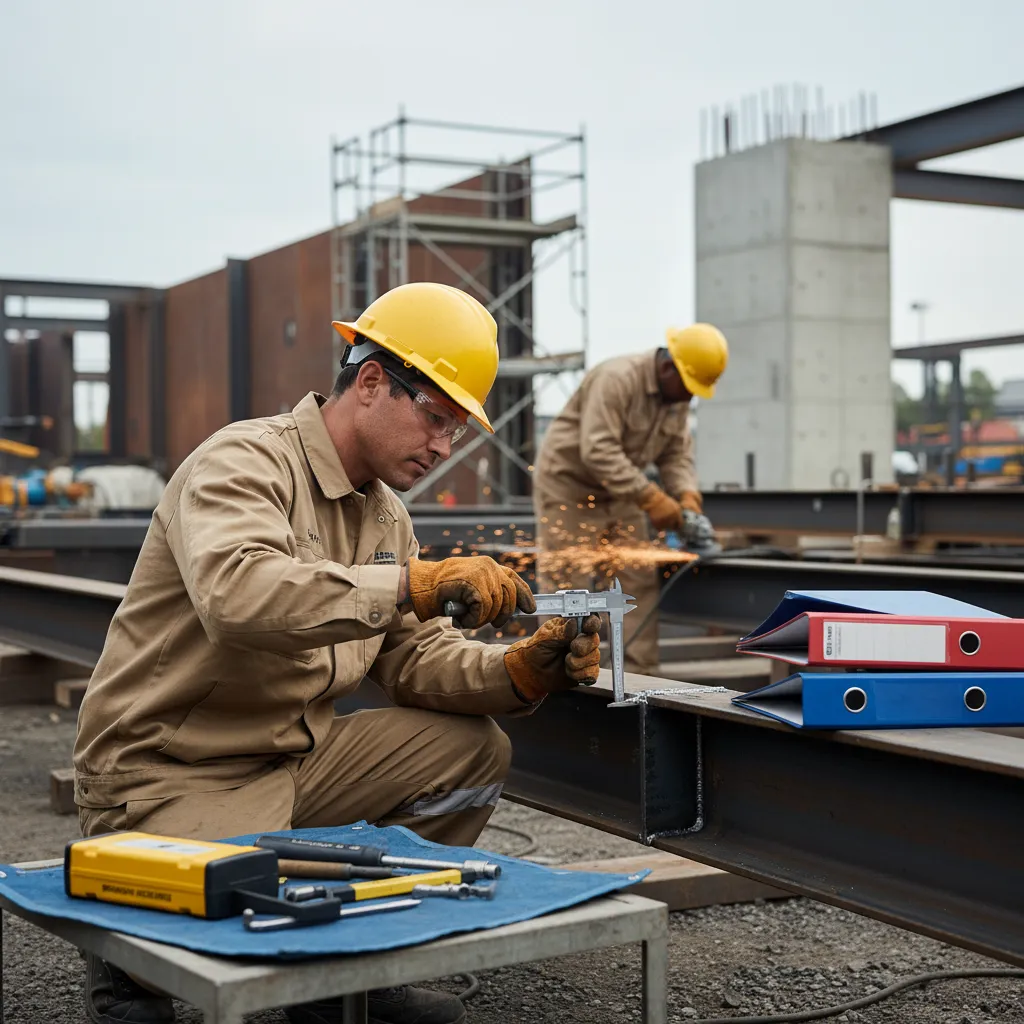
- ✓Practice physical weld inspection using a fillet gauge, undercut gauge, and Hi-Lo gauge on real or sample weldments
- ✓Complete timed open-book code look-up drills targeting under 90 seconds per Part C question
- ✓Confirm your Prometric testing center location, date, and bring valid government-issued photo ID
- ✓Prepare a list of approved exam-day materials: tabbed D1.1, approved calculator, welding gauges
- ✓Rest adequately for 48 hours before your exam date and avoid last-minute cramming sessions

The Code Book Exam Is Open-Book — But Speed Kills
AWS Part C allows you to use your D1.1 during the exam, but 46 questions in 3 hours leaves less than 4 minutes per question including look-up time. Candidates who have not rehearsed rapid D1.1 navigation consistently run out of time. Practice retrieving answers in under 90 seconds per question throughout your entire preparation period — the open-book format is an advantage only if your tabbing system is fast and reliable.
Developing an effective code book strategy is arguably the single highest-leverage activity you can invest time in during your CWI exam preparation, and it is the area where structured guidance pays the largest dividends for Florida candidates taking the test at Prometric testing centers statewide.
The AWS D1.1 Structural Welding Code — Steel is a dense, 600-plus-page document organized into eight major clauses, numerous annexes, and dozens of tables and figures. Understanding the logical architecture of the code before you begin tabbing is essential, because the exam frequently asks questions that require navigating from a general provision to a specific exception or from a table back to the clause that governs its application.
Clause 1 of D1.1 covers general requirements and scope, establishing which structural applications the code governs. Clause 2 addresses design requirements and weld size calculations, which generates a moderate volume of exam questions particularly around minimum fillet weld sizes from Table 2.4 and groove weld effective throat calculations.
Clause 3 covers prequalified joint details — arguably the most heavily tested single section across all editions of the CWI exam — and candidates who cannot rapidly retrieve figures and tables from this clause under time pressure routinely report running out of time on Part C. Tab every major figure in Clause 3 individually, not just the clause itself.
Clause 4 governs qualification requirements for welding procedures and welders, including the essential variables that require re-qualification when changed, and the documentation requirements for Welding Procedure Specifications and Procedure Qualification Records. Questions from Clause 4 typically ask candidates to identify which essential variable changes require a new PQR or which test positions qualify for which production positions. These are tabular look-up questions where a clear, well-organized index of Table 4.5 and its companion tables can save 60 to 90 seconds per question.
Clause 5 covers fabrication requirements including base metal preparation, fit-up tolerances, preheat and interpass temperature requirements, and postweld heat treatment provisions. Florida candidates working on structural steel projects encounter these requirements daily, giving them a practical familiarity that can translate directly into exam performance — provided they verify that their field experience aligns with the specific edition of D1.1 being tested. AWS periodically updates the code, and provisions that changed between editions are favorite exam question sources because they identify candidates who have read the current version versus those relying on outdated institutional knowledge.
Clause 6 is perhaps the most practically important section of D1.1 for a working CWI because it governs inspection requirements, including the roles and responsibilities of contractors and inspectors, mandatory inspection activities, NDE requirements, and the acceptance-rejection criteria for visual inspection.
Table 6.1, which summarizes visual inspection acceptance criteria for statically loaded structures, and the companion table for cyclically loaded structures are among the most heavily tested references in the entire code book. Know these tables so well that you can answer acceptance criteria questions for common discontinuity types — undercut, porosity, cracks, and incomplete fusion — in well under a minute.
Clauses 7 and 8 cover stud welding and strengthening and repair of existing structures respectively, and while they generate fewer exam questions than Clauses 3 through 6, they appear often enough that you should have them tabbed and at least reviewed once.
The annexes of D1.1 contain important supplementary material including ultrasonic testing procedures, commentary on selected code provisions, and alternative acceptance criteria that some exam questions specifically probe. Do not neglect the annexes during your code book familiarization — a question requiring you to locate an annex provision that a candidate has never opened can easily cost three to four minutes of precious exam time.
Practice exercises that replicate the exact format of Part C questions are the most efficient preparation tool for the code book section. Work through sets of 10 to 15 timed questions using your physical tabbed D1.1 rather than searching digitally, because the actual exam requires navigation of a physical book.
Track which clauses generate the most missed questions in your practice sessions and concentrate additional tabbing and review on those specific areas during the two weeks before your exam date. The combination of a well-organized code book, consistent timed practice, and a clear understanding of the code's logical architecture is what separates candidates who complete Part C comfortably from those who run out of time.
AWS specifies which edition of D1.1 is required for each testing window — bringing the wrong edition to your exam results in immediate disqualification from using reference materials during Part C. Always confirm the required code edition on your Authorization to Test letter and verify it against the AWS website at least 30 days before your exam date to allow time for ordering and tabbing a new copy if needed.
Once you hold your AWS CWI credential, the career opportunities available to you in Florida are extensive and span multiple industry sectors with meaningfully different compensation structures, work environments, and advancement trajectories. Understanding the post-certification landscape helps you position yourself strategically during your job search and negotiate compensation that reflects the genuine market value of your credential. The welding inspection field in Florida is not monolithic — salary ranges, work conditions, and required technical specializations vary substantially between the structural steel, shipbuilding, aerospace, oil and gas, and pressure vessel segments of the market.
The structural construction sector accounts for the largest single segment of CWI employment in Florida, driven by the state's sustained commercial, industrial, and residential construction activity across all major metro areas. CWIs working on structural steel projects typically operate as third-party quality assurance inspectors, either employed directly by engineering firms and inspection companies or working through staffing agencies that place credentialed inspectors on project sites. Base salaries in this segment typically range from $58,000 to $78,000 annually, with contractors and per diem arrangements often yielding higher effective compensation for inspectors willing to travel to project sites.
Florida's naval and commercial shipbuilding industry, concentrated primarily in Jacksonville and the surrounding North Florida region, represents a specialized and particularly lucrative niche for CWIs with experience in structural welds on marine applications. Shipbuilding CWIs often work alongside teams interpreting military specifications, Lloyd's Register requirements, and classification society standards in addition to the AWS codes that dominate most structural work. The complexity of these requirements commands premium compensation, and experienced shipbuilding CWIs in Jacksonville regularly earn $80,000 to $110,000 annually, with opportunities to advance into quality management, nondestructive testing program management, and supplier quality oversight roles.
The Space Coast region around Kennedy Space Center and Cape Canaveral continues to grow as a welding inspection employment hub following the expansion of commercial spaceflight activity. Aerospace welding inspection demands extremely high precision and adherence to NASA and industry-specific welding standards including AWS D17.1, the Specification for Fusion Welding for Aerospace Applications. CWIs seeking to enter this sector typically benefit from additional certifications and familiarity with aerospace quality management systems, but the compensation premium for credentialed inspectors with clearance eligibility and aerospace experience is substantial — often exceeding $95,000 annually for experienced candidates.
Beyond base employment, many Florida CWIs build consulting practices that supplement or replace traditional employment. Independent inspection consultants serving construction project owners, insurance underwriters, and litigation support clients can generate hourly rates of $75 to $150 or more, and experienced consultants with specialized code knowledge often earn well above what employed inspectors make in the same market. Building a consulting practice requires a track record of documented inspection work, strong professional references, and typically several years of post-certification experience, but the income ceiling and schedule flexibility of independent consulting make it an attractive long-term career goal for ambitious CWIs.
Professional development after initial certification is essential for both career advancement and credential maintenance. AWS requires CWI recertification every five years, and candidates must document a minimum number of months actively working as a welding inspector during the certification period. Pursuing endorsements and additional certifications — such as the CWI Senior Certified Welding Inspector designation, structural welding code endorsements for bridge (D1.5) or aluminum (D1.2) applications, or API pipeline welding inspection credentials — expands the scope of work you are qualified to oversee and significantly improves your negotiating position when pursuing higher-paying roles.
Networking within Florida's welding industry professional community accelerates career advancement more reliably than almost any other strategy. Active participation in your regional AWS Section, attendance at industry conferences such as the AWS Professional Program, and engagement in online communities where CWIs discuss technical challenges and career opportunities all contribute to building the professional reputation that opens doors to the most desirable positions. The Florida welding inspection market rewards credentialed inspectors who combine technical excellence with professional visibility, making community involvement an investment in your career that compounds over time.
The final weeks before your CWI exam date require a disciplined shift in focus from learning new material to consolidating what you already know and building test-taking stamina and confidence. Many candidates make the mistake of continuing to introduce new topics in the days immediately before their exam, which disrupts the mental organization needed for efficient recall under pressure. Instead, the final two weeks should be devoted entirely to timed practice under realistic exam conditions, targeted review of your weakest areas, and physical preparation for a long examination day that demands sustained mental focus across three demanding sections.
Simulating the actual exam experience during your practice sessions is one of the most effective strategies for reducing exam-day anxiety and improving performance. Set a timer for exactly three hours and work through a full-length practice exam without interruption, treating it as if every question counts.
After completing the simulated exam, score it immediately and spend an additional 60 to 90 minutes carefully reviewing every question you missed — not just identifying the correct answer, but understanding exactly why you selected the wrong option and what principle or code provision the question was actually testing. This active error analysis is far more effective preparation than simply retaking quizzes to accumulate correct answers.
Physical preparation for exam day deserves more attention than most study guides give it. The CWI examination is a multi-hour cognitive marathon, and factors like sleep quality, nutrition, physical comfort at the testing center, and managing exam anxiety materially affect your performance.
Candidates who arrive at their Prometric testing center having slept fewer than seven hours the night before, skipped breakfast, or consumed excessive caffeine consistently underperform relative to their practice exam results. Plan your exam day logistics carefully — identify the testing center location and parking in advance, plan a nutritious meal before arriving, and arrive 20 minutes early to complete check-in without rushing.
Managing the three-section exam sequence strategically also matters. Most Prometric CWI exam administrations allow you to take a short break between sections. Use these breaks to reset mentally — step outside briefly if possible, drink water, eat a light snack, and consciously let go of any difficulty you experienced in the previous section before beginning the next one. A challenging question in Part A cannot affect your Part B score, so carrying anxiety between sections only diminishes your performance without any benefit. Approach each section as a fresh start with its own three-hour window and its own pass-fail threshold.
For the code book section specifically, your strategy for managing time across 46 questions should be established before you sit down at the testing center. Many experienced CWI candidates recommend quickly skimming all 46 questions at the start of Part C and marking those that require complex multi-step look-ups versus those where you can find the answer immediately.
Completing the straightforward questions first banks time that you can invest in the more complex look-ups, and it ensures that easy points are not lost because you ran out of time while laboring over a difficult question. Adapt this strategy during your practice exams to confirm it works for your personal testing style.
After your exam session concludes, AWS typically provides preliminary results for Parts A and B at the testing center, while Part C results may take additional processing time. If you receive a passing result, celebrate appropriately — earning the CWI credential represents a meaningful professional achievement that positions you among the credentialed minority of welding professionals in Florida.
If any section result is not what you hoped for, AWS provides score information that helps you identify which knowledge domains to focus on before your next attempt. Most candidates who fail on a first attempt successfully pass on the second attempt when they use their score report to target remediation precisely.
Connecting with the broader CWI professional community in Florida immediately after certification accelerates your transition into the credential's benefits. Update your LinkedIn profile with your AWS CWI certification including your certification number and expiration date — this is the professional signal that most recruiters and hiring managers use to verify credentials. Notify your employer and any professional contacts who supported your preparation, and begin documenting your inspection work experience in a personal log from day one of post-certification employment, as this documentation will be essential when you apply for five-year recertification and when you pursue senior-level credentials in the future.
CWI Questions and Answers
CWI Jobs: Certified Welding Inspector Job Market Guide 2026
CWI Welding Inspector: Knowledge Areas & Exam Subjects
CWI Exam Prep: Complete Study Guide for Welding Inspectors
CWI - Certified Welding Inspector: Career Paths, Salary, and Requirements 2026

CWI Exam Eligibility: Requirements & Testing Centers
About the Author

Educational Psychologist & Academic Test Preparation Expert
Columbia University Teachers CollegeDr. Lisa Patel holds a Doctorate in Education from Columbia University Teachers College and has spent 17 years researching standardized test design and academic assessment. She has developed preparation programs for SAT, ACT, GRE, LSAT, UCAT, and numerous professional licensing exams, helping students of all backgrounds achieve their target scores.
Join the Discussion
Connect with other students preparing for this exam. Share tips, ask questions, and get advice from people who have been there.
View discussion (8 replies)