
CWI Welding Inspector: Knowledge Areas & Exam Subjects 2026 October
🗨️ Free CWI Welding Inspector: Knowledge Areas & practice test with questions and answer explanations. Prepare for the 2026 October exam with instant scoring.
The CWI exam — Certified Welding Inspector — isn't just a test of how well you can weld. It's a test of how well you understand welding from an inspector's perspective: the codes that govern it, the metallurgy behind it, the testing methods that verify it, and the documentation that proves it was done right. AWS designed this credential to certify professionals who can catch problems that others miss.
If you're preparing for the exam, understanding the subject areas in depth is more useful than memorizing facts. This guide breaks down the core knowledge domains, explains what the exam actually tests, and shows you how to build genuine competence in each area — not just surface-level familiarity.
How the CWI Exam Is Structured
The AWS CWI examination has three parts, and you need to pass all three to earn the credential:
- Part A: Fundamentals — General welding knowledge including processes, metallurgy, discontinuities, and terminology
- Part B: Practical — Visual inspection of actual weld samples against a specified code
- Part C: Code Book — Open-book application of a specific welding code (AWS D1.1 is the most common)
Each part carries different challenges. Part A rewards broad foundational knowledge. Part B rewards hands-on familiarity with real weld defects. Part C rewards code navigation — knowing where to find what you need, fast, under exam conditions.
Understanding this structure matters because your study time should be distributed accordingly. Candidates who over-invest in memorizing code text for Part C often underperform on Part A, where conceptual understanding — not code knowledge — is what's being tested.
Core Subject Areas: What CWI Welding Knowledge Actually Covers
Welding Process Principles
Every CWI needs a solid grasp of how different welding processes work. The exam covers SMAW, GMAW, GTAW, FCAW, SAW, and others — not just their names and acronyms, but the physics behind them. What's the role of shielding gas in GMAW? Why does GTAW produce cleaner welds than SMAW on thin materials? How does heat input affect distortion and residual stress?
Inspectors who understand process principles can recognize when a welder is operating outside of procedure — when voltage is too high, when travel speed is inconsistent, when the interpass temperature is climbing beyond limits. These aren't things you can detect by reading a welding procedure specification alone.
Work through CWI Welding Process Principles practice questions to test this knowledge and identify gaps before exam day.
Metallurgy and Weld Discontinuities
This is the domain that separates candidates who truly understand welding from those who've only worked around it. The exam tests your understanding of how metals behave when heated and cooled — the heat-affected zone (HAZ), grain growth, martensite formation, preheat and interpass temperature requirements, and the metallurgical reasons behind them.
You'll also need to understand the full taxonomy of weld discontinuities: porosity, slag inclusions, lack of fusion, lack of penetration, undercut, overlap, cracks (longitudinal, transverse, crater, hydrogen-induced), and more. For each type, the exam may ask about causes, prevention methods, or acceptance criteria from a code.
The difference between a discontinuity and a defect matters here: a discontinuity is any interruption in the typical structure of a weld; a defect is a discontinuity that exceeds the acceptance criteria of the applicable code. Inspectors who conflate the two create unnecessary rejection or miss real problems.
Practice with CWI Metallurgy and Weld Discontinuities questions to build this foundational knowledge.
Welding Procedure Specifications and Qualification Records
A welding procedure specification (WPS) is the written document that tells welders how to make a specific weld. A procedure qualification record (PQR) is the test data that supports it. A welder performance qualification (WPQ or WPQ) verifies that a specific welder can execute the procedure.
CWI candidates need to understand what essential variables are — the parameters that, if changed, require re-qualification of the procedure. Welding current, joint design, base metal P-number, filler metal classification, preheat temperature, PWHT requirements — these are all essential variables whose modification invalidates an existing WPS and requires a new PQR.
On the Part C exam, you'll often be given a WPS and asked whether a specific change requires re-qualification. This requires both code knowledge and an understanding of why those variables matter metallurgically. Work through CWI WPS and PQR Qualification practice questions to get comfortable with this material.
Nondestructive Examination Methods
NDT — nondestructive testing or examination — is central to the CWI's role. The exam covers all major methods:
- Visual Testing (VT) — the baseline inspection method; most welds receive VT at minimum
- Radiographic Testing (RT) — X-ray or gamma-ray imaging to reveal internal discontinuities
- Ultrasonic Testing (UT) — sound waves to detect internal flaws; increasingly preferred over RT
- Magnetic Particle Testing (MT) — surface and near-surface flaws in ferromagnetic materials
- Liquid Penetrant Testing (PT) — surface-breaking discontinuities in any non-porous material
For each method, the exam may ask about applicable materials, detection capabilities, limitations, and when one method is preferred over another. A CWI doesn't need to be certified in each NDT method, but does need to understand which methods detect what types of flaws under what conditions.
The CWI Nondestructive Examination Methods practice set covers this in depth — including the types of discontinuities each method is and isn't suited to detect.
Destructive Testing and Mechanical Properties
Destructive testing methods — tensile testing, bend testing, impact testing (Charpy V-notch), hardness testing — are used to qualify welding procedures and establish that welds meet mechanical property requirements. CWI candidates need to know what each test measures, how results are interpreted, and what acceptance criteria look like.
A guided bend test, for example, checks weld ductility and soundness. A root bend reveals fusion issues at the weld root that might not be visible on the surface. Face bends reveal surface-side fusion and soundness. Side bends are used on thick materials to check fusion throughout the weld cross-section.
Work through CWI Destructive Testing and Properties questions to reinforce these concepts.
Codebook Navigation and Application
Part C of the exam is open-book, but that doesn't make it easy. Candidates who walk in expecting to look everything up run out of time. The code books — AWS D1.1 is most common, but others including D1.2 (aluminum), D1.5 (bridges), and API standards are options — are dense, cross-referenced documents that reward familiarity.
Effective code book preparation means reading through the document enough times that you know roughly where things live. Prequalified WPS requirements are in one clause. Welder qualification is in another. Visual inspection criteria are somewhere else. Knowing the general structure lets you find specifics quickly.
Practice with the CWI Codebook Navigation and Application questions, and also practice actually using the code book with a timer running. Speed matters on Part C.
Practical Visual Inspection
Part B is where classroom knowledge meets physical reality. You'll inspect actual weld samples — some with defects, some acceptable — and evaluate them against a specified code. The challenge is that real weld discontinuities don't look like textbook photographs. They're subtle, partially obscured, or ambiguous.
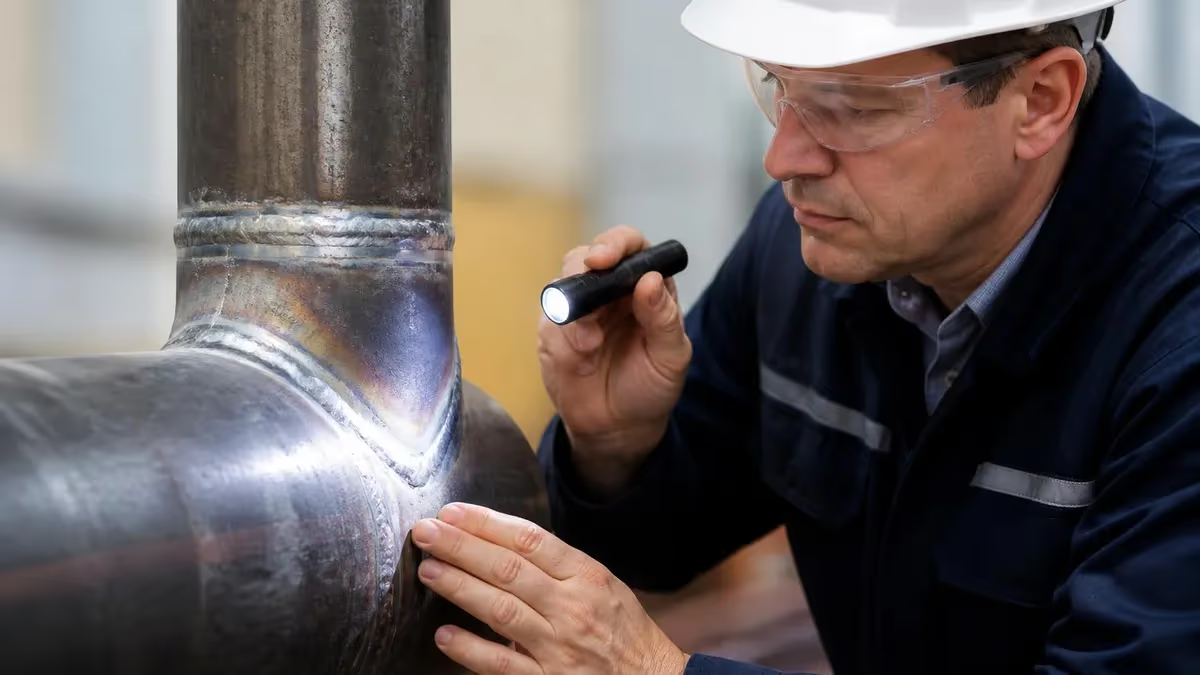
Good visual inspection technique involves proper lighting, correct use of measuring tools (weld gauges, rulers, fillet weld gauges), systematic coverage of the weld, and disciplined documentation. Inspectors who rush or skip areas consistently miss defects that are clearly present.
The CWI Practical Visual Inspection practice set helps you build the systematic approach the exam rewards.
What "Subject Knowledge" Really Means for CWI Candidates
There's a meaningful distinction between knowing facts and having subject knowledge. A candidate who knows that hydrogen-induced cracking is caused by diffusible hydrogen in the weld has a fact. A candidate who understands why high-strength steels are susceptible, why preheat reduces the risk, and why slow cooling rates help hydrogen escape — that candidate has subject knowledge.
AWS designed the CWI exam to test the latter. Scenario-based questions often describe a welding situation and ask what an inspector should do, or why a defect occurred, or what code provision applies. These questions can't be answered by memorizing definitions. They require understanding the underlying principles well enough to apply them to novel situations.
This is why practice questions matter so much — not just for exam preparation, but as a way to identify gaps between the facts you know and the understanding you actually have. When you get a question wrong, the explanation should tell you not just the correct answer but why it's correct. That's the information that builds real competence.
The Code Book Application Domain in Depth
Part C deserves special attention because candidates consistently underestimate it. The code book is a technical document written for practitioners, not students. Reading it cold, under exam conditions, without prior familiarity, is extremely difficult.
The most important preparation strategy is to use the code book while studying, not just when practicing Part C questions. When you study prequalified joint design, open the code book and find the relevant table. When you study welder qualification, find those requirements in the code. This repetition builds spatial memory — you start to know roughly where things are before you consciously remember them.
AWS D1.1, the Structural Welding Code for Steel, is organized into clauses covering general requirements, design, prequalification, qualification, fabrication, inspection, and stud welding. The annexes and commentary are not normative — they don't set requirements — but they're extremely useful for understanding intent.
Common Part C question areas include: prequalified joint details and their requirements, essential variables for WPS qualification, radiographic acceptance criteria, visual inspection acceptance criteria, and welder re-qualification triggers.
Building a Study Plan Around CWI Subject Knowledge
Eight to twelve weeks is a reasonable timeline for most candidates. Here's how to structure it:
Weeks 1–3: Focus on Part A fundamentals. Welding processes, metallurgy, discontinuities, testing methods. Use the AWS Welding Inspection Technology textbook as your primary reference. Complete 30–40 practice questions per study session.
Weeks 4–6: Shift to Part C preparation. Start reading AWS D1.1 systematically. Tab key sections. Practice finding specific information quickly. Complete code book navigation exercises with a timer.
Weeks 7–9: Practical inspection preparation for Part B. If you have access to weld samples, practice visual inspection with measuring tools. If not, study weld defect photographs carefully and practice identifying discontinuity types.
Weeks 10–12: Integration and review. Take full practice exams that simulate all three parts. Identify remaining weak areas and do targeted review. Focus on areas where your error rate is still high.
Common Mistakes CWI Candidates Make
Candidates who struggle on the exam often share common preparation mistakes.
Over-indexing on code memorization for Part C. The code book is open during Part C — you don't need to memorize it. You need to be fast enough to find what you need. Memorization time is better spent on Part A concepts.
Skipping metallurgy because it feels abstract. Metallurgy questions appear on Part A regularly, and they test understanding rather than recall. Candidates who skip this domain pay for it on exam day.
Treating practice questions as a pass/fail test rather than a learning tool. Every wrong answer is information. Review explanations carefully. Track which subject areas generate the most errors.
Not practicing with actual measuring tools before Part B. Weld gauges, Palmgren gauges, and other inspection tools feel unfamiliar if you haven't used them before. If you don't work with these tools daily, find a way to practice with them.
Underestimating the time pressure on Part C. Open-book doesn't mean unlimited time. Candidates who read slowly through unfamiliar code sections consistently run out of time. Familiarity, not just access, is what the exam rewards.
Did You Know? Passing the CWI exam on your first attempt saves both time and money. Start with diagnostic practice tests to identify weak areas.
- ✓Study all major welding processes (SMAW, GMAW, GTAW, FCAW, SAW)
- ✓Understand heat input calculations and their effect on metallurgy
- ✓Learn all weld discontinuity types, causes, and inspection methods
- ✓Study the heat-affected zone and preheat/interpass temperature requirements
- ✓Understand essential variables for WPS and PQR qualification
- ✓Learn all five major NDT methods and their capabilities/limitations
- ✓Study mechanical testing methods: tensile, bend, impact, hardness
- ✓Read AWS D1.1 systematically and tab key sections
- ✓Practice code book navigation with a timer
- ✓Complete practice questions for all Part A subject areas

Using Practice Questions to Build Real Competence
The most effective use of CWI practice questions isn't to rack up a high score — it's to expose the gaps between what you think you know and what you actually understand. This distinction matters because the exam consistently tests application, not recall.
When a practice question asks why a weld made with too-high heat input might produce a larger than expected heat-affected zone, it's testing whether you understand the relationship between heat input, peak temperature, and HAZ grain growth. Getting it right by guessing doesn't help you. Getting it wrong and understanding why, does.
Build the habit of reviewing every question you get wrong — and flagging questions you got right but weren't confident about. The explanations are where the real learning happens. Over time, you'll notice patterns: certain question types that consistently trip you up, specific domains where your understanding is still surface-level.
That self-knowledge is what you bring to exam day. You'll know where you're strong. You'll know where you need to be more careful. And you'll have the confidence that comes from genuinely understanding the material, not just having practiced enough to recognize answers.
Career Impact of the CWI Credential
The CWI is the most widely recognized welding inspection credential in the United States and carries significant weight internationally. Industries that rely heavily on certified welding inspectors include oil and gas, structural steel construction, pipeline, shipbuilding, pressure vessel manufacturing, and aerospace.
Salary data consistently shows a meaningful premium for CWIs compared to uncertified inspectors doing similar work. AWS recertification every three years maintains the credential's relevance — and keeps CWIs current with code updates and evolving inspection standards.
The knowledge domains covered by the CWI exam aren't just academic. Understanding metallurgy helps inspectors recognize when a base metal's characteristics create unusual inspection challenges. Understanding NDT capabilities helps inspectors specify the right examination method for a given situation. Understanding code intent — not just code text — helps inspectors make defensible decisions in situations the code doesn't explicitly address.
The exam is difficult because the job is demanding. Welding inspectors make decisions that affect structural integrity, worker safety, and in some industries, public safety. AWS designed the CWI credential to certify professionals who are genuinely qualified to make those decisions — not just familiar enough with the subject to pass a test.
CWI: Pros and Cons
- +CWI exam preparation strengthens your knowledge across all domains
- +Passing the exam proves competency to employers and clients
- +Study materials and practice tests are widely available
- +Exam-based credentials are portable across states and employers
- +Clear exam objectives help focus your study plan effectively
- −Exam anxiety can affect performance — practice tests help reduce it
- −Registration fees are non-refundable if you miss your test date
- −Limited retake opportunities may apply with waiting periods
- −Exam content updates periodically — use current study materials
- −Testing center availability may require advance scheduling
About the Author

Attorney & Bar Exam Preparation Specialist
Yale Law SchoolJames R. Hargrove is a practicing attorney and legal educator with a Juris Doctor from Yale Law School and an LLM in Constitutional Law. With over a decade of experience coaching bar exam candidates across multiple jurisdictions, he specializes in MBE strategy, state-specific essay preparation, and multistate performance test techniques.
Join the Discussion
Connect with other students preparing for this exam. Share tips, ask questions, and get advice from people who have been there.
View discussion (8 replies)