
Certified Welding Inspector (CWI): Certification Guide 2026 September
Free Certified Welding Inspector (CWI): practice test with instant feedback and detailed answer explanations. Prepare for your exam. 💯
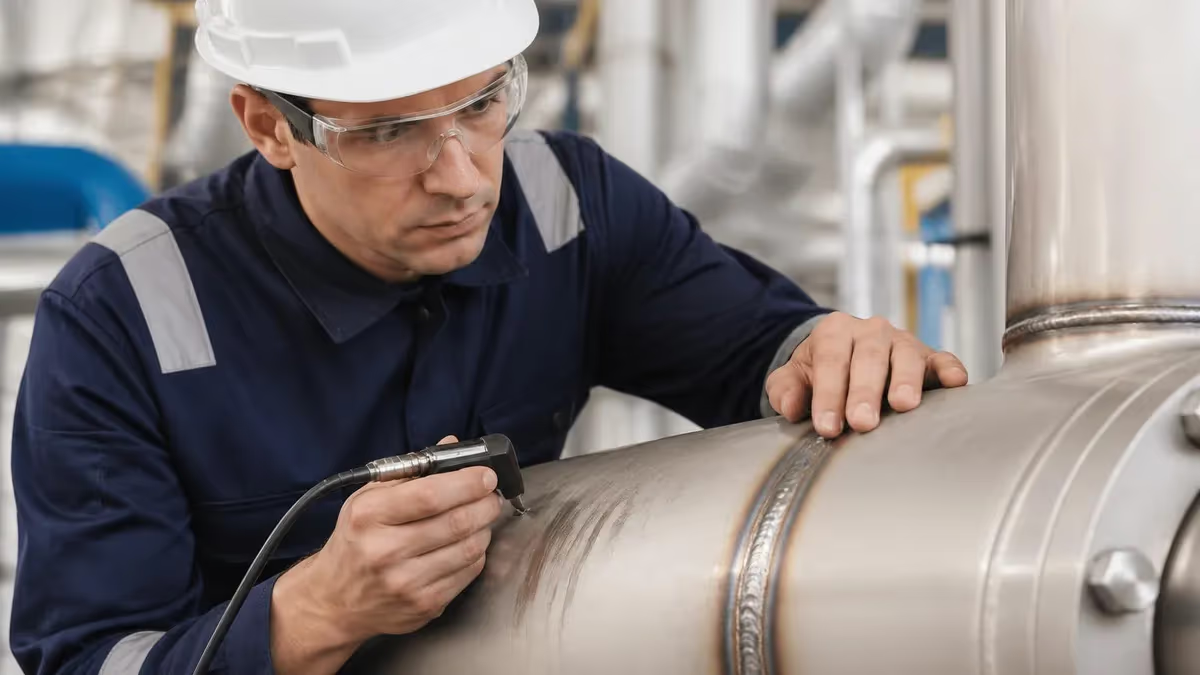
Certified Welding Inspector: What the CWI Credential Requires
The AWS CWI certification is the benchmark credential for professional welding inspectors in the United States and is recognized internationally. It's issued by the American Welding Society and signals that the holder has demonstrated knowledge of welding metallurgy, inspection methods, welding processes, and the ability to apply relevant codes and standards to real inspection scenarios. The CWI is not an entry-level credential -- it requires documented welding industry experience before you can even sit for the exam. But for experienced welding professionals looking to advance into inspection roles, it's the most marketable and widely required certification in the field.
The CWI exam has three distinct parts that must all be passed to earn the credential. Part A (Fundamentals) covers welding theory, metallurgy, welding processes, materials, nondestructive examination methods, weld symbols, and welding-related mathematics. Part B (Practical) tests your ability to perform actual visual inspection on provided weld specimens and identify discontinuities, measure weld geometry, and evaluate acceptability against applicable criteria. Part C (Code Book) is an open-book exam using either the AWS D1.1 Structural Welding Code or an alternative code you select during registration -- you must demonstrate the ability to navigate the code efficiently and apply its requirements to presented scenarios. All three parts require a 72% passing score, and all three must be passed in the same examination cycle (though AWS offers retake options for failed individual parts). Working through AWS CWI questions and answers covers the full range of topics tested across all three exam parts with explanations that reinforce both conceptual understanding and practical application.
The experience requirement is one aspect of CWI eligibility that candidates frequently misunderstand. AWS requires 5 years of experience in welding or a closely related field for candidates without a relevant degree. However, this is reduced for candidates with academic credentials: a bachelor's degree in welding engineering or welding technology reduces the requirement to 1 year; an associate's degree in a related field reduces it to 2 years; a high school diploma or GED combined with completion of a welding program from an AWS-accredited school reduces it to 3 years. The experience must be documented and verifiable. AWS reviews your submitted experience documentation as part of the application process, and applications with insufficient or improperly documented experience are rejected. Starting the documentation process well before your planned exam date avoids delays.
CWI Exam Content: What Each Part Tests
Part A (Fundamentals) is the most content-intensive part and covers the widest range of welding knowledge. The major topic areas include: welding processes (SMAW, GMAW, GTAW, SAW, FCAW, and others -- their characteristics, applications, and common discontinuities), welding metallurgy (heat-affected zone, effects of heat input on material properties, preheat and interpass temperature requirements, postweld heat treatment), destructive and nondestructive testing methods (tensile, bend, macro-etch, hardness, PT, MT, RT, UT, ET -- what each method detects and when each is appropriate), weld joint design and welding symbols, and inspection mathematics (calculating weld reinforcement, throat dimensions, heat input). The depth of knowledge required for Part A is substantial -- candidates with strong welding backgrounds typically spend 2-3 months studying Part A material before they feel exam-ready. Building strong fundamentals through CWI welding process fundamentals practice questions is the foundation for both Part A and Part B performance. Deep study of CWI metallurgy and weld discontinuities questions and answers covers the materials science content that consistently appears across multiple CWI exam sections. The examination is administered at AWS-approved testing facilities nationwide, and candidates should verify current exam dates, locations, and fee schedules directly with AWS, as these can change between certification cycles.

- ✓Review the official CWI exam content outline
- ✓Take a diagnostic practice test to identify weak areas
- ✓Create a study schedule (4-8 weeks recommended)
- ✓Focus on your weakest domains first
- ✓Complete at least 3 full-length practice exams
- ✓Review all incorrect answers with detailed explanations
- ✓Take a final practice test 1 week before exam day
CWI Overview
- Part A - Fundamentals (150 questions, 2 hrs): Welding processes, metallurgy, destructive/nondestructive testing, weld symbols, mathematics -- closed book; requires broad foundational knowledge
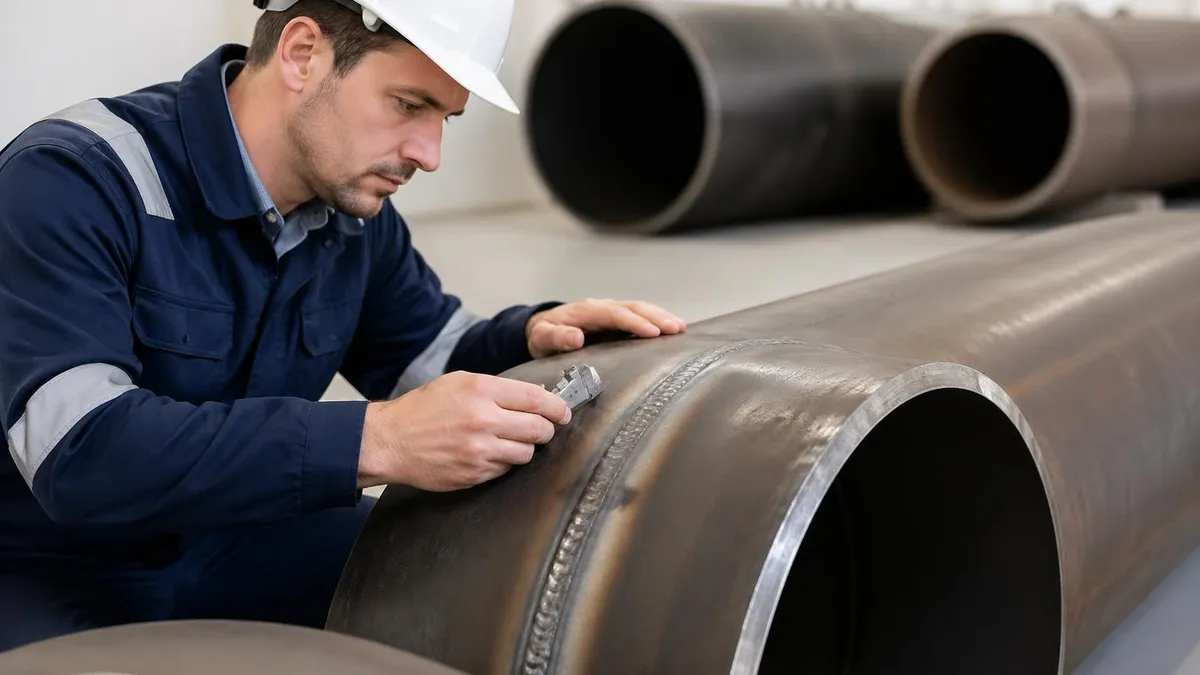
- Part B - Practical (46 questions, 2 hrs): Visual inspection of actual weld specimens using gauges and measurement tools -- tests hands-on inspection skill, not just theoretical knowledge
- Part C - Code Book (60 questions, 2 hrs): Open-book exam using your selected code (AWS D1.1, API 1104, ASME Section IX, or others) -- tests code navigation and application, not memorization
- Passing score: 72% on each part independently -- failing any single part requires retaking that part (Parts B and C can be retaken; Part A failure may require waiting)
- Exam duration: All three parts taken in one day -- approximately 6-7 hours total; stamina and pacing matter
Study Approach for the CWI Exam
Most successful CWI candidates spend 3-6 months in structured preparation. The most common mistake is underestimating Part A -- its breadth means that surface-level familiarity with each topic isn't sufficient. You need enough depth to correctly answer scenario questions that combine knowledge from multiple topic areas (for example, a question about appropriate NDE method selection for a specific material and defect type requires knowing both the metallurgical context and the NDE method's detection capabilities). The AWS Study Guide for the CWI Examination is the primary official resource and covers the Part A content in detail. Supplementing with the Welding Handbook (AWS) provides deeper metallurgical background for candidates who need it.
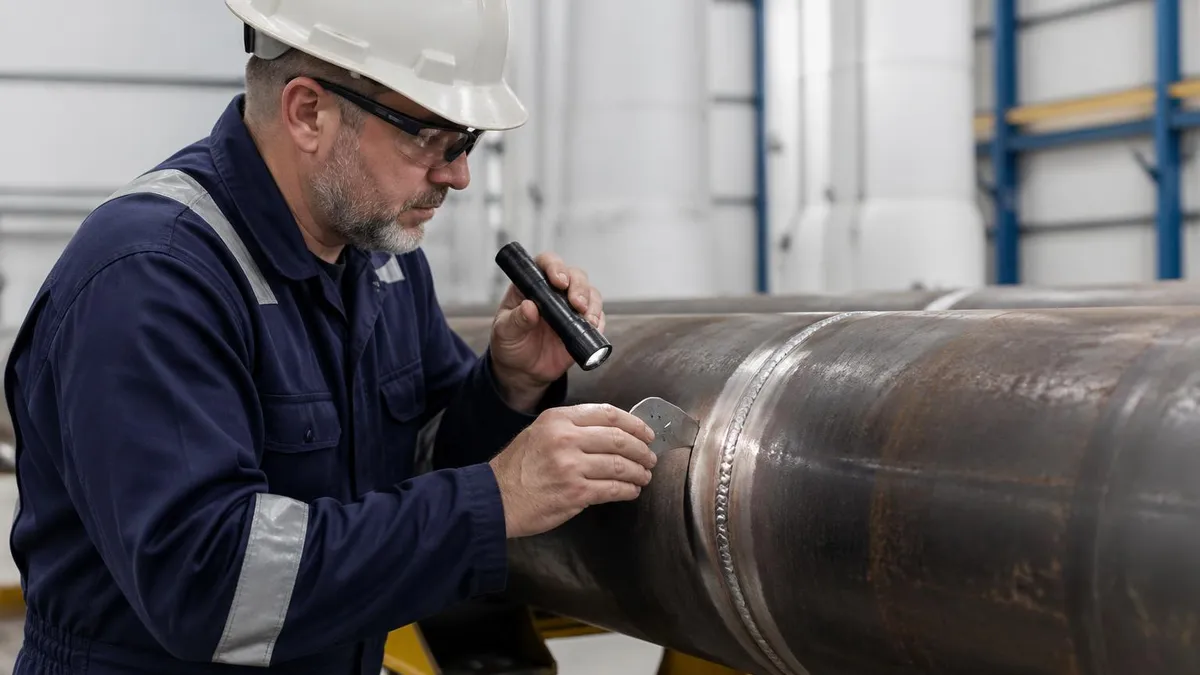
Part B (Practical) requires actual hands-on preparation with welding gauges. You need to be comfortable using a fillet gauge, hi-lo gauge, undercut gauge, and other visual inspection tools under time pressure. Many candidates practice Part B preparation by obtaining sample weld specimens and working through visual inspection procedures systematically. AWS-approved exam prep courses often include hands-on gauge practice as part of their curriculum, which is worth the cost for candidates who don't have access to specimens in their current work environment. Understanding exactly what each weld inspection measurement is evaluating -- why you measure throat size, why undercut is limited, what porosity clusters indicate -- is more effective than mechanical gauge use without conceptual understanding. Deep preparation using CWI practical visual inspection questions and answers builds the measurement skills and acceptability criteria knowledge that Part B tests. Mastering CWI code book application questions and answers develops the code navigation and application skills critical for Part C performance -- speed matters on the open-book section as much as knowledge.
Part C (Code Book) is the section where preparation strategy matters most. Because it's open book, many candidates underinvest in code preparation, assuming they can just look everything up. This is a significant mistake -- the time pressure on Part C means that candidates who need to search extensively for answers often don't finish. Successful candidates have extensively tabbed, highlighted, and annotated their code books, and have practiced navigating to key sections (joint design, prequalified joints, WPS requirements, welder qualification requirements, inspection criteria) in under 30 seconds each. Practice specifically with time constraints, because code navigation is a skill that improves with repetition, not just familiarity with the content.
CWI recertification is required every three years and involves demonstrating continued professional development. AWS accepts a combination of professional development hours, publications, education, or re-examination for renewal. This ongoing requirement reflects AWS's intent that CWI holders stay current with evolving codes, standards, and welding technologies. The welding industry is not static -- new materials, processes, and applications continuously expand what inspectors need to know. Career development beyond the base CWI credential includes AWS Senior Certified Welding Inspector (SCWI), specialty endorsements for specific inspection areas, and advanced NDE certifications that complement the CWI in specific industries like aerospace and nuclear.
The CWI credential requires ongoing renewal that reflects the AWS's recognition that welding inspection is an evolving field. New materials like high-strength low-alloy steels, duplex stainless steels, and advanced aluminum alloys present inspection challenges that weren't common when many current CWIs earned their initial certification. New processes and hybrid techniques require inspectors to extend their knowledge base continuously. Codes and standards are revised on 5-year cycles, with periodic amendments in between -- staying current with code changes is an ongoing professional obligation, not a one-time achievement. This is why AWS's recertification process emphasizes professional development rather than simple re-examination: the expectation is that CWIs are continuously learning, not just maintaining a credential earned years ago.
CWI Pros and Cons
- +Industry gold standard -- CWI is the most recognized welding inspection credential in the US; it's required or preferred by most employers who hire welding inspectors
- +Significant pay premium -- CWI holders command substantially higher pay than uncertified welding inspectors; surveys show 20-40% higher median compensation
- +Broad industry applicability -- CWI is applicable across structural, pipeline, manufacturing, aerospace, and marine applications without industry-specific recertification
- +Strong demand outlook -- welding inspection demand is driven by infrastructure investment, energy sector growth, and manufacturing expansion; qualified inspectors remain in high demand
- +Career advancement platform -- CWI opens paths to Senior CWI (SCWI), lead inspector roles, third-party inspection agency work, and quality management positions
- −Significant preparation investment -- 3-6 months of structured study is typical; Part A breadth is genuinely demanding even for experienced welders
- −Experience prerequisite barrier -- minimum 5 years of documented experience (reduced with credentials) means entry-level welders can't immediately pursue CWI
- −Three-part same-day exam is demanding -- 6-7 hours of testing across three distinct exams in one day tests stamina as well as knowledge
- −Renewal required every 3 years -- ongoing professional development hours required; adds administrative and training time to credential maintenance
- −Part B requires hands-on practice -- visual inspection gauge skills can't be developed from books alone; access to specimens and gauge practice is necessary preparation
CWI Questions and Answers
About the Author

Educational Psychologist & Academic Test Preparation Expert
Columbia University Teachers CollegeDr. Lisa Patel holds a Doctorate in Education from Columbia University Teachers College and has spent 17 years researching standardized test design and academic assessment. She has developed preparation programs for SAT, ACT, GRE, LSAT, UCAT, and numerous professional licensing exams, helping students of all backgrounds achieve their target scores.
Join the Discussion
Connect with other students preparing for this exam. Share tips, ask questions, and get advice from people who have been there.
View discussion (8 replies)