
CTE Center: How Regional Career & Technical Education Hubs Work 2026
🔎 CTE center explained: regional career and technical education hubs sharing welding, HVAC, health science, and IT labs across multiple districts.
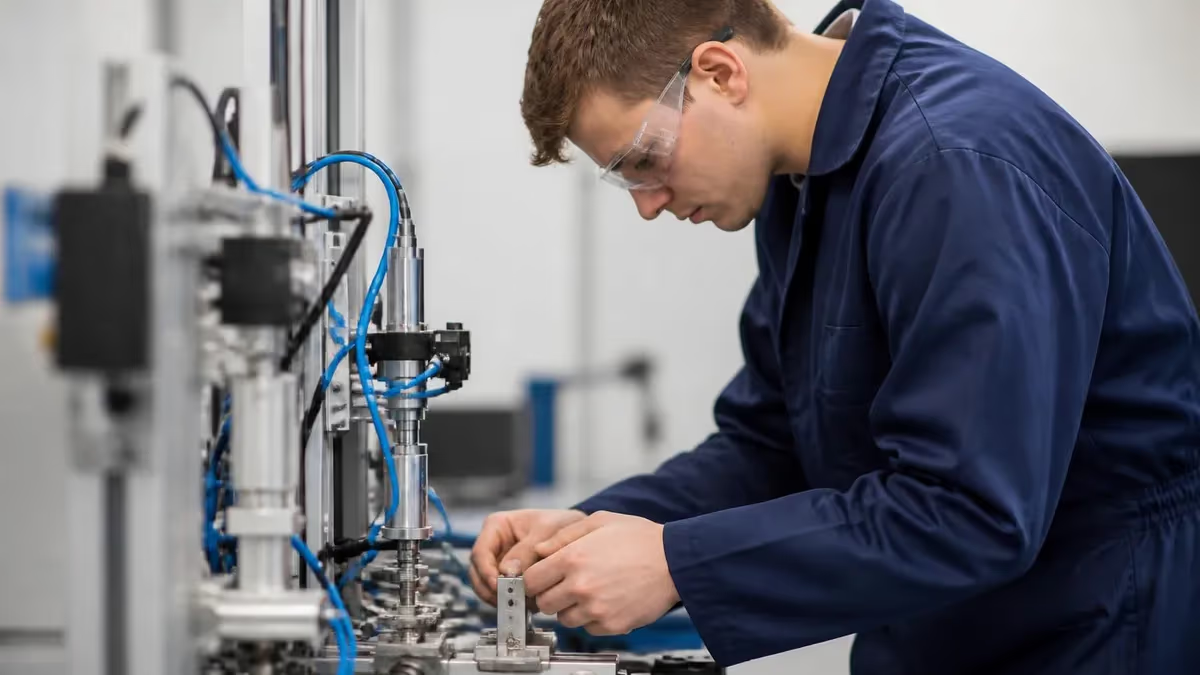
A CTE center isn't a regular high school. It's a shared regional campus that serves students from multiple districts — usually 4 to 12 sending schools clustered around one well-equipped facility. You attend your home high school for English, social studies, and electives. You ride a bus to the CTE center for half the day to learn welding, dental assisting, or network administration on industry-standard equipment that no single high school could afford alone.
Different states call it different things. Career center, tech school, vocational center, career academy, area technical center — same model, different label. Roughly 1,300 of these regional hubs operate across the United States. Ohio runs 49 Joint Vocational Schools. Pennsylvania has 84 Career and Technology Centers. Florida calls them district technical colleges. Whatever the name, the pattern is consistent: pool resources, share industry mentors, and graduate students with both a diploma and a real credential.
This guide walks through how regional CTE centers actually work — who funds them, who teaches the classes, what programs they offer, what certifications you walk out with, and how the half-day schedule fits with college applications. If you're a sophomore weighing whether to enroll, or a parent deciding if it'll hurt the college path, you'll find the trade-offs spelled out without sales talk.
The model itself dates back to the 1917 Smith-Hughes Act, but it didn't take its modern shape until the 1960s and 1970s when federal vocational funding pushed states to consolidate trade education into regional centers rather than scatter it thinly across every high school. That consolidation is why a single welding bay can serve 200 students a year today instead of two dozen — and why CTE graduates leave with credentials that mean something to employers.
CTE Centers at a Glance

Who Runs CTE Centers and Who Pays For Them
The funding model is what makes regional CTE centers work. Member districts each contribute a per-pupil share based on enrollment. State CTE formulas — Perkins V at the federal level, plus state CTE allocations — layer on top. The result: a $4 million welding lab serves 12 schools instead of one. No single district could justify the cost alone.
Governance varies by state. Ohio's Joint Vocational Schools have their own elected boards and operating budgets, separate from member districts. Pennsylvania CTCs run under joint operating committees with one rep per sending district. Texas Career and Technical Education campuses sit inside larger ISDs but draw students across attendance zones. Oklahoma operates 29 standalone CareerTech districts with dedicated millage levies — among the best-funded CTE systems in the country.
Instructors usually come straight from industry. A welding teacher with 18 years on offshore rigs. An IT instructor who ran a small managed-services firm before teaching. A culinary lead who spent a decade in hotel kitchens. State boards require teaching certificates, but most accept industry experience and a CTE-specific teaching license earned on the job. That industry pedigree is what keeps the labs current — instructors push for new equipment because they know what's actually used in shops today.
Industry advisory boards are the second piece of the puzzle. Every accredited CTE program has one — a group of working professionals, employers, and union reps who meet two to four times a year. They review curriculum, donate equipment, hire graduates, and tell the program when a credential is going stale or a new one is becoming the standard. Strong advisory boards are the single best predictor of whether a program is keeping pace with industry.
Regional CTE Centers — Shared Labs, Real Credentials, Half-Day Schedule
A CTE center is a regional career and technical education campus that pools resources across 4-12 sending school districts. Students attend their home high school for academics and ride a transfer bus to the CTE center for hands-on programs in welding, HVAC, cosmetology, automotive, health sciences, IT, culinary arts, and more. Most centers run half-day schedules and partner with community colleges for dual enrollment — meaning students graduate with a high school diploma, an industry certification, and stackable college credit. Alternative names include career center, tech school, vocational center, career academy, and area technical center — same model, different label by state.
Half-Day, Full-Day, and the Senior-Year Schedule
Most regional CTE centers run on a half-day schedule. You stay at your home high school for the morning — English, math, social studies, science — then ride a transfer bus to the CTE center for three afternoon periods. Reverse for some districts. Senior year often shifts to four or five periods at the CTE center if you're chasing a higher-tier certification or college-credit hours.
A few centers run full-day programs. These tend to be magnet-style — health science academies, performing arts conservatories, or aviation programs with their own academic teachers on staff. Full-day enrollment caps tighter and admission is competitive. Half-day is the default and serves the bulk of CTE enrollment nationally.
Schedule conflicts come up. Marching band, varsity sports, AP science labs — these can collide with CTE bus times. Most home high schools work around it by pairing CTE students with first-period electives at school. Some students drop band or move from varsity to club sports to make CTE work. Talk through the schedule before you commit — it's the most underestimated cost of enrollment.
The bus commute deserves its own honest assessment. Most regional CTE centers sit 10 to 25 miles from sending high schools. Round-trip transit cuts 50 to 90 minutes from your day. That's homework time, sleep time, or job time gone. For students who already commute 30 minutes from home to high school, adding another bus leg often means 12-hour school days by the time you factor in athletics. Decide whether that math works before signing the enrollment form.
Common CTE Program Clusters
- Programs: Welding, HVAC-R, Automotive, Diesel Tech, Electrical, Construction
- Top Certs: AWS D1.1, EPA 608, ASE, NCCER
- Entry Wage: $18-$28/hour
- Equipment: MIG/TIG/Stick stations, lifts, CNC, hydraulics labs
- Programs: CNA, EMT, Medical Assisting, Dental Assisting, Pharmacy Tech
- Top Certs: CNA state registry, NREMT, CCMA, RDA
- Entry Wage: $15-$22/hour
- Equipment: Draw chairs, exam rooms, sim manikins, dental ops
- Programs: Network Admin, Cybersecurity, Software Dev, Help Desk
- Top Certs: CompTIA A+, Network+, Security+, Cisco CCNA
- Entry Wage: $17-$25/hour
- Equipment: Server racks, virtualization labs, Cisco gear
- Programs: Cosmetology, Culinary, Graphic Design, Early Childhood
- Top Certs: State cosmetology license, ServSafe, CDA
- Entry Wage: $13-$20/hour
- Equipment: Salon stations, commercial kitchens, design suites
What Programs CTE Centers Actually Offer
Program lineups vary by region — coastal centers run marine technology, mountain regions run forestry, Rust Belt centers still run heavy manufacturing and machining. But seven or eight programs show up at almost every CTE center in the country because the labor demand is national.
The shop-side programs — welding, HVAC-R, automotive, diesel tech, construction trades, electrical — anchor most campuses. These are the programs that built CTE in the postwar era and they still pull steady enrollment because the wages remain strong. Welders coming out of CTE with an AWS D1.1 certification start at $20-$26/hour in most markets, more on union pipefitting jobs.
The healthcare-side has grown faster than any other cluster over the last 15 years. CNA, EMT, medical assisting, dental assisting, pharmacy tech, sterile processing — most large CTE centers run at least four of these. Demographics drive it: aging population, hospital expansion, home-health staffing crises.
Service and creative tracks fill out the rest. Cosmetology — long the most popular single program in CTE — runs at almost every regional center because the licensing hours fit neatly into the two-year senior schedule. Culinary arts, graphic design, IT/cybersecurity, criminal justice, early childhood education, and automotive collision repair round out typical offerings.
The IT and cybersecurity track has been the fastest-growing cluster in CTE over the last decade. State funding formulas now reward CompTIA, Cisco, and Microsoft credentials at the same rate as traditional trade certifications. Many CTE centers built dedicated cybersecurity labs in the past five years — virtualization racks, simulated SOC environments, capture-the-flag competition spaces. Graduates can step into help desk roles at $18-$22 per hour with Security+ alone, and the credential ladder up to network engineering or cloud roles is well-mapped through stacked CompTIA and vendor certs.

How CTE Centers Operate State-to-State
Joint Vocational School districts. Ohio runs 49 JVS districts, each with its own elected board, operating budget, and superintendent independent from sending districts. Most JVS campuses serve 8-15 member districts and enroll 800-2,200 high-school students plus an adult-learner program. Funding comes from a member-district per-pupil share, state CTE formula dollars, and federal Perkins V. Eastland-Fairfield, Tri-Rivers, and Polaris are among the larger operations.
Dual Enrollment and Stackable College Credit
Most regional CTE programs partner with local community colleges for dual enrollment. You finish high school with 9-24 transferable credit hours already on a community college transcript. Welding students often walk out with 12-18 credits toward an associate degree in welding technology. Health science students finish with 6-12 credits toward a nursing or allied-health AAS.
The credits stack two ways. First, they shorten time-to-degree if you continue at the partner community college — a CNA grad with 9 credits can finish an AAS in nursing in three semesters instead of four. Second, many credits transfer laterally to four-year programs through state articulation agreements, especially in IT and business pathways.
Dual-enrollment is usually free or low-cost to the student. The CTE center pays the per-credit fee to the partner college, sometimes with state pass-through funding. Compare that with full community college tuition — $4,000-$8,000 per year out-of-pocket — and the math gets compelling fast.
One caveat: not every dual-enrollment credit transfers to every four-year university. Ask the partner community college's transfer office which schools in your state accept the specific course numbers. Generally, in-state public universities accept them under articulation agreements; private and out-of-state schools are case-by-case. For students aiming at a four-year degree, focus on courses with established transfer pathways rather than highly career-specific electives.
The most common regret from CTE graduates isn't the program choice — it's underestimating the senior-year schedule squeeze. Half-day attendance plus an AP class plus varsity sports plus marching band rarely fits. Talk to your high-school counselor and the CTE center counselor together before junior year ends. Map the full senior schedule including bus times, lunch, and any required academic backloading. Students who quit CTE in senior year almost always cite scheduling, not the program itself.
Certifications You Actually Walk Out With
The credentials matter more than the diploma at this point. Employers in skilled trades look at the certification first — they want to know you've passed the same exam everyone else in the shop passed. CTE centers structure their senior year around getting students through these exams while school costs cover the testing fees.
Welding students chase AWS D1.1 structural welding certification, sometimes with additional ASME or API qualifications for pressure vessel work. HVAC students sit for EPA Section 608 refrigerant handling — required by federal law before you can touch a system that has refrigerant in it. Cosmetology students complete their state-required clock hours (1,000 to 1,600 depending on state) and sit for the state board exam.
Healthcare credentials lock in fast. CNAs take the state competency exam through the same registry adult learners use. EMT-Basic certification comes through National Registry of Emergency Medical Technicians. Medical assistants can sit for the CCMA through NHA or the CMA through AAMA depending on program accreditation. IT students stack CompTIA A+, Network+, Security+, and sometimes Cisco CCNA depending on the program track.
Ten Questions to Ask Before Enrolling at a CTE Center
- ✓Is the program accredited by the relevant state CTE board, and is the certification recognized statewide (not just locally)?
- ✓What is the first-attempt certification pass rate from the most recent graduating class? (Reputable centers publish this — anything below 75% is a red flag for that program.)
- ✓How many dual-enrollment college credit hours does the program offer, and which community college accepts them?
- ✓Is equipment current to industry standards? Walk the lab — old equipment teaches outdated workflows. (Welding bays should have MIG and TIG, not just stick. IT labs should run virtualization.)
- ✓Who pays for the certification exam fees — the school or the student? (Top centers cover exam fees; weaker ones pass the cost to families.)
- ✓What does last year's job placement data show? Specific employer names, wage ranges, and college enrollment percentages — not vague claims.
- ✓Can your home high school accommodate the half-day bus schedule with your other required courses (AP, sports, fine arts)?
- ✓What is the senior-year time commitment? Some programs jump from 3 to 5 periods at the CTE center in year two, conflicting with academic college prep.
- ✓Are instructors current industry practitioners or have they been out of the field for 10+ years? (Industry-current instructors push for equipment updates and know what employers want.)
- ✓What is the program's industry advisory board? Active employer involvement signals genuine career pipelines, not just classroom instruction.

What CTE Centers Don't Solve
The biggest myth: CTE replaces college. It doesn't, and the best CTE centers don't pretend it does. Roughly 60% of CTE concentrators nationally still enroll in some form of postsecondary education within a year of graduation — community college, four-year, technical college, or apprenticeship-affiliated training. CTE shortens that path and reduces debt, but it rarely ends it.
Geography matters more than people admit. A welding cert that lands you a $26/hour job in West Texas might net $16/hour in rural Mississippi. A medical assisting credential pays $20/hour in suburban Denver and $14/hour in small-town Arkansas. CTE doesn't guarantee a wage — it guarantees credentials. Where you take those credentials matters.
And not every program leads where it advertises. Cosmetology and culinary, in particular, have wide outcome ranges — some grads build six-figure careers, many grind through years of low-wage work before breaking out. Healthcare programs and skilled-trades programs (welding, HVAC, electrical, plumbing apprenticeship pipelines) have tighter wage floors and clearer ladders.
There's also a stigma question worth being honest about. CTE has shaken most of its old "for kids who don't go to college" reputation, but pockets of it linger — among parents, sometimes among guidance counselors, occasionally inside the home high school itself. The students who thrive in CTE tend to come in with a clear sense of why they're there. If you're enrolling because someone else thinks it's a fallback, the program won't land. If you're enrolling because you genuinely want the credential, the stigma fades fast once paychecks start.
CTE Center Enrollment Pros and Cons
- +Industry certifications earned during high school — AWS welding, EPA 608, CNA, CompTIA, ASE — without the $1,500-$3,000 adult-learner price tag
- +9-24 transferable college credits stacked toward an AAS through community college partnerships, free or low-cost to families
- +Equipment and instructors that no single high school could afford alone — pooled across 4-12 districts
- +Direct employer pipelines for graduates — many CTE centers place 30-50% of seniors into jobs before graduation
- +Clear postsecondary path: apprenticeship, community college AAS, or four-year college with strong work experience
- +Tuition-free public education — costs covered by member districts and state CTE formulas
- +Real-world soft skills built into the curriculum — punctuality, dress code, supervisor communication, customer interaction
- −Half-day schedule creates conflicts with AP courses, varsity athletics, marching band, and dual-language tracks
- −Bus commute time (often 25-45 minutes each way) cuts into homework and after-school activities
- −Some programs (cosmetology, culinary) have wide wage outcome ranges — credential alone doesn't guarantee strong income
- −Senior-year time commitment can grow from 3 to 5 daily periods, squeezing academic college-prep options
- −Smaller social circle from home high school — CTE students often feel split between two campuses
- −Equipment quality varies widely between centers — outdated welding bays or thin medical labs produce graduates who need bridge training
- −Geographic constraint: a CTE credential pays much more in some markets than others, and most graduates start their career locally
How to Evaluate a CTE Center Before Enrolling
Don't rely on the brochure. Walk the campus. Look at the equipment in the welding bay — is it stick-only, or does it have MIG and TIG stations and pulsed-arc machines? Are there enough CNC mills for one per two students or is the class sharing four machines among 20 kids? Does the medical assisting lab have draw chairs, an autoclave, and a working centrifuge, or just a poster of one?
Ask for placement data. Reputable CTE centers publish where last year's graduates landed — employer names, wage ranges, college enrollments. If the school can't give you a one-page handout with this information, the program isn't tracking it, which usually means outcomes are worse than they should be.
Talk to current seniors. Ask what changed about the program in the last two years. Ask which instructors push hard and which ones coast. Ask whether the certifications were paid for or whether students had to cover them. Two or three honest conversations with current students tell you more than the open-house tour.
Top-Rated CTE Centers Worth Knowing About
A handful of regional CTE centers consistently top state and national rankings. They're not the only good options — most well-funded regional centers do solid work — but they're useful reference points for what a strong program looks like.
The Polytech School District in Delaware operates as a state-wide vo-tech district with full-day programs and strong four-year college placement. Eastland-Fairfield Career & Technical Schools (Ohio) is one of the largest JVS districts in the country with 16 high-school programs and aggressive industry partnerships. Penn-Trafford CTC and the Pittsburgh Public CTE Magnet schools dominate Pennsylvania rankings. The Career & Technical Education Center at Hueytown (Alabama), Worcester Technical High School (Massachusetts), and the William F. Grady CTE Center (NY) regularly appear in regional best-of lists.
Florida's district technical colleges — Lindsey Hopkins in Miami-Dade, Atlantic Technical in Broward — function as combined high-school and adult-learner CTE campuses with strong industry pipelines into healthcare, aviation, and IT. Texas runs its CTE through standalone districts (Houston Independent's Mickey Leland College Prep, Dallas ISD's Skyline High) that combine academic rigor with two-year career tracks.
The pattern across top-rated centers: deep industry partnerships, current equipment, paid-for certifications, transparent placement data, and instructors who keep one foot in industry through summer work or consulting. If a center matches three of those four, it's worth a serious look.
CTE Questions and Answers
How this page was made: written with AI tools. We have not yet matched this exam's facts to an official source, so confirm fees, dates and rules with the exam body. Not reviewed by a subject-matter expert. Editorial policy