
CPC Mock Test: Free Practice Questions for the Certified Professional Coder Exam
Ace your CPC certification with free mock tests & practice questions. Simulate the real exam & boost your score. 🎯 Start practicing now!
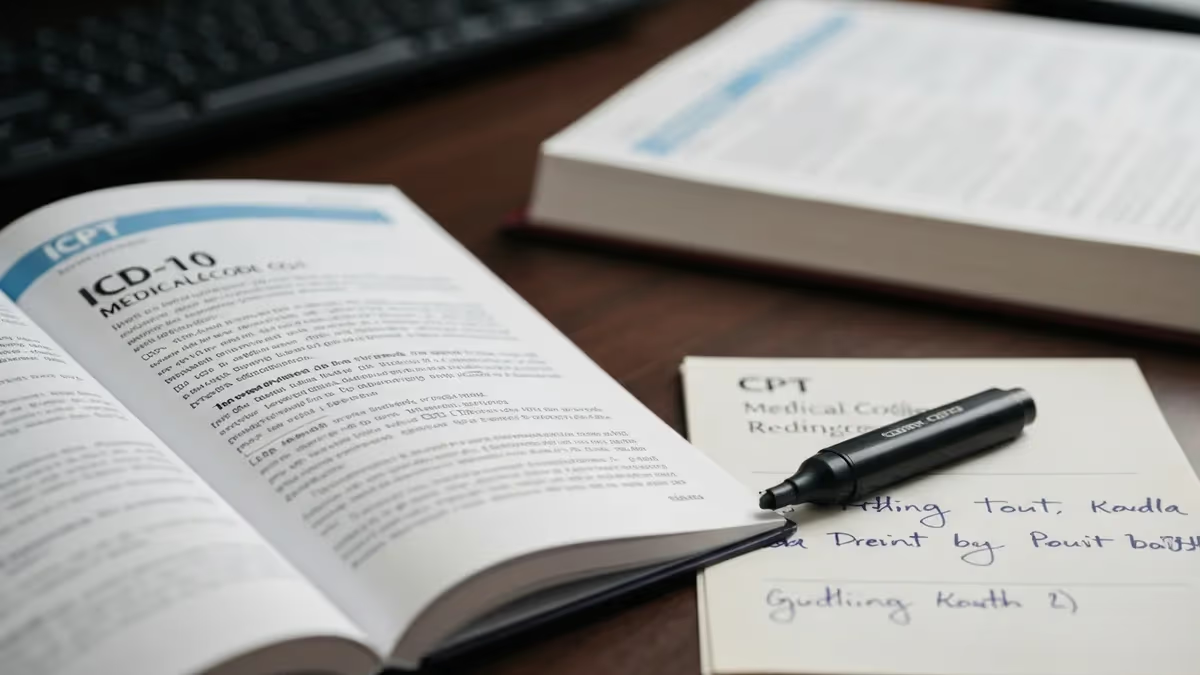
A cpc mock test is one of the most powerful study tools available to anyone preparing for the CPC certification exam offered by the American Academy of Professional Coders (AAPC). The Certified Professional Coder credential is widely regarded as the gold standard in medical coding, and earning it opens doors to high-demand careers across physician offices, hospitals, and insurance companies throughout the United States. Starting your preparation with realistic practice questions gives you a measurable baseline and reveals exactly which domains need the most attention before exam day.
The CPC exam consists of 100 multiple-choice questions drawn from 17 coding sections, and test-takers have five hours and 40 minutes to complete the full assessment. Because the exam is open-book but time-pressured, simply memorizing codes is not enough—you must develop the speed and accuracy to locate information in CPT, ICD-10-CM, and HCPCS Level II code books within seconds. Regular cpc test simulations under timed conditions train exactly that skill, helping you internalize code book structure so you can navigate it confidently on exam day.
Many candidates underestimate the diversity of topics the CPC exam covers. Beyond surgery and evaluation and management coding, the exam tests your knowledge of anesthesia, radiology, pathology, laboratory, medicine, and compliance guidelines. A comprehensive mock test exposes you to all of these domains in one sitting, giving you an accurate picture of your overall readiness rather than a false sense of confidence from studying only familiar sections. Identifying weak spots early means you can redirect your study hours where they matter most.
According to AAPC data, the first-time pass rate for the CPC exam hovers around 54 percent, which means nearly half of candidates do not pass on their first attempt. Candidates who incorporate structured practice testing into their preparation routinely outperform those who rely solely on textbook review. The reason is straightforward: practice questions force active recall, which is a far more effective learning mechanism than passive re-reading. Each question you answer incorrectly is a targeted lesson pointing you toward a specific coding rule or guideline you have not yet mastered.
One common misconception is that mock tests are only useful in the final weeks before an exam. In reality, baseline practice tests taken early in your study program serve a strategic planning function. They reveal your starting point across all 17 coding sections, allowing you to build a personalized study schedule that allocates the most time to your lowest-scoring areas. Candidates who test early, adjust their study plans accordingly, and retest regularly tend to see the steepest score improvements over their preparation period.
PracticeTestGeeks.com offers a growing library of free CPC practice questions covering every section of the exam, from anatomy and physiology foundations to integumentary surgery coding and HCPCS Level II supply codes. Each quiz is formatted to mirror the real exam's multiple-choice structure, and detailed answer explanations are provided so you understand not just which answer is correct but why the other options are wrong. This distinction matters enormously for the actual exam, where distractor answers are deliberately crafted to catch common misconceptions.
Whether you are a first-time candidate or retaking the exam to improve your score, a disciplined mock-test routine combined with targeted review of the AAPC's official study materials will give you the best possible chance of joining the more than 200,000 professionals who have earned their CPC certification. The sections below walk you through everything you need to know about the exam format, the most commonly tested topics, and proven strategies for maximizing your mock-test results.
CPC Certification by the Numbers
Key Facts at a Glance
| Item | Value | Details |
|---|---|---|
| Exam Questions | 100 | Multiple-choice format |
| Time Allowed | 5 hr 40 min | Open-book exam |
| Passing Score | 70% | Approx. 70 correct answers |

CPC Exam Format & Structure
| Section | Questions | Time | Weight | Notes |
|---|---|---|---|---|
| Medical Terminology & Anatomy | 10 | 34 min | 10% | Body systems, directional terms, prefixes/suffixes |
| ICD-10-CM Diagnosis Coding | 12 | 41 min | 12% | Includes guidelines and sequencing rules |
| CPT Evaluation & Management | 10 | 34 min | 10% | Office, hospital, and outpatient E/M levels |
| CPT Surgery (all systems) | 34 | 77 min | 34% | Largest section; 10+ subsections |
| Anesthesia, Radiology, Path & Lab, Medicine | 20 | 46 min | 20% | Combined specialty sections |
| HCPCS Level II & Modifiers | 8 | 20 min | 8% | Supplies, DME, and two-digit modifiers |
| Compliance & Regulatory | 6 | 8 min | 6% | HIPAA, fraud/abuse, billing rules |
| Total | 100 | 5 hours 40 minutes | 100% |
Understanding what the certified professional coder exam truly tests is the first step toward building an effective study plan. Unlike certification exams in other fields that reward memorization, the CPC exam is fundamentally a test of applied reasoning. You are permitted to bring your CPT, ICD-10-CM, and HCPCS Level II codebooks into the testing room, but having access to those books only helps if you already know how to use them efficiently. The exam is designed to reward coders who understand the logic behind code selection, not those who simply flip to random index entries.
The surgery section deserves special emphasis because it accounts for 34 of the 100 questions on the exam, making it by far the largest and most heavily weighted domain. Within surgery, you will encounter coding scenarios spanning the integumentary system, musculoskeletal system, respiratory system, cardiovascular system, digestive system, urinary system, reproductive systems, nervous system, and the eye and ear.
Each subsection has its own bundling rules, global surgery period concepts, and modifier applications that you must understand at a functional level. A single mock test covering just integumentary surgery coding can reveal whether you understand the difference between simple, intermediate, and complex wound repairs—a distinction that appears on nearly every CPC exam.
Evaluation and Management coding has undergone significant changes in recent years, with the 2021 AMA revisions to office and outpatient E/M guidelines shifting the focus from history and exam components to medical decision making and total time. These changes are tested on the current CPC exam, and many candidates who studied from older materials are caught off guard.
Your practice questions should reflect the current CPT guidelines, and any explanation that still references the three-component 1995 or 1997 documentation guidelines for office visits should be treated with caution unless the scenario specifically involves a hospital setting where those older guidelines may still apply.
ICD-10-CM diagnosis coding is another area where the exam rewards deep conceptual understanding over brute-force memorization. The official ICD-10-CM guidelines, published annually by CMS and the NCHS, are a testable document in their own right. Section I of the guidelines covers general coding rules such as code sequencing, combination codes, laterality, and the use of additional codes. Sections II, III, and IV cover outpatient, hospital inpatient, and physician reporting conventions respectively. Candidates who read and understand these guidelines—not just the tabular codes themselves—are consistently better prepared to answer the tricky diagnosis-sequencing questions that appear on the CPC exam.
Medical terminology and anatomy may seem like the easiest section to many candidates, but it is frequently underestimated. The 10 questions in this domain often serve as a prerequisite to answering surgery and medicine questions correctly, because if you misread the operative note due to unfamiliar anatomical terminology, you will select the wrong code regardless of how well you know the CPT manual. Spending time on root words, prefixes, and suffixes—as well as the precise anatomical definitions of terms like "proximal," "distal," "medial," and "lateral"—pays dividends across every section of the exam.
HCPCS Level II codes cover supplies, durable medical equipment, drugs administered in a physician office, and ambulance transportation services, among other items. While this section carries only 8 percent of the exam weight, the questions are often scenario-based and require you to understand which code set takes precedence when both a CPT code and a HCPCS code could apply.
The what is cpc blood test query is a common source of confusion among new coders—laboratory panels such as comprehensive metabolic panels are reported with CPT codes, while standalone supply items like glucose monitoring strips for diabetic patients are reported with HCPCS Level II codes. Understanding the boundary between these two code sets is essential for accurate coding in outpatient and physician office settings.
Compliance and regulatory questions test your knowledge of healthcare fraud and abuse laws, the False Claims Act, HIPAA privacy and security rules, and the CMS Correct Coding Initiative (CCI) edits. While these questions may seem abstract compared to hands-on coding scenarios, they are grounded in real-world scenarios that every professional coder encounters. Understanding which modifier to use when two procedures are performed on the same day by the same physician, and knowing how the CCI edits restrict certain code combinations, is directly applicable to daily coding work and is tested with corresponding rigor on the CPC exam.
CPC Exam Study Strategies That Work
The most overlooked element of CPC exam preparation is practicing under timed conditions from the very start of your study program. With 100 questions in 340 minutes, you have an average of 3 minutes and 24 seconds per question. That sounds generous until you encounter a complex operative note requiring you to look up three different codes, apply a modifier, and check bundling rules. Candidates who never practice under time pressure routinely find themselves running out of time on the actual exam, even when they know the material well.
Begin your timed practice with 25-question mini-exams that replicate a single section of the CPC, then progress to 50-question half-tests, and finally to full 100-question simulations. Track your time per question in each session. When you consistently finish a section with time to spare, you have built adequate speed in that domain. When you run long, that is a signal to practice tabbing your code books with adhesive tabs so you can locate sections in under 10 seconds—a technique that experienced CPC holders universally recommend.
Is the CPC Certification Worth Pursuing?
- +Industry-recognized credential accepted by virtually every US healthcare employer
- +Median salary for CPC holders exceeds $64,000 annually, significantly above uncredentialed coders
- +Open-book format rewards practical code book skills rather than pure memorization
- +Credential renews every two years with continuing education, keeping skills current
- +AAPC membership provides networking, job boards, and continuing education resources
- +CPC certification is a prerequisite for many specialized credentials like CPC-P and COC
- −Exam fee is $300 for AAPC members and $399 for non-members, plus annual membership costs
- −Preparation typically requires 3-6 months of dedicated study alongside full-time work
- −First-time pass rate of approximately 54% means many candidates must retake the exam
- −Retake fee applies each time, adding financial pressure to already-stressful preparation
- −Physical code books required for the exam must be purchased separately and can cost $150+
- −Two-year continuing education requirement demands ongoing professional development investment
CPC Mock Test Preparation Checklist
- ✓Purchase the current-year CPT manual, ICD-10-CM codebook, and HCPCS Level II book before starting practice tests.
- ✓Tab your code books with color-coded adhesive tabs for each major CPT section and ICD-10-CM chapter.
- ✓Complete a diagnostic 25-question practice test in each of the 17 CPC sections to identify your weakest domains.
- ✓Build a personal error log tracking every missed question, the correct rule, and the relevant code book page.
- ✓Practice at least two full 100-question timed mock tests before your scheduled exam date.
- ✓Review the ICD-10-CM Official Guidelines for Coding and Reporting, paying special attention to Sections I through IV.
- ✓Study CPT Appendix A modifiers until you can define each modifier and its impact on reimbursement from memory.
- ✓Practice E/M coding using the 2021 AMA guidelines for office and outpatient visits, not the outdated 1995/1997 criteria.
- ✓Complete at least one full anesthesia coding practice set, including calculating base units, time units, and qualifying circumstances.
- ✓Review CCI bundling edits for the five most commonly paired surgical code combinations in each body system.

The 70% Rule: What You Actually Need to Pass
The CPC exam does not have an officially published minimum passing score, but AAPC has historically awarded the credential to candidates who answer approximately 70 correct answers out of 100 questions. This means you can miss up to 30 questions and still pass—but only if your errors are distributed across sections rather than concentrated in a single high-weight domain like surgery. Focus your mock test review on surgery, E/M, and ICD-10-CM, which together account for more than half of all exam questions.
Scoring and passing the CPC exam requires a clear-eyed understanding of how points are distributed across the exam's 17 sections and how to strategically allocate your time and energy during the actual test. Because the exam is not scored by section—every question carries equal weight regardless of which domain it comes from—a strong performance in high-question-count sections like surgery and E/M can compensate for weaker performance in lower-volume sections like HCPCS Level II. This weighted distribution should directly influence how many hours you spend practicing each domain in your preparation program.
Time management during the actual exam is where many otherwise-prepared candidates run into trouble. The most effective strategy used by successful test-takers is to answer every question you are confident about on the first pass, mark uncertain questions for review, and skip questions requiring lengthy code book lookups until the second pass.
This approach ensures that you bank all the easy points first and do not run out of time before reaching questions you could have answered correctly with your available time. Never leave a question blank—because there is no penalty for wrong answers on the CPC exam, guessing always gives you at least a 25 percent chance of earning the point.
The open-book format of the CPC exam is both a blessing and a potential trap. Candidates who have not practiced with their physical code books often waste precious time during the exam searching for codes they should be able to locate in under 30 seconds. The solution is to use your code books during every single practice session, even for questions you already know the answer to.
This repetitive navigation practice is what builds the automatic, almost unconscious code book fluency that separates candidates who finish with time to spare from those who are still rushing through the final questions when the proctor calls time.
Understanding the difference between bundled and separately reportable services is one of the most tested concepts on the CPC exam, and it requires familiarity with both the CPT guidelines and the CMS Correct Coding Initiative edits. The CCI maintains a comprehensive table of code pairs that cannot be billed together unless a specific modifier is appended to indicate that the two procedures were performed independently and met the criteria for separate billing.
Modifier 59 (Distinct Procedural Service) and its more specific X-modifiers (XE, XS, XP, XU) are among the most frequently tested modifiers on the exam, and candidates who understand when and how to apply them correctly gain a significant scoring advantage.
Anesthesia coding is a unique domain within the CPC exam because it uses a formula-based approach rather than standard CPT time-based coding. The anesthesia fee is calculated by adding base units (assigned to each anesthesia code based on procedure complexity) to time units (typically one unit per 15 minutes of anesthesia time) and then multiplying by a conversion factor.
Qualifying circumstances—codes from the 99100-99140 range that account for unusual patient conditions—add additional units. Many candidates neglect anesthesia during preparation because it feels unfamiliar, but the exam consistently includes three to five anesthesia calculation scenarios, and understanding the formula makes these questions among the fastest to answer for well-prepared candidates.
Radiology coding presents its own distinct set of rules, particularly around the professional and technical components of imaging services. When a radiologist interprets an image taken at a hospital or imaging center that owns the equipment, the radiologist bills only the professional component using modifier 26, while the facility bills the technical component.
When a physician both performs and interprets the study in their own office using their own equipment, the global service is billed without a modifier. These component distinctions are tested directly on the CPC exam and are an area where mock test practice helps candidates develop accurate, automatic responses to scenario-based questions.
Pathology and laboratory coding shares some similarities with radiology in that it involves specific coding conventions for panels, automated versus manual procedures, and the boundary between physician interpretation and technical performance. CPT panels such as the comprehensive metabolic panel (80053) and lipid panel (80061) must be billed as the panel code when all panel components are performed, rather than as individual component codes—a bundling concept that carries over from general coding principles. Candidates who practice pathology and laboratory coding scenarios in their mock tests develop a better intuition for when panel codes apply and when individual component codes are appropriate.
AAPC allows candidates to retake the CPC exam up to eight times total, but each retake requires a separate registration fee of $300 for members or $399 for non-members. Candidates who fail must wait until the next available testing window, which means a failed attempt in late November may delay your certification by six to eight weeks depending on your location's testing schedule. Register for your exam at least four weeks in advance to secure your preferred testing site, and schedule your exam date after you are consistently scoring 75 percent or higher on full-length mock tests.
After passing the CPC exam and earning your certified professional coder certification, a new set of decisions and opportunities opens up. The credential itself is only the beginning of a career trajectory that can lead to roles in physician practice management, insurance company coding audits, compliance consulting, healthcare revenue cycle leadership, and remote coding positions with national staffing agencies. Understanding how to leverage your new credential strategically will determine how quickly your earning potential grows after certification.
Entry-level CPC holders typically start in physician office coding roles, where they apply their knowledge of CPT, ICD-10-CM, and HCPCS Level II codes to process claims for a specific specialty or group of specialties. These positions provide the hands-on experience required to qualify for more advanced credentials and higher-paying roles.
AAPC requires that CPC holders demonstrate two years of professional coding experience to remove the "apprentice" designation from their credential, which appears as CPC-A on your certification card until the experience requirement is satisfied. Many employers specifically advertise for full CPC holders rather than CPC-A holders, making it worth applying for positions that will give you the fastest path to completing your experience hours.
Specialty-specific credentials build on the CPC foundation and command significantly higher salaries in many markets. The Certified Outpatient Coder (COC) credential is ideal for coders working in hospital outpatient departments or ambulatory surgery centers, where facility coding rules under the Hospital Outpatient Prospective Payment System (OPPS) apply rather than the physician fee schedule. The Certified Professional Coder — Payer (CPC-P) credential is designed for coders working on the insurance side who review claims for accuracy and medical necessity. Each of these specialty credentials requires the base CPC and passing an additional specialty exam.
Remote coding positions have expanded dramatically since 2020, and CPC-credentialed coders are among the most sought-after professionals in this segment of the healthcare job market. National health information management companies, insurance companies, and large hospital systems all hire remote coders who can work from home while maintaining productivity metrics and quality standards. The CPC credential signals to remote employers that you have passed a rigorous standardized assessment and that your coding knowledge meets a nationally recognized benchmark. Many remote positions offer salaries comparable to or exceeding in-office roles, along with the flexibility that makes remote work particularly attractive.
Continuing education is a mandatory component of maintaining your CPC credential, and AAPC requires 36 continuing education units (CEUs) every two years to renew. At least 18 of these CEUs must be in medical coding, and at least one CEU must be in healthcare compliance. AAPC offers workshops, webinars, and an annual conference that fulfill CEU requirements, and many local AAPC chapters hold monthly meetings where members earn free CEUs through educational presentations.
Viewing continuing education as an opportunity rather than an obligation is the mindset shared by the most successful long-term CPC holders, who use their CEU research to stay current on annual CPT changes, ICD-10-CM updates, and evolving CMS policies.
Salary growth for CPC holders is strongly correlated with specialty experience, geographic market, and additional credentials. According to AAPC's most recent salary survey, coders with five or more years of experience and at least one specialty credential earn a median salary of approximately $78,000 per year, compared to $64,000 for holders with fewer than two years of experience.
Coders in high-cost metropolitan areas in California, New York, and Massachusetts tend to earn at the upper end of the salary range, while those in rural markets may earn closer to the national median. Remote positions have begun to narrow this geographic gap, as employers increasingly base compensation on national market rates rather than local cost-of-living adjustments.
The long-term career outlook for certified professional coders remains favorable due to the ongoing complexity of the US healthcare billing system and the regulatory environment that requires accurate, compliant coding for every clinical encounter. As ICD-10-CM codes become increasingly granular and CPT continues to add new codes for emerging technologies and procedures, the demand for credentialed coders who can navigate this complexity will only grow.
Beginning your journey with a strong foundation of mock test practice and earning your CPC certification puts you on a career path with genuine growth potential, competitive compensation, and the professional satisfaction of playing a critical role in healthcare's financial and administrative infrastructure.
In the final weeks before your CPC exam, the focus of your preparation should shift from broad content coverage to targeted performance optimization. If you have been diligently completing mock tests and tracking your error log, you should have a clear picture of your top three to five weak areas. At this stage, resist the temptation to review content you already know well—that time is better spent on targeted drill sessions in your weak domains, where even small improvements in accuracy translate directly to additional correct answers on exam day.
One of the most practical tips for the final week of CPC preparation is to practice building your own "cheat tabs" system in your code books. While you cannot annotate or tab your books in any way that constitutes a study guide or note system (AAPC prohibits books with extensive handwritten notes or inserted pages during the exam), you are permitted to use adhesive tabs to mark section boundaries.
Develop a consistent color-coded system—for example, blue tabs for major CPT sections, yellow tabs for ICD-10-CM chapters, and green tabs for HCPCS Level II categories—and practice navigating to any section within five seconds during your final mock tests. This fluency directly reduces your per-question time on exam day.
Sleep, nutrition, and physical readiness on exam day are factors that many candidates ignore during their preparation focus but that research consistently shows have a measurable impact on cognitive performance. The CPC exam is a five-hour-and-forty-minute cognitive marathon, and your brain's ability to maintain focus, process complex clinical scenarios, and make accurate code-selection decisions under time pressure depends heavily on being well-rested and properly fueled.
Plan to get at least eight hours of sleep on the two nights before your exam, eat a protein-rich breakfast on exam day, and bring a small snack for the break period if your testing center permits it.
During the actual exam, pay careful attention to the clinical scenario in each question before you open your code book. Many experienced coders advise reading the entire question stem twice, underlining or circling key terms like the specific body site, the laterality, whether the service was provided on a new or established patient, and whether the procedure was diagnostic or therapeutic.
These distinctions drive code selection, and misreading a single word in the clinical scenario can lead you to an entirely wrong code range. Slowing down for 30 additional seconds on the reading phase saves far more time than rushing to the code books with an incorrect interpretation.
Modifiers are one of the highest-leverage areas for last-minute score improvement on the CPC exam. A relatively small number of modifiers—26, 59, XE, XS, XP, XU, 51, 50, 22, 25, 57, TC, LT, RT, and the anesthesia physical status modifiers P1 through P6—appear repeatedly across multiple exam sections.
If you can quickly recall the definition and application criteria for each of these modifiers without looking them up, you save valuable time on modifier-related questions and free that time for the more complex operative note coding questions that require extended code book navigation. A focused one-week modifier review session in the final stretch of preparation pays disproportionate dividends on exam day.
After completing each full-length mock test in your final preparation phase, spend equal time on your review as you did on the test itself. This means at least five hours of post-test review for each 100-question simulation. For every question—not just the ones you missed—verify that you selected the correct code through the correct pathway in your code book.
It is entirely possible to select the correct answer through faulty reasoning, and discovering that early gives you the opportunity to correct your code selection process before the real exam. Correct answers reached through incorrect logic are a hidden vulnerability that mock test review can uncover and eliminate.
Finally, connect with the AAPC's local chapter network or online community forums as part of your final preparation. Coders who have recently passed the CPC exam often share exam-day observations, testing center logistics tips, and last-minute study strategies that you will not find in any official study guide.
While AAPC candidates are ethically bound not to share actual exam questions, the community discussion around general topic areas, testing strategies, and code book navigation techniques is a genuinely valuable resource. The coding community is remarkably collegial, and tapping into that collective experience in the final stretch of your preparation can provide both practical insights and the motivational boost that carries you through to a passing score.
CPC Questions and Answers

CPC Coding Jobs: Careers, Salaries, and How to Get Hired as a Certified Professional Coder

Certified Professional Coder Certification: CPC Exam Guide

CPC Certification Study Guide: Everything You Need to Pass the CPC Exam

CPC Exam: Complete Guide to the AAPC Certified Professional Coder Test

CPC Courses Online: How to Choose Training, Meet Requirements, and Pass the Certified Professional Coder Exam
About the Author

Certified Internal Auditor & Compliance Certification Expert
University of Illinois Gies College of BusinessBrian Henderson is a Certified Internal Auditor, Certified Information Systems Auditor, and Certified Fraud Examiner with an MBA from the University of Illinois. He has 19 years of internal audit and regulatory compliance experience across financial services and healthcare industries, and coaches professionals through CIA, CISA, CFE, and SOX compliance certification programs.
Join the Discussion
Connect with other students preparing for this exam. Share tips, ask questions, and get advice from people who have been there.
View discussion (8 replies)