
CPC-A Remote Jobs: How to Land Work-From-Home Medical Coding Positions with Your CPC Certification
Land CPC-A remote jobs with this complete guide. Explore work-from-home requirements, top employers, salary data & tips. 🎯 Start your remote coding career.
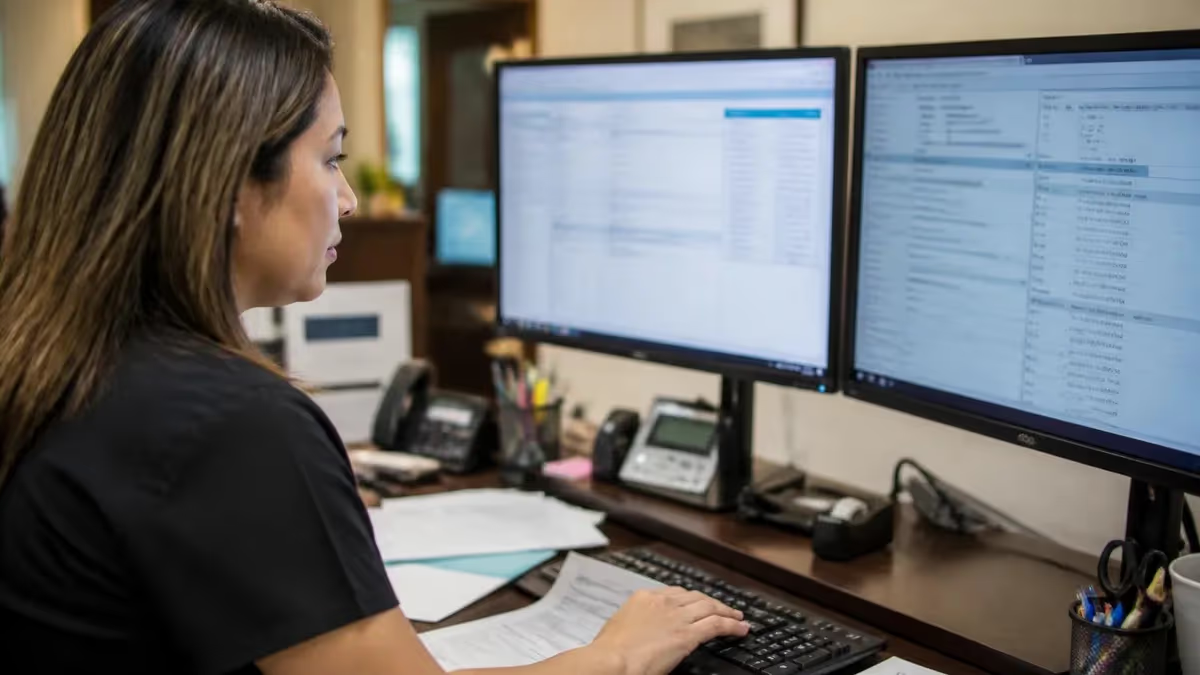
If you hold a CPC certification and want to work from home, you are entering one of the fastest-growing segments of the healthcare job market. CPC-A jobs work from home have exploded since 2020, with major insurers, hospital systems, and billing services now routinely hiring remote certified professional coders from across the country. The shift is not a temporary trend — it reflects permanent operational decisions by healthcare organizations that discovered remote coding teams deliver equal or better productivity at lower overhead costs compared to on-site staff.
The CPC credential, awarded by the American Academy of Professional Coders (AAPC), is the gold standard for outpatient and physician-office coding. When you pair that credential with the flexibility of remote work, you unlock a national job market rather than limiting your search to employers within commuting distance. A coder in rural Iowa can compete for the same position as someone in Chicago, provided they meet the technical and experience requirements the employer sets for its remote workforce.
Understanding what employers actually expect from CPC-A remote applicants is the first step toward landing a position. The "A" apprentice designation means you passed the CPC exam but do not yet have the two years of professional coding experience required to drop the apprentice suffix. Many remote employers will hire CPC-A coders, especially for entry-level accounts receivable, charge entry, or single-specialty coding roles where they provide structured mentorship. Knowing which employers actively recruit apprentice-level coders saves you considerable time and frustration during your job search.
Salary expectations for remote CPC-A positions typically range from $38,000 to $52,000 annually for entry-level roles, with experienced CPC coders (after removing the apprentice designation) earning $55,000 to $75,000 or more depending on specialty. Geographic pay differentials narrow significantly in remote positions, though some employers still apply location-based adjustments. Understanding this salary landscape helps you negotiate effectively and identify offers that undervalue your credential.
The technical setup required for remote medical coding is more rigorous than a typical work-from-home arrangement. Employers routinely require a dedicated, private workspace; a high-speed wired internet connection; dual monitors; and specific operating system versions to run their encoder software. HIPAA compliance is non-negotiable — you will sign a business associate agreement and may be subject to workstation audits. Preparing your home office before you begin applying signals professionalism and reduces the time-to-start once you receive an offer.
This guide walks you through every aspect of finding and securing remote CPC-A positions: the qualifications employers require, where to search for legitimate postings, how to structure your resume for applicant tracking systems, what the interview process looks like for remote coding roles, and how to build experience quickly so you can transition from CPC-A to full CPC status. Whether you just received your exam results or have been searching for months without success, the strategies here are drawn from current hiring patterns across the remote medical coding industry.
Before diving in, explore cpc a remote jobs for a side-by-side comparison of credential pathways that affect which remote positions you qualify for and how your earnings trajectory differs between certification types. Understanding where the CPC sits relative to other credentials helps you position yourself correctly in a competitive applicant pool.
CPC Remote Jobs by the Numbers

Core Requirements for CPC-A Remote Positions
You must hold a current, active credential from AAPC. Employers verify this directly through the AAPC directory. Lapsed credentials disqualify applicants immediately, so keep your CEU requirements current before applying to any remote role.
A private room with a lockable door, no shared screens, and a dedicated workstation is the standard requirement. Employers may conduct virtual walkthroughs and require signed attestations about your physical workspace before your first day.
Familiarity with Optum EncoderPro, 3M, or TruCode is often listed as required. Knowledge of common EHR platforms — Epic, Cerner, Meditech — is a significant differentiator even for entry-level remote CPC-A applicants.
Most employers require a minimum 25 Mbps wired connection, a Windows-based PC or laptop meeting specific OS requirements, and dual monitors. Mac systems are frequently incompatible with proprietary encoder platforms used by large coding companies.
Remote coders are typically held to daily productivity targets (number of charts coded) and accuracy rates above 95%. Understanding these benchmarks before accepting an offer ensures the role aligns with your current skill and speed level.
Finding legitimate remote CPC certification jobs requires knowing which job boards and employer types consistently post real openings versus which aggregate sites are cluttered with outdated listings or third-party headhunters who misrepresent the roles. The most reliable direct sources are the AAPC career center at aapc.com/careers, Indeed filtered to remote medical coding, LinkedIn with a remote filter applied, and the careers pages of large healthcare revenue cycle companies like Optum, Conifer Health Solutions, nThrive, Ciox Health, and Cognizant Healthcare. These organizations hire continuously and often have dedicated CPC-A onboarding tracks.
When using general job boards, apply the "remote" filter alongside keywords like "medical coder," "outpatient coder," "physician coding," or "professional fee coding" rather than searching broadly for "CPC" which returns unrelated results in construction, logistics, and other industries. Setting up daily email alerts on Indeed and LinkedIn with those filtered parameters ensures you see new postings within hours of publication — remote positions at reputable employers fill quickly, often within one to two weeks of posting.
Hospital systems are an underutilized source of remote CPC-A opportunities. While large academic medical centers often require in-person attendance for the first 90 days of employment, community hospitals and multi-specialty physician groups frequently allow fully remote work from day one. Search the career portals of regional health systems in your state — they may prefer local applicants for relationship and communication reasons while still allowing home-based coding. Regional employers often offer better benefits than national coding companies and more direct mentorship pathways.
Staffing agencies that specialize in healthcare revenue cycle are another strong channel. Firms like Staffmark Healthcare, Kelly Healthcare, Medix, and Staffcare regularly place CPC-A coders in contract and contract-to-hire remote roles. Contract positions can feel less stable than direct employment, but they are an excellent strategy for building the documented work experience needed to remove the apprentice designation. Two years of verifiable coding work, whether permanent or contract, counts toward full CPC status — the credential body does not distinguish between employment types.
Social media — specifically LinkedIn and the AAPC's own member forums and Facebook groups — surfaces unadvertised positions and referral opportunities that never appear on public job boards. Hiring managers in medical coding routinely post openings in professional groups before listing them externally, meaning network-connected coders get first access. Engaging consistently in these communities by answering coding questions, sharing study resources, and commenting on industry articles builds visibility that can translate directly into referral calls from recruiters.
Freelance and independent contractor remote coding is a third pathway that many CPC-A holders overlook. Platforms like Upwork and FlexJobs host medical coding contracts, and AAPC's own marketplace connects credentialed coders with small physician practices that need periodic coding support. While freelance income can be irregular initially, experienced CPC contractors charge $25 to $45 per hour, which far exceeds the equivalent hourly rate for many salaried entry-level positions. The tradeoff is the administrative overhead of self-employment and the need to carry your own professional liability coverage.
As you evaluate opportunities, be sure to compare the full compensation picture: base pay, productivity bonuses, health insurance, paid time off, and most importantly, whether the employer provides or reimburses encoder software subscriptions and AAPC membership fees. The annual AAPC membership and CEU costs can total $400 to $600 per year — employers who cover these costs are offering meaningful additional compensation.
For an in-depth look at how credential pathways affect hiring, review resources on certified professional medical coder jobs remote since yesterday to understand how the full CPC versus CPC-A distinction plays out in real hiring decisions across different healthcare settings.
Specialty Tracks for Remote Certified Professional Coder Roles
Evaluation and Management (E/M) coding is the highest-volume specialty in outpatient remote work. Remote coders focused on E/M review physician office notes, telehealth encounters, and urgent care visits to assign the correct 99202–99215 CPT codes based on medical decision making or total time. Mastery of the 2021 E/M guideline changes is non-negotiable for any remote coder applying to primary care or multi-specialty group practices, as these guidelines fundamentally changed how level of service is determined.
Entry-level remote E/M positions are among the most accessible for CPC-A holders because physician practices generate consistent daily volume, enabling structured productivity tracking and mentorship. Employers typically expect new remote E/M coders to process 25 to 40 charts per day within 90 days of starting, scaling to 50 or more charts daily as proficiency increases. Accuracy benchmarks are enforced through regular audits, and many employers offer a grace period during onboarding where audit feedback is educational rather than disciplinary.

Pros and Cons of Remote CPC-A Medical Coding Positions
- +Eliminates commute time and transportation costs, recovering 1–2 hours of personal time daily
- +Access to a national job market dramatically expands opportunities beyond local employers
- +HIPAA-compliant home office setup is a one-time investment that benefits your entire remote career
- +Flexible scheduling offered by many employers supports work-life balance and caregiving responsibilities
- +Productivity-based bonus structures allow high-performing coders to significantly exceed base salary
- +Reduced exposure to workplace illness and lower incidence of burnout reported by remote healthcare workers
- −CPC-A apprentice status limits access to the highest-paying remote specialty coding positions
- −Isolation from experienced colleagues slows skill development compared to in-person mentorship environments
- −Home office hardware, internet upgrades, and dedicated workspace costs fall on the employee in some companies
- −Productivity monitoring software used by employers can feel invasive and create performance anxiety
- −Limited networking visibility makes promotion and internal mobility harder than in office-based roles
- −Encoder software compatibility issues and IT support delays are more disruptive in a remote setting
Remote CPC-A Job Application Checklist
- ✓Verify your AAPC credential is active and your profile is publicly visible in the AAPC member directory.
- ✓Set up a dedicated, private home office space that meets HIPAA workstation requirements before applying.
- ✓Test your internet speed and ensure you have a wired connection capable of at least 25 Mbps download.
- ✓Install a Windows-compatible encoder trial (EncoderPro, TruCode) to confirm system compatibility.
- ✓Tailor your resume to include specific CPT, ICD-10-CM, and HCPCS code ranges you have worked with.
- ✓Create a LinkedIn profile listing your CPC-A credential prominently in your headline and about section.
- ✓Join AAPC local chapter online groups and specialty-specific Facebook coding communities for job leads.
- ✓Prepare a one-page cover letter addressing remote work reliability, productivity history, and HIPAA awareness.
- ✓Research each employer's productivity benchmarks and accuracy standards before the interview.
- ✓Have three professional references ready, ideally from instructors, supervisors, or coding peers who can attest to your accuracy.
The 95% Accuracy Rule Is Non-Negotiable
Every major remote medical coding employer enforces a minimum 95% accuracy rate on coding audits, typically reviewed monthly. Falling below this threshold during your probationary period — usually the first 90 days — can result in immediate termination. Before accepting any remote offer, ask specifically how accuracy is measured, what the audit sample size is, and what support is provided when accuracy drops. Understanding the audit process upfront protects you and helps you negotiate a realistic onboarding timeline.
Salary negotiation for remote CPC certification positions is an area where many new coders leave significant money on the table. The national median salary for a remote CPC-A coder as of 2025 is approximately $46,000 annually, but the range runs from $36,000 at smaller billing companies to $58,000 at large health systems with strong union or professional pay scales. Knowing where a specific employer falls within that range before you receive an offer requires research — review Glassdoor, Levels.fyi healthcare sections, and AAPC's annual salary survey data to benchmark expectations accurately.
Base salary is only part of the remote compensation picture. Productivity bonuses are standard in the industry and can add $3,000 to $10,000 annually for coders who consistently exceed their daily chart targets. Some employers structure bonuses quarterly; others pay them monthly. When evaluating offers, ask for the bonus structure in writing and request data on what percentage of current remote coders actually earn their full bonus — this tells you whether the targets are realistic or aspirational. Unreachable bonus thresholds are a common source of new-hire frustration in remote coding roles.
Benefits for remote medical coders vary dramatically by employer type. Large health systems like HCA Healthcare, CommonSpirit Health, and Dignity Health typically offer comprehensive benefits including employer-subsidized health insurance, 401(k) matching, paid parental leave, and tuition reimbursement — benefits that can be worth $15,000 to $20,000 annually beyond base pay. National coding companies like Optum and nThrive offer competitive benefits but may have less generous retirement contributions. Smaller billing services sometimes offer minimal benefits, compensating with higher base pay or more flexible scheduling.
Career growth trajectories for remote coders follow a fairly predictable arc. CPC-A coders who build their experience to two years typically advance to full CPC status, unlocking positions with $8,000 to $15,000 higher salary bands. From there, experienced remote coders often move into lead coder roles (providing quality audits and feedback to junior coders), coding educator positions, or compliance specialist roles. These mid-career positions are frequently remote-first and pay $65,000 to $85,000 annually. Some coders transition into remote coding management, overseeing distributed teams of 10 to 20 coders with salaries reaching into six figures.
Specialty credentialing accelerates salary growth more than any other single action a remote coder can take after achieving full CPC status. AAPC offers over 20 specialty credentials including the Certified Cardiology Coder (CCC), Certified Interventional Radiology Cardiovascular Coder (CIRCC), and Certified Ob/Gyn Coder (COBGC). Each specialty credential commands a salary premium of 10 to 20 percent over generalist CPC coders, and specialty-credentialed remote coders face far less competition for open positions because the credentialed talent pool is smaller.
The CPC exam itself covers a broad range of topics that map directly to the knowledge needed for remote work. Understanding the full certified professional coder certification body of knowledge — from E/M guidelines and CPT surgical coding to HCPCS Level II codes and compliance regulations — gives you the foundation to succeed in any remote specialty you ultimately choose. Employers know the CPC curriculum; demonstrating depth in the areas most relevant to their specialty during interviews gives you a measurable advantage over other CPC-A applicants with equivalent credentials on paper.
Long-term earning potential for remote certified professional coders is compelling relative to the educational investment required. Unlike nursing or physical therapy, where advanced credentials require multi-year degree programs, the CPC pathway from zero to credentialed coder takes six to twelve months and costs $2,000 to $5,000 in total training and exam fees. A remote coder who achieves full CPC status and one specialty credential within three years of starting can reasonably project earnings of $70,000 to $85,000 — a strong return on a modest initial investment that continues compounding through experience and additional specialization.

To remove the apprentice designation and achieve full CPC status, AAPC requires two years of professional coding experience documented by an employer or supervisor on official letterhead. Freelance and contract work qualifies, but you must be able to provide a verifiable contact at the organization who can confirm the dates and nature of your coding work. Undocumented or self-described experience is not accepted — start building your experience log from your very first coding position to avoid delays when you apply for credential upgrade.
Removing the CPC-A apprentice designation is the most important career milestone for any entry-level remote coder, and the path to achieving it within two years is both systematic and achievable with deliberate effort. The two-year clock starts from your first documented day of professional medical coding work — not from your exam pass date — which means starting your job search immediately after passing the CPC exam is critical. Every week of delay in landing your first position is a week added to the timeline before you can access the higher-paying positions reserved for full CPC coders.
The most effective strategy for building experience quickly in a remote role is to seek positions with high daily chart volume rather than low-volume positions that expose you to more complex cases. Early in your career, coding volume builds pattern recognition faster than complexity. A remote coder processing 40 straightforward primary care E/M charts per day will develop stronger foundational skills after three months than a coder who processes 10 complex surgical operative reports per day. Once your accuracy and speed are established, you can pursue complexity — not the other way around.
Mentorship in a remote environment requires proactive effort because you cannot rely on informal hallway conversations or shoulder-tap moments that naturally occur in office settings. When you accept a remote position, identify your supervisor, your quality auditor, and at least one peer coder who can serve as an informal resource.
Schedule weekly 15-minute video calls with your supervisor for the first three months — this level of engagement is not intrusive; most remote coding managers welcome it because it reduces errors and demonstrates professionalism. Ask your auditor to walk you through every correction on your monthly audit, not just the score.
Continuing education during your CPC-A period serves a dual purpose: it keeps your credential active through AAPC's 36-CEU biennial requirement, and it builds the specialty knowledge that accelerates your salary growth after removing the apprentice designation. AAPC offers free CEU webinars monthly, and many are specialty-focused. Attending consistently also builds your familiarity with coding guideline changes, which are released annually in October and take effect January 1 — remote coders who adopt changes quickly have a measurable accuracy advantage in the first quarter of each new calendar year when coding errors spike industry-wide.
Documentation habits are a remote coder's professional lifeline. Keep a running log of every type of encounter you code, every specialty you cover, and every system you use. This log becomes the foundation of your credential upgrade application and your resume when you advance. When you can show a prospective employer that you have coded 15,000 E/M encounters across primary care, urgent care, and telehealth over 18 months, your application converts from abstract credential to demonstrated capability — a far more compelling pitch than a resume that simply lists your CPC-A credential and your start date.
Professional involvement beyond your day job accelerates credential upgrade and networking simultaneously. Serving as a volunteer at your AAPC local chapter — even virtually — connects you with hiring managers, coding educators, and compliance officers who routinely refer qualified coders to openings before they are posted publicly. Volunteering for chapter education committees, presenting a short case study at a virtual chapter meeting, or helping organize a local coding workshop puts your name and credential in front of decision-makers who remember you when a remote opening emerges at their organization.
Once you achieve full CPC status and have established yourself in a remote role, the career landscape opens dramatically. Many experienced remote coders find that the skills they developed — rigorous attention to documentation, strong written communication with physicians and billing staff, proficiency in multiple EHR and encoder platforms, and the discipline required for self-directed remote productivity — position them exceptionally well for senior individual contributor and management roles.
The remote work model rewards self-starters, and coders who thrive in it consistently advance faster than those who wait for organizational structures to guide their growth. For additional strategies on navigating the full certification journey, the resources at certified professional medical coder jobs remote since yesterday provide detailed guidance on how the credential landscape intersects with remote hiring at every career stage.
Preparing your resume and LinkedIn profile for remote CPC-A applications requires a different approach than a general healthcare resume. Applicant tracking systems (ATS) used by large healthcare employers and coding companies filter candidates based on keyword matching before a human recruiter ever sees your application. Your resume must include the specific terms these systems search for: "CPC-A," "ICD-10-CM," "CPT coding," "HCPCS Level II," "medical coding," "revenue cycle," and the names of encoder platforms you have used. Missing even one high-weight keyword can eliminate your application before it is reviewed, regardless of your qualifications.
The formatting of your remote coding resume matters as much as the content. ATS systems parse resumes into structured data fields and struggle with tables, columns, graphics, and unusual fonts. Use a clean single-column format with standard section headers: Summary, Credentials, Technical Skills, Work Experience, and Education. Your AAPC credential and its current status should appear prominently in the credentials section, formatted exactly as AAPC formats it: "CPC-A, AAPC" with the year you passed the exam. Misformatting or abbreviating your credential in an unfamiliar way can cause ATS systems to miss it entirely.
Your professional summary statement at the top of your resume should be three to four sentences that speak directly to remote work capability, not just coding skill. Include a statement about your home office setup, your experience with remote tools (video conferencing, ticketing systems, electronic chart review), and your commitment to HIPAA compliance in a work-from-home environment. This framing immediately addresses the top concern that hiring managers have about remote CPC-A applicants: whether the candidate understands the professional and technical demands of unsupervised remote work.
Interview preparation for remote CPC-A positions involves anticipating both technical coding questions and behavioral questions about remote work habits. Common technical questions include scenario-based coding challenges: "Given this operative note summary, what CPT code and modifier would you assign?" Behavioral questions probe for self-discipline and communication: "How do you manage your productivity when working independently?" or "Describe how you handle a coding question when you cannot immediately reach your supervisor." Preparing specific, detailed answers to these questions — not generic responses — is what separates successful candidates from those who interview well but do not receive offers.
The onboarding period at a new remote coding position is the highest-risk time in your employment relationship. Remote coders who fail to meet productivity and accuracy benchmarks during the first 90 days are disproportionately likely to be released before completing their probationary period, and this early termination makes subsequent job searches more difficult.
Protect yourself by being explicit during the offer stage about what support and ramp time are provided, getting the productivity expectations in writing, and establishing a weekly check-in cadence with your supervisor from day one. Proactive communication during onboarding is far better received than reactive explanations for missed benchmarks.
Coding guideline updates are a professional responsibility that remote coders must track independently, without the organizational reminder systems that office-based coders benefit from. The AMA releases CPT code updates each October with an effective date of January 1. CMS releases ICD-10-CM updates on the same schedule. HCPCS Level II updates occur throughout the year. Subscribing to AAPC's email newsletter, following the CMS coding updates page, and setting calendar reminders for October publication dates ensures you are never caught applying outdated codes — an error category that auditors identify and report immediately.
The long-term professional community you build as a remote coder is your most durable career asset. The medical coding field evolves continuously — new guidelines, new technologies, new compliance requirements, and the emerging influence of AI-assisted coding tools that are already changing productivity expectations at large coding companies. Coders who remain actively connected to professional networks, continue earning specialty credentials, and engage with the broader healthcare revenue cycle community will navigate these changes successfully. Those who treat remote coding as an isolated activity, disconnected from the profession's evolution, will find themselves progressively less competitive as the market shifts beneath them.
CPC Questions and Answers

CPC Medical Coding Certification: Your Complete Guide to Becoming a Certified Professional Coder

CCS vs CPC: Certified Professional Coder Career, Duties & Certification Guide

What Is CPC? Certified Professional Coder Credential Guide

How to Become a Certified Professional Coder: Complete CPC Certification Guide

CPC Courses Online: How to Choose Training, Meet Requirements, and Pass the Certified Professional Coder Exam
About the Author

Certified Internal Auditor & Compliance Certification Expert
University of Illinois Gies College of BusinessBrian Henderson is a Certified Internal Auditor, Certified Information Systems Auditor, and Certified Fraud Examiner with an MBA from the University of Illinois. He has 19 years of internal audit and regulatory compliance experience across financial services and healthcare industries, and coaches professionals through CIA, CISA, CFE, and SOX compliance certification programs.
Join the Discussion
Connect with other students preparing for this exam. Share tips, ask questions, and get advice from people who have been there.
View discussion (8 replies)