
Cosmetology Tuition: Complete Cost Breakdown and Funding Guide for 2026 October
Compare cosmetology tuition costs by state, school type, and program length. Find scholarships, payment plans, and financial aid options for 2026 October. 🏆

If you've been searching cosmetology school near me and feel sticker shock at every tuition page, you are not alone. Cosmetology tuition in the United States ranges from roughly $5,000 at community colleges to over $25,000 at private beauty academies, and the price gap reflects more than just brand prestige. Tuition pays for hands-on training hours, licensing prep, kits, and supervised salon experience, all of which determine whether you'll walk out ready to pass your state board exam on the first attempt.
Understanding cosmetology tuition starts with understanding what you're actually buying. Most states require between 1,000 and 1,600 supervised training hours before you can sit for your licensing exam, and tuition rates are typically calculated per credit hour or as a flat program fee. A 1,500-hour program at a private academy may cost $18,000 to $22,000, while the same hour count at a public technical college might land between $6,000 and $10,000, before kit fees and books.
Tuition also varies dramatically by region. Cosmetology programs in California, New York, and Massachusetts tend to charge 30 to 50 percent more than equivalent programs in Texas, Ohio, or Florida. Urban schools usually price higher than rural ones, partly because of real estate costs and partly because of the volume of practice clients walking through the door. Knowing your local market helps you avoid overpaying for the same credential available cheaper just one county over.
The good news is that cosmetology training is one of the most aid-eligible vocational programs in the country. Accredited beauty schools qualify for federal Pell Grants, Direct Loans, and most state-level workforce grants. Many schools also offer in-house payment plans, work-study options, and scholarship programs sponsored by professional product lines like Redken, Paul Mitchell, and Aveda. With thoughtful planning, most students cover 60 to 100 percent of their tuition without out-of-pocket strain.
This guide walks you through every cost layer of cosmetology school: tuition itself, kit fees, registration costs, exam fees, and licensure renewals. We'll cover average prices by state, what to look for in a tuition contract, how to compare schools fairly, and which financial aid pathways actually work for beauty programs. By the end you'll know exactly what your real, all-in investment looks like for 2026.
We'll also address the hidden costs many prospective students overlook: transportation to clinic hours, missed work during full-time enrollment, kit replacement supplies, scrubs or salon uniforms, and the optional certifications that boost early salary. These line items can add $2,000 to $4,000 to your sticker price, but they're predictable when you plan for them. Treating tuition as a complete budget rather than a single number is how serious students protect their finances and their grades.
Finally, remember that tuition is an investment with a measurable return. The Bureau of Labor Statistics reports that licensed cosmetologists earn a median wage of $34,970 annually with top earners crossing $60,000, and successful salon owners or commission stylists frequently exceed $80,000 within five years. When tuition is compared against lifetime earnings, even pricier private academies often pay back inside two to four years.
Cosmetology Tuition by the Numbers
Cosmetology Tuition Costs by School Type
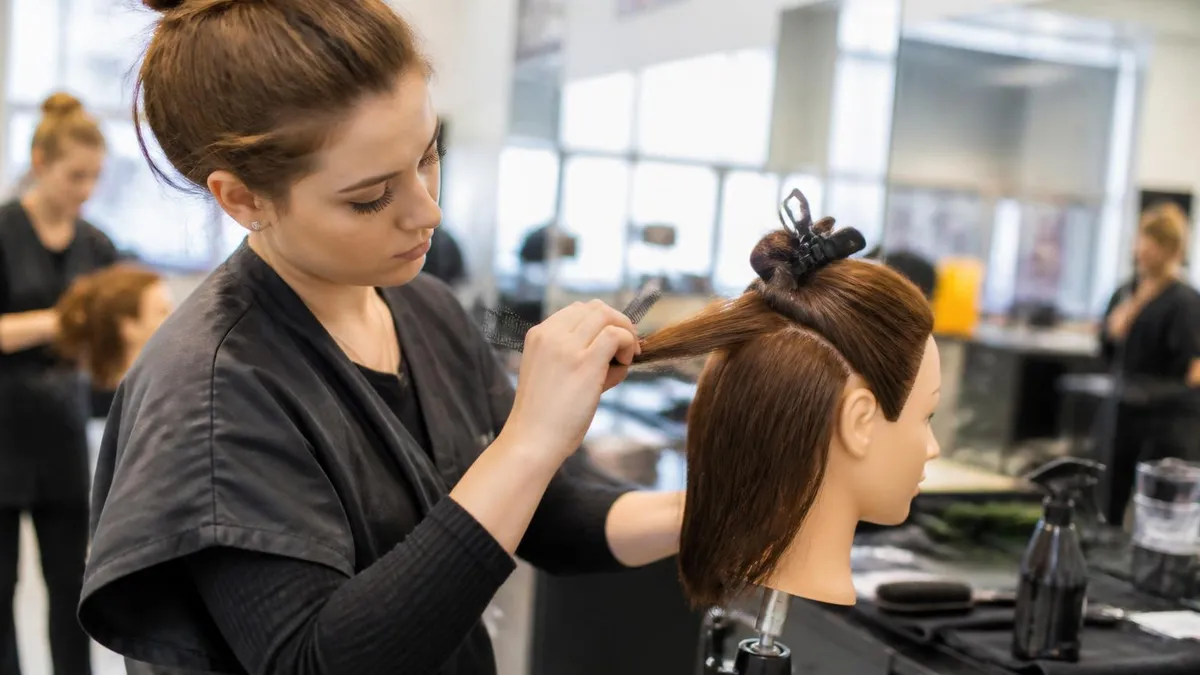
Public institutions offer cosmetology programs at $5,000 to $10,000 total tuition. Eligible for in-state residency discounts and standard federal aid. Best value if you live nearby and can commit to a fixed schedule.
State-funded vocational centers charge $7,000 to $14,000 for full programs. Often partner with local salons for clinical placements. Strong job placement support but limited brand-name product training.
Brand-affiliated schools like Aveda, Paul Mitchell, and Empire cost $15,000 to $25,000+. Higher tuition buys premium products, smaller class sizes, and recognized brand alumni networks that aid hiring.
Newer hybrid models charge $8,000 to $15,000 with theory online and hands-on hours at a partner salon. Flexible scheduling but verify your state board accepts the program format before enrolling.
When you pay cosmetology tuition, you're actually paying for a bundle of services that vary considerably by school. At minimum, tuition covers your classroom instruction, supervised clinic floor time, theory textbooks, and access to the school's product inventory. A well-structured program also includes your cosmetology cosmetologist exam preparation, mock state board testing, mannequin heads, and the final licensing paperwork assistance.
Beyond instruction, the kit fee is the next biggest line item, usually billed separately even when tuition is bundled. A standard cosmetology kit runs $1,500 to $3,500 and includes shears, combs, brushes, clippers, a blow dryer, hot tools, color bowls, perm rods, mannequins, and a professional case. Some schools require specific brands, while others let you bring your own as long as items meet sanitation standards. Always ask whether the kit is mandatory or optional before signing.
Application and registration fees add another $50 to $300 upfront, and these are rarely refundable once you've enrolled. Many schools also charge a one-time technology fee covering scheduling software, online learning portals, and digital theory materials. These fees can total $200 to $500 over the program's length and are easy to miss when comparing two tuition quotes side by side.
State licensing fees are separate from tuition and typically range from $50 to $150 for the written and practical exams. Some states also charge a temporary practice permit fee for the gap between school completion and license issuance. Plan for $200 to $400 in licensing-related costs above your tuition bill. Build this into your budget early, because you cannot legally work without paying these state fees regardless of how much tuition you've already covered.
Insurance, uniforms, and scrubs are smaller but consistent expenses. Most schools require student liability insurance at $30 to $75 per year and a specific dress code, often black scrubs with the school logo. Two complete uniform sets cost $80 to $150. Don't forget supportive shoes, since you'll spend 6 to 8 hours daily on your feet. Comfort footwear is a non-negotiable $80 to $200 investment that affects how you'll perform on the clinic floor.
Many private academies advertise an all-inclusive tuition figure, while public colleges itemize everything separately. Both approaches can be honest, but they make apples-to-apples comparisons harder. Always ask each school for an itemized cost of attendance sheet showing tuition, kit, fees, supplies, and estimated incidentals. Without this document, a $12,000 school may actually cost more than an $18,000 school once kits and fees are added.
Finally, consider what's NOT included in tuition: transportation to and from school, lunches during long clinic days, replacement supplies as your kit consumables run out, optional weekend workshops, and the cost of attending state board exam day, which often requires traveling to a regional testing center. Realistic incidental costs add $1,500 to $3,500 across a full program, so plan accordingly to avoid last-minute financial stress.
Cosmetology Practice Test Questions
Prepare for the Cosmetology Test exam with our free practice test modules. Each quiz covers key topics to help you pass on your first try.
Cosmetology Test Anatomy and Physiology
Cosmetology Exam Questions covering Test Anatomy and Physiology. Master Cosmetology Test concepts for certification prep.
Cosmetology Test Business and Career Manag...
Free Cosmetology Practice Test featuring Test Business and Career Management. Improve your Cosmetology Exam score with mock test prep.
Cosmetology Test Chemical Texture Services
Cosmetology Mock Exam on Test Chemical Texture Services. Cosmetology Study Guide questions to pass on your first try.
Cosmetology Test Haircolor and Lightening
Cosmetology Test Prep for Test Haircolor and Lightening. Practice Cosmetology Quiz questions and boost your score.
Cosmetology Test Haircutting and Styling
Cosmetology Questions and Answers on Test Haircutting and Styling. Free Cosmetology practice for exam readiness.
Cosmetology Test Infection Control and Safety
Cosmetology Mock Test covering Test Infection Control and Safety. Online Cosmetology Test practice with instant feedback.
Cosmetology Test Nail Care and Procedures
Free Cosmetology Quiz on Test Nail Care and Procedures. Cosmetology Exam prep questions with detailed explanations.
Cosmetology Test Nail Care and Services
Cosmetology Practice Questions for Test Nail Care and Services. Build confidence for your Cosmetology certification exam.
Cosmetology Test Principles of Skin Care
Cosmetology Test Online for Test Principles of Skin Care. Free practice with instant results and feedback.
Cosmetology Test Scientific Concepts
Cosmetology Study Material on Test Scientific Concepts. Prepare effectively with real exam-style questions.
Cosmetology Test Skincare and Services
Free Cosmetology Test covering Test Skincare and Services. Practice and track your Cosmetology exam readiness.
Cosmetology Test Wigs, Hair Extensions, an...
Cosmetology Exam Questions covering Test Wigs, Hair Extensions, and Hair Additions. Master Cosmetology Test concepts for certification prep.
Cosmetology Administrative Rules
Free Cosmetology Practice Test featuring Administrative Rules. Improve your Cosmetology Exam score with mock test prep.
Cosmetology On Hair & Scalp Properties
Cosmetology Mock Exam on On Hair & Scalp Properties. Cosmetology Study Guide questions to pass on your first try.
Cosmetology
Cosmetology Test Prep for Cosmetology. Practice Cosmetology Quiz questions and boost your score.
How Much Is Cosmetology School in Major States
California cosmetology tuition averages $18,000 to $26,000 for the required 1,000 training hours. The state's high cost of living, premium rent, and concentration of brand-name academies in Los Angeles, San Diego, and the Bay Area drive prices well above the national mean. Public community colleges in California offer the same hour requirement for $4,500 to $9,000 if you qualify for in-state tuition rates.
Arizona, Nevada, and Oregon fall in the $10,000 to $18,000 range with mid-sized cities offering the best value. The what is cosmetology question matters here because Arizona's 1,600-hour requirement adds meaningful program time and cost compared to neighboring states. Always verify your state's hour requirement before comparing tuition figures across regions.
Private Academy vs Community College Tuition
- +Lower upfront tuition at community colleges, often under $10,000 total
- +Federal Pell Grants frequently cover 50-100% of public school costs
- +Smaller class sizes at private academies improve hands-on practice time
- +Private academies offer name-brand product training valued by salons
- +Community colleges provide transferable college credits for future degrees
- +Private schools often include stronger job placement and alumni networks
- −Private academy tuition can exceed $25,000 with kits and fees
- −Community college waitlists can delay enrollment 6-12 months
- −Private schools may require enrollment in specific brand product lines
- −Community colleges sometimes lack premium tools and modern salon equipment
- −Hidden fees at private schools can add $2,000-$4,000 to advertised tuition
- −Public schools may have less flexible scheduling for working students
Pros and Cons at a Glance
| Pros | Cons |
|---|---|
| Smaller class sizes at private academies improve hands-on practice time | Private schools may require enrollment in specific brand product lines |
| Private academies offer name-brand product training valued by salons | Community colleges sometimes lack premium tools and modern salon equipment |
| Community colleges provide transferable college credits for future degrees | Public schools may have less flexible scheduling for working students |
Cosmetology Tuition Funding Checklist
- ✓Complete the FAFSA before your state's priority deadline to maximize aid
- ✓Verify your school is accredited by NACCAS or a regional accreditor
- ✓Request an itemized cost of attendance from every school you're considering
- ✓Apply for at least 5 industry scholarships such as ACE, Beauty Changes Lives, or Great Clips
- ✓Ask whether your employer offers tuition reimbursement for vocational training
- ✓Inquire about in-house payment plans with monthly installments and zero interest
- ✓Check your state's workforce development grant programs for beauty industry funding
- ✓Compare federal Direct Subsidized Loan terms before considering private loans
- ✓Research VA benefits if you or a spouse are eligible for GI Bill funding
- ✓Confirm whether kit fees and books are bundled or charged separately at each school
Always request the school's NACCAS placement and completion rates before signing
Schools accredited by NACCAS must publish their annual graduation, licensure pass, and job placement rates. A program charging $20,000 with a 40% completion rate is a worse value than a $12,000 program with 85% completion. These numbers predict whether tuition translates into a working career or just a stack of debt.
Scholarships and payment plans are the most underused tools in cosmetology financing. Industry-funded scholarships from professional brands distribute millions of dollars each year, yet the average school reports that fewer than 20 percent of enrolled students apply for any of them. The American Association of Cosmetology Schools (AACS) maintains a free national scholarship database, and most awards range from $500 to $2,500 per recipient. Stacking three or four small scholarships can offset an entire semester's tuition.
The Beauty Changes Lives Foundation alone awards over $400,000 in scholarships annually, with named scholarships sponsored by industry icons. Empire Beauty Schools, Paul Mitchell The School, and Aveda Institutes also run substantial in-house scholarship programs for students enrolled at their campuses. Applications usually require a short essay, a creative portfolio submission, or a video introducing your career goals. The competition is far less fierce than for traditional college scholarships, so your odds of winning are unusually good.
In-house payment plans are nearly universal at private beauty schools. Typical terms divide tuition into monthly installments over the program length, often interest-free or at very low rates. A $16,000 program spread over 12 months becomes a $1,333 monthly payment, manageable for many students working part-time. Always read the contract carefully for penalty clauses, late fees, and withdrawal refund policies before signing the financial agreement.
Federal Pell Grants are the gold standard of beauty school funding because they never need to be repaid. The maximum 2025-2026 Pell Grant is $7,395 annually, which covers half or more of tuition at most public cosmetology programs. Pell eligibility depends on your FAFSA-calculated Student Aid Index, and many cosmetology students qualify because the formula favors lower-income applicants. File the FAFSA as soon as October 1 each year for the best chance at full funding.
Federal Direct Loans fill the gap when grants alone don't cover tuition. Subsidized loans don't accrue interest while you're enrolled, making them the cheapest borrowing option for vocational students. Stafford loan limits for first-year independent students reach $9,500, which combined with Pell can fully fund most accredited cosmetology programs. Avoid private loans unless you've exhausted federal options first, since federal loans offer income-driven repayment and forgiveness protections private lenders won't match.
Workforce Investment Opportunity Act (WIOA) grants are an excellent but underused funding source. WIOA pays full tuition for qualifying displaced workers, low-income adults, and youth transitioning into in-demand careers. Cosmetology is a designated in-demand field in most states, making it eligible. Your local American Job Center can determine eligibility and route your application within weeks. Many WIOA recipients pay zero out of pocket for their entire training program plus kit costs.
Finally, employer sponsorship is rising. National salon chains like Great Clips, Hair Cuttery, and Supercuts now sponsor select students through dedicated tuition reimbursement programs in exchange for a one to two-year post-graduation employment commitment. The hourly wage may be modest, but graduating debt-free with a guaranteed job offer is one of the strongest financial outcomes available in any vocational field today.
Several large beauty school chains have faced federal investigation for misleading students about tuition costs, job placement rates, and loan obligations. Before signing any financial agreement, verify the school's status on the Department of Education's College Scorecard and check the Consumer Financial Protection Bureau database for complaints. Never sign a private loan agreement on the same day of your campus tour.
Maximizing your cosmetology tuition return on investment starts with treating school as a business expense rather than a lifestyle choice. Every dollar you spend on tuition should be evaluated against expected post-graduation earnings, job placement support, and credential portability. The highest-tuition school is not automatically the best, and the cheapest is not automatically a bargain. Smart students calculate cost per supervised clinic hour and cost per licensure pass rate before committing.
Choosing the right city or region for licensure significantly affects your ROI. A graduate licensed in San Francisco may earn $52,000 starting salary, while the same graduate in rural Oklahoma might earn $26,000. If you're geographically flexible, attending school in a lower-cost area and relocating after licensure can double your effective return. State licensing reciprocity makes this strategy practical, though you should verify reciprocity rules before enrolling, since not all states accept out-of-state hours equally.
Adding specialty certifications immediately after licensure dramatically increases your earning ceiling. Color specialist certifications, balayage and lived-in color training, lash extension certifications, and barbering crossover credentials each add $5,000 to $15,000 to annual earning potential. Most cost between $300 and $1,500 and can be completed in weekends. Bundling one specialty certification within your first year of practice typically pays for itself in three to six months of higher-priced services.
Maintaining your license through ongoing continuing education is also part of tuition ROI thinking. Most states require 8 to 16 hours of continuing education every two years, costing $100 to $400 per cycle. Treat continuing education as a strategic investment in higher-paying skills rather than a compliance chore. The stylists earning the top 10 percent of industry income are consistently the ones who reinvest in their craft annually.
Building a clientele during school is the single biggest predictor of post-graduation income. Schools with strong walk-in clinic traffic let you practice retention skills on real paying clients before graduation. By the time you're licensed, you may already have 30 to 80 regular clients ready to follow you to your first salon job. This jumpstart often translates into commission income two to three times higher than classmates who built their books from scratch after licensure.
Salon model choice after graduation also affects how quickly your tuition pays back. Commission salons offer steady income and benefits but cap earnings around industry averages. Booth rental allows higher take-home pay but requires you to fund your own marketing, supplies, and taxes. Commission usually pays back tuition faster in years one and two, while booth rental pulls ahead by year three for stylists with strong client retention and self-management discipline.
Finally, consider the long-term wealth-building potential of salon ownership. Cosmetology tuition is also a gateway credential to becoming a salon owner, which is among the most profitable small business categories in the United States. Roughly 12 percent of licensed cosmetologists eventually own salons, with median owner income exceeding $75,000 and top owners crossing $200,000 annually. Viewed through this lens, even a $25,000 tuition investment can be a launching pad for genuine wealth creation across a lifetime career.
With your tuition planning largely complete, your next concrete step is securing acceptance and locking in financial aid. Start by contacting the financial aid office at every school on your shortlist and requesting a sample award letter based on a typical FAFSA outcome. Award letters reveal how much grant aid you'll receive versus how much you'll need to borrow, which is the single most important number for choosing where to enroll.
Compare schools using a simple ROI formula: total all-in cost divided by expected first-year earnings. A $14,000 program leading to $34,000 starting income has an ROI ratio of 0.41, while a $24,000 program leading to $40,000 has 0.60. The lower number wins. Adjust upward for premium schools that demonstrably place graduates into higher-end salons, but always demand documented placement data, not marketing brochures or anecdotal success stories from the admissions counselor.
Time your enrollment thoughtfully. Many schools offer reduced tuition for off-cycle start dates in January, May, and September. Enrollment incentives can shave $500 to $1,500 off your sticker price. Also confirm whether your school's calendar aligns with your state board exam scheduling. Finishing 1,500 hours in March only to wait three months for a June exam slot delays your earning by a full quarter, which is real money lost.
Prepare your study habits before classes start. Cosmetology theory covers chemistry, microbiology, anatomy, electricity, color theory, and state law, all of which appear on the licensing exam. Free practice question banks help you preview the material and identify weak areas early. Students who start practicing exam-style questions in week one consistently pass the state board on the first attempt, which avoids the $50 to $150 retake fee and saves weeks of delayed employment.
Keep careful records of every dollar you spend on tuition, kits, books, supplies, and exam fees. Many of these expenses are tax-deductible as educational or business expenses, depending on your filing situation. The Lifetime Learning Credit allows up to $2,000 in annual tax savings for accredited program tuition. Working with a tax professional in your first filing year after enrollment usually pays for itself many times over in recovered deductions.
Finally, build your professional network during school, not after. Attend industry trade shows like ABS Chicago, IBS New York, and Premiere Orlando whenever possible. Many shows offer student pricing under $50, and the connections you make can lead to apprenticeships, mentor relationships, and first job offers worth far more than the entry fee. Treat school as the start of your career, not a preliminary step before it begins.
Cosmetology tuition is a substantial commitment, but with smart planning it becomes the most used investment a beauty professional ever makes. The students who plan their tuition, aid, scholarships, kit, and post-graduation strategy in parallel are the ones who graduate debt-light, license-ready, and immediately employable. Use this guide as a planning template, and revisit it whenever your circumstances change throughout your career.
Sample Cosmetology Test Practice Questions
Try these questions from our free Cosmetology Test practice tests. The correct answer and an explanation follow each question.
If a cosmetology establishment changes ownership, what must happen regarding its license?
- A. The original license remains valid for the new owner
- B. A new establishment license must be obtained before operating
- C. Only the manager's license needs updating
- D. The license transfers automatically after 60 days
Answer: B. A new establishment license must be obtained before operating
A change in ownership requires the new owner to apply for a new establishment license before continuing salon operations.
How long does a cosmetology apprenticeship typically need to be to qualify for licensure in states that allow this path?
- A. 500 hours
- B. 1,000 hours
- C. 2,000 hours
- D. 3,000 hours
Answer: C. 2,000 hours
States that permit apprenticeship as an alternative to school typically require around 2,000 hours of supervised on-the-job training.
Which situation would most likely prompt a cosmetology board to conduct a complaint investigation?
- A. A client who did not like their haircut style
- B. A report that a salon is operating without posting required licenses
- C. A salon that raises its service prices
- D. A stylist who offers a new hair coloring trend
Answer: B. A report that a salon is operating without posting required licenses
Operating without displaying required licenses is a regulatory violation that would trigger a board investigation to ensure compliance.
How many hours before a cosmetology license expires should a renewal application typically be submitted?
- A. At least 30 days before expiration
- B. On the exact expiration date
- C. Within 90 days after expiration
- D. Only when requested by the board
Answer: A. At least 30 days before expiration
Most state boards recommend submitting renewal applications at least 30 days before the license expiration date to avoid lapses.
Cosmetology Questions and Answers


About the Author
Licensed Cosmetologist & Beauty Licensing Exam Specialist
Paul Mitchell SchoolsMichelle Santos is a licensed cosmetologist with a Bachelor of Science in Esthetics and Salon Management from Paul Mitchell School. She has 16 years of salon industry experience and 8 years preparing students for state cosmetology board exams in theory, practical skills, and sanitation. She specializes in licensure preparation for cosmetologists, estheticians, and nail technicians.
Join the Discussion
Connect with other students preparing for this exam. Share tips, ask questions, and get advice from people who have been there.
View discussion (6 replies)