
Cosmetology Salary 2026 September: How Much Cosmetologists Really Earn
Cosmetology salary guide 2026 September: average pay, hourly rates, tips, top-paying states, and how to boost your income as a licensed cosmetologist. 🧠
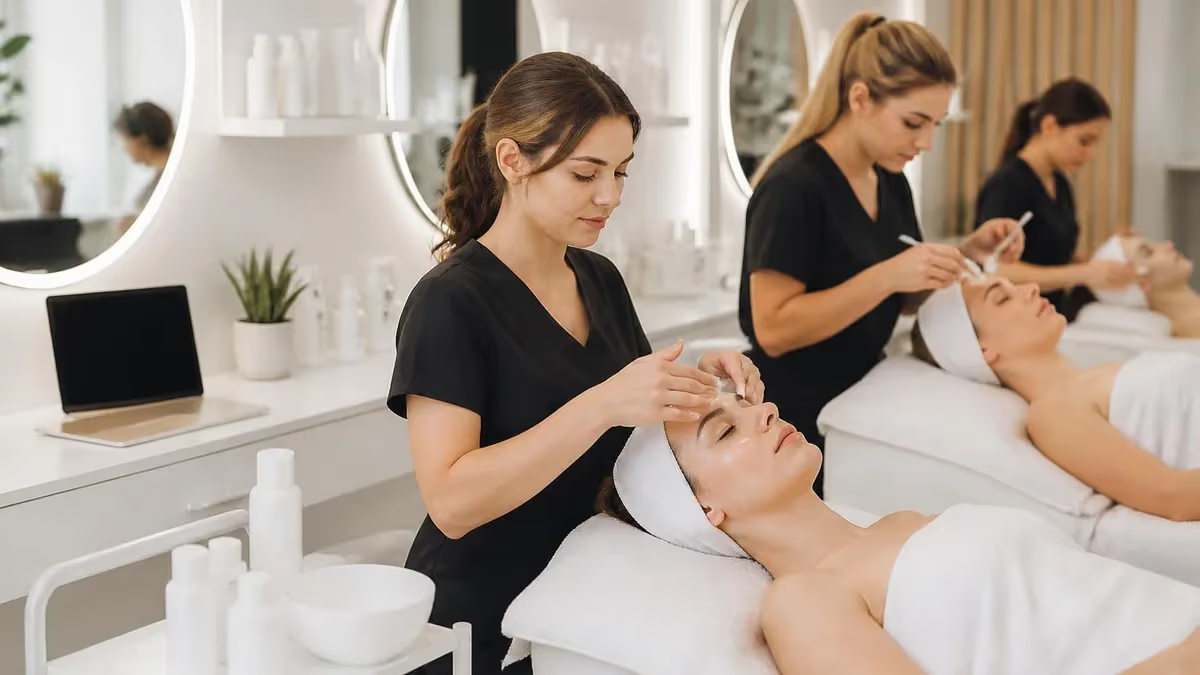
Cosmetology salary is one of the first questions every aspiring beauty professional asks, and the honest answer is more nuanced than the single number you will find on a job board. According to the Bureau of Labor Statistics, the median annual wage for hairdressers, hairstylists, and cosmetologists sits near $34,970, but real take-home pay swings dramatically based on location, specialty, tips, and whether you rent a booth or earn commission. Searching for a cosmetology school near me is step one, but understanding the earning landscape afterward is what keeps your career sustainable for decades.
Most newly licensed cosmetologists in the United States earn between $25,000 and $32,000 in their first year, before tips and product commissions are added. Those working in high cost of living markets like New York City, San Francisco, Seattle, or Washington D.C. routinely report base pay 30 to 45 percent higher than the national median. Rural stylists may earn less hourly, but their lower expenses and faster path to clientele often net comparable take-home income within two to three years of licensure.
Tips remain the single most underestimated component of cosmetology earnings. A stylist behind the chair four days a week in a mid-tier salon can collect $8,000 to $20,000 annually in cash and card tips, depending on service prices and clientele loyalty. Master colorists, balayage specialists, and extensions experts in luxury salons frequently report tip income exceeding $30,000 per year, pushing total compensation past $80,000 even when their base hourly wage looks modest on paper.
Specialization is the single fastest lever for raising your cosmetology salary. Generalists who cut, color, style, and do nails will always earn less per hour than focused experts who book back-to-back balayage clients at $250 a session. The data shows colorists, hair extension specialists, and bridal stylists out-earn general cosmetologists by 25 to 60 percent within five years. Education does not stop at graduation; the highest paid stylists invest in advanced training every year.
Employment model matters as much as skill. Commission stylists typically earn 40 to 60 percent of service revenue. Booth renters pay a flat weekly fee, often $150 to $400, and keep 100 percent of remaining service income plus tips. Salon owners, suite operators, and educators can scale earnings well above $100,000, though they take on overhead, marketing, and management responsibilities that pure service providers do not. Each path has a different ceiling.
Geography, license type, and continuing education combine to determine your final number. A licensed cosmetologist in Mississippi averages roughly $26,000 while the same license in Massachusetts averages closer to $46,000. State boards regulate scope of practice, which directly affects which services you can charge for. This guide breaks down every variable, salary by state, specialty premiums, tip math, freelance versus W-2 income, and the realistic timeline to reach six figures behind the chair.
Whether you are still researching your first program or you are five years into the chair and wondering why your paycheck has plateaued, the next sections give you data, benchmarks, and concrete strategies to grow your income. We will also cover the hidden costs that quietly eat into stylist earnings, things like back-bar fees, color charges, and education deductions that change net pay meaningfully each month.
Cosmetology Salary by the Numbers
Cosmetology Salary by Career Stage
Specialty drives the largest gap in cosmetology salary data. A general stylist who offers haircuts, blow-dries, and basic color may charge $45 to $85 per service in a mid-tier market. A color specialist offering full-head balayage, lived-in highlights, or vivid color charges $180 to $400 for the same chair time. Over a year, that pricing difference alone separates a $35,000 stylist from a $75,000 colorist working identical hours. Specialty is not luck; it is a deliberate education and marketing decision you make after licensure.
Hair extensions remain one of the most profitable cosmetology niches. Certified extension artists in tape-in, hand-tied, or fusion methods routinely charge $800 to $2,400 per install, plus maintenance every six to ten weeks. A specialist with thirty active extension clients can generate $150,000 in annual service revenue from extensions alone, before haircuts and color are added. Certification courses cost $1,500 to $5,000 but pay back within the first three to five clients.
Bridal and event styling is another high-margin path. Wedding stylists in major markets book $300 to $1,200 per bride for hair and makeup trials and day-of services, often serving the bridal party at additional per-person rates. Saturday morning weddings can produce $1,500 to $4,000 in a single five-hour window. Stylists who build a strong portfolio and partner with planners and venues can earn the bulk of their annual income in the May through October wedding season.
Barbering, men's grooming, and beard services have surged in salary potential. Licensed cosmetologists who add men's cutting and straight-razor work to their menu often see hourly revenue jump 20 to 35 percent because men's services book more frequently, every two to four weeks versus six to twelve weeks for women's color clients. High-end men's grooming salons in urban centers charge $65 to $120 per cut and shave, with stylists earning a 50 to 60 percent commission split.
Nail technicians, estheticians, and makeup artists licensed under broader cosmetology programs see varied salary outcomes. Nail techs average $32,000 to $40,000 nationally, but gel-X and Russian manicure specialists in cities like Los Angeles and Miami report $60,000 to $90,000 with strong tip income. Estheticians performing medical-grade treatments, chemical peels, and microneedling under physician oversight regularly earn $50,000 to $85,000, with the highest earners working in dermatology and med-spa settings.
Education and competition placement create their own income streams. Stylists who place in NAHA, ABS, or major brand competitions often receive sponsorship deals, freelance editorial bookings, and class-teaching fees of $1,500 to $5,000 per day. Brand educators for Redken, Wella, Aveda, Goldwell, and Schwarzkopf earn six-figure incomes through a mix of platform classes, in-salon training, and product royalties. These are not entry-level paths but they are realistic ceilings.
If you want to validate your knowledge before sitting for state boards, sharpen your cosmetology cosmetologist exam fundamentals with timed practice questions. Stronger exam scores correlate with stronger first-job offers because many salons review your written exam knowledge during apprentice interviews. Specialty-focused study time also helps you identify which earning track interests you most before you commit to expensive post-graduate certifications.

Cosmetology Practice Test Questions
Prepare for the Cosmetology Test exam with our free practice test modules. Each quiz covers key topics to help you pass on your first try.
Cosmetology Test Anatomy and Physiology
Cosmetology Exam Questions covering Test Anatomy and Physiology. Master Cosmetology Test concepts for certification prep.
Cosmetology Test Business and Career Manag...
Free Cosmetology Practice Test featuring Test Business and Career Management. Improve your Cosmetology Exam score with mock test prep.
Cosmetology Test Chemical Texture Services
Cosmetology Mock Exam on Test Chemical Texture Services. Cosmetology Study Guide questions to pass on your first try.
Cosmetology Test Haircolor and Lightening
Cosmetology Test Prep for Test Haircolor and Lightening. Practice Cosmetology Quiz questions and boost your score.
Cosmetology Test Haircutting and Styling
Cosmetology Questions and Answers on Test Haircutting and Styling. Free Cosmetology practice for exam readiness.
Cosmetology Test Infection Control and Safety
Cosmetology Mock Test covering Test Infection Control and Safety. Online Cosmetology Test practice with instant feedback.
Cosmetology Test Nail Care and Procedures
Free Cosmetology Quiz on Test Nail Care and Procedures. Cosmetology Exam prep questions with detailed explanations.
Cosmetology Test Nail Care and Services
Cosmetology Practice Questions for Test Nail Care and Services. Build confidence for your Cosmetology certification exam.
Cosmetology Test Principles of Skin Care
Cosmetology Test Online for Test Principles of Skin Care. Free practice with instant results and feedback.
Cosmetology Test Scientific Concepts
Cosmetology Study Material on Test Scientific Concepts. Prepare effectively with real exam-style questions.
Cosmetology Test Skincare and Services
Free Cosmetology Test covering Test Skincare and Services. Practice and track your Cosmetology exam readiness.
Cosmetology Test Wigs, Hair Extensions, an...
Cosmetology Exam Questions covering Test Wigs, Hair Extensions, and Hair Additions. Master Cosmetology Test concepts for certification prep.
Cosmetology Administrative Rules
Free Cosmetology Practice Test featuring Administrative Rules. Improve your Cosmetology Exam score with mock test prep.
Cosmetology On Hair & Scalp Properties
Cosmetology Mock Exam on On Hair & Scalp Properties. Cosmetology Study Guide questions to pass on your first try.
Cosmetology
Cosmetology Test Prep for Cosmetology. Practice Cosmetology Quiz questions and boost your score.
How Long Is Cosmetology School and How It Affects Your Salary
Most cosmetology programs in the United States require between 1,000 and 1,600 hours of training, depending on state requirements. At a full-time pace of 35 hours per week, that translates to roughly nine to fourteen months of school. Part-time evening or weekend programs typically stretch eighteen to twenty-four months. States like New York require 1,000 hours, while Oregon, Nebraska, and South Dakota require 1,800 to 2,100 hours, the highest in the country.
Program length affects your earning timeline more than your hourly rate. Graduating in nine months means you start earning a year before peers in longer programs. A first-year cosmetologist earning $28,000 effectively gains $28,000 in lifetime earnings by finishing school faster. That said, longer programs in states like Iowa and Oregon often produce more confident new graduates who book chairs faster and reach commission tiers sooner.
Cosmetology Career: Salary Pros and Cons
- +Tips can add $10,000–$30,000 on top of base pay annually
- +Specializing in color or extensions doubles earning potential
- +Flexible schedule with most stylists choosing their hours
- +Low cost to entry compared to four-year degrees
- +Strong job security with 8% projected growth through 2032
- +Booth rental allows 100% service revenue retention
- +Skills transfer across all 50 states with reciprocity in many
- −Median wage of $34,970 is below national average
- −No employer-paid benefits for booth renters or 1099 stylists
- −Physical wear from standing 8+ hours and repetitive motion
- −Income unstable in first 2 years while building clientele
- −Self-employment tax adds 15.3% for independent contractors
- −Continuing education costs $500–$3,000+ annually
- −Saturday and evening hours required at most salons
10 Steps to Boost Your Cosmetology Salary This Year
- ✓Track every tip in cash and on card so you understand true monthly earnings
- ✓Raise service prices 8–12% annually to keep pace with inflation and skill growth
- ✓Add one high-margin specialty service such as balayage or extensions within 12 months
- ✓Build a 600-photo Instagram portfolio focused on one signature service
- ✓Move from full commission to booth rental once you book 30+ clients weekly
- ✓Complete one advanced education course every 90 days at minimum
- ✓Ask every happy client for a Google review and a referral by name
- ✓Negotiate a 5% commission increase after hitting consistent monthly revenue goals
- ✓Sell retail products to add 10–20% to total monthly take-home pay
- ✓Set rebooking goals of 70%+ to stabilize income and reduce gap days
Rebooking is more profitable than new clients
Stylists who rebook 70 percent or more of clients before they leave the chair average 38 percent higher annual income than those who rely on walk-ins. A loyal client who returns every six weeks generates $1,200 to $3,500 annually in services and tips. Twenty loyal clients equal $24,000 to $70,000 in stable revenue before you add a single new face to your book.
Employment model is where smart stylists separate themselves financially. The four dominant models, commission, hourly plus commission, booth rental, and salon ownership, each produce different effective hourly earnings, tax outcomes, and lifestyle trade-offs. Understanding the math behind each model is the difference between feeling stuck at $35,000 and quietly clearing $90,000 with the same skill set. Most cosmetologists move through two or three models across their career as their clientele and confidence grow.
Commission salons typically pay 40 to 60 percent of service revenue, often on a sliding scale that rewards higher monthly production. A stylist generating $8,000 in monthly services at a 50 percent commission earns $4,000 plus tips. Pros include W-2 status, scheduled paychecks, supplied products, marketing support, and built-in clientele from walk-ins. Cons include the lower percentage and less control over pricing and schedule. Commission is ideal for the first three to five years post-licensure.
Booth rental flips the economics. You pay the salon owner a flat weekly fee, commonly $175 to $400 depending on city and salon prestige, and keep 100 percent of service revenue and tips. You become a 1099 independent contractor responsible for your own taxes, insurance, supplies, and continuing education. Booth renters with strong books often net 25 to 50 percent more take-home pay than commission peers, but inconsistent weeks hit harder because rent is owed regardless of bookings.
Suite rental, a newer model popularized by Sola Salons and My Salon Suite, combines booth rental privacy with semi-luxury infrastructure. Rent typically runs $300 to $800 per week for a private locking suite. Stylists who fill a suite four days weekly with $150-average tickets routinely report $90,000 to $140,000 in gross annual revenue. Net income after rent, products, taxes, and insurance typically lands between $55,000 and $95,000, well above commission averages.
Salon ownership is the highest-ceiling model but also the highest-risk. Owners earn from their own chair plus a 30 to 50 percent cut of stylist commissions and booth rents. A four-chair salon with three commission stylists and one booth renter can produce $80,000 to $200,000 in owner take-home, depending on overhead, location, and management efficiency. Most successful owners come from at least five years of behind-the-chair experience and have completed business or accounting coursework.
Freelance and on-location work, weddings, photoshoots, film, television, and editorial, can either supplement or replace traditional salon income. Established freelancers in major media markets command $750 to $2,500 day rates and often work through agencies that handle bookings. The unpredictability is real, but the income ceiling and creative freedom attract many experienced cosmetologists looking to escape standing eight hours a day at the chair. Many maintain a hybrid model for stability.
State regulators matter more than most stylists realize. The ohio state board of cosmetology and similar agencies in every state set the rules for scope of practice, supervision, and renewal. Knowing what services you legally can and cannot perform under your specific license type protects your income and prevents disciplinary action that could cost you your license entirely. Always confirm scope before adding a new service to your menu.
Many commission stylists are surprised to learn their salon charges back-bar fees, color charges, towel laundry, or product deductions that can shave 5 to 15 percent off gross commission. Always request a written compensation agreement before accepting any salon position. The difference between a 50 percent commission with no deductions and a 55 percent commission with $200 weekly product charges can be $5,000 to $9,000 annually in take-home pay.
Reaching six figures in cosmetology is absolutely possible, but it requires deliberate planning rather than waiting for raises that may never come. The stylists who clear $100,000 consistently share four habits, ruthless rebooking, specialty pricing, retail attachment, and continuous education. None of these require talent you do not already have; they require systems and discipline applied over a three to five year window. Most six-figure stylists hit that mark in years six through nine of their career.
The math works like this. A stylist working 32 service hours per week, 48 weeks per year, with an average ticket of $145 generates $222,720 in service revenue. At a 55 percent commission split or net booth rental equivalent, that produces roughly $122,500 before tips. Add $18,000 to $25,000 in tips and modest retail commissions, and total compensation lands between $140,000 and $150,000. The variables to control are average ticket, hours booked, and percentage retained.
Average ticket is the fastest lever. Raising your average from $95 to $145 requires either price increases or service upgrades like adding glosses to every color, treatment add-ons, or scalp services. Most stylists undercharge by 15 to 30 percent compared to local market rates because they fear losing clients. In practice, well-communicated 10 percent annual increases produce less than 5 percent client attrition, and the lost clients are typically your lowest-tipping, most demanding bookings anyway.
Hours booked is the second lever and the one most stylists overlook. A 60 percent booked chair, four hours sitting empty out of ten, costs you tens of thousands annually. Tightening your schedule with strong rebooking, online booking, and waitlist management can push utilization above 85 percent. Software like Vagaro, GlossGenius, Squareup, and Boulevard make this trivially easy and pay for themselves within the first month of use through reduced no-shows alone.
Retail attachment, the percentage of clients who buy a product, transforms many marginal incomes into comfortable ones. The industry benchmark is 30 percent retail attachment, but elite stylists hit 60 to 75 percent. At a 10 to 20 percent commission on retail, a stylist selling $400 in product per week adds $2,000 to $4,000 in annual income with almost no extra time investment. Retail also dramatically improves client retention because clients who buy your recommended products see better at-home results.
Personal branding through social media and Google reviews compounds over years. A cosmetologist with 10,000 engaged local Instagram followers and 200 five-star Google reviews has effectively built a marketing asset worth tens of thousands in lifetime client value. New stylists should commit to posting three high-quality before-and-after photos weekly from their first day behind the chair. The portfolio you build in your first three years often determines your earning trajectory for the next fifteen.
Finally, understand that licensure is portable but not automatic. If you move from one state to another, you may need to verify reciprocity or pass a state-specific exam. Renewal cycles, fees, and continuing education vary widely. Researching what is cosmetology licensing in your destination state before relocating can save months of lost income and unexpected exam fees, especially in states with stricter hour requirements like Oregon and South Dakota.
Practical income planning for cosmetologists begins with treating yourself as a business owner from your first paycheck, even if you are a W-2 commission stylist. Open a separate checking account for service income, automate 25 to 30 percent of every deposit into a tax savings account, and another 10 percent into a continuing education fund. This three-bucket system prevents the year-end tax panic that derails so many promising stylist careers and ensures you can pay cash for the next certification course that doubles your earning power.
Track your numbers monthly. Total services performed, average ticket, rebook percentage, retail attachment, and tip percentage of services. Most point-of-sale systems generate these reports automatically. Reviewing them on the first of each month, even for 20 minutes, surfaces patterns that lead to direct income gains. If your average ticket dropped from $140 to $128, you know to push add-on services next month. If rebook fell below 65 percent, you adjust the conversation at the end of each appointment.
Build a personal financial cushion of three to six months of expenses before transitioning from commission to booth rental. Booth rental requires you to absorb slow weeks, vacation time, sickness, and supply costs without an employer safety net. Stylists who jump to booth rental without savings often return to commission within a year because the financial pressure forces short-term decisions that hurt long-term clientele building. The cushion buys you the patience to grow methodically.
Insurance is non-negotiable. Professional liability coverage through providers like Beauty and Bodywork Insurance, Marine Agency, or PIIC costs $150 to $400 annually and protects you from claims related to chemical burns, allergic reactions, or accidental injury. Health insurance through ACA marketplace plans, a spouse's plan, or an industry association is essential for self-employed stylists. Disability insurance is the most overlooked, yet stylists rely entirely on physical ability to earn income, making it among the highest-value policies you can buy.
Retirement planning often gets ignored in beauty careers and it should not. A SEP-IRA or Solo 401(k) allows self-employed cosmetologists to shelter $7,000 to $69,000 annually in tax-advantaged retirement accounts. Even a modest $300 monthly contribution starting at age 25 compounds to roughly $750,000 by age 65 at historical market returns. Many salon software platforms now integrate directly with retirement providers, making contributions automatic, which is critical because manual saving rarely happens in service businesses.
Negotiation is a learned skill that pays better than most certifications. Whether you are interviewing for your first commission chair, requesting a percentage bump after a strong quarter, or quoting a custom price for a bridal trial, the willingness to ask clearly and confidently separates the top quartile of cosmetology salaries from the median. Practice your pitch out loud before every meeting. Reasonable, data-supported requests get approved far more often than stylists assume.
Finally, protect your most valuable asset, your hands, wrists, and back. Invest in cushioned anti-fatigue mats, well-fitted clogs or supportive sneakers, ergonomic shears, and a quality stylist chair you can sit on between blow-dries. Schedule monthly massage or chiropractic care as a business expense. The stylists who earn well into their fifties and sixties are the ones who treated body maintenance as part of their job from year one, not the ones who powered through pain until injury forced an unwanted early exit from the chair.
Cosmetology Questions and Answers


About the Author

Licensed Cosmetologist & Beauty Licensing Exam Specialist
Paul Mitchell SchoolsMichelle Santos is a licensed cosmetologist with a Bachelor of Science in Esthetics and Salon Management from Paul Mitchell School. She has 16 years of salon industry experience and 8 years preparing students for state cosmetology board exams in theory, practical skills, and sanitation. She specializes in licensure preparation for cosmetologists, estheticians, and nail technicians.
Join the Discussion
Connect with other students preparing for this exam. Share tips, ask questions, and get advice from people who have been there.
View discussion (6 replies)