
Cosmetology Meaning 2026 September
Cosmetology meaning explained: definition, history, services, training, licensing, and career paths in beauty. Salary, exam tips, and 2026 September outlook. ✅
What Cosmetology Actually Means
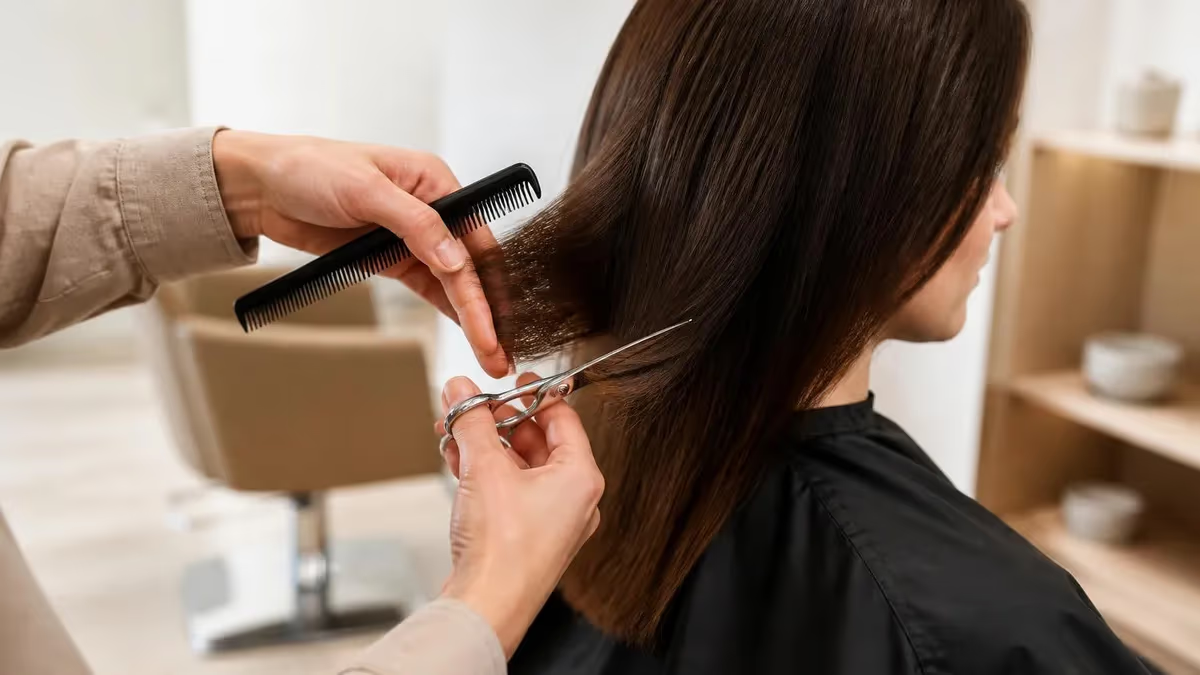
The word cosmetology sits on shelves of dictionaries quietly, but it carries a busy life. Stretched out, it means the study and skilled practice of beauty treatments — hair, skin, nails, and the personal grooming that ties them together. Pull it apart in Greek and you get kosmetikos (relating to adornment) and logia (the study of). So, literally, cosmetology is the study of adornment. That sounds dusty until you walk into a salon at 7 a.m., smell warm towels and clarifying shampoo, and watch someone transform a stranger into a person ready to face a job interview.
This guide is built for anyone hunting a clear, unfussy answer. Maybe you typed “what does cosmetology mean” into Google after a friend mentioned beauty school. Maybe you’re a parent trying to understand your teen’s career talk. Or maybe you’re prepping for your state board exam and want a tight refresher on the field’s scope. Whatever brought you here, you’ll leave with a working definition, a sense of the day-to-day, and a path forward if it interests you.
Short version? Cosmetology covers hair, skin, and nails — plus the science behind safe, sanitary, beautiful results. It’s licensed work in every U.S. state. It’s practical. It’s also, perhaps surprisingly, regulated almost as tightly as nursing because clients’ bodies are involved. Let’s dig in.
The reason the definition matters at all is this: cosmetology is not a casual hobby. It’s a regulated trade with a written body of knowledge, hands-on standards, and legal consequences for cutting corners. Calling yourself a cosmetologist without a license is, in most U.S. states, a misdemeanor — exactly the way calling yourself an electrician without one is. The word carries professional weight.
Why the Word Itself Matters
Definitions in trades aren’t academic exercises — they’re fence lines. The legal meaning of cosmetology is what determines who can hold a pair of shears over your scalp, who can pour a chemical relaxer onto your hair, and who can press a hot wax strip against your skin. When state legislators write licensing law, they start with a definition section. That definition decides which procedures fall under cosmetology, which fall under barbering, which require a medical license, and which fall outside the regulated zone entirely.
That’s also why the meaning of cosmetology is broader in some states than others. A few states fold lash extensions into cosmetology; others require a separate certificate. Some include light-based hair removal under cosmetology; others reserve it for medical estheticians. The dictionary gives you the rough shape. Your state board gives you the legally binding version.
Quick note on this guide: every section below is written from the working professional's angle — not the marketing brochure angle. If something is hard, we say it. If something is hyped, we say that too. Your time is too short for fluff, and so is mine. With that settled, here is the field, plainly.
Cosmetology by the Numbers
A Short, Honest History
People have been beautifying themselves forever. Egyptians ground malachite into eye paint around 4,000 BC. Romans had public bathhouses with masseuses, depilatory waxes, and elaborate hairstyling. The word cosmetology as an organized profession, though, didn’t really crystallize until the late 19th and early 20th centuries.
Take Madam C.J. Walker. She built one of America’s first hair-care empires in the 1900s and trained thousands of Black women to work in beauty — turning what had been informal kitchen-table work into a licensed trade. Around the same time, state legislatures started writing rules. By the 1930s, most states required a license. The reasoning was simple and unromantic: hair dye burned scalps, unsterilized razors spread infections, and someone had to draw a line. That line is the modern state board.
Today’s cosmetology, then, is a blend of artistry and public-health regulation. You learn how to do a balayage. You also learn why you can’t reuse a wax stick. Both halves are equally on the test, and both halves are equally on every state board examiner’s clipboard.
The 20th-Century Shift
What changed in the 20th century wasn’t the desire for beauty — it was the chemistry. Permanent waves, synthetic hair dyes, modern shampoos, and acrylic nail enhancements all arrived in roughly a 50-year window. Each one introduced new risks, new burns, new allergic reactions, and new regulatory headaches. Cosmetology emerged as a profession partly because somebody had to be trained to wield these chemicals without injuring clients.
The Great Depression accelerated the trade in an unexpected way too. With more women entering the workforce out of economic necessity, weekly salon visits became a small affordable luxury that stayed within reach. Cosmetology schools — many run as for-profit ventures — opened to meet that demand. The structure of the field as we know it today was largely set by 1960: state-approved schools, state board exams, license renewal cycles, and continuing-education requirements.

Cosmetology is the licensed, scientific, and creative study of hair, skin, and nail care — and the safe practices that protect both client and stylist while those services are performed. Every U.S. state regulates it. Every state expects formal training hours. Every state administers a written and a practical exam before issuing a license.
What’s Actually Inside the Definition
If you crack open a state board curriculum, you’ll find cosmetology split into three broad practice areas plus a layer of theory. The split isn’t accidental. Each area touches different parts of the body, different chemicals, and different risk levels — so each gets its own training block.
Hair work covers cutting, shaping, coloring, perming, relaxing, and styling. Skin care, often called esthetics inside cosmetology programs, includes facials, basic waxing, light chemical exfoliation, and makeup. Nail care, or manicuring, covers natural-nail manicures and pedicures plus artificial enhancements like acrylics and gels. Wrap all of this in a thick layer of infection control, anatomy, chemistry, and customer service, and you’ve got the field.
One nuance worth noting: cosmetology and the related single-discipline licenses sometimes overlap. An esthetician’s license is narrower; a cosmetology license is broader. A barber’s license, in many states, has its own track. Knowing the differences matters when you’re choosing a school — or hiring one.
The Three Core Pillars of Cosmetology
Cutting, coloring, chemical services, styling, and scalp care. This is the bulk of most salons' revenue and the largest portion of cosmetology school hours — roughly half of the standard curriculum across most states.
Facials, waxing, makeup application, and basic skin-care recommendations. Cosmetologists handle introductory services; medical estheticians and dermatologists go deeper into clinical work.
Manicures, pedicures, gel and acrylic enhancements, and nail-art design. Sanitation rules here are some of the strictest in the field because of bloodborne risks from cuticle work.
Anatomy, chemistry, infection control, electricity, ergonomics, and the laws that govern the trade. Roughly a third of every program — and the part that's easiest to underestimate when studying.
How Cosmetology Is Different From Related Fields
People conflate cosmetology with a few neighboring trades. Let’s clear that up because it affects which license you need and what you’re legally allowed to do.
A barber traditionally focuses on men’s grooming, short cuts, beards, and straight-razor shaves. In many states the curriculum overlaps with cosmetology by 80% but the straight-razor work is a barbering-only privilege.
An esthetician handles skin only — no haircuts, no chemical relaxers. The training is shorter (often 600 hours versus 1,500). But it goes deeper into skin physiology and treatment protocols than a typical cosmetology program.
A cosmetic dermatologist is a medical doctor. They prescribe medications, perform injections, and operate on skin. Cosmetologists don’t — ever — cross into that territory legally.
You’d be amazed how often a new student walks in thinking these are interchangeable. They aren’t. Scope of practice is everything.
Cosmetology vs. Related Licenses
Scope: Hair, skin, and nails. The broadest cosmetic license available.
Hours: 1,000–2,100 depending on state, typically averaging around 1,500.
Exam: Written theory test plus a practical demonstration with a mannequin head, kit, and timed tasks.
Reciprocity: Generally portable to other states with paperwork and sometimes a top-up exam.
What Cosmetologists Actually Do All Day
Forget the soft-focus shampoo commercials for a minute. A real cosmetologist’s shift looks like this: arrive 15 minutes early, restock the station, sanitize tools, check the day’s booking software. Then — client. Consultation. Service. Cash-out. Sanitize. Next client.
A busy stylist might do 8–12 services a day. Some are 30-minute trims that pay $35. Others are three-hour color corrections that pay $300. Many salons run on commission (35–60%) plus tips, so the math matters. Booth-rental stylists keep more but pay weekly rent and their own product costs.
The unglamorous truth: cosmetology is physical. You’re on your feet, arms raised, leaning forward, for hours. Most pros stretch, wear supportive shoes, and book breaks into their day. Sustainability of the body is a real career topic — and an early-school conversation that you may or may not get.
The Hidden Mental Work
One thing nobody tells you about cosmetology: the mental load is heavy. Every consultation is a mini negotiation. The client says “take an inch off.” You translate that into actual fingers held against actual hair, knowing that what one person calls an inch is another person’s shoulder-length lop. You manage expectations without crushing them. You learn to read facial micro-expressions in the mirror — that’s a real skill — and adjust mid-cut if you see hesitation.
Then there’s the emotional labor. Clients tell stylists things they don’t tell anyone else. Divorces, illnesses, anxieties, secrets. You’re a hair professional, not a therapist, but the chair is a kind of confessional. Most cosmetologists develop a quiet emotional discipline over the years. You absorb, redirect, and reset between clients. It’s tiring in a way that doesn’t show up on a time sheet but matters enormously in burnout statistics.
Cosmetology pairs the Greek kosmetikos (“skilled in adornment”) with -logia (“study of”). It enters English by way of the late 1800s, gaining its modern, regulated meaning in the U.S. around the 1930s when state licensure laws spread across the country in response to chemical injuries and infection outbreaks in unregulated salons.
How You Become a Cosmetologist
Three steps. Each one is a gate.
First, finish high school or earn a GED. Most states require this for licensure. Second, enroll in a state-approved cosmetology program. Hours range widely — New York is 1,000, California is 1,000 (as of 2022; it was 1,600 before that), Texas is 1,000, Massachusetts is 1,000, but several Southern states still sit at 1,500–1,800. Tuition runs $5,000 at community colleges to $20,000 at private institutes.
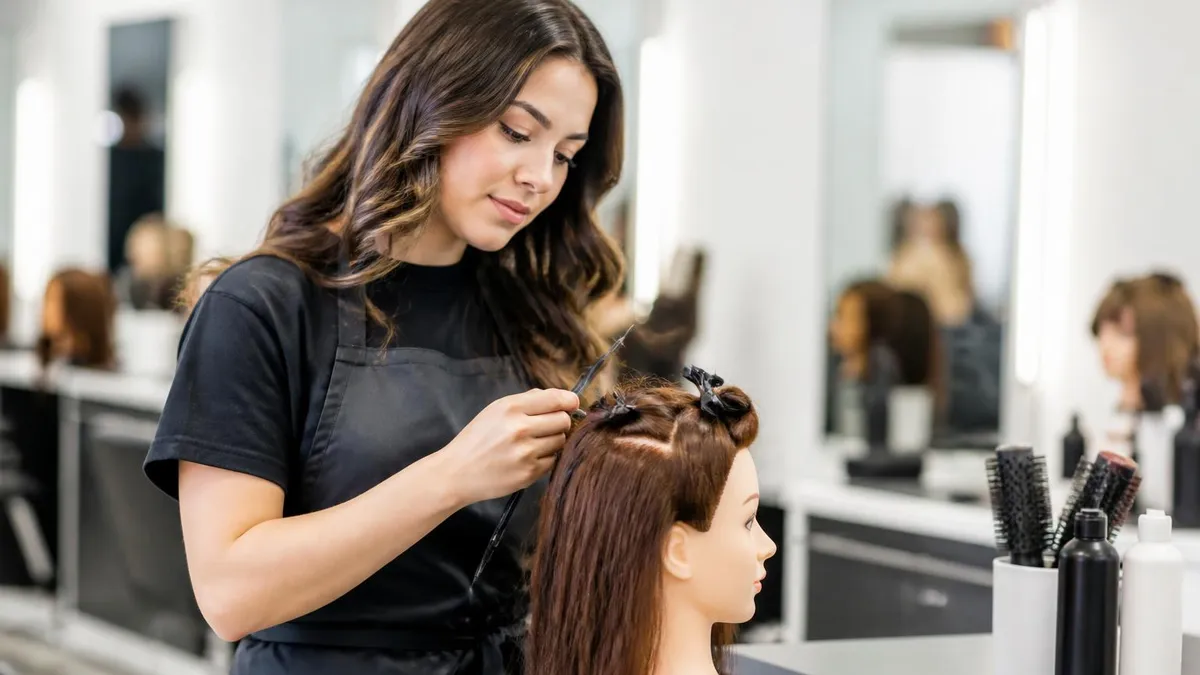
Third, pass your state board exam. That’s a written theory test plus a hands-on practical. The practical is where most people sweat. You bring a mannequin, your tools, and your own kit. You’re scored on specific tasks — a haircut, a color application, a sanitation procedure — against a published rubric. Examiners watch for safety violations first, then technique.
Pass rates vary by state but generally hover between 65% and 80% on the first attempt. Want a serious leg up before the test? Working through targeted question banks is the cleanest way to find the gaps in your theory knowledge. Browse the Cosmetology practice test bank and use it to drill chemistry, scalp anatomy, and state-law sections that trip people up most.

Cosmetology Licensing Checklist
- ✓Confirm you’re 16+ and have a high school diploma or GED
- ✓Verify your state’s required training hours (1,000–2,100)
- ✓Choose an accredited, state-approved program
- ✓Complete required clock hours with documented services on real clients
- ✓Pass the written theory exam (typically 75% or higher to pass)
- ✓Pass the practical exam with a mannequin head and personal kit
- ✓Submit license application and fingerprint background check
- ✓Pay state licensing fees ($50–$150 in most jurisdictions)
- ✓Renew every 1–2 years and complete continuing-education hours
- ✓Keep records of all CE certificates for future audit or reciprocity
- ✓Track your weekly clock-hour log and confirm signatures from instructors
- ✓Practice timed mannequin haircuts at least three times before the exam
- ✓Memorize your state's specific list of disinfection contact times
- ✓Network with at least two graduates from your target salon before applying
Where Cosmetology Can Take You (Career Paths)
The license is the entry ticket, not the destination. Roughly 60% of cosmetologists end up working in a traditional salon. The rest spread out into surprisingly varied territory.
Some go corporate — platform artists for brands like Redken, Wella, or Aveda, traveling to teach classes and demo new lines at trade shows. Others move into film and television, working on set as hair and makeup department staff. The Make-Up Artists & Hair Stylists Guild (IATSE Local 706) is the union that governs those gigs in Hollywood.
Then there’s entrepreneurship. Many seasoned stylists open their own salons by year five or seven. The smartest start as booth-renters first, learning the books before taking on a lease.
And don’t forget instruction. Every cosmetology school you walk into is staffed by former working stylists who passed an instructor exam. That’s a real second-act path for people whose hands or backs are tired of full-day client work.
Cosmetology Career Pros and Cons
- +Skills travel — you can work in any U.S. state after reciprocity paperwork
- +Creative outlet plus immediate, visible results from each appointment
- +Flexible scheduling once you build a steady clientele
- +Strong potential for self-employment and eventual salon ownership
- +Continued demand — beauty services are recession-resistant
- +Multiple specialty niches to grow into (color, lashes, scalp care)
- −Physically demanding — standing 8–10 hours, repetitive motion
- −Income is uneven, especially during the first two years building clientele
- −Chemical exposure can irritate skin and lungs without protection
- −Self-promotion and social-media work eat into real personal time
- −Continuing education and re-licensure fees never stop
- −Income depends heavily on geography and salon quality
Pros and Cons at a Glance
| Pros | Cons |
|---|---|
| Skills travel — you can work in any U.S. state after reciprocity paperwork | Income is uneven, especially during the first two years building clientele |
| Creative outlet plus immediate, visible results from each appointment | Chemical exposure can irritate skin and lungs without protection |
| Flexible scheduling once you build a steady clientele | Self-promotion and social-media work eat into real personal time |
| Strong potential for self-employment and eventual salon ownership | Continuing education and re-licensure fees never stop |
| Continued demand — beauty services are recession-resistant | Income depends heavily on geography and salon quality |
The Money Conversation
Cosmetologist salaries are one of those topics where the average hides the truth. The Bureau of Labor Statistics lists $35,400 as the 2024 median. That number includes part-timers, new licensees, and assistants. A booked, established stylist in a city salon pulls $70,000–$120,000. A celebrity colorist in Los Angeles or New York can clear $250,000.
The gap matters. Income depends on five variables: city you work in, type of salon (chain versus independent), commission structure, your speed, and the breadth of your service menu. A stylist who masters color, blowouts, and bridal work earns more than one who only cuts. A nail tech who adds gel and dip pricing tiers earns more than one who only does basic manicures.
The other variable nobody mentions: how good you are at the business side. Rebooking clients, selling retail product, managing your own time — these soft skills account for at least a third of any successful stylist’s income. Schools rarely teach them well. You’ll learn them on the floor or you’ll struggle.
Want a deeper look at the financial side? The Cosmetology practice test hub includes salary breakdowns by region and specialty alongside the exam-prep questions, which is helpful before you commit to a program.
Cosmetology Questions and Answers
Where Cosmetology Goes From Here
A definition is just a starting line. Here’s what really matters about the meaning of cosmetology: it’s a working answer to a working question. Someone, somewhere, wants to feel better in their own skin tonight. Cosmetology is the trained, licensed, careful response to that need. That’s why the field has survived recessions, pandemics, fashion swings, and TikTok trends. People will always want to be groomed by someone who actually knows what they’re doing.
If the field interests you, the next step isn’t a leap — it’s a series of small commitments. Visit a school. Sit in on a class. Talk to working stylists about their first year. Take a practice exam to see whether the science of cosmetology lights up your brain the same way the creative side does. Both sides matter equally.
And if you’re prepping for the state board right now, treat your study like a job. Two hours a day, six days a week, for six weeks before the exam. Mix reading with hands-on practice with timed question drills. The students who pass the first time are rarely the most talented — they’re the most consistent. That’s the part of cosmetology nobody puts on Instagram, but it’s the truest part of the trade.
Whatever path you choose from here, the meaning of cosmetology remains the same in practice: skilled, careful, regulated work that helps people show up to their own lives feeling like themselves. That's the whole craft, distilled.
About the Author
Licensed Cosmetologist & Beauty Licensing Exam Specialist
Paul Mitchell SchoolsMichelle Santos is a licensed cosmetologist with a Bachelor of Science in Esthetics and Salon Management from Paul Mitchell School. She has 16 years of salon industry experience and 8 years preparing students for state cosmetology board exams in theory, practical skills, and sanitation. She specializes in licensure preparation for cosmetologists, estheticians, and nail technicians.