
Communication Skills for Children: How to Build Strong Communicators from the Start
Help kids thrive with communication skills for children — practical strategies for listening, speaking, and expressing emotions clearly. 🎓
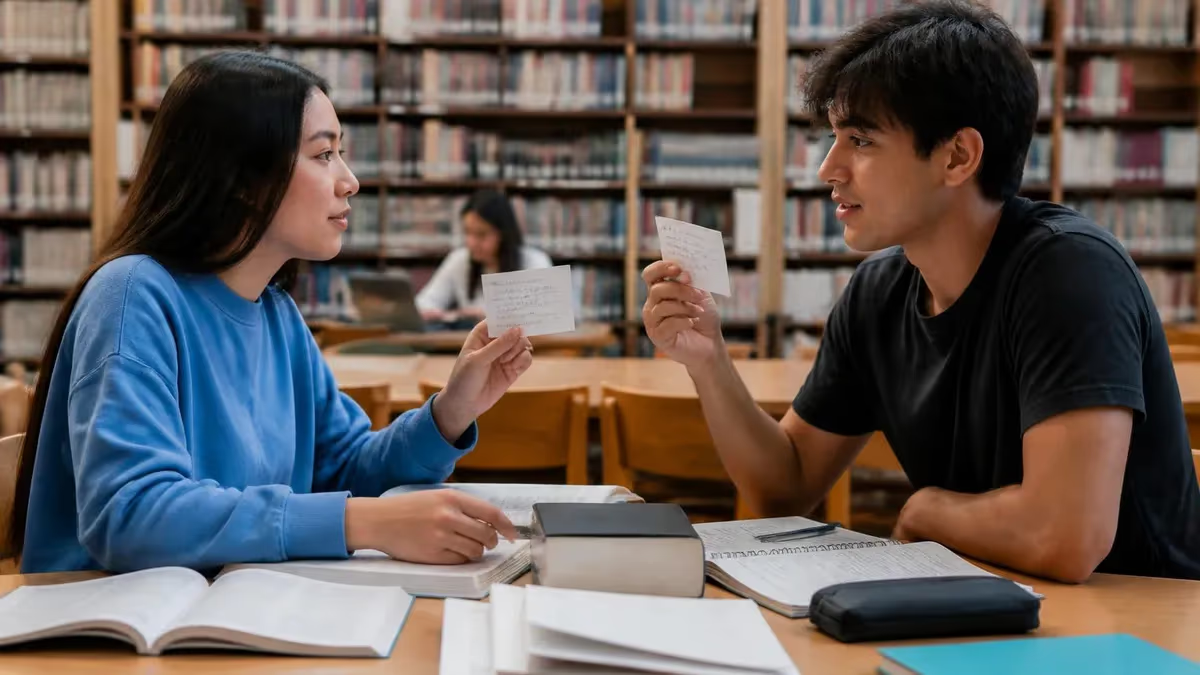
Communication skills for children are among the most powerful tools a parent, teacher, or caregiver can nurture. From the moment a toddler points to a toy they want to the moment a teenager explains why they need more independence, every interaction is built on a foundation of verbal and nonverbal communication. Children who develop strong communication skills early are better equipped to form friendships, succeed academically, resolve conflicts, and advocate for themselves throughout life.
Research consistently shows that language-rich environments in the early years lead to dramatically better outcomes. Children who hear more words, engage in more conversations, and practice expressing their thoughts develop larger vocabularies, stronger reading comprehension, and more sophisticated social reasoning. The gap between children who grow up in communication-rich homes and those who do not can be measured in millions of words heard by age three — a disparity with lasting effects on school readiness and long-term achievement.
But communication is far more than vocabulary. It includes the ability to listen actively, interpret tone and body language, take turns in conversation, ask thoughtful questions, and manage emotions well enough to express them clearly. Children must learn that communication is a two-way street. Speaking is only half the equation; understanding others requires patience, empathy, and focused attention — skills that must be practiced deliberately over many years.
Parents and educators play a central role in modeling these behaviors. When adults narrate their thinking aloud, ask open-ended questions, acknowledge feelings with words, and respond thoughtfully rather than dismissively, they show children exactly what effective communication looks like in real life. Children absorb these patterns long before they can articulate the principles behind them, making consistent modeling one of the highest-impact strategies available to caregivers.
Schools also contribute significantly to communication development. Classroom discussions, reading aloud, group projects, and structured debate all give children practice expressing complex ideas and receiving feedback from peers and teachers. When schools prioritize communication alongside traditional academic subjects, students emerge with a far more complete skill set for navigating college, careers, and civic life. Unfortunately, communication instruction is often treated as a byproduct of other subjects rather than a core competency in its own right.
This article explores the full landscape of communication skill development in children — from the foundational milestones of early childhood through the nuanced social communication demands of adolescence. You will find concrete strategies, research-backed insights, and practical activities that adults can implement immediately. Whether you are a parent trying to help a shy child open up, a teacher designing more engaging discussions, or a caregiver supporting a child with communication delays, the guidance here will help you move forward with confidence and clarity.
For a broader framework on developing these abilities across age groups, the resource on communication skills for children offers a comprehensive roadmap for building verbal fluency and clarity at every developmental stage. The strategies in that guide complement the age-specific approaches covered throughout this article, giving you a layered toolkit for supporting the young communicators in your life.
Children's Communication Development by the Numbers

Communication Milestones from Birth Through Adolescence
Birth to 12 Months: Foundation of Connection
Ages 1–3: First Words and Simple Sentences
Ages 3–5: Storytelling and Social Language
Ages 6–10: Reading, Writing, and Complex Conversations
Ages 11–14: Abstract Thinking and Perspective-Taking
Ages 15–18: Persuasion, Advocacy, and Professional Communication
Understanding the core communication skills children need — and why each one matters — helps adults provide targeted support rather than vague encouragement. The first and most foundational skill is expressive language: the ability to put thoughts, needs, and feelings into words. Children who struggle to express themselves are more likely to resort to tantrums, withdrawal, or aggression, not because they are poorly behaved but because they lack the verbal tools to communicate what they are experiencing internally. Building expressive vocabulary is therefore not just an academic goal — it is a social-emotional intervention.
Active listening is the second core skill, and it is often underestimated. True listening requires more than silence — it demands eye contact, body orientation toward the speaker, the ability to hold attention even when content is difficult, and the mental capacity to summarize and respond to what was said. Children who are strong listeners outperform their peers in reading comprehension, follow classroom instruction more accurately, and build deeper friendships. Listening can be explicitly taught through games like telephone, storytelling circles, and reflective retelling exercises that ask children to repeat or paraphrase what they heard.
Nonverbal communication forms a significant portion of all human interaction, yet it is rarely taught explicitly to children. Reading facial expressions, understanding personal space, using appropriate gestures, and matching body language to the emotional context of a conversation are skills that develop gradually and require direct instruction for many children — especially those on the autism spectrum or those who have grown up in environments where nonverbal cues were ambiguous or inconsistent. Role-playing, watching videos of interactions with the sound off, and discussing how characters feel in picture books all help children tune into this essential dimension of communication.
Emotional regulation and communication are deeply intertwined. A child who is flooded with emotion cannot communicate clearly, and a child who cannot communicate clearly is more likely to become emotionally dysregulated. Teaching children to name their feelings — to say "I feel frustrated" rather than throwing an object — is one of the most evidence-based ways to reduce behavioral problems while simultaneously building communication skill. The feelings vocabulary children develop in early childhood forms a scaffold for the emotional intelligence they will need throughout their lives.
Conversational skills — including turn-taking, topic maintenance, asking follow-up questions, and gracefully changing the subject — are learned through social practice and require a great deal of implicit teaching from attentive adults. Many children need explicit coaching on these dynamics. A child who monopolizes conversation, jumps to unrelated topics, or never contributes at all may simply be missing the mental models for how a good conversation flows. Circle time, structured partner discussions, and family dinners with conversation rules can all be powerful practice grounds.
Written communication emerges as a critical skill during the school years and continues to grow in importance through adolescence and into adulthood. The ability to organize thoughts on paper, adapt writing style to audience and purpose, and revise for clarity are all dimensions of communication that schools spend enormous energy on — and for good reason. Children who write well think well, and thinking well is the foundation of virtually every other communication competency. Journaling, letter writing, and even texting with attention to clarity and tone are all valid practice formats for building this skill.
Finally, public speaking and presentation skills deserve explicit attention even at the elementary level. The fear of speaking in front of others is consistently cited as one of the most common anxieties among adults, and much of that fear can be traced to inadequate practice and negative early experiences. When children regularly present to small groups in supportive environments — sharing a book report, explaining a science experiment, or narrating a personal story — they build the confidence that makes formal presentations far less intimidating later in life. Starting small and building incrementally is the key principle here.
Strategies for Building Communication Skills at Every Age
The single most effective strategy for building communication skills in young children is responsive conversation — talking with children, not just to them. When a toddler points at a dog and says "Dat!", a caregiver who responds with "Yes, that's a big brown dog! He's wagging his tail!" is doing something profoundly powerful: expanding vocabulary, confirming the child's communicative intent, and modeling the art of elaboration. This back-and-forth, sometimes called "serve and return" interaction, builds neural pathways that support language, social skills, and emotional regulation simultaneously.
Reading aloud together every day is equally transformative. Picture books expose children to vocabulary they would rarely encounter in everyday conversation, introduce narrative structure, build comprehension, and invite questions. When caregivers pause to ask "What do you think will happen next?" or "How do you think she feels right now?", they are scaffolding inferential thinking alongside language. Aim for at least 20 minutes of shared reading daily, choosing books slightly above the child's independent reading level to stretch vocabulary and concept understanding in a comfortable, low-pressure context.

Benefits and Challenges of Prioritizing Communication Skill Development
- +Children with strong communication skills form deeper, more stable friendships from an early age
- +Early language development predicts better reading comprehension and academic achievement across all subjects
- +Expressive vocabulary reduces emotional outbursts by giving children words for their inner experience
- +Strong communicators are more confident in new social situations including starting school or joining groups
- +Communication skills compound over time — early investment yields exponentially greater returns in adolescence
- +Children who communicate well are more likely to seek help from adults when facing problems or distress
- −Communication development varies significantly across children, and comparison to peers can create unnecessary anxiety
- −Building strong communication skills requires consistent adult investment of time and intentional energy daily
- −Quiet or introverted children may be misidentified as having communication deficits when they simply have different styles
- −Screen time, if unmanaged, can reduce the face-to-face interactions most critical for communication development
- −Cultural and linguistic differences mean "good communication" looks different across families and communities
- −Children with speech delays or language disorders may need specialized support that generic strategies cannot fully provide
Daily Communication Practice Checklist for Parents and Educators
- ✓Read aloud together for at least 20 minutes every day, pausing to ask prediction and feeling questions
- ✓Use open-ended questions at meals — avoid questions that can be answered with just yes or no
- ✓Name and validate emotions when children are upset, modeling feelings vocabulary in context
- ✓Play listening games like telephone, storytelling circles, or 20 questions to build active listening skills
- ✓Practice turn-taking in conversations explicitly, using a talking object if needed to make the rule concrete
- ✓Encourage children to retell the plot of a movie, book, or event in their own words with a beginning, middle, and end
- ✓Limit passive screen time during mealtimes to protect family conversation opportunities
- ✓Provide low-stakes public speaking practice — let children explain things to guests, read aloud, or present projects
- ✓Role-play challenging social scenarios such as resolving a conflict or introducing yourself to someone new
- ✓Celebrate communicative courage — praise attempts to speak up, ask for help, or express a difficult feeling
The 5:1 Conversation Ratio
Research from the Harvard Center on the Developing Child suggests that the quality of back-and-forth conversational exchanges — not just the quantity of words a child hears — is the most reliable predictor of language development. Aim for five genuine conversational exchanges for every one directive or instruction you give. This simple shift transforms the communication environment without requiring extra time or resources.
Communication challenges in children are common, varied, and highly treatable when identified early. Among the most frequently encountered are speech sound disorders, where children have difficulty producing certain sounds accurately; language disorders, which affect the ability to understand or use words and sentences; and stuttering, which disrupts the flow of speech. Each of these conditions has evidence-based interventions, and the earlier a child receives support, the better the long-term outcomes tend to be. If you notice that a child's communication significantly lags behind developmental milestones, consulting a speech-language pathologist is always the right first step.
Selective mutism is a less well-known but important communication challenge that deserves special attention. Children with selective mutism can speak fluently in some contexts — typically at home with close family — but become entirely silent in other settings, most often school or social gatherings. This is not defiance or shyness; it is an anxiety-based condition that requires specialized intervention. When teachers and parents respond with patience, graduated exposure strategies, and no pressure to speak, most children with selective mutism make significant progress over time with appropriate support.
Social communication disorder, sometimes called pragmatic communication disorder, affects children's ability to use language appropriately in social contexts. These children may have adequate vocabulary and grammar but struggle with the implicit rules of conversation — knowing when to speak and when to listen, how to interpret sarcasm or indirect requests, and how to adjust their communication style for different audiences and relationships. Social communication disorder is often associated with autism spectrum disorder but can also occur independently. Targeted social skills instruction, often delivered in small groups, is the most effective intervention approach.
Anxiety is one of the most underrecognized barriers to communication development in children. A child who is anxious about saying the wrong thing, being laughed at, or failing to meet adult expectations may simply stop trying. Over time, avoidance becomes self-reinforcing — the less the child practices, the less confident they feel, and the more they avoid. Breaking this cycle requires adults to create genuinely low-stakes communication environments where mistakes are normalized and effort is celebrated regardless of outcome. This is especially critical during the middle school years when social judgment from peers is at its most intense.
Bilingual and multilingual children present a unique and frequently misunderstood profile. Code-switching — moving fluidly between two languages within a single conversation — is a sophisticated cognitive skill, not a sign of confusion or delay. Bilingual children may develop vocabulary in each individual language more slowly than monolingual peers simply because they are distributing their learning across two systems, but their total conceptual vocabulary across both languages is typically at or above monolingual norms. Caregivers and educators should celebrate bilingualism as a communication strength and avoid pressuring families to abandon home languages in favor of English.
Children who have experienced adverse childhood experiences — including trauma, neglect, or household instability — often show communication delays and difficulties that are directly linked to those experiences rather than to any innate deficit. When the environment does not support safe, consistent, responsive interaction, the neurological systems that underpin communication development are compromised. Trauma-informed approaches to communication support recognize this connection and focus on creating safety, predictability, and relationship before targeting specific communication skills. Healing the relationship is often a prerequisite for building the skills.
For educators, the most impactful systemic intervention is creating classroom environments where all forms of communication are valued and practiced across every subject area. Reading and writing are universal — but so are speaking and listening. When science class includes structured discussion of experimental findings, when history includes debate of multiple perspectives, and when math class includes students explaining their reasoning aloud, communication development becomes embedded in the curriculum rather than siloed in one class. This integration approach produces markedly stronger communicators and simultaneously deepens content learning.

If a child is not meeting key communication milestones — such as using at least 50 words by 24 months, combining words by 30 months, or being understood by strangers at least 75% of the time by age four — an evaluation by a licensed speech-language pathologist is strongly recommended. Early intervention is far more effective than a wait-and-see approach, and evaluations are typically available at no cost through public school systems in the United States for children aged three and older under the Individuals with Disabilities Education Act.
Practical activities are where communication skill-building moves from theory to lived experience, and the best activities feel like play rather than instruction. One of the most versatile and research-supported tools for early childhood is dramatic play, sometimes called pretend play or imaginative play.
When children play house, doctor, or grocery store, they are practicing real communicative functions — giving instructions, making requests, negotiating roles, and narrating events — in a low-stakes environment where they control the narrative. Adults can expand the complexity of dramatic play by joining in, introducing new vocabulary, and posing problems that require the children to communicate their way to a solution.
Storytelling activities are powerful at every age. For young children, sequencing picture cards and narrating the story builds narrative structure. For school-age children, story starters and round-robin storytelling develop creativity, turn-taking, and coherent organization of ideas. For teenagers, writing and sharing personal narratives, opinion pieces, or fictional stories builds the synthesis of thinking and writing that underlies all advanced communication. When families make storytelling a regular dinner-table ritual — taking turns sharing the best part of the day or inventing a collaborative bedtime story — they build communication skills effortlessly and joyfully.
Board games and card games offer a surprisingly rich communication curriculum. Games like Taboo, Articulate, Story Cubes, and Codenames require players to describe, explain, infer, and strategize — all in real time with real social stakes. Even traditional games like Scrabble and Boggle build vocabulary in a motivating context. The key is choosing games that require verbal interaction rather than solitary or screen-based play. Family game night, when communication games are part of the rotation, can be one of the most productive and enjoyable communication development environments available to families.
Debate and discussion activities are particularly valuable for older children and teenagers. Structured academic controversy — a technique where students argue one side of an issue, then switch and argue the opposite side — builds perspective-taking, evidence-based argumentation, and flexibility of thinking simultaneously. Even informal dinner-table debates about low-stakes topics ("Was the movie good or not and why?") give children practice constructing and defending arguments in a supportive environment. The goal is not to win but to practice the mechanics of reasoned communication.
Technology, when used thoughtfully, can be a powerful ally in communication development. Podcasting projects let children research a topic and present it in audio format, building both content knowledge and verbal fluency. Video journals encourage children to articulate their thoughts and feelings on camera. Text-based creative writing platforms connect children with authentic audiences for their writing. The key distinction is between passive consumption of content — which provides minimal communication development benefit — and active creation of content, which demands that children communicate something to someone for a real purpose.
Community service and real-world projects create communication demands that feel genuinely meaningful to children and teenagers. When a student has to write a letter to a local official, present a proposal to the school board, or interview a community member for a local history project, the communication is authentic and the stakes feel real. This kind of project-based communication practice produces deeper skill development than drill exercises precisely because the child has a genuine reason to communicate clearly and persuasively. Connecting communication development to real-world impact is one of the most motivating and effective strategies available to educators.
Finally, it is worth remembering that communication development is not a race. Children develop at different rates, in different sequences, and with different strengths. The child who is a quiet, careful listener may be developing communication skills just as robustly as the child who talks constantly — just in different dimensions.
The goal is not to produce children who are loud, outgoing, or verbose but to equip every child with the full range of communication tools they need to navigate their specific life with confidence, clarity, and connection. Celebrating each child's unique communication style while gently expanding their repertoire is the most respectful and effective approach of all.
Putting all of this into practice requires a shift in how adults think about their role in children's communication development. Rather than waiting for problems to emerge and then seeking remediation, the most effective approach is proactive — creating environments and routines that build communication skills continuously as a natural part of everyday life. This starts with the recognition that every interaction is a communication learning opportunity. The way an adult responds to a child's question, manages a conflict, or expresses their own emotions is simultaneously a lesson in how communication works in the real world.
One of the most transformative practices adults can adopt is genuinely listening to children — not performatively listening while mentally composing a response, but actually suspending judgment, maintaining eye contact, and fully receiving what the child is communicating before responding. When children experience this quality of listening from adults, two things happen simultaneously: they feel valued and understood, which strengthens the relationship and their willingness to communicate; and they internalize a model of attentive listening that they then begin to replicate in their own interactions with peers and others. The adult's listening practice becomes the child's listening education.
Consistency is the most important ingredient in communication development. One exceptional dinner conversation does not build a strong communicator. One brilliant classroom discussion does not either. What builds strong communicators is the daily accumulation of hundreds of small interactions over many years — conversations that model curiosity, respect, clarity, and genuine engagement. Adults who commit to consistent, intentional communication practices over the long term see the most dramatic results in the children they work with, even when the individual interactions seem unremarkable in the moment.
It is also important to create explicit opportunities for children to reflect on their own communication. Asking a child "How do you think that conversation went?" or "What would you say differently next time?" builds metacommunicative awareness — the ability to observe and evaluate one's own communication as it is happening. This metacognitive layer is what separates communicators who grow continuously from those who plateau. Children who develop this self-awareness become self-directed learners of communication, continually refining their approach based on their own observations and the feedback they receive from others.
Setting communication goals with children — especially older children and teenagers — can be highly motivating. A goal might be as simple as "I will try to ask one follow-up question in every conversation this week" or as ambitious as "I will join the debate team this semester." When children participate in setting their own communication goals and tracking their progress, they develop ownership over their development and are more likely to sustain effort over time. Adults serve best in this process as coaches and encouragers rather than evaluators or critics.
Cultural humility is an essential component of supporting communication development in diverse communities. What counts as good communication varies across cultures in ways that are profound and non-obvious — different cultures have different norms around eye contact, directness, the appropriate role of silence, the relationship between speakers of different ages or statuses, and the expression of disagreement. Adults who work with children from cultural backgrounds different from their own must approach these differences with genuine curiosity and respect rather than assuming that the dominant cultural norms represent universal standards of communicative competence.
The long view is essential. Communication skills are not a destination but a lifelong journey of refinement and growth. Adults who themselves continue to develop as communicators — who read widely, seek feedback, practice difficult conversations, and remain curious about how language and meaning work — model the most important lesson of all: that communication is a craft worth cultivating at every stage of life. When children see the adults around them committed to this ongoing development, they receive permission and inspiration to remain learners themselves throughout their own lives as communicators.
Communication Skills Questions and Answers

How to Improve Verbal Communication Skills: A Complete Guide to Speaking with Clarity and Confidence

Communication Skills CV: How to List, Describe, and Prove Your Abilities to Employers

Advanced Communication Skills: How to Master High-Impact Conversations, Persuasion, and Professional Influence

Communication Skills Resume: How to Showcase Communication Abilities and Land More Interviews in 2026

Receptive Communication Skills: How to Listen, Understand, and Respond Effectively
About the Author

Educational Psychologist & Academic Test Preparation Expert
Columbia University Teachers CollegeDr. Lisa Patel holds a Doctorate in Education from Columbia University Teachers College and has spent 17 years researching standardized test design and academic assessment. She has developed preparation programs for SAT, ACT, GRE, LSAT, UCAT, and numerous professional licensing exams, helping students of all backgrounds achieve their target scores.