
COA Sample Questions 2026 October: Practice Tests for the Certified Ophthalmic Assistant Exam
Master your COA exam with free coa sample questions covering all domains. Practice tests, tips & study tools. 🎯 Start now!
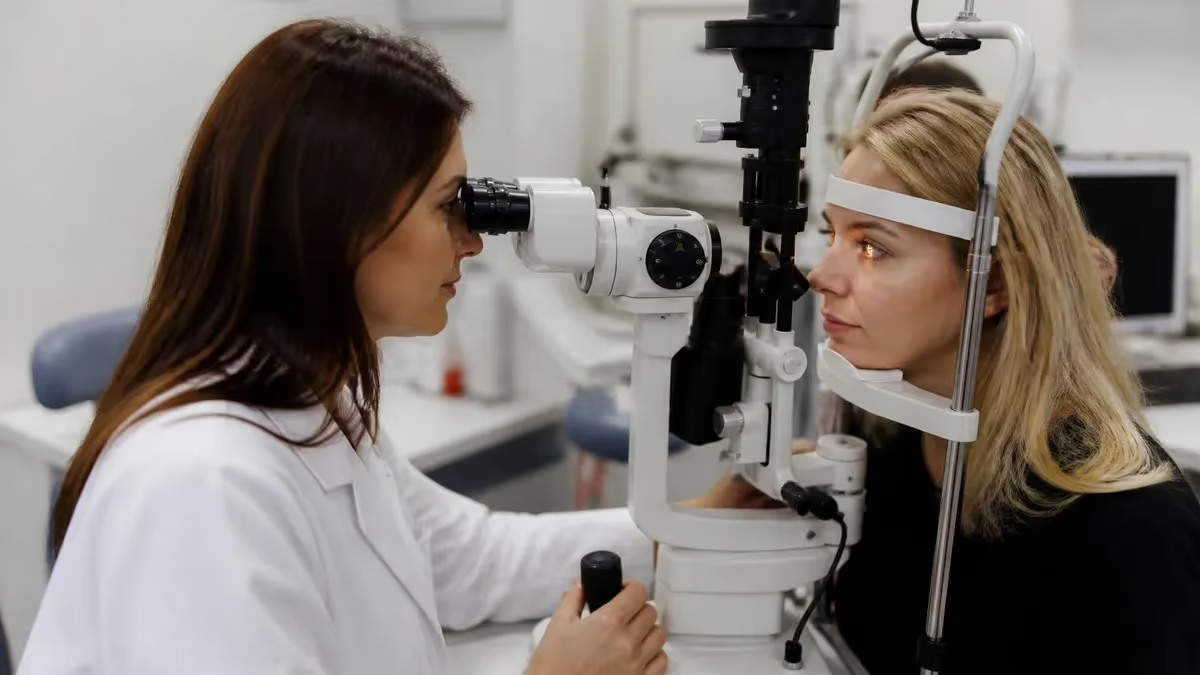
If you are preparing for the Certified Ophthalmic Assistant examination, working through high-quality coa sample questions is the single most effective study strategy you can adopt. The COA credential, awarded by the Joint Commission on Allied Health Personnel in Ophthalmology (JCAHPO), validates that ophthalmic assistants possess the foundational clinical knowledge needed to support safe patient care. Understanding the coa meaning in a professional context — it stands for Certified Ophthalmic Assistant — is just the beginning; the real challenge is mastering the breadth of content tested across seven major domains on exam day.
Many candidates wonder how these practice questions differ from the real exam. Authentic COA-style questions mirror the scenario-based format used by JCAHPO, presenting brief clinical vignettes and asking you to select the best action, identify the correct instrument, or interpret a diagnostic result. When you encounter questions that feel unfamiliar, that discomfort signals exactly where additional study time belongs. Consistent exposure to timed sample questions also builds the mental stamina needed to work through 200 items without fatigue affecting your accuracy in the final hour.
The COA exam covers a wide range of ophthalmic topics, from basic ocular anatomy and visual acuity measurement to contact lens fundamentals, pharmacology, and patient communication. Each domain carries a different weight, so understanding which sections contribute most to your total score helps you allocate study hours strategically. Tonometry, refractometry, and ocular motility together represent a substantial portion of the exam — neglecting any one of these areas can meaningfully lower your final result.
Beyond content knowledge, test-taking strategy matters enormously. Experienced candidates know to read every answer choice before committing, to eliminate obviously incorrect options first, and to flag uncertain questions for review rather than spending excessive time on a single item. Reviewing your coa sample questions performance after each timed session helps you track improvement week over week and identify persistent weak spots before test day arrives.
The COAs who pass on the first attempt share a common trait: they combine structured content review with repeated, realistic practice testing rather than relying on passive reading alone. Active recall — the cognitive process triggered when you attempt an answer before checking the key — produces stronger long-term retention than rereading notes or watching instructional videos. This is why building a daily habit around sample question sets produces dramatically better outcomes than a single intensive cram weekend.
This page brings together the most comprehensive collection of free COA practice resources available online in 2026. You will find topic-specific quiz sets, exam-format tables, domain-by-domain study guidance, and actionable preparation timelines — everything you need to walk into the testing center with confidence. Whether you are sitting for your first attempt or retaking the exam after a previous try, the structured approach outlined here will help you make the most of every study hour and achieve the passing score that advances your ophthalmic career.
COA Certification by the Numbers
Key Facts at a Glance
| Item | Value | Details |
|---|---|---|
| Total Exam Questions | 200 | Multiple choice format |
| Exam Duration | 3.5 hrs | Includes break time |
| Exam Application Fee | $175 | JCAHPO member rate |
| Content Domains Tested | 7 | Weighted by importance |
COA Exam Format & Domain Breakdown
| Section | Questions | Time | Weight | Notes |
|---|---|---|---|---|
| History Taking & Patient Communication | 30 | ~30 min | 15% | Includes documentation skills |
| Visual Assessment & Testing | 40 | ~42 min | 20% | Visual acuity, color vision, fields |
| Ocular Motility & Alignment | 24 | ~25 min | 12% | Cover tests, prism, strabismus |
| Tonometry & Glaucoma Screening | 24 | ~25 min | 12% | IOP measurement techniques |
| Contact Lens Fundamentals | 20 | ~21 min | 10% | Fitting, care, complications |
| Ocular Pharmacology | 30 | ~30 min | 15% | Drug classes, side effects, instillation |
| General Medical Knowledge | 32 | ~35 min | 16% | Anatomy, optics, microbiology |
| Total | 200 | 3.5 hours | 100% |
Understanding how to use COA sample questions effectively is just as important as having access to them. Many candidates make the mistake of reading a question, checking the answer immediately, and moving on without absorbing the reasoning behind the correct choice. This passive approach produces very little lasting retention. Instead, treat every practice session as a genuine testing simulation: set a timer, commit to your answer before looking at the key, and write a brief note explaining why each wrong answer is incorrect — not just why the right one is right.
Spaced repetition is the most evidence-backed technique for retaining clinical vocabulary and procedural details over time. Rather than grinding through 100 questions in a single sitting and then taking a week off, aim for 20 to 30 questions every day across a six to eight week window. This consistent low-volume approach exploits the brain's natural consolidation processes, ensuring that concepts reviewed on Monday resurface automatically when you encounter related questions on Friday. Apps like Anki can help automate the spacing intervals, but even a simple paper flashcard system works well for ophthalmic terminology.
Categorize your errors as you practice. A wrong answer caused by misreading the question stem is a test-taking problem, not a knowledge gap — slow down and reread more carefully. A wrong answer caused by confusing applanation tonometry with non-contact tonometry is a content problem that requires returning to your textbook or review notes. Keeping a running error log organized by domain lets you generate a personalized study list of exactly the concepts that have tripped you up, so you can prioritize them in the final two weeks before your exam date.
Timed full-length simulations become critical in the final three to four weeks of your preparation. Working through 200 questions in one sitting reveals stamina weaknesses you would never detect through shorter daily sessions. Many candidates discover they perform well on isolated topic sets but lose 5 to 10 percentage points during a full simulation simply because concentration drifts after the first 90 minutes. Identifying that problem early — and training yourself to maintain focus through short mindfulness techniques or strategic pacing — can be the difference between passing and falling just below the cut score.
Collaborative study is an underrated tool for COA candidates. Forming a small study group of two or three colleagues preparing for the same exam allows you to quiz each other verbally, debate ambiguous answer choices, and explain concepts out loud — a process that forces deeper encoding than silent reading. When you can teach a concept clearly enough that a peer understands it, you have genuinely mastered it. Group sessions also introduce accountability: knowing others expect you to show up prepared makes it far less likely you will skip a study day.
Pay close attention to the language JCAHPO uses in official practice materials. Terms like "most appropriate," "first action," and "best response" signal that multiple answers might seem plausible but only one fits the clinical context precisely. Learning to detect these qualifier words and think through the scenario at a slightly slower pace prevents the common error of selecting the first answer that sounds familiar rather than the answer that best addresses what the question is actually asking. This metacognitive habit is one of the clearest predictors of first-attempt success on credentialing exams.
Finally, make liberal use of the free domain-specific quizzes available on this page. Each set is mapped to a specific COA content domain, so after identifying your weakest area through a diagnostic full-length simulation, you can target exactly that domain with focused practice. Review performance data across multiple quiz sessions to confirm that your scores in a given area are trending upward before shifting your attention to the next priority. A systematic, data-driven approach to sample question practice transforms preparation from an anxious guessing game into a confident, measurable process with a clear finish line.
COA Meaning: Core Topic Areas Explained
Tonometry is the measurement of intraocular pressure (IOP) and represents one of the highest-yield topics on the COA exam. Candidates must know the operating principles behind Goldmann applanation tonometry, the non-contact air-puff method, and the Tono-Pen. Normal IOP ranges from 10 to 21 mmHg, and values consistently above that threshold — combined with optic nerve findings and visual field changes — contribute to a glaucoma diagnosis. Questions frequently test instrument calibration, patient positioning, and the role of corneal thickness in IOP accuracy.
Understanding the different glaucoma subtypes helps candidates navigate scenario-based questions efficiently. Primary open-angle glaucoma is the most common form in the United States and progresses silently, making routine screening critical. Narrow-angle or acute angle-closure glaucoma presents with sudden eye pain, nausea, and dramatically elevated IOP — a medical emergency requiring immediate intervention. COA exam questions on this topic often test whether the candidate recognizes the emergency scenario and knows the correct first response, including when to refer to the supervising ophthalmologist.

COA Sample Questions: Practice Tests vs. Textbook-Only Study
- +Active recall during practice questions encodes information far more durably than passive reading
- +Timed question sets build exam stamina and reduce test-day anxiety significantly
- +Instant feedback after each question pinpoints knowledge gaps before the actual exam
- +Domain-specific sets allow targeted remediation of weak subject areas
- +Repeated exposure to exam-style phrasing trains you to interpret question stems accurately
- +Progress tracking across multiple sessions provides measurable evidence of improvement
- −Low-quality sample questions with inaccurate answer keys can reinforce incorrect knowledge
- −Over-reliance on practice tests without content review leaves foundational gaps unfilled
- −Question fatigue from excessive daily volume can reduce the quality of each practice session
- −Without error analysis, repeating the same mistakes across sessions produces no improvement
- −Sample questions cannot replicate the precise difficulty calibration of the real JCAHPO exam
- −Candidates who memorize answer patterns rather than understanding concepts often struggle with novel scenarios
COA Exam Preparation Checklist
- ✓Obtain the current JCAHPO COA Candidate Handbook and review all domain weights before studying
- ✓Complete a full-length diagnostic practice test to establish your baseline score by domain
- ✓Create a six-to-eight week study calendar with specific topics assigned to each day
- ✓Study ocular anatomy diagrams until you can label all major structures from memory
- ✓Practice Goldmann applanation tonometry technique on a simulation model or with a mentor
- ✓Work through at least 20 targeted sample questions per domain per study week
- ✓Review all commonly used ophthalmic drugs, their drug classes, indications, and side effects
- ✓Practice documenting patient histories using standardized SOAP note format
- ✓Complete two full-length timed simulations (200 questions each) in the final four weeks
- ✓Analyze every wrong answer, categorize the error type, and add the concept to your review list

The 70% Rule: Your Practice Score Benchmark
JCAHPO does not publish the exact passing score for the COA exam, but most candidates who pass consistently score 70% or higher on full-length practice simulations in the weeks before their test date. If your practice scores plateau below 65%, prioritize domain-specific remediation over additional full-length tests — targeted content review followed by focused practice sets will move your score more efficiently than repeating simulations without addressing root knowledge gaps.
A domain-by-domain study strategy is the most efficient path to a passing COA score, and understanding the relative weight of each content area is the starting point for building that strategy. The general medical knowledge and visual assessment domains together account for roughly 36 percent of the total exam, making them the highest-priority areas for most candidates. If your diagnostic practice test reveals weaknesses in either domain, front-load your study schedule with intensive review of those areas before moving on to domains that are already close to your target performance level.
Ocular pharmacology is frequently underestimated by first-time COA candidates who focus almost exclusively on hands-on clinical skills. The exam tests drug knowledge in meaningful depth, including the mechanism of action of beta-blockers used to lower intraocular pressure, the indications for cycloplegic agents during refraction, the signs of allergic versus toxic reactions to topical medications, and the correct procedure for instilling eyedrops without contaminating the bottle tip. Candidates who neglect pharmacology often find themselves losing 10 or more points in a domain they could have mastered with two dedicated study weeks.
Patient history and documentation is another domain where clinical experience alone is not sufficient preparation. The exam tests specific knowledge about chief complaint documentation, the components of a complete ocular history, techniques for eliciting reliable symptom descriptions from patients with communication barriers, and the legal requirements surrounding informed consent and HIPAA-compliant recordkeeping. Many working ophthalmic assistants are surprised to discover that their day-to-day documentation habits do not always align with the textbook-correct approaches tested on the credentialing exam.
The ocular motility and alignment domain requires candidates to understand cover testing technique, the difference between a phoria and a tropia, how to use a prism bar to measure deviation, and the clinical significance of different strabismus patterns.
Questions in this domain are often scenario-based, presenting a child with an observable eye turn and asking the candidate to identify the most appropriate initial assessment step or to interpret the result of a cover-uncover test. Practicing these scenarios verbally — explaining your reasoning out loud as if you were teaching a colleague — cements the procedural logic more effectively than silent reading.
Contact lens knowledge ties directly into patient safety competencies, and the exam reflects that emphasis. Beyond the mechanics of lens fitting, candidates must understand the risk factors for contact lens-related infections, the red flags that should prompt immediate lens removal and urgent evaluation, and the communication strategies that improve patient adherence to wearing and care schedules. The COA plays a frontline role in contact lens patient education, and the exam rewards candidates who understand that role in its full clinical context rather than treating contact lenses as a purely technical topic.
Visual field assessment is a subtopic within the visual assessment domain that warrants dedicated attention. Confrontation fields can detect gross defects quickly in a clinical setting, but automated perimetry produces the quantitative data ophthalmologists use for glaucoma monitoring and neuro-ophthalmology workup.
COA candidates should understand when each method is appropriate, how to position and instruct patients for reliable results, and how to recognize common artifacts and fixation errors that can invalidate a visual field test. Questions about visual field patterns associated with specific neurological lesions — such as bitemporal hemianopia in pituitary tumors — appear with enough regularity that committing the classic patterns to memory is well worth the study time.
The COAS credential — the Certified Ophthalmic Assistant Specialist designation sometimes confused with the standard COA — represents an advanced level in the JCAHPO career ladder, but understanding the terminology helps candidates navigate study resources correctly and avoid wasting time on material above their current exam level. Stick to the COA content outline when selecting study materials and practice questions, and resist the temptation to study COT-level content before you have thoroughly mastered COA domains. Building a deep, confident foundation at the COA level is the fastest route to both certification and long-term career advancement in ophthalmic care.
JCAHPO requires candidates to document at least one year of full-time work experience under physician supervision before sitting for the COA exam. Applications typically must be submitted six to eight weeks before your desired testing window, and incomplete applications are returned without review — missing a deadline can delay your exam by an entire testing cycle. Verify your eligibility and submission deadlines directly at the JCAHPO website before scheduling study time around a specific test date.
Exam-day strategy begins the night before your scheduled test date, not in the waiting room of the testing center. Experienced COA candidates know that arriving without a concrete plan for pacing, managing uncertainty, and maintaining focus is a significant risk — one that sample question practice directly addresses.
During your timed practice simulations, experiment with different time-management approaches: some candidates prefer to work straight through at a steady pace of approximately one minute per question, flagging difficult items for a second-pass review. Others prefer to complete the questions they feel confident about first and return to harder items with remaining time.
On test day, the check-in process at a Pearson VUE or similar proctored testing center involves biometric identification, a brief tutorial on the computer interface, and a short orientation period before your clock starts. Use the tutorial time to orient yourself to the flagging feature, the question review panel, and the answer-change mechanism — these tools can save meaningful time if you know how to use them without thinking. Candidates who skip the tutorial and dive immediately into question one sometimes discover interface features mid-exam and lose time learning the system under pressure.
Managing test anxiety during the actual exam requires the same techniques you practiced during your simulations. If you encounter a question that seems completely unfamiliar, do not dwell on it — flag it, make your best educated guess, and move forward.
Stalling on a single difficult question can trigger a cascade of time pressure that affects your performance on the next 20 items, which may all fall within your areas of strength. Consistent forward momentum, combined with a disciplined second-pass review of flagged items, outperforms any approach that treats individual hard questions as problems to be solved at the expense of the overall exam.
Nutrition and sleep in the 48 hours before your exam have a measurable effect on cognitive performance that most candidates dramatically underestimate. Cognitive fatigue from poor sleep degrades the working memory functions most heavily taxed by clinical scenario questions — the ability to hold multiple facts in mind simultaneously while evaluating answer choices.
Aim for at least seven hours of sleep the night before the exam, eat a balanced breakfast with protein and complex carbohydrates on test morning, and bring a light snack for the optional break if your exam format allows one. Hydration matters as well — even mild dehydration reduces concentration and increases error rates on timed cognitive tasks.
Post-exam, JCAHPO typically delivers preliminary pass/fail results at the testing center immediately after you complete the exam on a computer-based testing platform. Official score reports follow by mail or through the JCAHPO online portal within a few weeks. If you pass, your COA certificate and wallet card will arrive within 45 to 60 days.
If you do not pass, the score report will include a domain-by-domain performance breakdown that identifies your weakest areas — use that feedback to build a targeted remediation plan before scheduling your retake. JCAHPO allows multiple retake attempts, and candidates who approach a retake with a structured, data-driven study plan based on their diagnostic score report consistently improve their outcomes.
Continuing education requirements keep the COA credential current after you earn it. JCAHPO requires 36 hours of continuing ophthalmic education every three years for recertification, with specific requirements for clinical topics. Staying engaged with continuing education not only satisfies recertification but also keeps your clinical knowledge current as ophthalmic technology evolves — an important career benefit that compounds over time. Many COA holders find that the same disciplined study habits that helped them pass the initial exam serve them well throughout a continuing education regimen that supports career growth toward the COT and COMT levels.
The journey from COA candidate to certified professional is challenging but entirely achievable with the right combination of content mastery, strategic practice, and consistent effort. The resources on this page — including domain-specific quiz sets, preparation checklists, and study schedules — give you everything needed to build a preparation plan that fits your schedule and addresses your individual knowledge gaps. Use them consistently, track your progress honestly, and approach your exam date knowing that thorough, evidence-based preparation is the most reliable predictor of success on the COA credentialing examination.
If you want more targeted practice, the coa practice test page covers the same material with additional questions and explanations.
Practical preparation tips for the final two weeks before your COA exam focus on consolidation rather than new learning. By the time you enter the final fortnight of your study schedule, you should have covered all seven content domains at least twice. The goal now is to reinforce high-yield concepts, shore up any remaining weak areas identified through your practice data, and transition your mental state from learning mode to performance mode. Avoid introducing unfamiliar textbooks or entirely new study resources at this stage — the cognitive disruption of switching systems outweighs any marginal benefit from a new source.
Review your error log every other day during the final two weeks, spending the bulk of your time on concepts you have consistently missed rather than topics you already answer correctly. Focus particularly on questions where you understood the topic but selected the wrong answer due to misreading the stem — these represent easy points you can recover by slowing down and reading more carefully on exam day. Simulate that deliberate reading pace during your final practice sessions so it becomes automatic under pressure.
Mnemonics and visual memory anchors help lock in high-density factual lists that are difficult to retain through understanding alone. The classes of glaucoma medications, the layers of the cornea in order from anterior to posterior, the cranial nerves controlling extraocular movements, and the components of a complete ocular history all lend themselves to mnemonic devices. Creating your own mnemonic is more effective than borrowing someone else's, because the creative effort of constructing it forces deeper engagement with the underlying material.
If you have access to a mentor or supervising ophthalmologist, request feedback on your clinical technique in the areas most tested on the COA exam. Watching a more experienced colleague perform Goldmann tonometry or a cover test and then attempting it yourself with their real-time feedback accelerates skill consolidation in ways that no practice question can replicate. The COA exam tests clinical knowledge through multiple-choice questions, but the conceptual understanding that enables correct answers is grounded in hands-on clinical experience.
On the night before your exam, prepare everything you need to bring — your identification documents, any required authorization materials from JCAHPO, your testing center address, and a light snack. Lay out your clothes, confirm your transportation plan, and set an alarm that gives you comfortable time to arrive 15 to 20 minutes early. Arriving rushed or uncertain about logistics adds unnecessary stress that competes with the focused mental clarity you want to bring to the first question. Treat exam morning as you would any important professional appointment that requires calm, prepared readiness rather than last-minute scrambling.
After completing the exam, resist the urge to immediately compare answers with fellow candidates in the parking lot. Post-exam item discussion is almost always counterproductive — it surfaces ambiguous questions, introduces doubt about answers you felt confident in, and adds anxiety during a waiting period you cannot do anything to change.
Instead, do something restorative: take a walk, have a good meal, spend time with supportive people in your life. If the result is a pass, celebrate it genuinely — earning the COA credential reflects months of disciplined effort and real clinical competence. If a retake is needed, the domain-level score report will give you a precise, actionable roadmap for the next attempt.
The COA credential opens tangible career doors: higher earning potential, expanded clinical responsibilities, recognition by supervising physicians, and a foundation for advancement toward the Certified Ophthalmic Technician (COT) and Certified Ophthalmic Medical Technologist (COMT) levels. Every hour invested in high-quality sample question practice and structured content review is an investment in a credential that will serve your ophthalmic career for years. Start your practice sessions today, track your progress systematically, and approach your exam date with the confidence that comes from thorough, evidence-based preparation.
Sample COA - Certified Ophthalmic Assistant Practice Questions
Try these questions from our free COA - Certified Ophthalmic Assistant practice tests. The correct answer and an explanation follow each question.
Which test best evaluates for a latent deviation (phoria) that is only revealed when binocular fusion is disrupted?
- A. Cover-uncover test
- B. Hirschberg corneal reflex test
- C. Alternate cover test
- D. Maddox rod test only
Answer: C. Alternate cover test
The alternate cover test rapidly moves the occluder from eye to eye, preventing fusion and revealing both manifest (tropia) and latent (phoria) deviations. The cover-uncover test reveals only manifest deviations.
During the cover-uncover test, the examiner covers the right eye. The left eye moves outward (temporally) to pick up fixation. This finding MOST likely indicates:
- A. Left esotropia
- B. Left exotropia
- C. Right hypertropia
- D. Orthophoria
Answer: A. Left esotropia
If the uncovered (left) eye moves outward when the right eye is covered, the left eye was turned inward (esotropia) before coverage. The outward refixation movement reveals a manifest inward deviation of the left eye.
The Hirschberg test estimates the angle of strabismus by observing corneal light reflections. If the corneal reflex appears at the pupil margin of the right eye and centered in the left eye, approximately how many prism diopters of deviation is estimated?
- A. 5–10 prism diopters
- B. 15–20 prism diopters
- C. 30–45 prism diopters
- D. 60–80 prism diopters
Answer: B. 15–20 prism diopters
In the Hirschberg test, a decentered corneal light reflex at the pupil margin corresponds to approximately 15 prism diopters (pd) of deviation. Each millimeter of decentration equals approximately 15 pd (some sources use 7° or 22 pd/mm depending on reference).
During a swinging flashlight test, an ophthalmic assistant observes that the patient's right pupil dilates when the light is moved from the left eye to the right eye. Which of the following does this finding indicate?
- A. Physiologic anisocoria
- B. A left oculomotor nerve palsy
- C. A right efferent pupillary defect
- D. A right afferent pupillary defect (APD)
Answer: D. A right afferent pupillary defect (APD)
The swinging flashlight test is used to detect a relative afferent pupillary defect (RAPD or APD), also known as a Marcus Gunn pupil. This defect indicates a problem with the afferent pathway (optic nerve). When light is swung from the normal eye to the affected eye, the affected pupil receives a weaker signal to constrict and will paradoxically dilate.
Take the full COA - Certified Ophthalmic Assistant practice test
COA Questions and Answers

COA 2025 Results: Complete Guide to COA Exam Scores, Pass Rates & Next Steps

COA Practice Questions 2026: Complete Study Guide for Certified Ophthalmic Assistant Exam Prep

COA Certification Online: Complete Training Guide & Requirements for 2026

COA Study Guide PDF: Complete Prep Guide for the Certified Ophthalmic Assistant Exam

What Does a COA Do? Complete Career Guide for Certified Ophthalmic Assistants
About the Author

Educational Psychologist & Academic Test Preparation Expert
Columbia University Teachers CollegeDr. Lisa Patel holds a Doctorate in Education from Columbia University Teachers College and has spent 17 years researching standardized test design and academic assessment. She has developed preparation programs for SAT, ACT, GRE, LSAT, UCAT, and numerous professional licensing exams, helping students of all backgrounds achieve their target scores.
Join the Discussion
Connect with other students preparing for this exam. Share tips, ask questions, and get advice from people who have been there.
View discussion (7 replies)