
CNG Vehicles For Sale: Complete Buyer's Guide to New, Used, and Converted Natural Gas Cars and Trucks
📗 Shopping for CNG vehicles for sale? Compare new, used, and bi-fuel natural gas cars and trucks, prices, dealers, conversions, and total cost of ownership.

Searching for cng vehicles for sale in 2026 looks very different than it did a decade ago, and that surprises most first-time shoppers. While dedicated factory CNG passenger cars like the Honda Civic GX have been discontinued, the secondary market is rich with low-mileage fleet trade-ins, OEM bi-fuel pickups, upfitted vans, and aftermarket-converted sedans. Buyers can routinely find compressed natural gas vehicles priced 20 to 40 percent below their original sticker, often with maintenance records that put gasoline-only equivalents to shame.
The reasons people shop CNG have not changed much: dramatically lower fuel costs, cleaner tailpipe emissions, and access to HOV lanes in several states. What has changed is the supply mix. Today the bulk of cng vehicles for sale come from fleet operators rotating equipment, municipal auctions, and specialty dealers in Oklahoma, Texas, Utah, and California where infrastructure is densest. Understanding where these vehicles come from helps you negotiate smarter and avoid overpaying for a tank that may be approaching its 15 or 20 year retirement date.
This buyer's guide walks you through every meaningful decision: dedicated versus bi-fuel, OEM versus converted, new versus used, and light-duty pickup versus heavy-duty work truck. We compare fuel economy on a gasoline gallon equivalent (GGE) basis, explain tank inspection cycles required by federal law, and break down the EPA emissions certification paperwork that determines whether a converted vehicle is even legal to register in your state. If you want a foundation in the fuel itself, our overview of What Is CNG? A Plain-English Guide to Compressed Natural Gas is a good companion read.
Pricing varies wildly. A 2014 Honda Civic Natural Gas with 90,000 miles can sell for $7,500 in Tulsa and $11,000 in Los Angeles. A converted 2020 Ford F-250 bi-fuel pickup might list at $34,000 while the gasoline-only twin trades for $28,000 — the $6,000 spread reflecting the conversion cost. Cargo vans from Ford, Chevrolet, and Ram dominate the work-truck listings, and Class 8 over-the-road tractors with Cummins Westport ISX12N engines round out the heavy-duty market.
Safety, often the first question new buyers ask, is well-documented. CNG tanks are pressure-tested to 4,500 psi, vented away from cabins, and have a stronger crash record than gasoline tanks in head-on and rear-impact tests. NHTSA data and NFPA 52 compliance govern installation. The vehicles do require periodic visual and structural tank inspections every three years or 36,000 miles, and tanks must be retired at their stamped expiration — usually 15 years from the date of manufacture for Type 3 and Type 4 cylinders.
Finally, financing and incentives can swing the math significantly. Some states still offer alternative fuel vehicle tax credits, utility companies in Oklahoma and Utah offer rebates on home refueling appliances, and the federal Alternative Fuel Vehicle Refueling Property Credit covers up to 30 percent of station equipment. By the end of this guide you will know what to look for on a listing, what to ask a seller, and how to compare total cost of ownership against a gasoline or diesel alternative.
CNG Vehicles For Sale by the Numbers

Types of CNG Vehicles You Can Buy Today
Runs exclusively on compressed natural gas. Single fuel system, single tank type, optimized engine calibration. Best fuel economy and emissions, but limited to range of CNG infrastructure in your area.
Carries both a gasoline tank and a CNG tank, switching between fuels at the touch of a dashboard button. Most common configuration for pickups and vans because it eliminates range anxiety.
Built on the assembly line by Ford, GM, or Ram with EPA and CARB certification baked in. Honda Civic GX (2012-2015) is the classic example. Resale value holds well because paperwork is clean.
A gasoline vehicle modified by an EPA-certified upfitter using approved kits. Common on Ford F-250/F-350, Chevy Silverado 2500HD, and full-size vans. Quality depends entirely on the installer.
Class 6, 7, and 8 trucks with Cummins Westport ISX12N or L9N engines. Refuse trucks, transit buses, and over-the-road sleeper cabs dominate this segment with strong fleet trade-in availability.
Deciding between new and used cng vehicles for sale comes down to three variables: budget, intended use, and whether you need warranty coverage. New dedicated CNG passenger cars are essentially extinct in the US market — Honda ended Civic Natural Gas production in 2015 — but new bi-fuel pickups from Ford, GM, and Ram remain available through specialty upfitters who install OEM-approved CNG packages on freshly built trucks. Expect to pay $8,000 to $15,000 over the gasoline-only MSRP for the conversion, plus full factory warranty pass-through on the conversion components.
The used market is where most buyers actually shop, and supply has grown steadily as fleets cycle out their early-2010s purchases. Tulsa, Oklahoma City, Salt Lake City, Phoenix, and Los Angeles consistently show the deepest inventory. Online platforms like CNGPrices.com, fleet auction sites such as Ritchie Bros and IronPlanet, and specialty dealers in CNG-heavy markets list hundreds of vehicles at any given time. Pricing on a used Civic GX has stabilized in the $8,000-$13,000 range depending on mileage and tank life remaining.
Fleet trade-ins deserve special attention. Utility companies, municipal sanitation departments, and shuttle operators run rigorous maintenance programs, so a 90,000-mile fleet pickup often has better records than a 60,000-mile privately owned one. Look for vehicles with stamped maintenance logs, recent tank inspection certificates, and documentation of any fuel-system component replacements. Pay particular attention to the regulator, fuel rail, and CNG-specific spark plugs — these are wear items unique to natural gas operation.
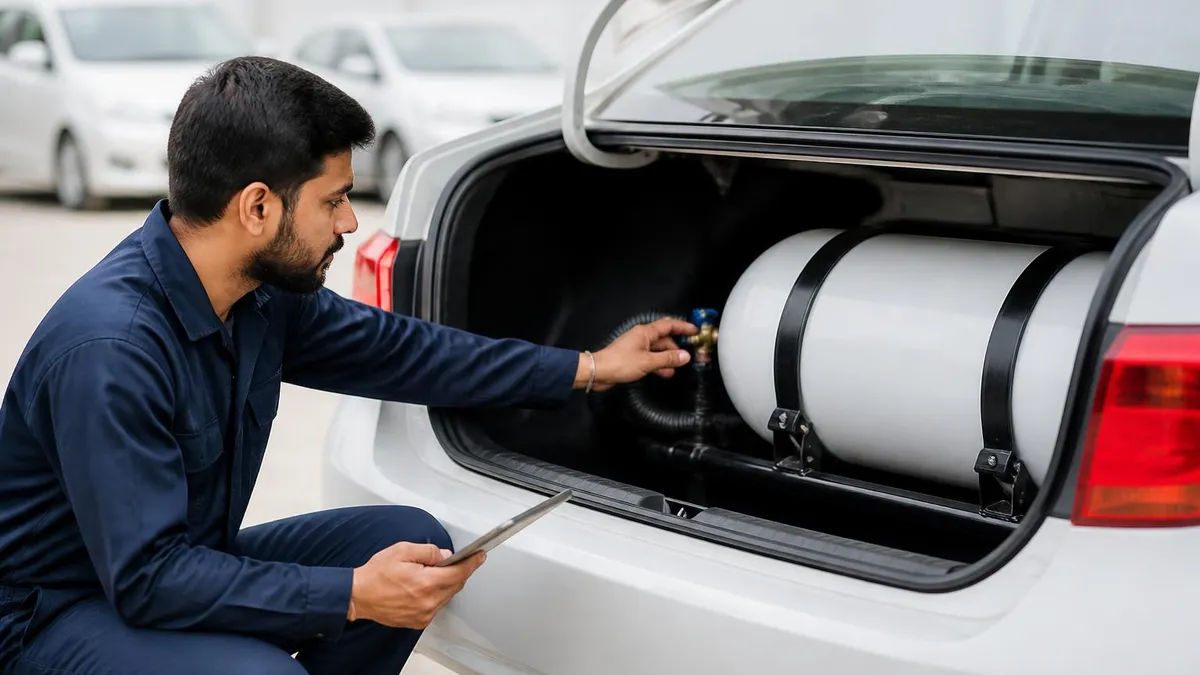
Tank age is the single most important number on a used CNG vehicle. Federal law (NFPA 52) requires retirement of CNG cylinders 15 to 25 years from manufacture depending on tank type. A 2010 Civic GX with original tanks has only a few years of service life left, and replacement tank assemblies can run $3,000-$6,000 installed. Always read the tank's manufacturer stamp — usually visible inside the trunk or under the truck bed — and subtract that year from today to estimate remaining life.
Mileage benchmarks differ from gasoline norms. CNG combustion is cleaner and produces fewer carbon deposits, so engines often last longer. A well-maintained 200,000-mile CNG sedan can still run cleanly, but consumables like the fuel filter, pressure regulator, and oxygen sensors all need periodic replacement. Our deeper coverage of CNG Vehicles: Complete Guide to Compressed Natural Gas Cars and Trucks walks through model-by-model reliability data and known issues.
Inspection before purchase is non-negotiable. Hire a mechanic with documented CNG experience — they are rare outside Oklahoma, Utah, and California — to perform both a standard pre-purchase inspection and a CNG-specific cng vehicle maintenance check. The cost runs $150-$300 and pays for itself when you avoid a tank near retirement, a leaking high-pressure line, or a failed regulator. Sellers who refuse a proper inspection are signaling problems you do not want to inherit.
Finally, consider the registration and titling process in your state. Most states accept EPA and CARB documentation without issue, but a handful — including New York and Massachusetts — have additional emissions paperwork for converted vehicles. Confirm before you sign anything. The conversion's EPA Certificate of Conformity number should be physically present on a label under the hood, and a copy should accompany the title transfer. Without it, registration can stall indefinitely.
CNG Practice Test Questions
Prepare for the CNG - Compressed Natural Gas exam with our free practice test modules. Each quiz covers key topics to help you pass on your first try.
CNG Environmental and Economic Benefits
CNG Exam Questions covering CNG Environmental and Economic Benefits. Master CNG Test concepts for certification prep.
CNG Fleet Management and Driver Operations
Free CNG Practice Test featuring CNG Fleet Management and Driver Operations. Improve your CNG Exam score with mock test prep.
CNG - Compressed Natural Gas CNG Propertie...
CNG Mock Exam on - Compressed Natural Gas CNG Properties and Safety. CNG Study Guide questions to pass on your first try.
CNG - Compressed Natural Gas Codes, Standa...
CNG Test Prep for - Compressed Natural Gas Codes, Standards, and Compliance. Practice CNG Quiz questions and boost your score.
CNG - Compressed Natural Gas Cylinder Insp...
CNG Questions and Answers on - Compressed Natural Gas Cylinder Inspection and Regulations. Free CNG practice for exam readiness.
CNG - Compressed Natural Gas Emergency Pro...
CNG Mock Test covering - Compressed Natural Gas Emergency Procedures and Response. Online CNG Test practice with instant feedback.
CNG - Compressed Natural Gas Facility and ...
Free CNG Quiz on - Compressed Natural Gas Facility and Ventilation Requirements. CNG Exam prep questions with detailed explanations.
CNG - Compressed Natural Gas Fueling Stati...
CNG Practice Questions for - Compressed Natural Gas Fueling Station Operations. Build confidence for your CNG certification exam.
CNG - Compressed Natural Gas Fuel System C...
CNG Test Online for - Compressed Natural Gas Fuel System Components. Free practice with instant results and feedback.
CNG - Compressed Natural Gas Maintenance a...
CNG Study Material on - Compressed Natural Gas Maintenance and Troubleshooting. Prepare effectively with real exam-style questions.
CNG - Compressed Natural Gas System Diagno...
Free CNG Test covering - Compressed Natural Gas System Diagnostics and Repair. Practice and track your CNG exam readiness.
CNG - Compressed Natural Gas Vehicle Conve...
CNG Exam Questions covering - Compressed Natural Gas Vehicle Conversion and Installation. Master CNG Test concepts for certification prep.
Bi-Fuel vs Dedicated vs Converted CNG Vehicles For Sale
A dedicated CNG vehicle runs only on compressed natural gas with no gasoline backup. The Honda Civic GX, Ford F-150 dedicated, and most transit buses fall into this category. Engine calibration, ignition timing, and compression ratio are all optimized for CNG's higher 130 octane rating, which delivers cleaner combustion and superior tailpipe emissions compared to bi-fuel setups.
The trade-off is range. Without a gasoline reserve, you must plan trips around CNG station locations, and rural travel becomes difficult outside the major fuel corridors. Dedicated vehicles also typically have larger or multiple tank assemblies eating into trunk or bed space. For urban fleets and commuters in CNG-rich metros like Oklahoma City or Salt Lake City, dedicated is the most efficient choice.
Should You Buy a CNG Vehicle? Pros and Cons
- +Fuel costs run 40-60 percent below gasoline on a per-mile basis
- +Lower emissions including 34 percent less CO2 and 95 percent less particulate matter
- +Engine oil stays cleaner longer because of cleaner combustion
- +Many states grant HOV lane access regardless of passenger count
- +Strong used-market values from fleet trade-in supply
- +Refueling at home possible with Phill or FuelMaker compressors
- +Federal and state tax credits available for both vehicles and stations
- −Limited public refueling infrastructure outside major metros
- −Higher upfront cost for new bi-fuel or converted vehicles
- −Tank inspections required every 3 years or 36,000 miles
- −Tank retirement at 15-25 years adds $3,000-$6,000 replacement cost
- −Fewer mechanics trained on CNG-specific fuel systems
- −Cargo or trunk space reduced by tank installation
- −Resale dependent on local CNG infrastructure strength
CNG Vehicles For Sale: Pre-Purchase Checklist
- ✓Read the tank manufacturer stamp and calculate years of service life remaining
- ✓Confirm the EPA Certificate of Conformity sticker is present under the hood
- ✓Request the most recent CNG tank visual inspection certificate
- ✓Verify all maintenance records, especially regulator and fuel filter replacements
- ✓Check the high-pressure fuel lines for chafing, kinks, or corrosion
- ✓Run a leak test at the fuel rail and tank connections with a calibrated detector
- ✓Confirm the dashboard fuel gauge reads accurately on both CNG and gasoline (bi-fuel)
- ✓Test cold-start behavior — CNG vehicles can struggle if the regulator is failing
- ✓Locate the nearest CNG station and verify it accepts public payment
- ✓Get written confirmation of how your state titles converted vehicles before paying
Tank manufacture date determines remaining service life
Every CNG cylinder is stamped with its manufacture date. Type 1 steel tanks retire at 25 years; Type 3 and Type 4 composite tanks retire at 15-20 years. If you buy a 2009 vehicle with original tanks in 2026, you may have only three years before mandatory retirement — and replacement runs $3,000-$6,000 installed. Always subtract the stamp year from today before negotiating price.
Total cost of ownership is where CNG vehicles either justify themselves or fall short, and the math depends heavily on miles driven, local fuel pricing, and how long you plan to keep the vehicle. The headline savings come from fuel: nationally, compressed natural gas averages around $1.50 per gasoline gallon equivalent (GGE) compared to $3.45 for regular unleaded. A driver covering 20,000 miles per year in a vehicle rated at 25 MPG-equivalent saves roughly $1,560 annually at those prices.
Maintenance costs run lower over the long haul. CNG burns cleaner than gasoline, so oil change intervals can stretch, spark plugs last longer, and exhaust systems show less corrosion. Counterbalancing this are CNG-specific service items: the high-pressure regulator typically needs attention at 75,000-100,000 miles, oxygen sensors are stressed differently, and tank inspections add roughly $100-$200 every three years. Net maintenance expense usually lands $200-$400 below an equivalent gasoline vehicle annually.
Acquisition cost is where buyers get tripped up. A used Honda Civic GX in good condition with healthy tanks runs $8,000-$13,000, comparable to a gasoline Civic of the same vintage. But a converted heavy-duty pickup carries a $6,000-$12,000 premium that takes meaningful miles to amortize. If you only drive 8,000 miles a year, that premium may never pay back before the tanks retire. Fleet operators covering 40,000+ miles annually recover it in 18-30 months.
Depreciation is the wild card. CNG vehicles depreciate more steeply than gasoline equivalents in markets without strong CNG infrastructure — try selling a converted Ram 2500 in rural Vermont and you will discover the audience is tiny. In Oklahoma, Utah, Texas, and California, the depreciation curve flattens because demand stays consistent. Always factor your exit strategy: if you plan to relocate, the resale market at your destination matters as much as the local one.
Insurance is typically a wash. Major carriers including State Farm, Progressive, and GEICO insure CNG vehicles at standard rates, though a few smaller insurers add small surcharges for converted vehicles. Always disclose the conversion to your insurer — failing to do so can void claims after an accident. Get written confirmation that the CNG system is covered before binding the policy, and keep the conversion paperwork with your insurance documents.
Incentives shift the picture meaningfully in certain states. Oklahoma, Utah, Pennsylvania, and Colorado all maintain some form of alternative fuel vehicle credit or grant, and several utilities offer rebates on home refueling appliances. The federal Alternative Fuel Vehicle Refueling Property Credit covers 30 percent of station installation up to $1,000 for residential or $30,000 for commercial. Check your state's Department of Environmental Quality website before you buy — incentives change yearly.
Finally, factor refueling time and convenience. Public CNG stations refuel in 5-15 minutes for a passenger car, comparable to gasoline. Home refueling appliances like the Phill or FuelMaker take 4-8 hours overnight, but the electricity-equivalent cost can drop your effective fuel price to under $1 per GGE. If you have natural gas service at home, the appliance pays back in 3-5 years for daily drivers. Without it, you are dependent entirely on public stations.

Aftermarket CNG conversions must carry an EPA Certificate of Conformity sticker under the hood. Without it, the vehicle may not be legal to register in your state, and resale becomes nearly impossible. Some states including New York and Massachusetts require additional emissions paperwork. Never accept a verbal assurance from a seller — physically locate the label before transferring funds.
Where you shop for cng vehicles for sale matters as much as what you buy. The richest inventory lives in Oklahoma, Texas, Utah, Arizona, and California — states with strong infrastructure, established CNG fleets, and dealers who actually understand the product. Listings outside these markets tend to be one-offs, often from owners who relocated without considering local refueling options, and pricing can be erratic.
Online marketplaces are the natural starting point. CNGPrices.com runs a vehicle classifieds section pulled from dealers nationwide. AutoTrader and Cars.com let you filter by fuel type, though listings can be miscategorized. eBay Motors carries a steady stream of converted pickups and vans, often from former fleet operators. Always cross-reference any listing with the VIN through the National Insurance Crime Bureau and a Carfax report before traveling to see a vehicle.
Fleet auctions deserve their own consideration. Ritchie Bros, IronPlanet, and GovDeals run frequent auctions where municipalities and utility companies offload their CNG fleets. Prices can be 30-50 percent below comparable dealer listings, but you typically buy as-is with no inspection contingency. This is the right channel for buyers with mechanical experience and tolerance for risk. Bring a CNG-savvy mechanic to the preview day, not just to the post-purchase shop visit.
Specialty dealers exist in every major CNG market. In Tulsa, Drive Natural specializes exclusively in CNG vehicles. In Salt Lake City, several Honda dealers maintain dedicated Civic GX inventory. In Southern California, Westport-affiliated upfitters sell both new conversions and refurbished trade-ins. These dealers typically offer warranties on their conversions and tanks, plus financing tailored to alternative fuel vehicles. The premium over private-party pricing is usually $1,500-$3,500, and it often buys peace of mind worth more than that.
Private-party listings on Craigslist and Facebook Marketplace produce the best deals — and the highest risk. Sellers may not know their own tank's retirement date, the conversion's EPA status, or whether the vehicle is legal in your state. Approach every private listing assuming nothing is documented and insist on a full pre-purchase inspection at your expense. The seller's willingness to accommodate this is the single best signal of whether you should proceed.
Don't overlook commercial vehicle dealers. Many regional truck dealers carry late-model bi-fuel Ford and GM pickups returned at lease-end, and these vehicles often include their original CNG conversion warranty. Pricing tends to be transparent because these dealers move volume, and you can usually negotiate trade-in for a gasoline vehicle. For deeper background on the technology you're buying into, our guide to CNG Car: How Compressed Natural Gas Vehicles Work, Benefits, Costs, Available Models, and Safety covers the engineering details.
Finally, think about refueling before you ever look at vehicles. Map every public CNG station within 30 miles of your home and workplace using the Alternative Fuels Data Center locator. Visit at least one in person — verify it accepts public payment, has 3,600 psi fast-fill capability (not just slow-fill), and is not behind a restricted fleet gate. Buying a vehicle without confirming this leads to buyer's remorse fast, no matter how cheap the deal was.
With your shortlist of cng vehicles for sale narrowed down, the practical work begins. Schedule the pre-purchase inspection before you negotiate price — if the inspection turns up a regulator at end of life or tanks within two years of retirement, you have leverage to either walk away or renegotiate by the cost of those repairs. A good CNG mechanic will run a smoke test on the fuel lines, scan the engine control module for CNG-specific fault codes, and physically inspect the tank brackets for corrosion.
Once you have committed to a vehicle, document everything at the point of sale. Photograph the tank manufacturer stamps, the EPA Certificate of Conformity label, the conversion installer's plate (for converted vehicles), and the most recent inspection certificate. Get the seller's signature on a bill of sale that explicitly references the CNG system and confirms it is operational. This paper trail protects you if the state DMV questions anything during titling.
Registration varies by state but follows a predictable pattern. Most states accept the EPA certification at face value. California requires CARB-specific paperwork and may demand a referee inspection for converted vehicles. New York adds an Office of the Attorney General disclosure for aftermarket modifications. Allow two to three weeks beyond a normal gasoline vehicle for any state-level emissions verification, and budget $50-$200 in additional fees.
Insurance should be set up before you drive the vehicle home. Call your carrier with the VIN and explicitly disclose CNG fuel type and any aftermarket conversion. Get the agent to email written confirmation that the policy covers the CNG fuel system, tanks, and lines. Without that confirmation in writing, a future claim involving fuel system damage may be denied. Most carriers do not charge extra, but the documentation matters.
Plan your first 1,000 miles around learning the vehicle's habits. Bi-fuel pickups behave differently on each fuel — power delivery, fuel economy, and even shift points can shift between modes. Practice the fuel-mode switch in safe conditions before you need it on a highway. Verify the dashboard fuel gauges read accurately by filling each tank to capacity and noting odometer-to-empty figures. Cold weather changes CNG behavior; range can drop 10-15 percent below 30°F.
Establish a relationship with a CNG-capable shop near you. Most general repair shops cannot work on the high-pressure fuel system, and dealerships may decline conversion-related work entirely. The Natural Gas Vehicle Institute (NGVi) maintains a directory of certified technicians searchable by zip code. Build the relationship before you need emergency repairs — having a known phone number to call when a regulator fails on a Sunday saves significant grief.
Finally, study the broader ecosystem. Understanding how stations operate, what payment systems they use, and how to read the pressure gauges all become second nature after a few months. Our guide to CNG Stations: How to Find, Use & What to Expect walks through fast-fill versus time-fill, payment cards, and what to do if a station is down. The more you know about refueling, the less stressful ownership becomes, and the more confident you will be on long trips outside your home market.
CNG Questions and Answers

What Is CNG? A Plain-English Guide to Compressed Natural Gas
CNG Practice Test Video Answers

CNG Stations: How to Find, Use & What to Expect

CNG Vehicles: Complete Guide to Compressed Natural Gas Cars and Trucks

CNG Car: How Compressed Natural Gas Vehicles Work, Benefits, Costs, Available Models, and Safety
About the Author

Educational Psychologist & Academic Test Preparation Expert
Columbia University Teachers CollegeDr. Lisa Patel holds a Doctorate in Education from Columbia University Teachers College and has spent 17 years researching standardized test design and academic assessment. She has developed preparation programs for SAT, ACT, GRE, LSAT, UCAT, and numerous professional licensing exams, helping students of all backgrounds achieve their target scores.
Join the Discussion
Connect with other students preparing for this exam. Share tips, ask questions, and get advice from people who have been there.
View discussion (8 replies)