
PG&E CNG Station Photos: A Visual Guide to Compressed Natural Gas Fueling Infrastructure
Explore PGE CNG station photos and learn how compressed natural gas fueling infrastructure works for US drivers and fleets. ✅

If you have ever searched for pge cng station photos online, you already understand the value of seeing a fueling station before you arrive. Pacific Gas and Electric Company operates and supports a network of compressed natural gas fueling sites across California, and understanding what these stations look like — from the compressor units to the dispenser nozzles — can help drivers, fleet managers, and curious motorists feel far more confident before their first fill-up. Visual references demystify the process and set realistic expectations about the physical layout of a modern CNG fueling site.
Compressed natural gas stations differ significantly from traditional gasoline or diesel pumps. Instead of underground tanks filled with liquid fuel, CNG stations rely on high-pressure storage vessels, sophisticated compressors, and specially engineered dispensers that deliver natural gas at pressures ranging from 3,000 to 3,600 pounds per square inch. When you look at cng station photos, you will immediately notice this distinctive equipment, which gives CNG sites a more industrial appearance compared to a conventional gas station.
PG&E has been a major player in expanding CNG infrastructure in Northern and Central California for decades. The utility company partners with municipalities, transit agencies, and private fleet operators to build and maintain fueling stations that serve everything from city buses and garbage trucks to over-the-road freight vehicles. Their stations are typically recognizable by consistent signage, safety barrier installations, and the characteristic tall, blue or silver high-pressure storage tubes that store natural gas at full fill pressure before dispensing.
Understanding station photography also matters for people studying for CNG-related certification exams, fleet management credentials, or alternative fuel vehicle endorsements. Being able to identify key components — such as the priority panel, the cascade storage system, the time-fill versus fast-fill dispensers, and the emergency shutoff valve locations — is a practical skill that photos can help reinforce far better than text descriptions alone. Many candidates find that visual study aids dramatically improve their retention of technical material.
Beyond certification prep, CNG station photos serve a real operational purpose for fleet managers planning routes and fueling schedules. Knowing the physical configuration of a station — whether it has multiple fast-fill lanes, covered fueling bays, or dedicated time-fill overnight parking — helps dispatchers build more efficient operations. Photos posted on apps like GasBuddy, the U.S. Department of Energy's Alternative Fuels Station Locator, and operator websites allow fleet managers to assess capacity before committing vehicles to a particular route corridor.
For the general public, seeing photos of a CNG station for the first time can resolve a lot of uncertainty. Many consumers who are considering a compressed natural gas vehicle — or who have recently purchased one — worry that fueling will be complicated or that stations will look confusing and intimidating. In practice, modern CNG dispensers are designed to be nearly as simple to operate as a standard gasoline pump, with clear color-coded hoses, straightforward pressure gauges, and intuitive nozzle connectors that lock securely into the vehicle receptacle.
This guide walks through what you will actually see in PG&E and other public CNG station photos, explains the major infrastructure components captured in those images, and provides practical knowledge for drivers, fleet professionals, and students preparing for CNG certification assessments. Whether you are fueling a Honda Civic Natural Gas, a transit bus, or a Class 8 semi-truck, recognizing the equipment around you makes every fill-up safer and more efficient.
CNG Fueling Infrastructure by the Numbers

Key Components Visible in CNG Station Photos
Tall cylindrical tubes — often blue, white, or silver — that store natural gas at 3,600 PSI. These cascade storage banks are one of the most visually distinctive features of any CNG station and are clearly visible in overhead and wide-angle station photographs.
Large mechanical units, often housed in enclosed shelters or behind sound-barrier walls, that compress natural gas from pipeline pressure (less than 1 PSI) up to 3,600 PSI for storage and dispensing. You can spot them by their size, piping connections, and ventilation panels.
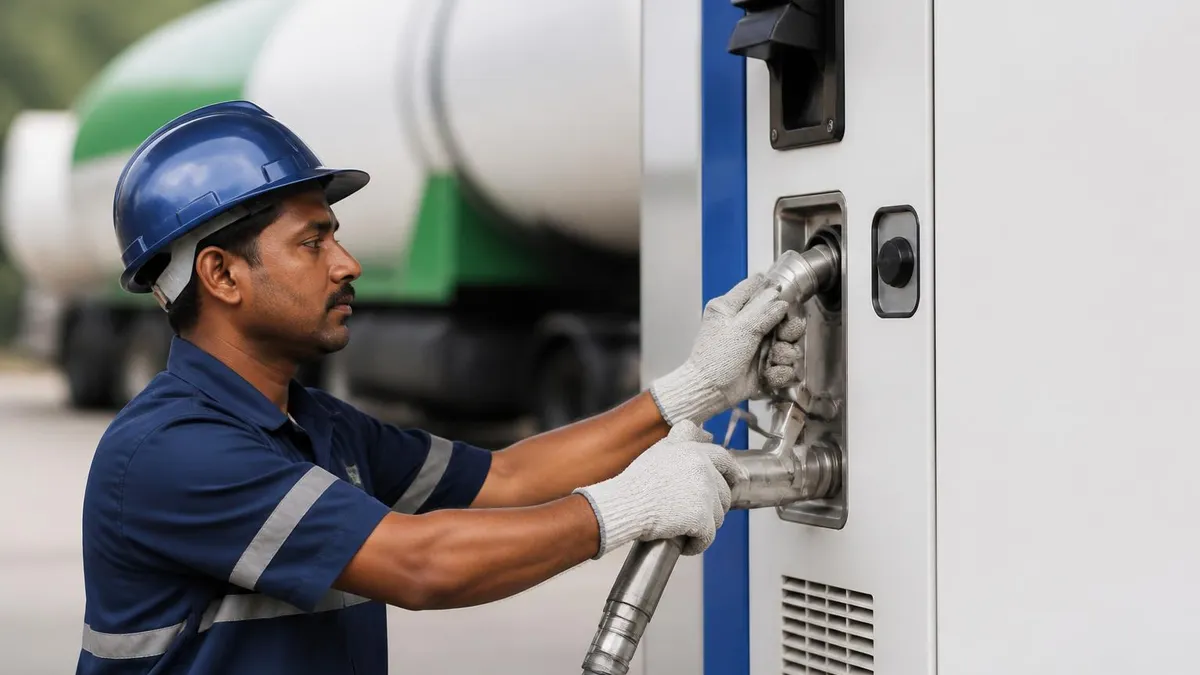
These look similar to gasoline pumps but feature heavier hoses, a pressure gauge display, and a specialized nozzle. Fast-fill dispensers are rated for retail use and fill a vehicle in three to five minutes, making them the most photogenic and recognizable element for consumer-facing CNG stations.
Control panels that manage which storage vessel feeds the dispenser at any given moment. These are typically mounted on walls or enclosures adjacent to the dispensers and are visible in close-up station photos as metal boxes with gauges and valve handles.
Bright yellow bollards, emergency shutoff button housings, No Smoking signs, and NFPA 52 compliance markers are visible in virtually every professional CNG station photo. Knowing these markers helps drivers locate emergency controls quickly during an actual fueling stop.
Learning to read a CNG station photo is a skill that pays dividends both on certification exams and in real-world fleet operations. The first thing to orient yourself to is the overall layout. Most public CNG stations are organized with the compressor room or enclosure on one side, the cascade storage vessels along a back or side wall, and the dispenser islands positioned where vehicles can pull through or pull up alongside them.
This layout is driven by safety codes — primarily NFPA 52, the Vehicular Gaseous Fuel Systems Code — that require specific setback distances between equipment and property lines, buildings, and ignition sources.
When looking at station photos, pay attention to the color coding of hoses and piping. The Compressed Natural Gas industry uses standardized color conventions to help operators and emergency responders quickly identify system components. Green is often used on dispenser hose covers and vehicle receptacles to indicate CNG, distinguishing it from hydrogen (which uses red coding in many applications) or propane (which typically uses blue or orange). This green-coded equipment shows up clearly in station photos and is a useful visual anchor for students learning to identify CNG infrastructure.
Another important detail visible in many station photographs is the dispenser display screen. Modern CNG dispensers show real-time pressure readings, the amount of gas dispensed in gasoline gallon equivalents (GGE), and the total cost of the transaction. Some advanced dispensers also display the station's current storage pressure, giving experienced drivers a quick sense of whether the station is running at full capacity or has been heavily used and may deliver a slightly lower fill. Understanding these displays makes you a more informed consumer and a safer operator.
Safety equipment placement is another key element to identify in station photos. Every CNG station must have clearly marked emergency shutoff valves — sometimes called Emergency Fuel Shutoff or EFS valves — that can stop gas flow to all dispensers instantly. These are typically red or orange button-style controls mounted on posts or walls near the dispenser islands and at the compressor enclosure entry point. Certification exams frequently ask about the location and function of these controls, and seeing them in photos helps cement the knowledge in a way that a diagram alone cannot achieve.
The storage vessel configuration reveals a lot about a station's capacity and design. A station built primarily for transit buses or heavy trucks will typically have a much larger cascade storage bank than one designed for light-duty passenger vehicles.
Some stations use a two-bank cascade — a standard bank at 3,000 PSI and a high-pressure bank at 3,600 PSI — while others use three or even four banks to maximize fill quality across a wide range of incoming vehicle tank pressures. Photos of these multi-bank systems show a striking array of interconnected cylinders and piping that can look complex but follows a logical pressure-management sequence.
Lighting and canopy structures are also instructive details in CNG station photographs. Because many fleet vehicles fuel overnight during time-fill operations, CNG stations often have extensive lighting — both for safety and for convenience. Some stations, particularly those serving transit agencies or municipalities, have full canopy coverage over the dispenser islands, similar to a traditional gas station. Others are open-air installations with minimal overhead coverage. Knowing this from a photo helps fleet managers plan for weather considerations and night-shift fueling logistics at unfamiliar stations.
Finally, look for the payment and card reader terminals in dispenser photos. Public CNG stations increasingly feature the same card reader and PIN pad technology found at gasoline stations, making the payment process identical for drivers.
Some fleet-only stations use proprietary fleet cards or RFID key fobs instead, and photos of these dispensers will show a different style of access terminal — often a simpler keypad or card slot — rather than the full credit card terminal common on public-access islands. Recognizing these differences helps drivers know what to expect before they arrive at an unfamiliar station for the first time.
CNG Fueling Types: What Station Photos Reveal
Fast-fill CNG stations are designed for on-demand retail use and are the type most commonly photographed and shared online. These stations compress and dispense gas at high flow rates, typically filling a light-duty passenger vehicle in three to five minutes and a heavy-duty transit bus in eight to fifteen minutes. The dispensers are mounted on islands identical in layout to a conventional gasoline station, and the high-pressure hoses are permanently connected to the nozzle storage holsters you see in photos.
The equipment captured in fast-fill station photos includes the cascade storage system that allows the dispenser to draw from pre-compressed gas rather than waiting for a compressor to build pressure in real time. This is what makes fast-fill fueling practical for public access. The storage vessels in these photos are typically located behind a fence or wall at the rear of the station, connected to the dispenser islands by buried or overhead high-pressure stainless steel piping. PG&E fast-fill locations serving Northern California follow this design pattern consistently.

CNG Stations vs. Traditional Gas Stations: Key Differences
- +Lower fuel cost per GGE — often 30 to 50 percent less than gasoline on an energy-equivalent basis
- +Cleaner burning fuel reduces maintenance costs on engines and exhaust systems over the vehicle's lifecycle
- +CNG dispensers are increasingly user-friendly with intuitive color-coded nozzles and digital displays
- +Many fleet CNG stations offer time-fill overnight options, eliminating mid-shift fueling stops
- +CNG is domestically produced, reducing supply chain vulnerability to international oil price shocks
- +Modern CNG stations have sophisticated safety systems including automatic leak detection and emergency shutoffs
- −Public CNG station coverage remains much sparser than gasoline stations, especially in rural areas
- −Fast-fill stations require significant upfront capital investment, limiting expansion in low-demand corridors
- −CNG vehicle range is typically shorter than diesel equivalents due to the lower energy density of compressed gas
- −The large high-pressure storage vessels and compressor equipment require substantial real estate for each station
- −Nozzle compatibility varies between older CNG stations and newer installations, creating occasional connection issues
- −Station downtime for compressor maintenance can leave fleets without fueling access if no backup station exists nearby
Pros and Cons at a Glance
| Pros | Cons |
|---|---|
| Cleaner burning fuel reduces maintenance costs on engines and exhaust systems over the vehicle's lifecycle | Public CNG station coverage remains much sparser than gasoline stations, especially in rural areas |
| CNG dispensers are increasingly user-friendly with intuitive color-coded nozzles and digital displays | Fast-fill stations require significant upfront capital investment, limiting expansion in low-demand corridors |
| Many fleet CNG stations offer time-fill overnight options, eliminating mid-shift fueling stops | CNG vehicle range is typically shorter than diesel equivalents due to the lower energy density of compressed gas |
| CNG is domestically produced, reducing supply chain vulnerability to international oil price shocks | The large high-pressure storage vessels and compressor equipment require substantial real estate for each station |
| Modern CNG stations have sophisticated safety systems including automatic leak detection and emergency shutoffs | Nozzle compatibility varies between older CNG stations and newer installations, creating occasional connection issues |
CNG Station Safety Features to Identify in Photos
- ✓Locate the Emergency Fuel Shutoff (EFS) button — typically red, mounted on a post near dispensers.
- ✓Identify the high-pressure storage vessel area — should be fenced or behind a physical barrier.
- ✓Confirm No Smoking and No Open Flame signage is posted at all station entry points.
- ✓Check for a gas detector panel — usually mounted near the compressor enclosure entrance.
- ✓Identify the ventilation louvers or fans on any enclosed compressor or storage room.
- ✓Note the bollards and vehicle barriers protecting compressor units and storage vessels from impact.
- ✓Confirm dispenser hoses are stored in holsters and not dragging on the ground between vehicles.
- ✓Identify the pressure relief valve discharge pipes — typically pointing skyward above storage vessels.
- ✓Look for the NFPA 52 compliance placard on the dispenser or fueling island signage post.
- ✓Verify that fire extinguisher mounting brackets are visible and accessible near the dispenser island.
A Full Fill Depends on Station Storage Pressure
One detail that station photos cannot convey — but that every CNG driver should know — is that the quality of your fill depends on the pressure remaining in the cascade storage system. A station that has been heavily used during peak hours may deliver a fill that is 10 to 15 percent below rated capacity, even if the dispenser shows a completed transaction. Arriving early in the morning or late at night, when storage vessels have had time to rebuild pressure, consistently delivers the fullest possible tank.
For fleet operations professionals, CNG station photos are not just informational curiosities — they are operational planning tools. A fleet manager responsible for routing fifty compressed natural gas vehicles across a region needs to know the physical configuration of every fueling stop on each route. Does the station have covered fast-fill lanes that can handle the company's largest vehicles? Are there enough time-fill posts for an overnight fill operation at the depot, or will vehicles need to queue? Photos answer these questions faster than any text description and are routinely used in route planning software and fleet management databases.
PG&E's CNG station network in California includes a mix of publicly accessible fast-fill locations and fleet-dedicated time-fill installations. Their stations serve light-duty vehicles, transit buses, refuse trucks, and Class 8 over-the-road freight tractors. The visual differences between a station designed for passenger cars and one engineered for heavy-duty vehicles are striking. Heavy-duty stations typically have larger storage vessel banks, higher-capacity compressors, and dispensers with heavier-gauge hoses rated for the longer fill times required by large tanks — all details that become apparent when comparing station photos side by side.
Driver training programs increasingly incorporate station photography as part of their curriculum. New CNG vehicle operators are shown photos of the dispensers they will encounter, the safety equipment they need to locate, and the correct nozzle connection procedure before they ever approach a real station. This visual pre-training reduces fill-time errors, minimizes the risk of nozzle damage from incorrect connections, and helps drivers locate emergency shutoffs quickly if something goes wrong. Fleet safety coordinators often build photo libraries of every station on their regular routes and include these in driver orientation packets.
The certification exams administered by organizations such as the Natural Gas Vehicle Institute (NGVi) and the National Institute for Automotive Service Excellence (ASE) test candidates on CNG station components and safety procedures. Many of the questions on these exams are accompanied by diagrams or described scenarios that closely mirror what you would see in a station photograph. Candidates who have spent time studying real station photos consistently report that they can answer equipment identification questions more quickly and accurately than those who studied from diagrams alone. The photographic study approach builds pattern recognition that transfers directly to the exam environment.
Regulatory compliance is another domain where station photography plays an important role. Station operators must document their installations for permitting purposes with the local fire marshal and the California Energy Commission. These documentation packages often include photographs taken during construction and after commissioning that show the as-built configuration of all major components. Fleet managers reviewing a potential new fueling station partner should ask to see these compliance photographs as part of their due diligence — they confirm that the installation meets code and that all safety systems are properly positioned and labeled.
Emergency responders — fire departments, hazmat teams, and EMS crews — also benefit from access to CNG station photographs. Many fire departments maintain photographic reference libraries of alternative fuel stations in their jurisdiction so that crews responding to an incident can quickly orient themselves to the equipment layout and locate emergency controls without hesitation.
PG&E and other station operators are often willing to share official station photos and layout drawings with local emergency services as part of their community safety programs. Some stations go a step further and host on-site familiarization visits for first responders, supplementing the photos with hands-on equipment walk-throughs.
Environmental monitoring equipment is another feature visible in detailed station photos. Modern CNG stations are equipped with combustible gas detectors that continuously sample the air around compressors and storage vessels. If concentrations reach a preset threshold — typically 10 to 25 percent of the lower explosive limit (LEL) — the system automatically shuts down the compressor and dispensers and triggers an alarm.
These detector heads are typically small cylindrical sensors mounted at strategic points on the equipment enclosure walls, and knowing where to look for them in photographs helps both drivers and facility managers confirm that this critical safety infrastructure is in place before initiating a fueling operation.

Most US public CNG stations use the NGV1 nozzle standard for light-duty vehicles and the NGV2 standard for heavy-duty applications. Before visiting an unfamiliar station, confirm which nozzle type is available — particularly if you drive an older vehicle or a heavy-duty truck. Photos of the dispenser nozzle can often be found on the station's listing page in the Alternative Fuels Station Locator maintained by the US Department of Energy, helping you verify compatibility before you make the trip.
Finding high-quality CNG station photos for research, training, or route planning purposes is easier today than it has ever been, thanks to a combination of government databases, fleet industry resources, and consumer review platforms. The US Department of Energy's Alternative Fuels Station Locator at afdc.energy.gov is the most authoritative public database of CNG stations in the country, and many station listings include user-submitted photographs that show the dispenser layout, the signage, and the general condition of the facility. This is an excellent first stop for anyone researching a specific station.
Google Maps Street View and Google Business Profile photos are another rich source of CNG station imagery. Drivers who have fueled at a location often upload photos showing the dispenser interface, the hose and nozzle configuration, the payment terminal, and the surrounding facility layout.
These user-generated images provide a realistic, unfiltered view of what the station looks like in actual operating conditions — including details like the condition of the hoses, the clarity of the signage, and the amount of space available for vehicles to maneuver. Fleet managers conducting remote site assessments frequently rely on these photos as a first-pass evaluation before sending a vehicle to a new station.
Utility company and station operator websites are a third important source of official photography. PG&E, Clean Energy Fuels, TruStar Energy, and other major CNG infrastructure operators maintain online station finders that often include professional photographs of their facilities. These photos tend to show the station in its best light — well-maintained, clearly signed, and fully operational — and are useful for understanding the intended design of the installation. For training purposes, official operator photos are often the clearest and most detailed images available of specific equipment models and configurations.
Industry publications and trade associations also publish CNG station photography as part of their editorial content. Organizations like NGVAmerica, the Alternative Fuels & Chemicals Coalition, and the American Gas Association regularly feature station opening announcements, technology showcases, and case studies that are accompanied by high-resolution photographs. These images often highlight specific technical innovations — like ultra-fast fill technology, solar-powered compressors, or dual-fuel dispensing islands — that give fleet professionals a window into where the technology is heading.
Social media platforms, particularly LinkedIn and Instagram, have become unexpected but valuable repositories of CNG station imagery. Fleet managers, equipment manufacturers, and alternative fuel advocates regularly post photos of new station openings, fueling operations, and infrastructure upgrades. Searching hashtags like #CNG, #CompressedNaturalGas, #NGV, or #AlternativeFuels on these platforms surfaces a steady stream of real-world station photography from across the country. Following accounts associated with equipment manufacturers like Cummins Westport, Agility Fuel Solutions, or IMW Industries will expose you to photos of some of the newest and most advanced CNG fueling equipment available.
For students and certification candidates, building a personal photo reference library is a highly effective study strategy. Screenshot or download station photos organized by equipment type — one folder for compressor units, one for fast-fill dispensers, one for time-fill posts, one for safety equipment — and review them regularly alongside your study materials. Pair each photo with the technical specification or safety code reference it illustrates. This active, image-reinforced study method builds the kind of durable visual memory that helps candidates confidently answer equipment identification and safety procedure questions under exam conditions.
When using any online CNG station photos for professional purposes — training materials, presentations, or published fleet guides — be sure to obtain proper permissions from the photographer or rights holder, or use images published under Creative Commons licenses that permit reuse. The DOE's Alternative Fuels Station Locator and government agency websites typically publish images in the public domain, but operator and manufacturer photos are generally protected by copyright. Using properly licensed imagery protects your organization and ensures that the stations and manufacturers who invest in high-quality photography continue to make it available to the industry.
Whether you are a first-time CNG vehicle driver, a seasoned fleet manager, or a student preparing for a compressed natural gas certification exam, developing strong visual literacy around CNG fueling infrastructure will serve you well throughout your career. The practical tips covered in this guide — from how to read a dispenser display to how to identify emergency shutoff locations in a photograph — translate directly to safer, more confident fueling experiences in the real world. The more familiar you are with what a station looks like before you arrive, the smoother your actual fueling operation will be.
One of the most important habits you can build is to always check the station listing on the Alternative Fuels Station Locator or a similar resource before visiting an unfamiliar CNG station. Confirm that the station is currently open and operational — CNG stations do experience temporary closures for compressor maintenance, equipment upgrades, or permitting issues — and review any available photos or user comments about the facility's current condition. A quick two-minute check before departure can save you from an unexpected detour and the frustration of arriving at a closed or non-functional station with a low fuel gauge.
When you arrive at a CNG station for the first time, take a moment to orient yourself before approaching the dispenser. Locate the emergency shutoff button — usually a large red button on a post near the island — and note its position relative to where you will be standing during the fill. Identify the gas detector panel if visible, and confirm that all safety signage is in place and legible. This brief orientation takes less than thirty seconds but ensures that you know exactly where to go if something unexpected occurs during the fueling process.
For fleet managers building a CNG fueling program from scratch, commissioning a professional photographic survey of every station on your planned route network is a worthwhile investment. These photos should capture each station's compressor area, storage vessel configuration, all dispenser islands, the emergency shutoff locations, the lighting coverage, and the vehicle maneuvering space. Include GPS coordinates and hours of operation in each photo record. This reference library becomes an invaluable training tool for new drivers and a risk management resource for safety compliance documentation.
On the technical side, staying current with CNG station equipment evolution is important for both fleet managers and certification candidates. The industry has been moving toward higher-capacity dispensers, smarter cascade management systems that optimize fill quality automatically, and integrated telematics platforms that allow fleet managers to monitor station performance remotely. New station photos regularly appear in trade publications showcasing these advances, and following them helps you understand the gap between older installations you might encounter on established routes and the latest generation of equipment being installed at new sites.
Practice tests and certification exams in the CNG field often include scenario-based questions that describe a situation at a fueling station and ask you to identify the correct response. Having a strong mental image of what a CNG station looks like — built through consistent study of real photographs — allows you to visualize the scenario clearly and apply your technical knowledge with greater confidence. Candidates who can mentally walk through a station layout perform significantly better on these applied questions than those who have only studied abstract diagrams or text descriptions.
Finally, share what you learn. If you are a fleet safety manager, build station photo presentations into your regular driver safety briefings. If you are an instructor teaching CNG technology, curate a library of up-to-date station photos and integrate them into your curriculum.
If you are a driver who has found a particularly well-run or well-designed CNG station, take a few photos and submit them to the Alternative Fuels Station Locator or the station operator's website — your contribution helps the next driver arriving at that station feel more prepared and confident. The CNG community benefits when knowledge and visual resources are shared openly across the industry.
Sample Compressed Natural Gas Practice Questions
Try these questions from our free Compressed Natural Gas practice tests. The correct answer and an explanation follow each question.
During a fast-fill at a public CNG station, why may the displayed fuel gauge reading drop shortly after fueling ends?
- A. Fuel leaks out immediately after filling
- B. Gas cools and contracts after the fast-fill heat of compression dissipates
- C. The check valve has failed
- D. The ECM resets the gauge automatically
Answer: B. Gas cools and contracts after the fast-fill heat of compression dissipates
Fast-fill compresses gas rapidly, raising its temperature and pressure; as the gas cools to ambient temperature, pressure and the gauge reading drop slightly.
How frequently should compressor valve inspections typically be performed in a CNG fueling station?
- A. Only when a valve failure is suspected based on performance degradation
- B. Once every five years as part of a major equipment overhaul schedule
- C. Per manufacturer specifications, typically every 1,000 to 4,000 operating hours
- D. Daily external visual checks are sufficient for valve maintenance requirements
Answer: C. Per manufacturer specifications, typically every 1,000 to 4,000 operating hours
CNG compressor valves are high-cycle wear components prone to fatigue failure; manufacturer-specified inspection intervals ensure problems are identified before unplanned shutdowns occur.
What does a priority panel control in a CNG fueling station?
- A. Employee access to restricted areas
- B. Which storage bank is used to fill a vehicle at each stage of fueling
- C. Recording of daily transaction data
- D. The odorization level of dispensed gas
Answer: B. Which storage bank is used to fill a vehicle at each stage of fueling
A priority panel directs gas flow from the lowest-pressure storage bank first, then automatically switches to higher banks as pressure differentials decrease.
According to NFPA 52, which of the following is a mandatory requirement for the operator of a CNG fueling station?
- A. To recalibrate the station's compressor on a weekly basis.
- B. To have a documented, active maintenance plan for the station equipment.
- C. To visually inspect every vehicle's CNG cylinders before allowing fueling.
- D. To provide a certified attendant for every public fueling transaction.
Answer: B. To have a documented, active maintenance plan for the station equipment.
Recent versions of NFPA 52, the Vehicular Natural Gas Fuel Systems Code, mandate that every CNG station, whether new or existing, must have a written and actively implemented maintenance plan. This plan is crucial for ensuring the ongoing safety, reliability, and proper performance of all station components.
CNG Questions and Answers

What Is CNG Gas? A Complete Guide to Compressed Natural Gas for US Drivers and Fleets

CNG Gas Price: What Drivers and Fleets Pay for Compressed Natural Gas in the US

CNG Jobs: Careers in the Compressed Natural Gas Industry
CNG Trucks for Sale: Complete Buyer's Guide to New and Used Compressed Natural Gas Vehicles
What Is CNG? A Plain-English Guide to Compressed Natural Gas
About the Author

Educational Psychologist & Academic Test Preparation Expert
Columbia University Teachers CollegeDr. Lisa Patel holds a Doctorate in Education from Columbia University Teachers College and has spent 17 years researching standardized test design and academic assessment. She has developed preparation programs for SAT, ACT, GRE, LSAT, UCAT, and numerous professional licensing exams, helping students of all backgrounds achieve their target scores.
Join the Discussion
Connect with other students preparing for this exam. Share tips, ask questions, and get advice from people who have been there.
View discussion (8 replies)