
CNG Station Design: How Compressed Natural Gas Fueling Stations Are Built and Operated
Learn CNG station design — components, costs, safety, and how fueling stations are built for fleets and public use. ✅ US guide.

Understanding cng station design is essential for fleet managers, fuel system engineers, energy planners, and anyone considering compressed natural gas as a transportation fuel. A CNG station is far more than a simple pump — it is a sophisticated infrastructure system that compresses natural gas from pipeline pressure (typically 0.25 to 200 psi) up to 3,600 psi or higher, stores that compressed gas in high-pressure vessels, and dispenses it safely into vehicles within minutes. Getting the design right determines whether a station is safe, reliable, cost-effective, and capable of serving the vehicles that depend on it.
CNG fueling stations in the United States have expanded dramatically over the past two decades, driven by federal clean energy incentives, fleet emission mandates, and the growing availability of natural gas across the country. Today there are more than 1,000 public CNG stations in the US and thousands more private or fleet-only stations serving transit agencies, refuse haulers, school districts, trucking companies, and municipal fleets. Each of these stations was engineered around a specific set of design principles that balance throughput, safety, site constraints, and budget.
The core components of any CNG station include a natural gas inlet and metering system, one or more compressors, high-pressure storage cascades, dispensing equipment with hoses and nozzles, control and safety systems, and the civil infrastructure — concrete pads, canopies, electrical service, and signage — that ties it all together. The way these components are sized, arranged, and integrated determines the station's performance characteristics, including how many vehicles it can fuel per hour and how quickly those vehicles can be refueled.
There are two fundamental CNG station architectures in widespread use today: fast-fill stations and time-fill stations. Fast-fill stations are designed to refuel vehicles in three to five minutes, much like conventional gasoline stations, and are the standard at public-access sites. Time-fill stations dispense CNG more slowly overnight, directly from a lower-pressure compressor into vehicles parked in a depot, and are preferred by fleets that return to a central yard each night. Hybrid stations combine both approaches to serve different vehicle types and operational schedules.
Designing a CNG station requires close coordination among natural gas utilities, equipment manufacturers, civil engineers, fire marshals, and local permitting authorities. The National Fire Protection Association's NFPA 52 standard — Vehicular Natural Gas Fuel Systems Code — governs station layout, setback distances, ventilation requirements, and emergency shutdown systems across the US. Additional guidance comes from OSHA regulations, EPA air quality rules, local building codes, and the standards published by the Compressed Gas Association. Navigating this regulatory landscape is one of the first challenges any project team faces.
From a financial perspective, CNG station costs vary enormously based on station type, throughput capacity, site conditions, and region. A small time-fill station for a ten-vehicle municipal fleet might cost $150,000 to $300,000 installed. A high-throughput fast-fill station capable of serving transit buses around the clock can cost $2 million to $5 million or more. Understanding these cost drivers — and how design choices affect both capital expenditure and long-term operating costs — is critical for anyone evaluating a CNG infrastructure investment.
This guide walks through every major aspect of CNG station design, from site selection and equipment sizing through regulatory compliance, safety systems, cost structures, and operational best practices. Whether you are a fleet manager exploring CNG for the first time or an engineer already working on a station project, the information here will give you a solid foundation for making informed decisions about compressed natural gas infrastructure.
CNG Station Design by the Numbers

CNG Station Types: Choosing the Right Configuration
Designed for retail or public-access fueling, fast-fill stations compress gas into large buffer storage vessels in advance so vehicles can refuel in three to five minutes. Ideal for transit agencies, refuse fleets, and public corridors with high vehicle turnover.
Vehicles connect to low-pressure dispensing posts overnight and fill slowly over several hours. Lower capital cost and simpler equipment make time-fill ideal for return-to-base fleets like school buses, utility trucks, and municipal vehicles that park at a central depot nightly.
Hybrid stations integrate both fast-fill and time-fill capability on a single site. They serve light-duty vehicles and visitors quickly at fast-fill dispensers while also accommodating overnight fleet vehicles at time-fill posts — maximizing utilization of the compressor investment.
Trailer-mounted CNG stations can be deployed at construction sites, special events, or new fleet rollouts before permanent infrastructure is built. They connect to local gas lines or compressed tube trailers and provide flexible fueling without the lead time of permanent construction.
The compressor is the heart of any CNG station, and selecting the right compressor type and sizing it correctly are among the most consequential decisions in the entire design process. CNG compressors are positive-displacement machines — most commonly reciprocating piston compressors, though rotary screw and linear compressors are also used in specific applications.
The compressor must raise the natural gas pressure from the incoming pipeline pressure, which can range from a few psi in residential distribution lines to over 100 psi in industrial transmission lines, all the way up to 4,000 to 5,000 psi to fill storage vessels that ultimately deliver gas at 3,600 psi to vehicles.
Compressor sizing is driven by two primary factors: the peak fueling demand the station must meet and the duty cycle over which that demand occurs. For a time-fill station, the compressor runs continuously overnight, so a smaller, slower machine can still fill an entire fleet by morning.
For a fast-fill station, the compressor must keep high-pressure storage topped up even during the busiest fueling periods, which might mean dozens of buses filling simultaneously at a transit hub during a short break in service. Engineers use vehicle fuel consumption data, daily mileage records, and arrival pattern modeling to calculate the required compressor output in standard cubic feet per minute (SCFM) or gasoline gallon equivalents (GGE) per hour.
High-pressure storage, also called buffer storage or cascade storage, is a defining feature of fast-fill station design. Buffer storage consists of multiple banks of pressure vessels — typically steel or composite cylinders arranged in parallel — divided into low, medium, and high-pressure banks.
Dispensers draw from the high-pressure bank first, then cascade down through medium and low banks as the high bank depletes, equalizing pressure across all banks to maximize the amount of gas delivered to vehicles before the compressor needs to intervene. This cascade sequencing is managed by electronic controls and solenoid valves and is fundamental to achieving fast, consistent fueling performance.
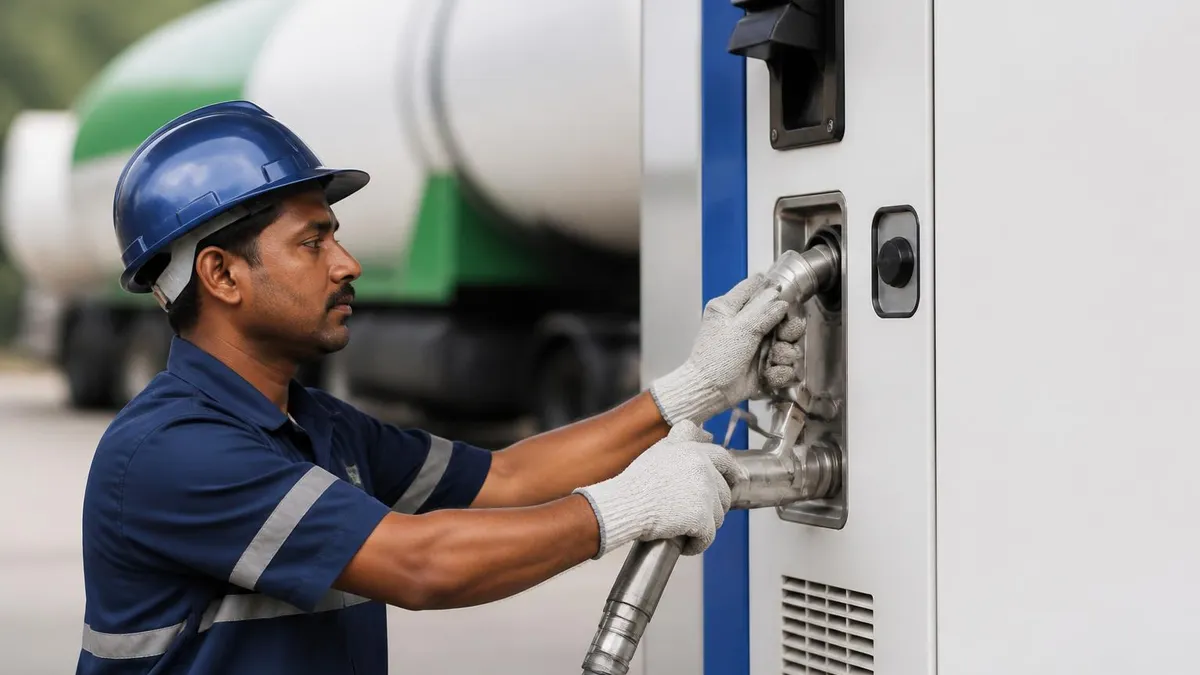
The dispenser is the customer-facing component of the station — the equipment the driver actually interacts with. CNG dispensers look superficially similar to gasoline dispensers but operate at dramatically higher pressures. They include a hose assembly rated for 4,500 psi or higher, a break-away safety coupling that separates cleanly if a vehicle drives away with the nozzle connected, a metering system calibrated in GGE or kilograms, and a temperature-compensation circuit.
Because natural gas density varies with temperature, CNG dispensers are required under NIST Handbook 44 to temperature-compensate their meter readings to 60°F to ensure customers receive accurate quantities regardless of ambient conditions.
The gas quality system is an often-overlooked but critical component of station design. Natural gas from the pipeline typically contains moisture, heavier hydrocarbons, compressor lubricant carryover, and occasionally particulates that can damage vehicle fuel systems if they reach the vehicle tank. Most CNG stations incorporate a coalescing filter and moisture separator on the inlet side, an oil coalescing filter downstream of the compressor, and a final high-pressure particulate filter ahead of the dispenser. Some stations also include gas chromatography or Wobbe index measurement equipment to verify gas quality meets SAE J1616 specifications before it is dispensed.
Electrical infrastructure is a substantial cost and design consideration for CNG stations. Large compressors — those rated above 50 horsepower — typically require three-phase electrical service, which may not be available at all sites and can require a utility transformer upgrade costing $20,000 to $100,000 or more depending on the distance to the nearest three-phase line. Station controls, lighting, dispensers, and communications systems also draw power. Many station operators today are evaluating solar photovoltaic systems to offset station electricity consumption, reducing operating costs while improving the environmental profile of CNG fueling.
Control systems and telemetry have become increasingly sophisticated in modern CNG station design. A programmable logic controller (PLC) or industrial computer manages compressor start/stop, cascade valve sequencing, emergency shutdown triggers, alarm annunciation, and data logging. Remote monitoring via cellular or internet connection allows operators and equipment manufacturers to track station performance, receive maintenance alerts, and diagnose problems without a site visit. Many stations now integrate with fleet management software, allowing fleet managers to track fuel consumption, cost per GGE, and carbon credits in real time from a desktop or mobile dashboard.
CNG Station Design Process: Site, Permitting, and Engineering
Choosing the right location for a CNG station involves evaluating natural gas pipeline access, electrical service availability, traffic flow, zoning designation, soil conditions, and proximity to sensitive receptors like schools and residences. Sites with existing high-pressure gas mains nearby offer significant cost advantages because the utility extension required is shorter and the inlet pressure is higher, reducing the compression ratio the compressor must achieve and improving efficiency. Flood zone status, prevailing wind direction relative to ignition sources, and vehicle turning radii for the largest vehicles the station will serve all factor into the siting analysis.
NFPA 52 establishes minimum separation distances between CNG station equipment and property lines, buildings, parking areas, and other fuel storage. A compressor, for example, must be separated from building openings by at least 10 feet, and high-pressure storage vessels require 10 to 25 feet of clearance depending on their total water capacity. These setback requirements can be a binding constraint on urban infill sites where land is scarce, and designers sometimes use underground storage or specially rated enclosures to reduce the effective footprint of the station while maintaining code compliance.

Advantages and Challenges of CNG Station Design and Operation
- +Lower fuel cost per GGE compared to diesel — typically $1.00 to $1.50 per GGE less at the station level, generating significant fleet savings over time
- +Substantial reduction in tailpipe emissions, including up to 90% less particulate matter and 25% less nitrogen oxide compared to diesel-powered equivalents
- +Domestic fuel source reduces dependence on imported petroleum and insulates fleet operators from international oil price volatility
- +Established NFPA 52 and ANSI codes provide a clear, well-understood regulatory framework that engineers and fire marshals are familiar with nationwide
- +Time-fill design option lowers capital cost dramatically for return-to-base fleets, often achieving payback in three to five years at current natural gas prices
- +Modern telemetry and remote monitoring systems allow operators to manage station performance, maintenance, and fuel accounting from any location
- −High upfront capital cost — fast-fill stations can cost $2 million to $5 million installed — creates a significant financial barrier for smaller fleets and municipalities
- −Natural gas pipeline access is required, and extending service to a new site can add $50,000 to $500,000 or more to project costs depending on distance
- −Permitting complexity and long lead times in some jurisdictions can delay station opening by six to eighteen months after a final investment decision
- −Compressed natural gas is a flammable fuel, and NFPA 52 setback requirements can make high-density urban sites difficult or impossible to develop
- −Vehicle range on CNG is generally lower than diesel for heavy-duty trucks, requiring careful route planning and potentially more frequent fueling stops
- −Compressor maintenance, including valve replacement, piston ring service, and oil changes, requires specialized technicians not always available in smaller markets
CNG Station Design and Development Checklist
- ✓Confirm natural gas pipeline access at the site and obtain pressure and flow data from the local utility before proceeding with design.
- ✓Verify three-phase electrical service availability or budget for a utility transformer upgrade if the compressor exceeds 50 horsepower.
- ✓Complete a vehicle fueling demand analysis using fleet mileage records to size the compressor and storage system accurately.
- ✓Select station type — fast-fill, time-fill, or hybrid — based on vehicle return-to-base patterns and daily fueling schedule.
- ✓Prepare a site plan showing all NFPA 52 required setback distances from property lines, buildings, ignition sources, and traffic lanes.
- ✓Submit pre-application materials to the local fire marshal and building department early to identify code interpretation issues before final design.
- ✓Obtain an air quality permit or permit exemption determination from the state environmental agency based on projected annual throughput.
- ✓Specify a coalescing inlet filter, compressor oil separator, and high-pressure particulate filter to meet SAE J1616 gas quality requirements.
- ✓Include an emergency shutdown (ESD) system with manual pull stations at the dispenser islands and at a remote location per NFPA 52.
- ✓Plan for remote telemetry and alarm notification to enable proactive maintenance and minimize station downtime after commissioning.
Cascade Storage Sequencing Is the Key to Fast-Fill Performance
The single most impactful design decision for fast-fill CNG station performance is how cascade storage banks are sized and sequenced. Properly engineered cascade systems can deliver 95% or more of the stored gas to vehicles before the compressor must intervene, while a poorly designed system may waste 30 to 40% of stored capacity — dramatically reducing throughput and increasing compressor run time. Always size each cascade bank to the specific vehicle tank size and pressure profile of the fleet being served, not to a generic rule of thumb.
The cost structure of a CNG station project divides into capital costs, which are incurred once during construction, and operating costs, which recur throughout the station's service life. Understanding both is essential for building a realistic business case and securing the financing or incentive funding that most CNG station projects require.
Capital costs include equipment procurement, installation labor, site civil work, utility connections, permitting fees, and engineering design fees. Operating costs include natural gas commodity cost, electricity for the compressor motor, scheduled maintenance, unscheduled repairs, insurance, and any applicable station operator fees if the station is outsourced to a third-party operator.
Equipment costs vary substantially by manufacturer and station configuration. A small single-compressor time-fill station with ten to fifteen dispensing posts might require a 25-horsepower compressor package costing $80,000 to $120,000 installed. A fast-fill station with a 200-horsepower compressor, 10,000 standard cubic feet of cascade storage, and four dual-hose dispensers could see equipment costs of $600,000 to $1,000,000 before site work and installation. Installation costs — which include mechanical piping, electrical work, concrete pads, canopies, and commissioning — typically add 40% to 80% of equipment cost on top of the equipment price, depending on site complexity and local labor market conditions.
Federal and state incentive programs have historically played a critical role in making CNG station economics work. The Alternative Fuel Infrastructure Tax Credit under Section 30C of the Internal Revenue Code has provided a 30% tax credit on CNG station installation costs, though the availability and terms of this credit have changed over time and project developers should verify current law before building it into a financial model.
The Department of Energy's Clean Cities program and various state energy offices have offered grants and low-interest loans for CNG station development, particularly for public-access stations that serve multiple fleets and provide open access to the general public.
The natural gas commodity cost at the station is typically structured as a negotiated industrial tariff with the local distribution company, which can be significantly lower than the residential rate on a per-therm basis for stations with high throughput. Station operators then mark up the commodity cost to cover compression electricity, maintenance, debt service, and profit margin when selling to external customers. Most public CNG stations price fuel in gasoline gallon equivalents to allow easy comparison with gasoline prices at neighboring stations, though the actual measurement and custody transfer is conducted in standard cubic feet or kilograms.
Financing a CNG station project often involves combining multiple funding sources. Equipment financing or lease arrangements from specialty lenders allow operators to spread the capital cost over five to ten years. Public-private partnerships, where a municipality provides land and utility easements while a private operator finances and builds the station, have been used successfully in many cities. Revenue-sharing arrangements between the station operator and anchor fleet customers — where the fleet commits to purchasing a minimum annual volume of CNG — can significantly improve the lender's confidence in the project's cash flow and reduce the interest rate the operator pays.
The payback period for a CNG station investment depends critically on the station utilization rate and the differential between CNG and diesel prices. At current natural gas prices in most US markets, fleets switching from diesel to CNG can save $0.50 to $1.50 per diesel gallon equivalent, depending on the local gas and diesel price environment.
A transit authority operating 100 buses consuming an average of 10,000 GGE per bus per year would save $500,000 to $1.5 million annually on fuel — more than enough to justify a station investment of $3 to $5 million with a payback of three to eight years and an attractive return on invested capital over a twenty-year station life.
Long-term operating cost management requires careful attention to compressor maintenance scheduling. Reciprocating compressors require valve replacement every 1,500 to 3,000 operating hours, piston ring inspection at similar intervals, and oil changes every 500 to 1,000 hours. Keeping a spare valve kit on site and negotiating a preventive maintenance contract with the compressor manufacturer or an authorized service provider are best practices that can prevent unplanned downtime that costs far more than the maintenance itself. Many modern compressor packages include hour meters and condition monitoring sensors that signal maintenance needs before failures occur, allowing proactive scheduling around the fleet's fueling schedule.

All CNG fueling stations in the United States must comply with NFPA 52, Vehicular Natural Gas Fuel Systems Code, which is adopted by reference in most state and local building codes. Non-compliant stations can be shut down by the fire marshal and may void equipment warranties and liability insurance. Always verify that your design engineer has current NFPA 52 certification and confirm the applicable edition of the code with your local authority having jurisdiction before finalizing the design.
Safety systems in CNG station design are not optional features — they are fundamental requirements that protect personnel, vehicles, the surrounding community, and the significant capital investment represented by the station equipment. The primary safety hazard at a CNG station is the release of flammable natural gas, which can ignite if it contacts an ignition source, and the mechanical hazard of high-pressure piping and vessels, which can cause serious injury if they fail suddenly. Modern CNG stations manage these risks through a layered approach combining robust design, high-quality components, redundant safety devices, and well-trained operating procedures.
The emergency shutdown system, or ESD, is the most critical safety component in the station. When activated — either automatically by a sensor or manually by a person pulling an emergency stop pull — the ESD closes the main gas inlet valve, stops the compressor, closes all high-pressure storage isolation valves, and cuts power to dispensers.
ESD activation points are required by NFPA 52 at each dispenser island and at a remote location accessible to emergency responders without requiring them to enter the immediate hazard area. ESD systems must be tested on a scheduled basis and records of those tests maintained for inspection by the authority having jurisdiction.
Gas detection systems provide an early warning of leaks before concentrations reach explosive levels. Catalytic bead or infrared gas detectors are mounted at low points in enclosed compressor buildings and at the base of outdoor equipment where heavier-than-air components of the gas stream might accumulate.
When a detector senses gas at 20% of the lower explosive limit (LEL), it typically triggers an alarm; at 40% LEL, the system automatically activates the ESD. Detectors must be calibrated and bump-tested on a schedule defined by the manufacturer and the station's operating and maintenance manual, typically quarterly or semi-annually depending on the technology used.
Pressure relief devices protect every vessel and piping circuit from overpressure. High-pressure storage vessels are equipped with pressure relief valves (PRVs) set to open at 110% of the maximum allowable working pressure (MAWP) and rupture disks sized to discharge safely in the event of a fire.
All relief valve outlets are piped to a safe discharge location — typically a vent stack elevated above the roofline and directed away from ignition sources — in accordance with NFPA 52 requirements. The sizing of relief devices must account for the maximum credible heat input from a fire engulfing the vessel, not just the normal operating pressure excursions from compressor surging or dispenser malfunction.
Grounding and bonding are essential electrical safety measures at CNG stations. Static electricity can accumulate on vehicle fuel systems and on dispensing hoses during the rapid transfer of high-pressure gas, and an electrostatic discharge at a gas connection point could potentially ignite a fuel-air mixture.
CNG dispenser hoses are constructed with a conductive inner core bonded to the dispenser frame, and the dispenser frame is grounded to the station grounding grid. Vehicles do not require separate grounding in the CNG standards because the sealed, high-pressure fuel transfer process does not create the same static generation mechanism as unconfined liquid fuel transfer.
Fire suppression systems are required in enclosed compressor buildings and are recommended — though not universally required — in outdoor fast-fill stations depending on the local fire code. Dry chemical suppression systems are commonly used for compressor areas because they are effective on natural gas fires and do not create electrical hazards. CO2 systems are sometimes used in smaller, totally enclosed spaces. In all cases, the suppression system must be designed so that its discharge does not create an oxygen-deficient atmosphere that would endanger personnel attempting to enter the space to investigate or recover from the fire event.
Training and operational procedures are the human-factor layer of the CNG station safety system. Station operators and fleet personnel who fuel vehicles must be trained in normal operating procedures, emergency response procedures, and the recognition of abnormal conditions that indicate a developing problem.
Many CNG equipment manufacturers offer training programs, and the NGV America trade association publishes reference materials for station operators. Documenting these procedures in a written operations and maintenance manual and ensuring that all personnel who work at or use the station have received appropriate training before they begin is a best practice that protects both safety and the operator's legal liability position.
Maintaining a CNG station at peak performance over its operational life requires a structured, documented maintenance program that covers both preventive maintenance on a fixed schedule and condition-based maintenance driven by monitoring data. The compressor — as the highest-wear component in the station — deserves the most attention and typically has the most comprehensive maintenance schedule.
Compressor manufacturers publish detailed maintenance interval recommendations in their operation and maintenance manuals, and deviating from those recommendations, even in the interest of avoiding short-term downtime, tends to result in more frequent major failures that cost far more in lost uptime and repair parts than the deferred maintenance would have cost.
Preventive maintenance tasks that every CNG station operator should schedule include quarterly inspection and calibration of all gas detection sensors, semi-annual testing of the ESD system through the full actuation sequence, annual inspection and flow testing of all pressure relief valves, monthly filter differential pressure checks and replacement of filters that have reached their maximum allowable pressure drop, and daily visual inspections of hoses, nozzles, and breakaway couplings for signs of wear, cracking, or damage.
Dispenser hoses are particularly subject to mechanical wear from vehicle traffic and weathering, and should be replaced at the first sign of external damage without waiting for a leak to develop.
Remote monitoring systems have transformed CNG station maintenance management over the past decade. Most modern compressor packages come with factory-installed data acquisition systems that log operating parameters — suction and discharge pressures at each stage, oil temperature, vibration, motor current, and valve temperature where available — on a continuous basis and transmit alarm conditions to a remote monitoring center. Compressor manufacturers like Ariel, Exterran, and Galileo offer service contracts that include remote monitoring with guaranteed response time commitments, allowing fleet operators to focus on their core transportation business without needing to maintain in-house CNG maintenance expertise.
Record keeping is a regulatory requirement as well as a good operational practice for CNG stations. NFPA 52 requires that records of ESD tests, gas detector calibrations, and pressure relief valve testing be maintained and available for inspection. Local fire codes may impose additional documentation requirements. Beyond the minimum regulatory requirements, tracking compressor run hours, fuel throughput, electricity consumption, and maintenance events in a computerized maintenance management system (CMMS) allows operators to calculate accurate cost per GGE metrics, identify trends that indicate developing equipment problems, and build the maintenance history that supports future capital planning decisions.
Capacity expansion planning is a consideration that should begin well before the station actually runs out of capacity. The most cost-effective time to add a second compressor, expand the cascade storage, or add dispenser islands is during initial construction, when civil infrastructure, electrical service, and gas piping can be sized for the future expansion at relatively low incremental cost.
Modular CNG station designs from manufacturers like Clean Energy, Trillium, and IMW Industries are specifically engineered to facilitate future expansion with minimal retrofit work, and specifying modular equipment at initial design is a widely recommended best practice for stations where fleet growth is anticipated.
Technology evolution in the CNG station market is worth monitoring as operators plan both new stations and major renovations. Ionic compression technology, which uses liquid pistons rather than mechanical pistons to compress gas, offers significant advantages in terms of reduced maintenance, improved isothermal efficiency, and elimination of oil contamination of the gas stream.
Several manufacturers are now offering ionic compressors for CNG station applications, and early adopters report substantially lower maintenance costs compared to conventional reciprocating units. Similarly, carbon fiber reinforced polymer (CFRP) cascade storage vessels are entering the market at competitive prices relative to traditional steel vessels, offering weight savings that can reduce structural requirements for rooftop or elevated storage installations.
The long-term outlook for CNG station design is shaped by the broader energy transition, including the growing availability of renewable natural gas (RNG) produced from landfills, wastewater treatment plants, and agricultural waste. RNG is chemically identical to fossil natural gas and can be used in any CNG station without equipment modification, but it has a near-zero or even negative carbon intensity on a lifecycle basis when the methane is captured from organic waste that would otherwise decompose and release it to the atmosphere.
Many fleets are now committing to transition from fossil CNG to RNG over time, and some CNG station operators are already sourcing RNG under long-term supply contracts to differentiate their fuel offering and attract customers with aggressive sustainability commitments.
CNG Questions and Answers

What Is CNG Gas? A Complete Guide to Compressed Natural Gas for US Drivers and Fleets

CNG Filling Station: Everything You Need to Know About Compressed Natural Gas Fueling

CNG Jobs: Careers in the Compressed Natural Gas Industry

CNG vs LPG Meaning: What's the Difference Between Compressed Natural Gas and Liquefied Petroleum Gas?
CNG Trucks for Sale: Complete Buyer's Guide to New and Used Compressed Natural Gas Vehicles
About the Author

Educational Psychologist & Academic Test Preparation Expert
Columbia University Teachers CollegeDr. Lisa Patel holds a Doctorate in Education from Columbia University Teachers College and has spent 17 years researching standardized test design and academic assessment. She has developed preparation programs for SAT, ACT, GRE, LSAT, UCAT, and numerous professional licensing exams, helping students of all backgrounds achieve their target scores.
Join the Discussion
Connect with other students preparing for this exam. Share tips, ask questions, and get advice from people who have been there.
View discussion (8 replies)