
CNG Fueling Station: Complete Guide to Finding, Using, and Understanding Compressed Natural Gas Infrastructure in the US
💡 Everything you need to know about CNG fueling stations — how they work, where to find them, costs, and tips for fleet and personal vehicle drivers.

A CNG fueling station is where drivers and fleet operators refuel vehicles running on compressed natural gas, a cleaner-burning alternative to gasoline and diesel that has gained significant traction across the United States over the past two decades.
Whether you operate a long-haul semi-truck, a transit bus, or a personal passenger car converted to CNG, understanding how these stations work — and where to find them — is essential to making the most of your investment in natural gas transportation. As of 2026, there are more than 1,000 public CNG stations operating across the country, with thousands more private fleet stations serving transit agencies, municipalities, and commercial fleets.
Compressed natural gas is stored at extremely high pressure — typically 3,600 pounds per square inch (PSI) — and dispensed through specialized nozzles that differ from conventional gasoline or diesel pumps. The fueling process is straightforward once you understand the equipment, but first-time users often find the technology unfamiliar. Unlike liquid fuels, CNG is measured in gasoline gallon equivalents (GGE), which allows direct comparison with conventional fuel pricing. A single GGE of CNG delivers roughly the same energy content as one gallon of gasoline, making cost comparisons simple and transparent for drivers accustomed to traditional fuel pricing.
The growth of the CNG fueling network in the US has been driven by a combination of federal incentives, state clean air mandates, and strong fleet economics. Heavy-duty trucking companies, school districts, airport shuttle operators, and refuse collection companies have led the adoption curve, investing in both CNG vehicles and dedicated fueling infrastructure. Public stations have followed in high-traffic corridors along Interstate highways, particularly in California, Texas, Oklahoma, and the Mountain West, where natural gas production and distribution infrastructure already existed at scale.
For drivers planning routes or fleet managers evaluating CNG infrastructure, the station network has matured considerably. Tools like the US Department of Energy's Alternative Fuels Station Locator provide real-time data on public and private CNG stations nationwide, including hours of operation, accepted payment methods, and fueling pressure.
Mobile apps from companies like TruckPark and GasBuddy have also integrated CNG station data, making it easier than ever to plan trips around available fueling points. Understanding the difference between fast-fill and time-fill stations is especially important for trip planning, as fueling times can vary from three minutes to several hours depending on the station type.
The economics of CNG fueling have historically favored fleet operators, where the high daily mileage and predictable fueling patterns make the infrastructure investment viable. For private CNG vehicle owners, home fueling appliances called PHAs (Personal Fueling Appliances) once offered overnight slow-fill capability, though the availability of these units has fluctuated with market conditions. Today, the primary access point for most drivers remains the public or private CNG fueling station, making knowledge of this infrastructure foundational to operating any CNG-powered vehicle successfully.
Whether you are a fleet manager evaluating CNG for your organization, a driver recently assigned to a CNG-powered route, or simply researching the technology for certification or professional development, this guide covers everything you need to know about CNG fueling stations — from the physics of compression to practical tips for the pump. For those exploring the full ecosystem of CNG transportation, learning about cng fueling station infrastructure alongside vehicle options provides a complete picture of what this technology can offer your operation.
Throughout this article, we'll break down station types, fueling procedures, safety protocols, cost considerations, and the regulatory environment that governs CNG infrastructure in the United States. The goal is to give you the confident, working knowledge you need to use CNG fueling stations effectively and to answer the kind of questions that appear on certification exams and fleet operator training programs across the country.
CNG Fueling Infrastructure by the Numbers

Types of CNG Fueling Stations
The most common public CNG stations, fast-fill sites deliver fuel in 3–10 minutes using large compressors and buffer storage tanks. These stations work identically to conventional gas stations and are found along major highways and in urban centers.
Designed for overnight fleet fueling, time-fill stations connect directly to vehicles parked in a depot. Fueling occurs slowly over 6–8 hours, making it ideal for buses, garbage trucks, and delivery vehicles that return to base each night.
Many large fleet operators install combination stations that offer both fast-fill dispensers for daytime needs and time-fill posts for overnight refueling. This hybrid approach maximizes flexibility while controlling infrastructure capital costs.
LCNG stations receive liquefied natural gas by truck, then vaporize and compress it on-site. This approach suits locations far from pipeline infrastructure and enables higher throughput than direct pipeline-fed compression alone.
Residential CNG fueling units connect to household natural gas lines and slowly fill a vehicle overnight. While slower than commercial stations, they offer unmatched convenience for personal CNG vehicle owners with access to utility natural gas.
The CNG fueling process begins with understanding what makes it fundamentally different from dispensing liquid gasoline or diesel. When you pull up to a CNG dispenser, the fuel you receive is natural gas that has been compressed to 3,000 or 3,600 PSI — far above the 200–250 PSI that comes through utility pipelines.
This compression is achieved by large industrial compressors at the station, which draw gas from the utility main and squeeze it into high-pressure storage vessels called cascade storage systems. The cascade system typically consists of three or more banks of high-pressure cylinders, each charged to slightly different pressures, which allows the dispenser to deliver a full charge quickly without requiring the compressor to run continuously during fueling.
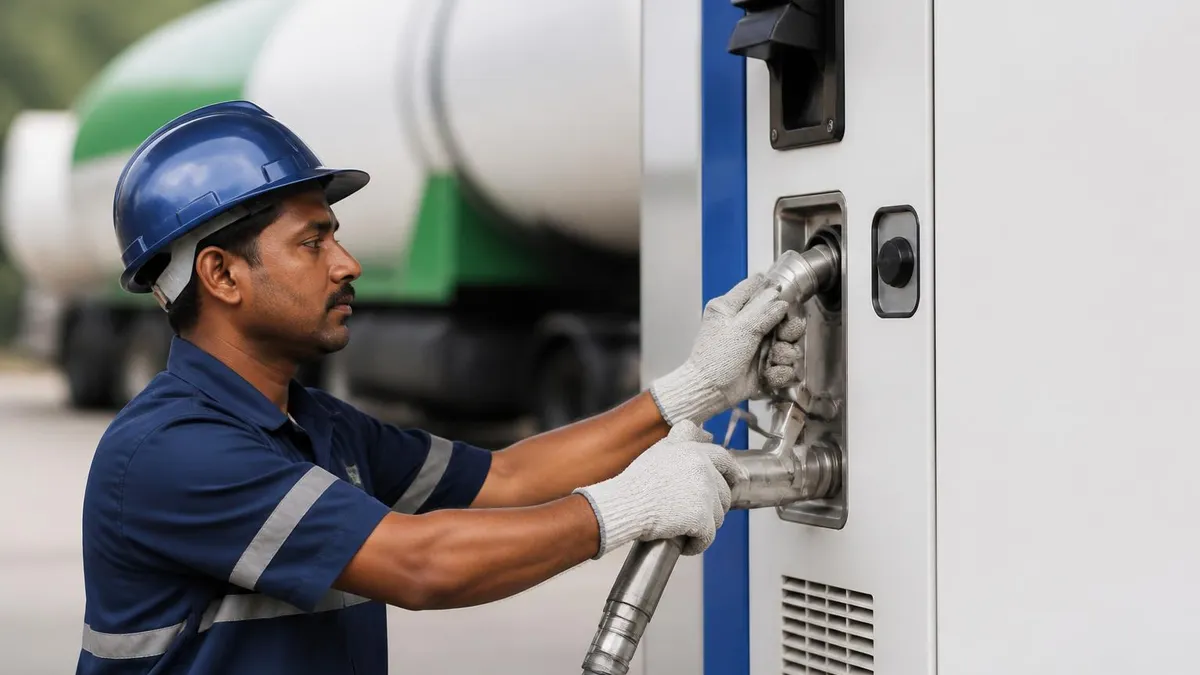
When you connect the dispenser nozzle to your vehicle's fill port, the nozzle engages a breakaway safety coupling that prevents accidental disconnection under pressure. CNG nozzles in the United States follow the NGV1 standard for light-duty vehicles and the NGV2 standard for heavy-duty trucks and buses. These standards, established by the American National Standards Institute (ANSI), ensure compatibility across all CNG vehicles and dispensers nationwide. The nozzle is inserted, a locking mechanism engages, and the flow begins automatically once the dispenser confirms a secure connection — making the process safer than many drivers initially expect.
Fueling measurement at a CNG station differs from liquid fuels in one important respect: you're measuring a gas, not a liquid. Dispensers use a flow meter calibrated to report fuel delivery in gasoline gallon equivalents (GGE). One GGE equals 126.67 standard cubic feet of natural gas at 60°F and standard atmospheric pressure.
The dispenser's computer automatically compensates for temperature variations because gas density changes with temperature, ensuring you always receive a consistent energy delivery regardless of ambient conditions. This temperature compensation, governed by SAE International standards, is why you may notice the dispenser running slightly longer on a hot summer day than on a cold winter morning.
The fill process itself typically takes between three and ten minutes for a passenger vehicle and up to fifteen minutes for a large transit bus or heavy-duty truck at a well-maintained fast-fill station. The time varies depending on how empty the vehicle's cylinders are, the cascade storage pressure available at the station, and the line pressure from the utility main.
A vehicle arriving with near-empty cylinders will actually fill faster initially — the pressure differential between the cascade storage and the vehicle tanks drives rapid gas transfer — but may slow as the pressures equalize near the end of the fill cycle.
Temperature plays a particularly important role in CNG fueling, a phenomenon known as temperature rise or heat of compression. As gas flows rapidly into the vehicle's cylinders, it compresses further and heats up — sometimes significantly. A warm fill means the gas occupies more volume per unit of energy, effectively reducing the amount of fuel delivered by mass.
Many modern dispensers compensate by targeting a specific density rather than a fixed pressure reading. Some stations also use chilling equipment to cool the gas before delivery, ensuring a dense, energy-rich fill regardless of ambient temperature. This technology, common at high-volume fleet stations, maximizes vehicle range on every fill.
After the fill is complete, the dispenser locks out and displays the total GGE delivered and the cost. You then depress a release lever on the nozzle to vent the small amount of residual pressure trapped between the nozzle and the vehicle valve — a brief hiss that is normal and expected. The nozzle then disconnects cleanly, and you replace the dust cap on the vehicle fill port to protect against contamination.
The entire process, from pulling in to pulling out, typically takes no longer than a conventional gasoline stop once you're familiar with the equipment. Many CNG drivers report that this process quickly becomes second nature, often faster than a diesel fill on a large truck.
Understanding the fueling process at a deep level is valuable not just for daily operations but for certification exams that cover CNG fleet management and driver operations. Many questions on these exams test knowledge of GGE measurement, cascade storage function, temperature compensation, and nozzle standards — all topics that arise directly from understanding how a CNG station actually works. Drivers and fleet operators who understand the mechanics behind the fuel are better equipped to diagnose fueling issues, communicate with maintenance staff, and optimize vehicle range on every trip they take.
CNG Station Costs and Pricing Explained
CNG fuel is priced in gasoline gallon equivalents (GGE), making direct cost comparison with gasoline straightforward. Nationally, CNG prices have consistently ranged from $2.00 to $2.80 per GGE in recent years, often running $0.50 to $1.50 below the prevailing retail gasoline price. This spread is the primary economic driver behind CNG fleet adoption, as the savings per vehicle compound dramatically across large fleets logging tens of thousands of miles annually.
Prices vary by region, with natural gas-producing states like Texas, Oklahoma, and Colorado typically offering the lowest CNG prices at public stations. California stations, while more numerous, often charge higher rates due to state fuel taxes and regulatory costs. Fleet operators with dedicated on-site stations frequently negotiate supply contracts directly with their local utility, locking in prices well below public station rates and providing budget predictability that gasoline purchasers rarely achieve.

CNG Fueling Stations: Advantages and Limitations
- +Fuel typically costs 30–50% less per GGE compared to gasoline or diesel at retail prices
- +Domestic natural gas supply reduces exposure to volatile global oil price swings
- +CNG burns cleaner, producing significantly lower NOx, particulate matter, and CO2 emissions
- +Fast-fill stations deliver a full charge in 3–10 minutes, comparable to gasoline fueling time
- +Extensive safety record: CNG cylinders are tested to extreme pressures and have an excellent track record
- +On-site time-fill stations give fleet operators complete fueling control and eliminate third-party dependence
- −Public CNG station network is far smaller than gasoline stations, limiting route flexibility for some drivers
- −Station construction costs of $200K–$2.5M+ represent a significant barrier for smaller fleets
- −CNG vehicle range is typically 15–25% lower than diesel equivalents due to tank volume constraints
- −Fast-fill station performance degrades during peak demand periods when cascade storage is depleted
- −Natural gas pipeline access is required for station siting, ruling out many rural or remote locations
- −CNG infrastructure knowledge gaps among mechanics and emergency responders can create operational challenges
Pros and Cons at a Glance
| Pros | Cons |
|---|---|
| Domestic natural gas supply reduces exposure to volatile global oil price swings | Public CNG station network is far smaller than gasoline stations, limiting route flexibility for some drivers |
| Extensive safety record: CNG cylinders are tested to extreme pressures and have an excellent track record | Fast-fill station performance degrades during peak demand periods when cascade storage is depleted |
| On-site time-fill stations give fleet operators complete fueling control and eliminate third-party dependence | Natural gas pipeline access is required for station siting, ruling out many rural or remote locations |
CNG Fueling Station Pre-Fueling Safety Checklist
- ✓Park the vehicle fully within the fueling bay with the engine off before approaching the dispenser.
- ✓Inspect the vehicle's CNG fill port for dirt, damage, or corrosion before connecting the nozzle.
- ✓Confirm the dispenser displays an active, ready status before initiating the fueling sequence.
- ✓Select the correct nozzle type: NGV1 for light-duty vehicles, NGV2 for heavy-duty trucks and buses.
- ✓Insert the nozzle fully into the fill port and engage the locking mechanism before opening gas flow.
- ✓Remain at or near the vehicle during fueling — never leave a CNG dispenser unattended.
- ✓Monitor the dispenser display for pressure and GGE delivery throughout the fill cycle.
- ✓If you detect a gas odor or hear an unusual hissing sound, stop fueling immediately and alert station staff.
- ✓After fueling, depress the nozzle relief lever to vent residual pressure before disconnecting.
- ✓Replace the dust cap on the vehicle fill port immediately after removing the fueling nozzle.
Always Compare CNG Prices in GGE, Not by Volume
CNG is a gas measured in cubic feet, but stations price it in gasoline gallon equivalents (GGE) so you can compare directly with gasoline costs. One GGE equals 126.67 standard cubic feet of natural gas at 60°F. When evaluating CNG economics, always use the GGE price — not the raw cubic-foot price — to make accurate fuel cost comparisons across vehicle types and fuel alternatives.
Finding a CNG fueling station in the United States has become considerably easier as digital tools have caught up with the infrastructure. The US Department of Energy's Alternative Fuels Station Locator, available at afdc.energy.gov, remains the most comprehensive and authoritative database of CNG stations nationwide. The tool allows filtering by station type (public, private, planned), fuel type, and hours of operation, and it is updated regularly with data from station operators and state energy offices. For route planning on long-haul trips, the map view makes it straightforward to identify fueling gaps and plan intermediate stops accordingly.
Beyond the DOE's official tool, several third-party apps and platforms have integrated CNG station data into broader fuel price and routing tools. TruckPark, a popular app among commercial truckers, includes CNG station locations with payment method details and trucker reviews. Pilot Flying J and Love's Travel Stops — two of the largest truck stop chains in the US — have expanded their CNG station footprints significantly, adding fast-fill stations at high-traffic Interstate locations to serve the growing Class 8 CNG truck market. Their proprietary apps allow drivers to verify station availability and lock in fuel prices before arrival.
The geographic distribution of public CNG stations reflects both historical natural gas infrastructure and regulatory push from state clean air programs. California leads the nation with the densest public CNG network, driven by the California Air Resources Board's (CARB) decades-long effort to reduce tailpipe emissions from heavy-duty vehicles.
Texas and Oklahoma follow, benefiting from abundant in-state natural gas production that keeps fuel prices low and makes station economics attractive. The Mountain West corridor — particularly Utah, Colorado, and Nevada — has also seen strong CNG station growth, driven by state incentive programs and the natural gas truck fleets serving mining and construction industries.
For fleet operators evaluating whether to establish a private CNG station or rely on the public network, the decision typically comes down to daily fuel volume and route predictability. Fleets consuming more than 5,000 GGE per month — a threshold easily met by 20–30 heavy-duty vehicles — almost always find that private on-site fueling offers better economics than public station pricing.
Below that volume, the capital cost of station construction may not pencil out, and public stations or negotiated commercial fueling contracts become the preferred approach. Many fleet managers begin with public station access, then build private infrastructure as their CNG vehicle count grows.
The I-10 corridor from Los Angeles to Jacksonville, Florida, represents one of the best-developed CNG fueling corridors in the country, with public and commercial stations spaced roughly every 200–300 miles — well within the range of modern CNG semi-trucks equipped with extended-range fuel systems. Similarly, the I-35 corridor from Laredo, Texas, through Dallas and Oklahoma City to Kansas City has seen substantial station investment from both public entities and private energy companies seeking to serve the growing number of CNG-powered cross-border freight trucks. These corridors demonstrate how concentrated investment in fueling infrastructure unlocks broader vehicle adoption.
Planned and under-construction station data in the DOE locator provides a useful forward-looking view of where the network is expanding. States with active clean transportation programs — including New York, Illinois, and Washington — have announced significant CNG station expansion plans tied to transit fleet electrification alternatives and commercial vehicle clean air mandates. Monitoring these expansion plans is valuable intelligence for fleet procurement teams deciding whether CNG infrastructure will support their operational geography over a five- to ten-year vehicle lifecycle horizon.
For drivers preparing for CNG certification exams, questions about station location resources, corridor coverage, and infrastructure planning are common. Understanding the DOE Alternative Fuels Station Locator and the major fueling corridors not only helps you answer exam questions accurately but also builds the practical knowledge that makes you a more effective operator or fleet manager in the field. The intersection of station access knowledge and operational decision-making is exactly where professional CNG expertise adds the most tangible value to employers and fleet programs.

Public fast-fill CNG stations vary significantly in compressor size and cascade storage capacity. A station designed for light-duty vehicles may be overwhelmed by a heavy-duty truck requiring 80+ GGE, causing slow fills or incomplete charges. Before routing a large fleet vehicle to an unfamiliar public station, confirm its heavy-duty capacity by calling ahead or checking the station's DOE listing for maximum flow rate data.
Fleet infrastructure planning for CNG is a multi-layered process that requires coordination among vehicle procurement teams, fuel supply managers, facility engineers, and utility companies. The starting point for any serious fleet CNG evaluation is a fuel consumption analysis: how many vehicles will use CNG, what are their daily mileage and fuel consumption patterns, and when do they return to base? These answers determine whether time-fill, fast-fill, or combination fueling is the right fit, and they drive the compressor sizing calculation that anchors the entire station design process.
Utility interconnection is the critical path item in most CNG station projects. Natural gas utilities typically require four to eight months to engineer and construct a new service lateral capable of delivering the high-volume gas flow that a CNG compressor demands. This timeline often surprises fleet managers accustomed to diesel fueling infrastructure, which can be installed relatively quickly with above-ground tank placement. Engaging the local utility early — ideally 12 to 18 months before the target vehicle deployment date — is the single most important scheduling action in a fleet CNG project.
Permitting for CNG stations falls under a combination of federal, state, and local jurisdictions. At the federal level, NFPA 52 — the Vehicular Natural Gas Fuel Systems Code — establishes the baseline safety requirements for CNG fueling equipment, piping, and siting. Most states adopt NFPA 52 by reference, though some add state-specific amendments. Locally, fire marshals typically have inspection and approval authority over CNG facilities, and their familiarity with the technology varies considerably by jurisdiction. Engaging a CNG-experienced permitting consultant early in the project helps navigate local requirements efficiently and avoids costly redesigns.
Compressor selection is the most consequential equipment decision in a CNG station build. The two dominant compressor technologies are reciprocating (piston-driven) and rotary screw. Reciprocating compressors dominate the CNG station market for their high efficiency and ability to reach 3,600 PSI with minimal oil carry-over into the gas stream — a quality concern for vehicle fuel systems. Rotary screw compressors are quieter and require less frequent maintenance but are generally less efficient at high pressures. For most fleet applications, reciprocating compressors from manufacturers like Ariel, GreenField Compression, and Bauer remain the standard choice.
Dispenser selection involves choosing between card-lock commercial dispensers, open-access public dispensers, and fleet management system-integrated dispensers that log fueling events per vehicle. Fleet operators almost universally prefer integrated dispensers that capture vehicle ID, driver ID, GGE dispensed, and transaction timestamp automatically — data that feeds directly into fleet management software for fuel cost allocation, maintenance scheduling, and emissions reporting. Leading dispenser manufacturers in the US market include Wayne Fueling Systems, Gilbarco Veeder-Root, and ANGI Energy Systems, each offering models compatible with major fleet management platforms.
Emergency planning and staff training round out the fleet infrastructure picture. CNG stations require on-site emergency response protocols that cover compressor shutdowns, cylinder leak response, and fire response procedures. The Compressed Gas Association (CGA) and the American Gas Association (AGA) publish training materials and certification programs for CNG station operators. Many fleet operators require all drivers who fuel at company stations to complete a brief CNG fueling safety orientation before their first solo fueling event. This training investment pays dividends in both safety outcomes and reduced equipment damage from improper nozzle handling or overpressure incidents.
For fleet managers researching the full vehicle and infrastructure ecosystem, exploring options for cng fueling station-compatible vehicles alongside station planning delivers the most complete operational picture. The interplay between vehicle tank capacity, daily range requirements, and station throughput capability determines whether a CNG program delivers on its economic and environmental promise — or falls short due to inadequate infrastructure planning. Getting both sides of this equation right from the start is what separates successful CNG programs from those that struggle with range anxiety, fueling delays, and cost overruns.
Practical success at a CNG fueling station comes down to preparation, situational awareness, and a solid understanding of the equipment. For drivers new to CNG, the best advice is to take your first fill at a station during off-peak hours — early morning or mid-afternoon on a weekday — when staff are more available for questions and the cascade storage is fully charged from overnight compressor operation. Avoid the end-of-day rush at public stations near fleet depots, where cascade storage may be partially depleted from heavy afternoon fueling activity, resulting in slower fills and potentially incomplete charges.
Route planning with CNG requires a different mindset than gasoline routing because the refueling network is sparser and station throughput varies. A practical rule of thumb for CNG long-haul drivers is to plan stops every 200 miles on unfamiliar routes, even if your vehicle's range theoretically extends to 300+ miles.
This buffer accounts for route deviations, elevation changes that increase fuel consumption, and the possibility that a station may be temporarily out of service for compressor maintenance. Always have a backup station identified for every planned fuel stop, using the DOE locator's trip planner feature to identify alternatives within 50 miles of each primary stop.
Seasonal considerations affect CNG fueling in ways that gasoline and diesel drivers may not anticipate. In cold climates, vehicle CNG cylinders can build up moisture over time, particularly in older systems, which can freeze and restrict gas flow during very cold weather. Properly maintained cylinder systems with functioning filter/dryers are not susceptible to this problem, but drivers should be aware of any unusual pressure drop at startup in cold weather conditions. In hot summer weather, temperature rise during filling means slightly shorter effective ranges — compensate by filling to the dispenser's auto-shutoff on every stop rather than stopping early.
Payment at CNG stations follows the same patterns as conventional fuel stations, with the added complexity that many fleet stations are card-lock only — accessible exclusively with a fleet fuel card or proprietary RFID credential. Major CNG networks like Clean Energy Fuels, TruckPark, and Pilot Flying J issue fleet cards that work at their own stations; some also have cross-network agreements that broaden acceptance. For drivers operating outside their primary network, having a backup payment method — Visa, Mastercard, or a secondary fleet card — prevents getting stranded at a station that doesn't accept your primary card.
Maintaining a fueling log is a best practice that pays dividends for both individual drivers and fleet managers. Recording the station location, GGE dispensed, odometer reading, and final fill pressure at each stop creates a dataset that reveals vehicle performance trends over time.
A vehicle that consistently delivers fewer miles per GGE than its rated efficiency may have a cylinder issue, injector fouling, or a catalytic converter problem — all diagnosable conditions that, left unaddressed, increase fuel costs and reduce vehicle reliability. Fleet management software can automate this tracking, but the discipline of capturing accurate data at the pump is still a driver responsibility.
For those preparing for CNG certification exams or professional driver qualification tests, understanding the full arc of a CNG fueling event — from route planning and station selection through the physical fueling process to post-fill data recording — is essential knowledge. Exam questions frequently test not just the mechanics of CNG fueling but the decision-making and procedural discipline that distinguish a competent CNG operator from someone who merely knows how to connect a nozzle. Practice exams and scenario-based study tools are particularly valuable for internalizing this procedural knowledge before test day.
The CNG fueling station landscape in the United States continues to evolve rapidly, with new stations opening regularly along freight corridors and in urban transit markets. Staying current with network developments through the DOE Alternative Fuels Station Locator, industry publications like NGT News and Natural Gas Vehicles for America (NGVA) bulletins, and fleet association communications keeps operators ahead of the curve. The drivers and fleet managers who invest in deep CNG knowledge — not just the minimum required to pass a license exam — are the ones who unlock the full economic and environmental potential of compressed natural gas transportation.
Sample Compressed Natural Gas Practice Questions
Try these questions from our free Compressed Natural Gas practice tests. The correct answer and an explanation follow each question.
What type of portable fire extinguisher is most appropriate for use at a CNG fueling station?
- A. Water-type extinguisher
- B. CO2 extinguisher
- C. Dry chemical ABC-rated extinguisher
- D. Foam extinguisher
Answer: C. Dry chemical ABC-rated extinguisher
ABC dry chemical extinguishers are appropriate at CNG stations because they handle ordinary combustibles, flammable gases/liquids, and energized electrical equipment.
Which training requirement is mandated for employees who fuel CNG vehicles at a fleet's private fueling station under OSHA standards?
- A. Hazard Communication (HazCom) training on compressed gas hazards and emergency procedures
- B. CDL Class B licensing
- C. NFPA 1 Fire Inspector certification
- D. EPA-certified fuel economy testing
Answer: A. Hazard Communication (HazCom) training on compressed gas hazards and emergency procedures
OSHA's Hazard Communication Standard requires employees working with compressed gases, including CNG, to receive training on associated hazards and safe handling procedures.
A technician is observing the fueling of a vehicle at a fast-fill CNG station that uses a three-bank cascade storage system. To achieve the most complete fill, in what sequence should the dispenser draw gas from the storage banks?
- A. First from the low-pressure bank, then medium, and finally topping off from the high-pressure bank.
- B. First from the high-pressure bank, then medium, and finally from the low-pressure bank.
- C. Simultaneously from all three banks until the vehicle's cylinder pressure equalizes.
- D. Only from the high-pressure bank to ensure the fastest possible fill time.
Answer: A. First from the low-pressure bank, then medium, and finally topping off from the high-pressure bank.
A cascade storage system is designed to maximize the pressure differential between the station's storage and the vehicle's tank throughout the fill. It starts with the lowest pressure bank, which can still transfer a significant volume of gas into the nearly empty vehicle tank. As the vehicle's tank pressure increases, the system switches to the medium, and then the high-pressure bank to complete the fill, ensuring a fuller, more efficient transfer of gas.
During a fast-fill at a public CNG station, why may the displayed fuel gauge reading drop shortly after fueling ends?
- A. Fuel leaks out immediately after filling
- B. Gas cools and contracts after the fast-fill heat of compression dissipates
- C. The check valve has failed
- D. The ECM resets the gauge automatically
Answer: B. Gas cools and contracts after the fast-fill heat of compression dissipates
Fast-fill compresses gas rapidly, raising its temperature and pressure; as the gas cools to ambient temperature, pressure and the gauge reading drop slightly.
CNG Questions and Answers
CNG Trucks for Sale: Complete Buyer's Guide to New and Used Compressed Natural Gas Vehicles
CNG Practice Test Video Answers

What Is Compressed Natural Gas (CNG)? The Complete Guide for US Drivers and Fleet Managers
What Is CNG? A Plain-English Guide to Compressed Natural Gas

CNG Pump: How Compressed Natural Gas Fueling Works, What to Expect, and Why It Matters
About the Author

Educational Psychologist & Academic Test Preparation Expert
Columbia University Teachers CollegeDr. Lisa Patel holds a Doctorate in Education from Columbia University Teachers College and has spent 17 years researching standardized test design and academic assessment. She has developed preparation programs for SAT, ACT, GRE, LSAT, UCAT, and numerous professional licensing exams, helping students of all backgrounds achieve their target scores.
Join the Discussion
Connect with other students preparing for this exam. Share tips, ask questions, and get advice from people who have been there.
View discussion (8 replies)