
CNA Classes Online 2026 September: What You Can (and Cannot) Do Online
🎓 Prepare for the CNA Classes Online 2026 September: What You Can certification. Practice questions with answer explanations covering all exam domains.
What CNA Training Can Be Done Online vs. In Person
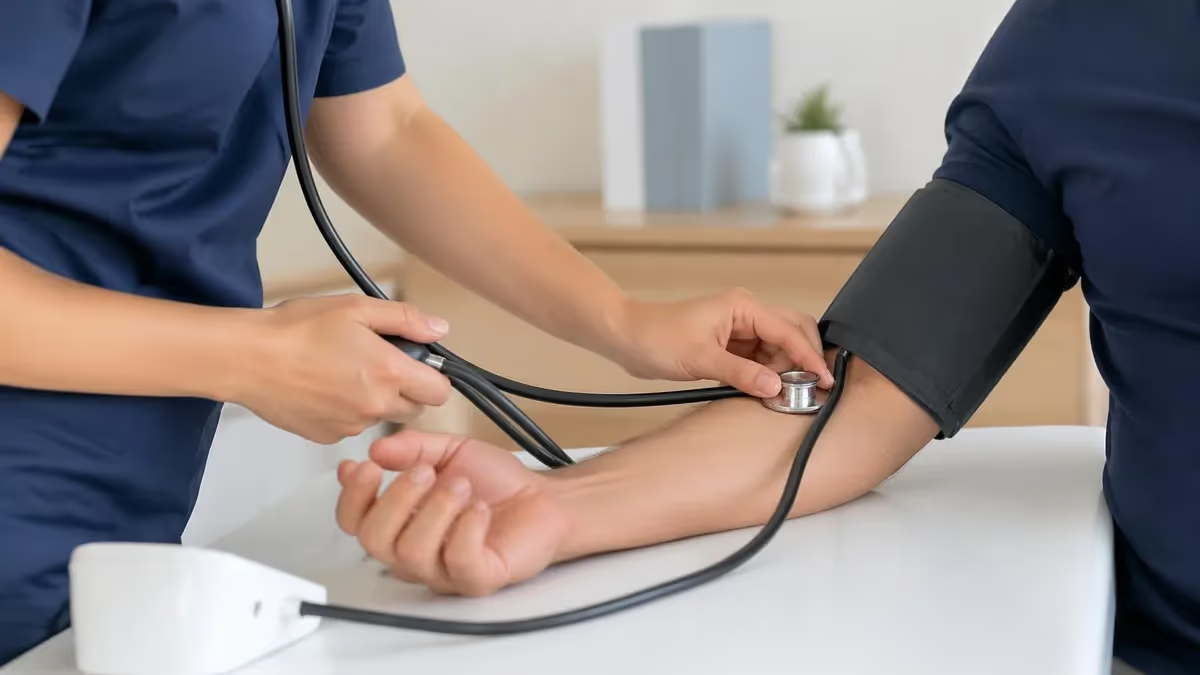
The most important thing to understand about CNA training online is this: no legitimate, state-approved CNA program can be completed entirely online. Federal law and state regulations require that CNA training include supervised clinical practicum — hands-on patient care hours completed in a real healthcare facility under qualified supervision. This clinical component cannot be replaced by online simulations, virtual reality, or video demonstrations.
What Can Be Done Online (Didactic Component)
The didactic — classroom knowledge — component of CNA training can be completed online through hybrid programs. Online didactic content covers: anatomy and physiology relevant to patient care; nursing assistant roles, responsibilities, and scope of practice; infection control and standard precautions; patient rights and legal/ethical responsibilities; communication and interpersonal skills; safety and emergency procedures; vital signs measurement concepts; and documentation principles. This knowledge content can be effectively learned through online modules, videos, readings, and assessments. Many legitimate CNA programs now offer this portion online, allowing students to complete the classroom portion at their own pace and schedule before coming in for the in-person clinical component.
What Cannot Be Done Online (Clinical Component)
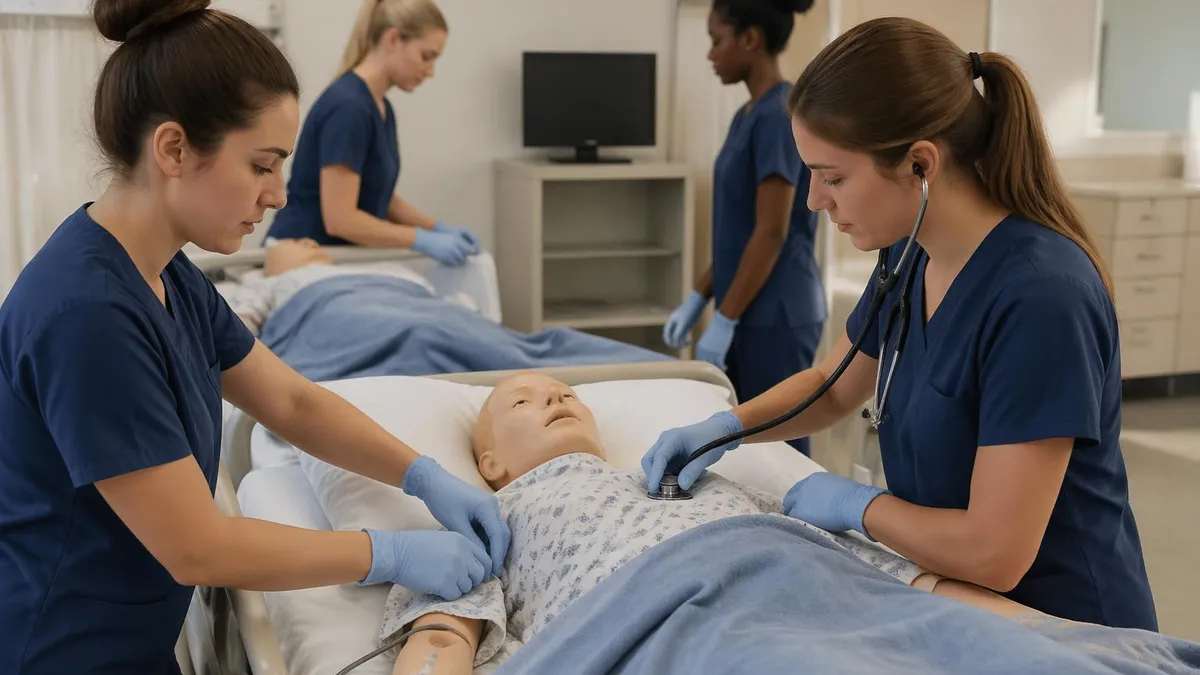
The clinical practicum component requires in-person supervised practice in a real healthcare facility — typically a skilled nursing facility or long-term care community. Clinical hours involve: performing direct patient care under a qualified CNA instructor's observation; practicing skills such as vital signs, bed bath, oral hygiene, positioning, catheter care, and range of motion exercises on actual patients or in lab settings with high-fidelity manikins; and demonstrating competence in each skill before advancing. Federal regulations require a minimum of 16 hours of supervised clinical practicum, and many states require more. This component exists because skills like safe patient transfers, catheter care, and proper positioning require hands-on practice — they cannot be adequately learned by watching videos alone.

Hybrid CNA Programs with Online Didactic Components
Legitimate hybrid CNA programs combine an online classroom component with required in-person clinical hours. These programs are state-approved and qualify graduates for the state CNA certification exam. They are a practical option for adults who need scheduling flexibility for the didactic portion but can commit to the required in-person clinical days.
How Hybrid Programs Work
In a hybrid CNA program, students log into an online learning management system to complete readings, watch instructional videos, pass knowledge assessments, and participate in any online discussion components — all on a self-paced or scheduled online basis. Once the online didactic curriculum is completed (typically verified by passing an online assessment), students move to the in-person clinical phase. Clinical days are scheduled at a partner healthcare facility, typically a skilled nursing facility, where students practice skills with actual residents under a clinical instructor's direct supervision. The total program length in a hybrid format is typically 4 to 8 weeks, depending on how quickly students complete the online component and when clinical days are scheduled.
Finding Legitimate Hybrid Programs
Legitimate hybrid CNA programs are listed in your state's registry of approved CNA training programs, published by the state's department of health, department of public health, or equivalent regulatory authority. When evaluating an online CNA program, ask specifically: Is this program approved by [your state]'s CNA training program registry? What is the in-person clinical component requirement, and where will clinicals be completed? Legitimate programs will be able to provide their state program approval number and specific clinical partner sites. Programs that claim to offer full CNA certification entirely online — with no in-person clinical requirement — are not legitimate and their certificates will not be accepted by your state's Nurse Aide Registry.
Free CNA Study Resources Online
While full CNA certification requires a paid, state-approved program (or a free employer-sponsored program), there are substantial free online resources for CNA knowledge preparation and exam study.
State Adult Education Programs
State-funded adult education programs — available through community colleges, workforce development agencies, and adult learning centers — frequently offer free or very low-cost CNA training to eligible adults. These programs are funded under the Workforce Innovation and Opportunity Act (WIOA) and are designed to help adults enter the healthcare workforce. Eligibility requirements and funding availability vary by state and county. Contact your local community college, county employment office, or state workforce agency to ask about available funded CNA training options. Some state adult education programs offer fully paid CNA training including exam fees for income-eligible participants.
Free Online CNA Study Content
For candidates already enrolled in a CNA program or preparing to take the state exam, free online study resources are widely available. Khan Academy provides free anatomy and physiology content that directly supports CNA learning. YouTube channels dedicated to CNA skills and nursing assistant training provide visual demonstrations of clinical skills like vital signs, catheter care, and patient positioning — useful for review before the clinical skills exam. CNA state exam review videos and flashcard sets are available on platforms including YouTube, Quizlet, and Anki. Free CNA practice tests are available here on PracticeTestGeeks and through other test prep websites.
Free CNA Skills Checklists
Many state health departments publish the clinical skills checklists used in the state CNA competency exam — these are publicly available documents listing the exact steps and criteria used to evaluate each clinical skill on the exam. Practicing skills against the exact state evaluation criteria helps candidates avoid failing the skills test on technicalities. Search your state's department of health website or Nurse Aide Registry website for the CNA skills evaluation criteria or clinical skills performance checklists.
Finding State-Approved CNA Programs
Every state maintains a registry of state-approved CNA training programs. Using this registry — not third-party program listing websites — is the only reliable way to verify that a program will qualify you for the state CNA certification exam.
How to Find Your State's Program Registry
Navigate to your state's department of health, department of public health, or healthcare workforce regulatory agency website and search for 'CNA training programs,' 'nurse aide training,' or 'nursing assistant approved programs.' Most states publish a searchable database or downloadable list of approved training programs including the program name, address, and contact information. Use this list to identify programs in your area that are confirmed state-approved — then contact them to ask about online or hybrid options. Not all state-approved programs are listed on third-party program directories, so going to the official source prevents inadvertent enrollment in a non-approved program.
Community Colleges
Community colleges offering CNA programs are almost always state-approved, as community college programs undergo accreditation and regulatory oversight. Search your local community college's website for 'CNA,' 'nursing assistant,' or 'certified nurse aide' under their healthcare or continuing education departments. Community college CNA programs are frequently the most affordable non-employer-sponsored option for candidates seeking program quality and state approval, with hybrid (partly online) options available at many institutions.

Employer-Sponsored CNA Training
Many healthcare employers — particularly skilled nursing facilities, assisted living communities, and home health agencies — offer sponsored CNA training as a way to recruit and develop their own workforce. Employer-sponsored programs are often the most affordable pathway to CNA certification, frequently provided at no cost to participants in exchange for a work commitment.
How Employer-Sponsored Programs Work
Healthcare employers with state-approved CNA training programs hire candidates without CNA certification and train them on the job. The training is typically provided during paid or partially paid hours — candidates are employees (or employee candidates) during training, not students paying tuition. In exchange, participants typically commit to working at the sponsoring facility for a period after certification (commonly 6 to 12 months). If the participant leaves before the commitment period ends, they may be required to repay the training costs — understand the repayment terms before enrolling.
Large Employers Offering CNA Training
Dialysis companies — particularly DaVita and Fresenius Medical Care — actively recruit and train CNA-certified individuals for patient care technician (PCT) roles in their dialysis centers, and provide additional dialysis-specific training. Many hospital systems offer CNA training programs or sponsor CNA certification for candidate employees or community members as part of healthcare workforce development initiatives. Home health agencies frequently offer free or subsidized CNA training to candidates willing to work in home health settings post-certification. Contact local nursing homes, assisted living facilities, home health agencies, and hospital human resources departments directly to ask about any sponsored CNA training programs they offer — these programs may not be widely advertised.
CNA Checklist
- ✓Verify any program on your state's official approved CNA training program registry before enrolling
- ✓Confirm the program has a required in-person clinical component (not fully online)
- ✓Ask the program for their state program approval number and clinical partner site names
- ✓Check for free or subsidized training through state adult education or WIOA-funded programs
- ✓Ask local nursing homes, assisted living, and home health agencies about sponsored CNA training
- ✓Use free online resources (Khan Academy, YouTube CNA skills videos, practice tests) for exam prep
- ✓Download your state's CNA clinical skills performance checklists from the health department website
- ✓Compare program costs, schedule flexibility, and clinical site locations before choosing a program
- ✓Take free CNA practice tests to assess knowledge before the state written exam
CNA Practice Test Questions
Prepare for the CNA - Certified National Accountant exam with our free practice test modules. Each quiz covers key topics to help you pass on your first try.
CNA Auditing Principles
CNA Exam Questions covering Auditing Principles. Master CNA Test concepts for certification prep.
CNA Business Law and Ethics
Free CNA Practice Test featuring CNA Business Law and Ethics. Improve your CNA Exam score with mock test prep.
CNA Managerial Accounting
CNA Mock Exam on CNA Managerial Accounting. CNA Study Guide questions to pass on your first try.
CNA Cost Accounting
CNA Test Prep for Cost Accounting. Practice CNA Quiz questions and boost your score.
CNA Financial Accounting
CNA Questions and Answers on Financial Accounting. Free CNA practice for exam readiness.
CNA Tax Fundamentals
CNA Mock Test covering Tax Fundamentals. Online CNA Test practice with instant feedback.
CNA National Accountant Career Opportuniti...
Free CNA Quiz on National Accountant Career Opportunities and Benefits. CNA Exam prep questions with detailed explanations.
CNA National Accountant Eligibility and Qu...
CNA Practice Questions for National Accountant Eligibility and Qualifications. Build confidence for your CNA certification exam.
CNA Pros and Cons
- +Online testing eliminates travel time and costs, making the exam more accessible for candidates in remote areas
- +Flexible scheduling windows for online delivery allow candidates to test at their preferred time of day
- +Online delivery often supports on-screen calculators, scratch paper tools, and accessible features for candidates who need them
- +Immediate or faster score delivery compared to some paper-based testing formats
- +Candidates who perform better in familiar environments may find home testing conditions less stressful than test centers
- −Technical requirements (reliable internet, compatible hardware, quiet room) create barriers for some candidates
- −Remote proctoring software can generate false security violations, leading to score cancellations that require appeals
- −Home testing environments introduce interruptions and distractions that dedicated testing centers eliminate
- −Technical issues during the exam require time-consuming support processes that may not be resolved before session timeout
- −Not all exam versions or score types are available via online delivery — some credentials require in-person testing for official certification
CNA Questions and Answers


About the Author

Registered Nurse & Healthcare Educator
Johns Hopkins University School of NursingDr. Sarah Mitchell is a board-certified registered nurse with over 15 years of clinical and academic experience. She completed her PhD in Nursing Science at Johns Hopkins University and has taught NCLEX preparation and clinical skills courses for nursing students across the United States. Her research focuses on evidence-based exam preparation strategies for healthcare certification candidates.