
CNA Practice Tests 2026 July: Free Test Prep for Nursing Assistants
Free CNA practice test with questions and answer explanations. Prepare for the 2026 July exam with instant scoring. 🗨️

About the CNA Competency Exam
The CNA (Certified Nursing Assistant) competency exam, also called the Nurse Aide Competency Evaluation, is a two-part test required to become a state-certified nursing assistant. It is administered by state-approved testing organizations — in many states, Pearson VUE, Prometric, or D&S Diversified Technologies — and must be passed before you can work as a CNA in a nursing home, hospital, home health agency, or other care facility.
The CNA exam has two components: a written (or oral) knowledge test and a skills performance evaluation. Both parts must be passed to receive CNA certification. Some states allow candidates to take the written test and skills test on the same day; others schedule them separately. You must apply to your state's nurse aide registry and pay an exam fee before scheduling — fees typically range from $80 to $150 depending on the state and testing vendor.
CNA training programs typically last 4 to 12 weeks and consist of classroom instruction and supervised clinical hours. Federal regulations (OBRA 1987) require a minimum of 75 hours of CNA training — 16 hours of clinical training and 59 hours of theory. Many states exceed this federal minimum and require 120 to 175+ hours of training. After completing your approved training program, you are eligible to take the CNA competency exam, which must be passed within 24 months of completing training.

CNA Written Test: Topics and Format
The CNA written test consists of multiple-choice questions covering the knowledge that nursing assistants need to provide safe, competent care. The number of questions varies by state and testing vendor, but typically ranges from 60 to 100 questions. The exam is scored on a pass/fail basis — most states require 70% to 80% correct to pass.
Role of the Nursing Assistant
Questions about the nursing assistant's role cover: the scope of practice (what CNAs are and are not allowed to do), working under the supervision of licensed nurses, legal and ethical responsibilities, patient rights under federal law, reporting requirements for abuse, neglect, and exploitation, and professionalism and work ethics. The nursing assistant's role within the healthcare team — as a team member who reports to and takes direction from RNs and LPNs — is fundamental to this category.
Safety and Emergency Procedures
Safety questions cover: fall prevention and safe patient handling, proper use of mechanical lifts and transfer equipment, fire safety (RACE: Rescue, Alert, Confine, Extinguish), disaster response, restraint alternatives, electrical safety, and reporting unsafe conditions. Emergency procedure questions include recognizing emergencies, calling for help, positioning an unconscious patient, and performing basic emergency responses such as the Heimlich maneuver and CPR (though CNAs typically initiate CPR and call for help rather than leading resuscitation).
Infection Control
Infection control is one of the highest-tested areas on CNA exams. Key topics include: hand hygiene (the single most important infection control measure), Standard Precautions (applied to all patients, all the time), Transmission-Based Precautions (Contact, Droplet, Airborne) and the PPE required for each, proper donning and doffing of PPE, isolation procedures, handling of soiled linens and waste, and the chain of infection (pathogen → reservoir → portal of exit → transmission → portal of entry → susceptible host).
Restorative Care and Independence
Restorative care questions address: promoting resident independence and dignity, assisting with ambulation and mobility exercises, range of motion (ROM) exercises (active, passive, and active-assisted), proper positioning, use of assistive devices, and restorative approaches to activities of daily living (ADLs). The philosophy underlying restorative care is 'do with, not for' — the nursing assistant's role is to support the resident in doing as much as possible for themselves.
CNA Skills Performance Test
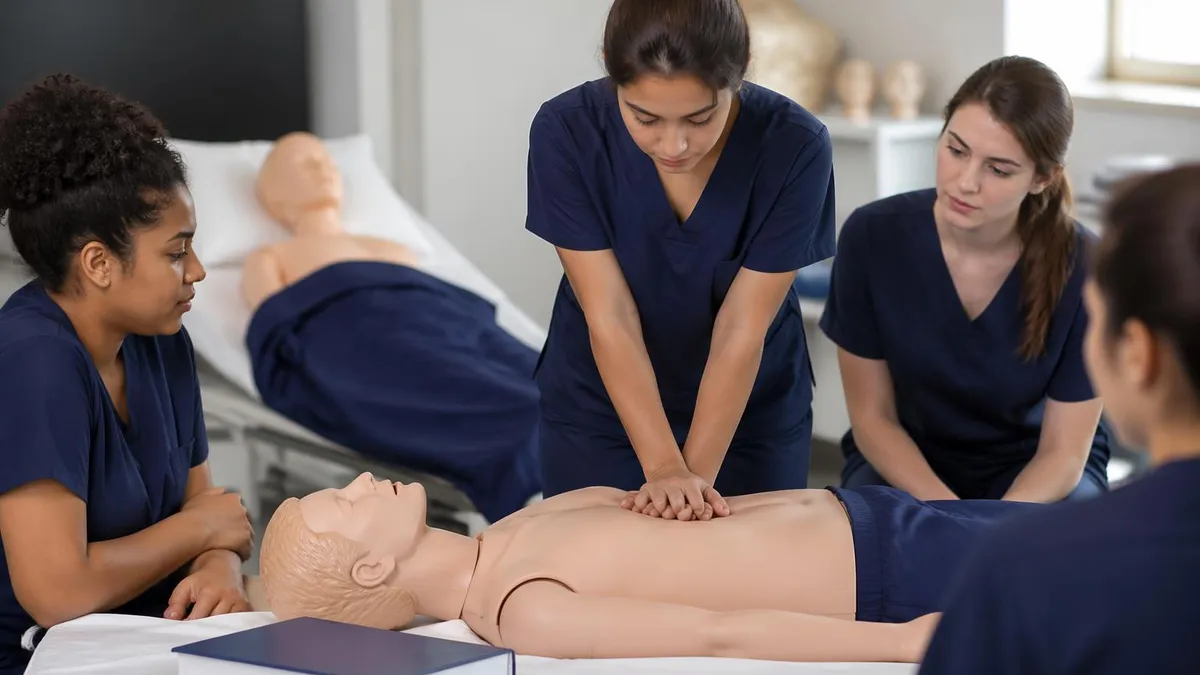
The skills performance test evaluates your ability to safely perform nursing assistant tasks. A trained evaluator observes you performing a specified number of skills — typically 5 skills selected randomly from a state-specific list of approximately 20 to 30 skills. You must correctly perform each skill in the proper sequence, including all required safety steps, to receive a passing score.
Commonly Tested CNA Skills
The skills tested on the CNA performance exam vary by state but commonly include: hand hygiene (proper handwashing technique — always part of every other skill), measuring and recording vital signs (blood pressure, pulse, respirations, temperature), transferring a resident from bed to wheelchair using proper body mechanics and safety equipment, providing peri-care (perineal care), positioning a resident in the Fowler's or lateral position, making an occupied bed, ambulating a resident with a gait belt, providing oral hygiene to a conscious or unconscious resident, putting on and removing PPE (gown, gloves, mask), measuring and recording urinary output, and assisting with range of motion exercises.
Failing a Skill
Most states allow you to fail one skill and still pass the overall performance test, provided all other skills are passed and no critical errors occurred. Critical errors (actions that could endanger the patient's safety, such as failing to raise side rails after a procedure or using incorrect infection control technique) typically result in automatic failure of that skill regardless of other performance. Review your state's specific skill competency checklists — available from your state nursing aide registry — and practice each skill in the exact sequence listed on the checklist.
Preparing for the Skills Test
Practice each skill repeatedly until you can perform it correctly from memory without prompting. Have someone read the skill steps aloud while you perform them. Time yourself — most evaluations give you 20 to 30 minutes to complete all five skills, with setup time. Prioritize infection control steps: always wash hands before and after each skill, use gloves when appropriate, and clean equipment after use. Many candidates fail skills not because they do not know the technique, but because they omit handwashing or another safety step under test pressure.
CNA Study Tips and Preparation Strategy
Effective CNA exam preparation combines content review with skills practice. A focused 2 to 4 week study plan following completion of your training program is sufficient for most candidates to pass both portions on their first attempt.
Use Your Textbook and State Skills Checklist
Your CNA training textbook (commonly 'Hartman's Nursing Assistant Care' or 'Mosby's Textbook for Nursing Assistants') is the best content review source for the written test. The content maps directly to what is tested. Your state's nursing aide registry website publishes the specific skills checklist used for performance evaluations — download it and practice each skill in the exact listed sequence.
Focus on High-Frequency Content Areas
Written test questions are not equally distributed across all topics. Infection control, patient rights (including the specific rights outlined in the Omnibus Budget Reconciliation Act of 1987), safety and fall prevention, activities of daily living, nutrition and hydration, and communication are consistently among the highest-tested content areas. Know Standard Precautions, Transmission-Based Precautions, and the associated PPE requirements cold — these appear in multiple question forms on virtually every CNA exam.
Practice Questions and Rationale Review
Take multiple full-length CNA practice tests before your exam date. For every question you miss, identify which knowledge gap caused the error and review that content section. CNA written test questions are often phrased as clinical scenarios — 'A resident refuses to eat breakfast. What should the nursing assistant do first?' — requiring you to apply knowledge to a patient situation rather than simply recall a fact. Practice questions train this applied reasoning alongside factual knowledge.

State-Specific CNA Requirements
CNA certification is state-specific — your certification is issued by your state's nursing aide registry and is not automatically valid in other states. However, most states have reciprocity processes that allow CNAs certified in good standing in one state to transfer their certification to another state without retesting.
Training Hours by State
States exceed the federal 75-hour minimum to varying degrees. Examples: California requires 160 hours; Texas requires 100 hours; New York requires 120 hours; Florida requires 120 hours; Ohio requires 75 hours (the federal minimum). Higher training hour requirements mean more time in both classroom instruction and clinical practice before you qualify to sit for the exam.
Exam Retake Policies
If you fail the CNA exam, retake policies vary by state and testing vendor. Most states allow up to 3 attempts before requiring additional training. Federal regulations specify that candidates have up to 24 months from completing an approved training program to pass the competency exam. If you exceed this time limit without passing, you must complete a new approved training program before retesting.
Registry and Background Check
After passing both portions of the CNA competency exam, your state nursing aide registry adds your name to the state's approved CNA registry. Employers verify CNA status through the registry. Most states conduct background checks as part of the CNA application process. Felony convictions related to abuse, neglect, or financial exploitation of vulnerable adults disqualify applicants from CNA certification in most states.
CNA Checklist
- ✓Download your state's CNA skills checklist from the state nursing aide registry
- ✓Review your CNA training textbook — focus on infection control, patient rights, safety
- ✓Know Standard Precautions and all three Transmission-Based Precaution types (Contact, Droplet, Airborne)
- ✓Know resident rights under OBRA 1987
- ✓Practice each skills test skill until you can perform it correctly from memory
- ✓Always practice handwashing before and after every skill
- ✓Take at least 3 full-length CNA written practice tests
- ✓Review rationales for every missed question — identify the knowledge gap
- ✓Schedule both the written test and skills test before your 24-month training window expires
CNA Practice Test Questions
Prepare for the CNA - Certified National Accountant exam with our free practice test modules. Each quiz covers key topics to help you pass on your first try.
CNA Auditing Principles
CNA Exam Questions covering Auditing Principles. Master CNA Test concepts for certification prep.
CNA Business Law and Ethics
Free CNA Practice Test featuring CNA Business Law and Ethics. Improve your CNA Exam score with mock test prep.
CNA Managerial Accounting
CNA Mock Exam on CNA Managerial Accounting. CNA Study Guide questions to pass on your first try.
CNA Cost Accounting
CNA Test Prep for Cost Accounting. Practice CNA Quiz questions and boost your score.
CNA Financial Accounting
CNA Questions and Answers on Financial Accounting. Free CNA practice for exam readiness.
CNA Tax Fundamentals
CNA Mock Test covering Tax Fundamentals. Online CNA Test practice with instant feedback.
CNA National Accountant Career Opportuniti...
Free CNA Quiz on National Accountant Career Opportunities and Benefits. CNA Exam prep questions with detailed explanations.
CNA National Accountant Eligibility and Qu...
CNA Practice Questions for National Accountant Eligibility and Qualifications. Build confidence for your CNA certification exam.
CNA Pros and Cons
- +CNA practice tests reveal specific knowledge gaps that study guides alone cannot identify
- +Timed practice builds the pace and endurance needed for the actual exam, reducing time-pressure surprises on test day
- +Reviewing incorrect answers on practice tests is one of the highest-ROI study activities available
- +Multiple free practice test sources allow candidates to access a variety of question styles without significant cost
- +Consistent practice test performance tracking shows measurable progress and identifies when readiness is approaching target level
- −Third-party practice tests vary significantly in quality and alignment with the actual exam — not all practice questions reflect real exam difficulty or style
- −Taking practice tests too early (before content review) produces discouraging scores and less useful diagnostic information
- −Memorizing practice test answers rather than understanding underlying concepts does not transfer to novel exam questions
- −Limited official practice tests mean candidates eventually exhaust authentic materials and must rely on less-accurate alternatives
- −Practice test performance may not reflect actual exam day performance due to differences in testing environment and conditions
CNA Questions and Answers

CNA License: State Requirements, Verification & Reciprocity

NCLEX Exam Prep: Study Strategies That Actually Work for RN and PN

CNA Salary: What Certified Nursing Assistants Earn 2026

CNA Career Overview 2026: Salary, Training, Certification & Job Outlook

CNA (Certified National Accountant) Test: Your Guide
About the Author

Registered Nurse & Healthcare Educator
Johns Hopkins University School of NursingDr. Sarah Mitchell is a board-certified registered nurse with over 15 years of clinical and academic experience. She completed her PhD in Nursing Science at Johns Hopkins University and has taught NCLEX preparation and clinical skills courses for nursing students across the United States. Her research focuses on evidence-based exam preparation strategies for healthcare certification candidates.