
CNA Exam Tips: Difficulty, Cost & Interview Prep 2026 September
🗨️ CNA exam tips covering difficulty, cost ($100-150), question count, Florida challenge route, and 40+ CNA interview questions and answers for new hires.

The Certified Nursing Assistant exam stands between you and a steady healthcare paycheck, and most candidates underestimate how much smart preparation moves the needle. The CNA test is not designed to trick you, but it does demand familiarity with infection control, patient rights, vital signs, and a handful of demonstrated clinical skills that examiners watch like hawks.
If you walk in cold, you will probably fail the skills portion long before the written section. If you walk in over-prepared, you waste weeks reviewing material that barely appears on the test. The trick is knowing where to focus, which is exactly where most candidates lose time and money.
This guide pulls together the tips that actually matter. We break down the difficulty level, the realistic question count, the fee ranges across states, the unusual Florida challenge route that lets eligible candidates skip the full training course, and the cheat-sheet approach that Reddit study groups have been refining since 2025. We then pivot to the part of the journey nobody talks about: the interview.
Once you pass the test, you still have to convince a Director of Nursing that you are calm, kind, and coachable. The second half of this article walks through the most common CNA interview questions and answers, what hiring managers actually listen for, and how to handle the behavioral curveballs that come up in nearly every facility interview.
The reason this matters is timing. Most CNA programs are designed to push you from enrollment to certification in six to twelve weeks, and most students plan to start working within thirty days of passing. That compressed window leaves almost no room for a failed attempt, a botched interview, or a missed fee deadline.
Treat the next two to three months as a single coordinated project: study smart, pass the test, then immediately apply the same energy to landing your first role. Candidates who treat the exam and the interview as one connected process consistently outperform those who tackle them separately.
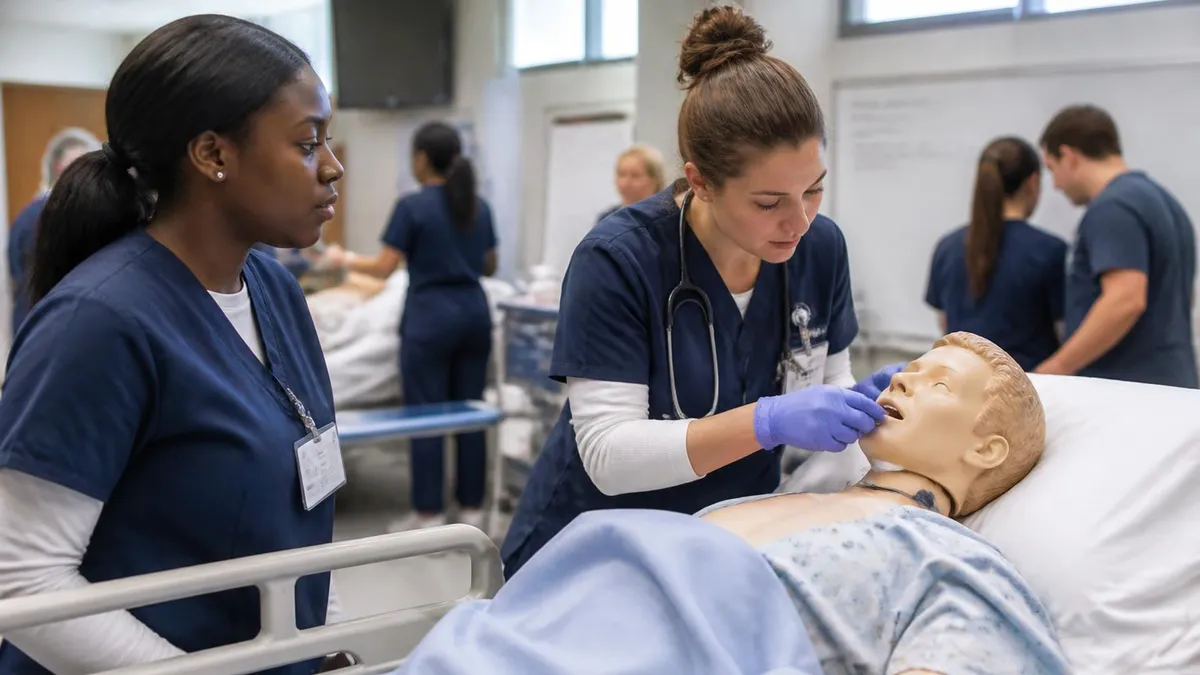
Most state CNA exams are administered by Prometric, Headmaster, or Credentia (NNAAP), and the exact format varies by state. Generally, you face 60 to 100 multiple-choice written questions and a clinical skills evaluation where the examiner picks five random skills from a list of about 25. You demonstrate each skill on a live volunteer while the examiner scores critical steps.
Miss a critical step (handwashing before patient contact, calling the resident by name, leaving the call light within reach) and you fail that skill, even if everything else was perfect. The grading is binary on critical steps. There is no partial credit, no second chance within the same skill, and no negotiation with the examiner about what counts.
Is the CNA exam hard? Honest answer: it is moderately challenging. The written section is rated easier than the clinical, but only if you have studied the official candidate handbook. The clinical is where most failures happen because nervous candidates skip courtesy steps or forget to record vital signs in writing before reporting them. The national first-attempt pass rate hovers around 80 percent, which means roughly one in five candidates needs a retake.
Retakes cost money and waiting time, so over-preparing the first round is cheaper than gambling. How hard is the CNA exam compared to other allied health certifications? Most graduates who have also taken the phlebotomy, EKG, or medical assistant exams rate the CNA written test as easier in content but harder in delivery, because the clinical skills portion has no analog in those other exams. You are being judged on physical performance under direct observation, which adds a layer of nerves that pure multiple-choice tests do not.
What 2025 Reddit CNA Guides Keep Repeating
Scroll the r/CNA subreddit and the same three tips appear in nearly every passed-the-test thread: (1) memorize the four-step handwashing sequence cold because it is graded on every skill, (2) record your numbers on paper before announcing them to the examiner, and (3) talk to your patient the entire time, even when the patient is a silent volunteer. Reddit consensus is that examiners pass candidates who behave like real caregivers, not robotic step-followers.
Cost-wise, expect to pay between $100 and $150 for the full exam in most states. California sits at the top end around $135, Texas runs about $115, Florida ranges from $115 to $140 depending on whether you do the full exam or a skills-only retake, and several Midwest states come in under $110. The fee usually covers both the written and clinical components in one sitting.
If you fail one section, you typically retest only that section for about half the original fee. Some training programs bundle the exam fee into tuition, while others bill it separately at the end of the course. Always confirm with your program coordinator before paying out of pocket, because surprise fees on test day are one of the top complaints from CNA candidates online.
How many questions are on the CNA test exactly? It depends on your state and test provider. Prometric states like Maryland and Virginia use 60 questions on the written exam. Credentia (NNAAP) states like Pennsylvania and Virginia use 70. Headmaster states like Montana and Idaho run 75. Credentia in Florida uses 60 written plus a separate oral option for candidates who request reading accommodation.
The clinical skills count is consistent: five random skills, drawn from roughly 25 published possibilities. You have about two hours total for both sections combined, and most candidates finish in 90 minutes. Time pressure is rarely the issue. Skipping a step under nerves is the real risk.
If you are weighing program quality, look at the in-house pass rate before tuition. Reputable training providers publish their first-attempt pass rate, and anything above 85 percent is a strong signal. Programs in the 60 to 70 percent range often skimp on clinical lab hours, which is where you build the muscle memory the examiner is grading. Cheap tuition can become expensive fast if you need two retakes and a refresher course before passing.
Focus 60% of study time on infection control, resident rights, communication, and vital signs ranges. These four domains carry the most questions.
Practice all 25 published skills out loud with a partner. Always start with handwashing, identify the resident, explain the procedure, and end with the call light.
Florida lets eligible candidates skip the 75-hour course and test directly. You still pay the exam fee but save tuition. Strict eligibility rules apply.
Prepare three patient stories you can adapt to any behavioral question. Hiring managers care about compassion and reliability above all else.
How to challenge the CNA test in Florida is one of the most searched questions in the CNA world, and the answer surprises most people. Florida is one of the few states that lets you sit the official CNA exam without completing an approved 75-hour training course, provided you meet alternative eligibility.
You qualify if you have completed at least one semester of a Florida-approved nursing program, hold an out-of-state CNA license you cannot transfer through standard reciprocity, or have documented hands-on caregiving experience the Board of Nursing accepts. You apply directly through Prometric Florida, pay the full $140 exam fee, and pass both written and clinical sections to receive your certification.
The challenge route saves time and tuition (usually $600 to $1,200 in Florida) but it is brutal without structured preparation. You are responsible for learning the same content as students in a full course, then performing skills under examiner pressure without instructor feedback. Most candidates who succeed on the challenge route study for six to eight weeks using a CNA workbook, a YouTube skills playlist, and at least one in-person practice session with a working CNA or RN willing to coach them. If you do not have that mentor, the full course is almost always the better investment.
Beyond Florida, only a handful of states permit any form of challenge testing, and each has unique eligibility paperwork. New York, Texas, and Arizona allow nursing students who completed Fundamentals of Nursing to test directly. California allows out-of-state CNAs with active certification to test without retraining. Most other states require the full 75-hour course regardless of background. Always confirm with your state Department of Health rather than relying on forum advice, because eligibility rules change yearly and outdated Reddit threads have steered candidates wrong more than once.
The written exam pulls heavily from six topic areas: infection control (handwashing, PPE, isolation precautions), resident rights (privacy, dignity, refusal of care, abuse reporting), basic nursing skills (vital signs, range of motion, intake/output), personal care (bathing, grooming, toileting, feeding), communication (with residents, families, and the nursing team), and mental health/social service needs. Roughly 30 percent of questions test infection control or safety. Memorize normal vital sign ranges for adults, recognize signs of abuse, and know who you report to and when.
The skills cheat sheet that Reddit study groups have refined over the past two years is not a list of answers. It is a sequence you memorize so deeply that you can perform any of the 25 skills without thinking about the structure. The sequence: knock and greet, identify the resident, wash hands, explain the procedure, gather supplies, provide privacy, perform the skill using proper body mechanics, observe the resident throughout, record measurements in writing, dispose of waste correctly, wash hands again, lower the bed, and leave the call light within reach.
If you cement this 13-step shell in your muscle memory, you only need to learn the unique middle steps for each skill. Practice the shell at home on a stuffed animal or pillow until you can run through it without looking at a checklist.
How many can you miss on the CNA skills test? You cannot miss any critical step on any of the five assigned skills. Critical steps are usually three to seven per skill (handwashing, identification, privacy, observation, recording, call light, and one or two skill-specific actions). On the written portion, you can miss roughly 20 to 25 percent of questions and still pass, depending on your state. Most states require 70 to 75 percent correct on the written test. Florida requires 75 percent. California requires 70 percent. Always check your state handbook for the exact cutoff before exam day.
One subtle scoring quirk catches a lot of candidates off guard. On most state rubrics, a single critical-step failure within a skill does not automatically fail the entire exam, but two failed skills out of five does. That means you can recover from one botched handwashing if every other skill is clean. The takeaway is to slow down and reset your composure after a slip rather than rushing through the remaining skills in a panic. Examiners report that the candidates who fail multiple skills in a row almost always do so because they let the first mistake throw their concentration.
CNA test out in Minnesota works differently. Minnesota does not technically allow a pure challenge route, but if you complete an approved 75-hour course you can immediately test out through Headmaster. Some programs offer a compressed 8-day boot camp specifically designed to get experienced caregivers (home health aides, hospital techs, nursing students) through certification fast. Tuition for these boot camps runs $400 to $700 versus the standard $1,000 to $1,500 for a full-length course. Always verify the program is on the Minnesota Department of Health approved registry before paying.
Exam day itself is mostly logistics. Arriving late means automatic forfeit of the exam fee in most states. Wearing the wrong attire (open-toed shoes, large jewelry, long unsecured hair, scrubs with logos) often means rescheduling. Forgetting your two forms of ID always means rescheduling. The candidates who fail the easy stuff on exam day were almost always the ones who skipped reading the candidate handbook the night before.
Read it twice the week of your test, set out your clothes and IDs the night before, and arrive 45 minutes early to settle nerves. The best-prepared candidates do a final twenty-minute review of the 13-step shell in the parking lot, then walk into the testing center quiet and focused, not flipping through a stack of notes at the check-in desk.
- ✓Bring two forms of unexpired government ID, with at least one photo ID matching your registration name exactly.
- ✓Wear plain scrubs in any solid color, closed-toe non-slip shoes, hair tied back, and zero jewelry except a plain wedding band and small stud earrings.
- ✓Arrive 45 minutes before your scheduled time so check-in stress does not bleed into your test performance.
- ✓Bring a small snack and water for the break between written and clinical sections; you cannot bring them into the testing area but you can use them during the break.
- ✓Carry a watch with a second hand or count using the wall clock; you cannot use a phone or smart watch to count pulse or respirations.
- ✓Review the 13-step shell sequence one final time in the parking lot, then leave your study materials in the car so you walk in clear-headed.
- ✓Treat the volunteer as a real resident from the moment you enter the room — examiners start scoring from the second you knock on the door.
If you fail your first attempt, do not panic. Most states allow three attempts within two years before requiring you to repeat the full 75-hour course. Look at your score report (mailed within 10 business days in most states) to identify exactly which skill or content area sank you. Roughly 60 percent of clinical failures are handwashing or call-light errors.
Roughly 40 percent of written failures are infection control questions. Both are easily fixable with targeted review rather than a full course retake. Book your retake within two to three weeks while the muscle memory is still fresh, then practice the failed skill with a partner at least ten times before you go back in.
- +Full course provides structured instruction, hands-on lab time, and instructor feedback throughout 75 hours.
- +Full course graduates have higher first-attempt pass rates (around 85 percent vs 60 percent for challenge candidates).
- +Full course tuition is often eligible for workforce grants, Pell-like state aid, or employer reimbursement.
- +Full course includes clinical rotations in real long-term care facilities, which doubles as a job audition.
- −Challenge route saves $600 to $1,500 in tuition and four to eight weeks of class time.
- −Challenge route is ideal for nursing students, military medics, and experienced home health aides.
- −Challenge route candidates fail at higher rates and often need a paid retake.
- −Challenge route does not include clinical placement, so candidates miss the easiest path to a first CNA job offer.
Once you pass and your name appears on the state nurse aide registry, the job hunt begins. Long-term care facilities, hospitals, hospice agencies, home health companies, and assisted living communities are usually hiring. The interview is where many new CNAs stumble because they assume the certification alone is enough. It is not.
A Director of Nursing has dozens of certified candidates to choose from, and the hiring decision almost always comes down to soft skills: punctuality, compassion, communication, and willingness to handle the messy parts of the job without complaint. The candidates who land the best shifts and the best facilities are almost always the ones who interview like seasoned caregivers, even when they have zero paid experience.
CNA interview questions and answers fall into three buckets: motivation, behavioral, and situational. Motivation questions ask why you chose this career. Behavioral questions ask you to describe past situations. Situational questions ask what you would do in a hypothetical. The strongest candidates use the STAR method (Situation, Task, Action, Result) for behavioral questions, and they always end with a positive result or lesson learned.
They never badmouth previous employers, residents, or coworkers, even when asked about conflict. If a hiring manager asks why you left your last job, frame the answer around what you want next (more patient contact, broader skill exposure, schedule stability) rather than what was wrong with the previous role.
Practice your answers out loud, not just in your head. The first time you say a story aloud is always the roughest version of it. Record yourself on your phone, listen back, and trim the rambling middle. Aim for 90-second answers for behavioral prompts and 60-second answers for motivation prompts. Hiring managers tune out at the two-minute mark, and a tight, well-rehearsed story signals professionalism long before the content of the story does.
Salary expectations are another common interview pitfall. New CNAs in 2025 earn between $16 and $22 per hour depending on state, shift differential, and facility type. Hospital CNAs typically earn $2 to $4 more per hour than long-term care CNAs but face higher acuity. Night shifts pay 10 to 15 percent more than day shifts. Weekend Baylor positions (two 12-hour shifts for 36 hours of pay) are popular among CNAs with weekday school or family commitments.
When asked about salary, give a researched range based on your local market rather than a single number, and always say you are open to discussing the full benefits package including health insurance, paid time off, and tuition reimbursement for nursing school. Tuition reimbursement is the hidden gem: many facilities will pay $3,000 to $6,000 toward an LPN or RN bridge program if you commit to one or two years of service.
Finally, follow up. Send a brief thank-you email within 24 hours of the interview, mention one specific thing you appreciated about the conversation or facility, and reiterate your interest. Hiring managers consistently report that thank-you notes tip them toward candidates who are otherwise tied. It is a 90-second task that disproportionately moves your application up the pile. Bringing the same discipline you used to pass the exam into your job search turns a piece of paper into a paycheck faster than any other strategy.
CNA Questions and Answers
About the Author

Registered Nurse & Healthcare Educator
Johns Hopkins University School of NursingDr. Sarah Mitchell is a board-certified registered nurse with over 15 years of clinical and academic experience. She completed her PhD in Nursing Science at Johns Hopkins University and has taught NCLEX preparation and clinical skills courses for nursing students across the United States. Her research focuses on evidence-based exam preparation strategies for healthcare certification candidates.
Join the Discussion
Connect with other students preparing for this exam. Share tips, ask questions, and get advice from people who have been there.
View discussion (8 replies)