
Clerical Skills Definition: What They Are, Why They Matter, and How to Get Hired
Master the clerical skill definition for office careers. Learn core duties, exam tips, and salary data to land your next job. 🎯
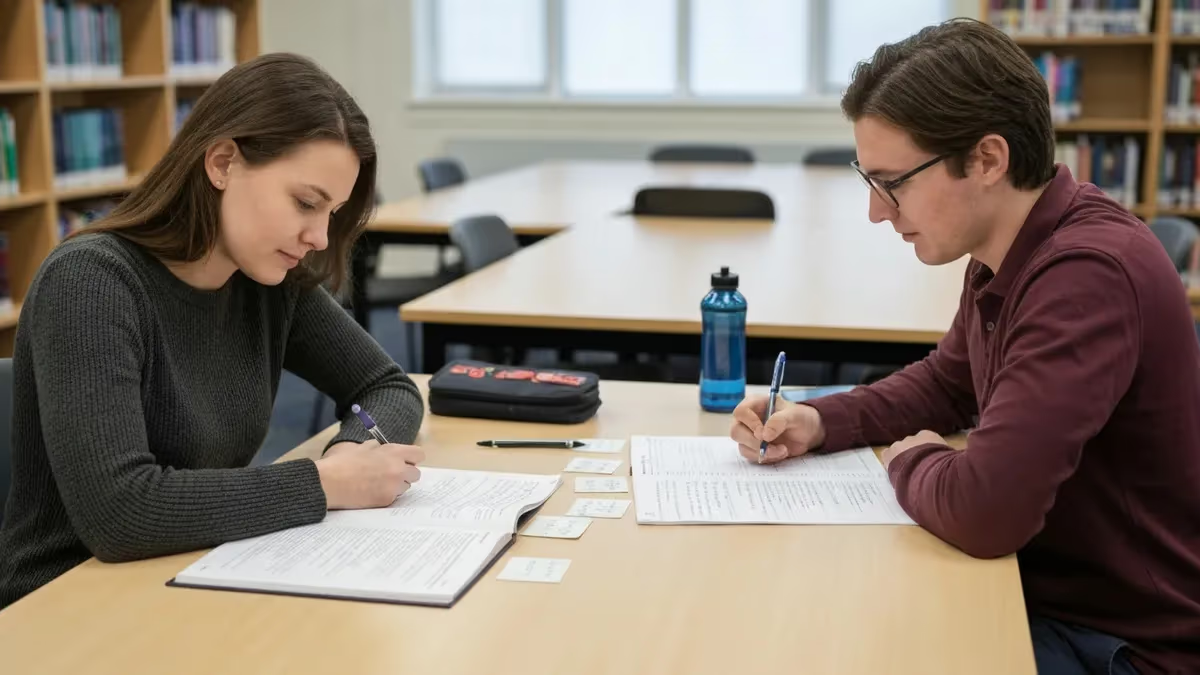
A clerical skill is any practical ability that allows an employee to perform administrative, organizational, and communication tasks in an office or institutional setting. From data entry and filing to scheduling meetings and drafting correspondence, clerical skills form the backbone of virtually every business operation in the United States. Employers across industries — from healthcare and government agencies to retail corporations and law firms — actively seek candidates who can demonstrate these abilities on standardized assessments and in real-world tasks.
Understanding the full clerical skills definition means recognizing that these competencies extend far beyond typing speed. They include numerical accuracy, reading comprehension, attention to detail, the ability to follow complex instructions, and proficiency with standard office software. Hiring managers often use pre-employment tests to verify that applicants possess these abilities before extending a job offer, which means preparation is not optional — it is essential.
The demand for clerical workers in the U.S. is substantial. The Bureau of Labor Statistics reports millions of office and administrative support positions across the country, with median wages that vary by role, industry, and geographic region. Whether you are applying for a position as an administrative assistant, records clerk, data entry operator, or customer service representative, your ability to demonstrate measurable clerical skill will directly determine your competitiveness in the hiring process.
One reason clerical skills are so valued is their transferability. An employee who can manage filing systems, maintain spreadsheets, handle multi-line phone systems, and compose professional emails can move between industries with relative ease. This flexibility makes investing time in developing clerical competencies one of the smartest career decisions an entry-level or mid-career job seeker can make, regardless of their educational background or work history.
Preparation for clerical exams often surprises candidates with its breadth. Tests frequently assess spelling and grammar, arithmetic, alpha-numeric coding, information ordering, and even spatial reasoning in some formats. Knowing which specific skills will be measured on your target exam — and then deliberately practicing those areas — is the most direct path to a passing score and, ultimately, a job offer.
In this guide, you will find a complete breakdown of what clerical skills are, the specific competencies employers measure, how to build those skills systematically, and what to expect from the most common clerical pre-employment tests. Whether you are brand new to office work or a seasoned professional seeking to advance, the information here will help you approach your career goals with clarity and confidence.
Throughout this article, we draw on real exam formats, industry salary data, and practical preparation strategies to give you the most comprehensive picture possible. By the time you finish reading, you will understand exactly which clerical skills matter most, how they are tested, and what concrete steps you can take starting today to sharpen your abilities and stand out from the competition.
Clerical Careers by the Numbers
Core Clerical Skills Every Employer Looks For
The ability to input information quickly and without errors is foundational. Employers measure both speed (keystrokes per hour) and accuracy rate. Most clerical roles require at least 40–60 WPM with an error rate below 2 percent on standard assessments.
Organizing physical and digital records alphabetically, numerically, or chronologically is a daily clerical duty. Candidates are often tested on alpha-numeric ordering tasks that simulate real filing scenarios under timed conditions.
Basic arithmetic — addition, subtraction, multiplication, division, percentages, and basic fractions — appears on nearly every clerical exam. Accuracy without a calculator is frequently required, making mental math practice a high-priority preparation task.
Drafting emails, memos, and reports requires solid spelling, grammar, and punctuation. Many exams include proofreading sections where candidates must identify and correct errors in sample documents within a fixed time limit.
Familiarity with Microsoft Office Suite — Word, Excel, Outlook, and PowerPoint — is expected in most clerical roles. Some employers also test proficiency with industry-specific software such as scheduling platforms or database management systems.
Clerical assessments are pre-employment tests designed to verify that applicants can handle the day-to-day demands of office work before they are hired. Understanding how these exams are structured helps candidates allocate preparation time wisely. The most common formats combine multiple-choice questions, timed exercises, and occasionally typing tests administered either on paper or through a computer-based platform. Some large employers administer their own proprietary exams, while others use standardized assessments developed by third-party testing companies.
The clerical workplace relies heavily on accuracy under pressure. Because of this, most clerical exams are deliberately timed to assess how well candidates perform when they cannot simply spend unlimited time on each question. Test takers are often surprised to find that they run out of time before completing all sections. Practicing under realistic time constraints — using a timer and refusing to check answers mid-section — is one of the single most effective preparation strategies available.
Most standardized clerical exams cover five to eight discrete skill areas. A typical assessment might include a verbal skills section testing grammar and vocabulary, a numerical reasoning section covering arithmetic word problems, a checking or verification section where candidates compare two lists of data for discrepancies, a coding section using simple substitution codes, and a reading comprehension section based on a short passage. Understanding which sections carry the most weight on your specific exam helps prioritize study efforts.
One area that consistently trips up candidates is the checking or verification section. In these exercises, test takers are shown two columns of information — names, numbers, codes, or addresses — and must quickly identify which items match and which do not. Speed is critical because the lists can be long and the differences subtle. Building this skill requires deliberate practice with side-by-side comparison exercises, and even a few minutes of daily practice can produce measurable improvement within a week or two.
Numerical reasoning questions on clerical exams are rarely advanced mathematics. They focus on practical arithmetic: calculating totals from a column of figures, finding a percentage of an amount, determining a missing value in a simple equation, or converting between units of measurement. The challenge is not complexity but rather the combination of accuracy and speed. Many candidates who understand the math still lose points because they rush and make careless errors, which is why checking your work efficiently within time limits is itself a skill worth practicing.
Reading comprehension sections assess whether a candidate can extract relevant information from a workplace document such as a policy memo, procedure manual, or customer letter. Questions typically ask about specific details in the passage, the main idea, or the logical implication of a statement. Candidates who read business documents regularly — even informally — tend to perform significantly better on these sections than those who approach the passages cold on exam day.
Overall, the best approach to any clerical exam is systematic: identify the specific sections on your target test, practice each skill area in isolation first, then take full-length timed mock exams to build test-taking stamina and simulate actual conditions. Reviewing every wrong answer carefully — understanding not just the correct answer but why your initial response was wrong — accelerates improvement more than simply repeating practice without reflection.
Key Clerical Skill Categories Explained
Verbal skills tested in clerical exams include spelling, grammar, punctuation, and vocabulary. Candidates must identify misspelled words, select the grammatically correct version of a sentence, and choose the best word to complete a business sentence. These questions reflect the daily reality of drafting correspondence, proofreading documents, and communicating clearly with colleagues and customers. A strong command of standard American English usage is non-negotiable for most office roles.
Effective preparation for verbal sections involves reviewing common spelling pitfalls — words like "accommodate," "occurred," "necessary," and "separate" appear frequently. Grammar review should focus on subject-verb agreement, correct pronoun usage, comma placement, and apostrophe rules. Even candidates with strong English backgrounds benefit from targeted review, because exam questions are designed to present subtle errors that are easy to overlook when reading quickly under time pressure.
Clerical Careers: Advantages and Challenges
- +High job availability — millions of clerical openings exist nationwide across every industry sector
- +Low barrier to entry — most positions require only a high school diploma or GED plus passing exam scores
- +Skills are highly transferable between industries, giving you flexibility throughout your career
- +Predictable working hours — most clerical roles follow standard 9-to-5 schedules with minimal overtime
- +Clear career advancement paths from entry-level clerk to administrative manager or executive assistant
- +Many positions offer comprehensive benefits including health insurance, retirement contributions, and paid leave
- −Salary growth can plateau without additional credentials, certifications, or demonstrated specialized skills
- −Repetitive tasks such as data entry and filing can lead to fatigue or reduced engagement over time
- −Pre-employment exams create a competitive hurdle that requires deliberate preparation to clear successfully
- −Technology changes — including automation and AI tools — are reshaping some entry-level clerical duties
- −High-volume offices can be stressful environments with demanding accuracy and turnaround time expectations
- −Remote work opportunities vary significantly depending on employer, industry, and specific role requirements
Pros and Cons at a Glance
| Pros | Cons |
|---|---|
| High job availability — millions of clerical openings exist nationwide across every industry sector | Salary growth can plateau without additional credentials, certifications, or demonstrated specialized skills |
| Low barrier to entry — most positions require only a high school diploma or GED plus passing exam scores | Repetitive tasks such as data entry and filing can lead to fatigue or reduced engagement over time |
| Skills are highly transferable between industries, giving you flexibility throughout your career | Pre-employment exams create a competitive hurdle that requires deliberate preparation to clear successfully |
| Clear career advancement paths from entry-level clerk to administrative manager or executive assistant | Technology changes — including automation and AI tools — are reshaping some entry-level clerical duties |
| Many positions offer comprehensive benefits including health insurance, retirement contributions, and paid leave | High-volume offices can be stressful environments with demanding accuracy and turnaround time expectations |
Clerical Exam Preparation Checklist
- ✓Identify the exact name and format of the clerical exam your target employer uses before beginning study
- ✓Review all core skill areas: data entry, arithmetic, spelling, grammar, coding, and information ordering
- ✓Practice typing at least 20 minutes daily to build speed toward the 40–60 WPM range most employers require
- ✓Complete timed practice tests under realistic conditions — use a timer and avoid pausing mid-section
- ✓Review every incorrect answer on practice tests to understand the error before moving on
- ✓Memorize common spelling problem words that appear frequently on clerical language tests
- ✓Drill mental arithmetic for addition, subtraction, multiplication, percentages, and simple division daily
- ✓Practice alpha-numeric ordering exercises to build speed on filing and coding tasks
- ✓Study Microsoft Office basics — especially Excel functions and Word formatting — if your target role requires software testing
- ✓Get adequate sleep the night before your exam and arrive with enough time to settle in before the test begins
Speed Plus Accuracy — Not One or the Other
On most clerical exams, leaving questions blank typically costs more than an educated guess. Practice answering every question within a set time limit, even if you are not fully confident, then review flagged items at the end. Candidates who finish with time to spare outscore those who leave sections incomplete, regardless of how carefully the latter group worked.
Building clerical skills for long-term career advancement requires more than just passing one exam. The employees who rise from entry-level clerk positions to administrative coordinator, office manager, or executive assistant roles are those who treat each work assignment as an opportunity to deepen their skill set. They volunteer for cross-departmental projects, learn new software tools proactively, and seek feedback on their written communications. Over time, this deliberate skill-building compounds into a professional profile that stands out to hiring managers at more senior levels.
One of the most underestimated clerical skills is written communication. Being able to draft a clear, professional email — free of grammatical errors, appropriately concise, and organized logically — is a skill that differentiates average performers from high performers in virtually every office setting. Many clerical workers settle for functional writing when polished writing would have a substantially greater impact on their professional reputation. Taking even one business writing course or reading a solid style guide can produce noticeable results relatively quickly.
Technology proficiency is increasingly central to clerical career advancement. Employers are no longer satisfied with candidates who can only perform basic word processing. Familiarity with cloud-based collaboration tools such as Google Workspace, Microsoft 365, Slack, and project management platforms like Asana or Trello is becoming a baseline expectation rather than a bonus. Candidates who list specific software proficiencies on their resumes — and can demonstrate those abilities in an interview or skills assessment — have a meaningful competitive advantage over those with only general computer skills.
Organizational skills are another high-impact area for development. The ability to manage multiple priorities simultaneously, maintain accurate filing systems, track deadlines without reminders, and set up logical workflows for recurring tasks are abilities that employers notice and reward. In practice, developing organizational skills means creating deliberate systems rather than relying on memory: to-do lists, calendar alerts, structured file naming conventions, and standardized templates for recurring documents all demonstrate the kind of systematic thinking employers value in senior clerical and administrative roles.
Interpersonal communication is sometimes overlooked in conversations about clerical skills, but it is critically important in any customer-facing or team-oriented office environment. Clerical employees often serve as the first point of contact for visitors, callers, and new staff members. The ability to communicate clearly, professionally, and warmly — even under pressure — reflects directly on the organization. Candidates who demonstrate strong interpersonal awareness in interviews are consistently ranked higher by hiring managers, all else being equal.
Continuing education and professional certification can accelerate clerical career growth significantly. Organizations like the International Association of Administrative Professionals (IAAP) offer credentials such as the Certified Administrative Professional (CAP) designation, which signals to employers that a candidate has met a verified standard of competency. Similarly, Microsoft Office Specialist (MOS) certifications for individual applications like Excel or Word carry real weight in many hiring decisions, particularly for roles that involve heavy spreadsheet or document work.
Finally, networking within your organization and your industry plays a larger role in clerical career advancement than many candidates realize. Attending department meetings, joining professional associations, and building genuine relationships with colleagues at all levels creates the social capital that opens doors to unadvertised opportunities. Many mid-level administrative positions are filled internally before they are ever posted publicly, which means that visible, engaged, and well-regarded clerical employees have a consistent advantage over external applicants.

Many first-time test takers are shocked by how quickly time runs out on clerical exams. Sections that seem manageable during casual practice become stressful under a strict timer. Begin timed practice at least two weeks before your actual exam date so that the pace feels familiar rather than alarming on test day. Practicing only untimed exercises is one of the leading reasons candidates underperform relative to their actual ability level.
Clerical careers in the United States offer a wide range of salary outcomes depending on industry, geographic location, employer size, and the specific role. According to Bureau of Labor Statistics data, general office clerks earn a median annual wage of approximately $39,000 to $42,000, while administrative assistants and secretaries in specialized fields such as legal, medical, or executive support can earn median wages between $50,000 and $70,000 or more. Government clerical positions at the federal level frequently carry competitive salaries plus strong benefits packages that include pension plans and generous leave policies.
Understanding the clerical meaning across different employer types helps set realistic salary expectations. Large corporations, government agencies, healthcare systems, and educational institutions tend to offer structured pay scales with predictable raises tied to performance reviews and tenure. Smaller businesses and nonprofit organizations may offer less structured compensation but sometimes provide greater variety in daily responsibilities and faster advancement for high performers. Knowing which environment aligns with your financial and professional goals is an important part of making a strategic job search decision.
Geographic location significantly affects clerical salaries in the U.S. Metropolitan areas such as New York City, San Francisco, Washington D.C., and Seattle consistently post higher wages for clerical roles than rural or small-city markets, reflecting differences in cost of living and local labor market competition. However, remote work has partially equalized this dynamic for some roles — data entry operators, virtual administrative assistants, and remote records clerks may earn market rates tied to employer location even while living in lower-cost regions, making remote-eligible positions especially valuable for geographically flexible candidates.
The job outlook for administrative and clerical occupations presents a mixed picture. While overall employment in the broader category is projected to experience modest contraction over the next decade due to automation of routine tasks, certain specializations remain strong or are growing. Medical secretaries and health information technicians are in increasing demand due to healthcare sector growth. Legal secretaries and administrative assistants in law firms, compliance departments, and financial services continue to be sought after. Candidates who combine traditional clerical skills with specialized industry knowledge are consistently better positioned than generalists.
For candidates targeting government clerical positions at the federal, state, or local level, civil service examinations represent a specific and structured pathway. These exams are administered by government human resources departments and often follow a standardized format that includes verbal ability, quantitative reasoning, reading comprehension, and sometimes a writing assessment. Scores are ranked, and positions are filled from lists of eligible candidates in score order, which means that every additional point on a civil service exam has a direct, measurable effect on hiring likelihood. Thorough preparation for these exams is not just helpful — it is strategically essential.
Healthcare clerical roles — including medical receptionists, patient service representatives, health unit coordinators, and medical records clerks — represent one of the fastest-growing niches within the broader clerical employment landscape. These positions require the same core clerical skills as general office roles, plus familiarity with medical terminology, patient confidentiality regulations under HIPAA, and healthcare-specific software platforms like Epic or Cerner. Candidates who invest in learning these supplementary competencies alongside core clerical skills significantly broaden their employability in a sector with consistently strong hiring volume.
Ultimately, the clerical field rewards candidates who approach their careers with intentionality. Knowing which skills matter, which exams to prepare for, which specializations are growing, and which employers offer the best advancement opportunities gives proactive job seekers a substantial edge. Whether you are just starting out or looking to move into a higher-paying administrative role, the investment you make in your clerical skill development today creates real and lasting returns in your earning potential and job security for years to come.
Practical preparation for clerical exams and clerical careers works best when it is consistent rather than intensive. Short daily practice sessions of 20 to 30 minutes — spread over several weeks — produce better results than a single all-day cramming session immediately before the exam. This is because clerical skills like typing speed, coding fluency, and mental arithmetic are procedural abilities that improve through repetition over time, not knowledge that can simply be memorized the night before a test.
Start your preparation by taking a diagnostic practice test to establish your current performance baseline. Identify the specific sections where your speed or accuracy falls below target, and focus your early practice sessions on those weak areas. This targeted approach is more efficient than studying all areas equally, since candidates typically have uneven skill profiles — strong in some areas, weaker in others — and the greatest score gains come from addressing the weakest links first.
For typing and data entry specifically, free online typing practice tools provide structured lessons and timed tests that track words per minute and error rate over time. Setting a daily typing practice goal — for example, a minimum of 15 minutes per day for four weeks — and tracking your progress creates accountability and makes improvement visible. Most candidates who practice consistently see measurable speed gains within two to three weeks, which can translate directly into better scores on keyboard-based clerical assessments.
Grammar and spelling review is most effective when it focuses on patterns rather than isolated word lists. Understanding why certain words are spelled a particular way, why a comma is placed in a specific position, or why a pronoun must agree with its antecedent in number helps candidates recognize and correct errors they have not explicitly memorized. Grammar workbooks, online grammar courses, and even reputable style guides like Strunk and White's "The Elements of Style" can all serve as effective review resources for clerical candidates at any skill level.
Mock exams under realistic conditions are the most powerful preparation tool available. Ideally, you should complete at least three to five full-length practice tests before your actual exam date, each time simulating the actual test environment: quiet space, no interruptions, strict time limits, no answer-checking until the section ends. After each mock exam, spend as much time reviewing your errors as you spent taking the test itself. Understanding your mistakes at a conceptual level — not just noting the right answer — is what prevents the same errors from repeating.
On exam day, pace management is the practical skill that ties everything together. Before starting any section, quickly scan the number of questions and the time allotted to calculate how many seconds you can spend per question. If a section has 40 questions in 10 minutes, that is 15 seconds per question — a brisk pace that requires confident, committed responses rather than prolonged deliberation. Candidates who internalize this math before beginning each section manage their time far more effectively than those who simply work through the questions and hope the time holds out.
After the exam — whether you are waiting for results or planning a retake — continue building your clerical skills through practical application. Volunteer to help with data entry projects, set up a personal filing system for household documents, draft emails with extra care for grammar and clarity, and keep exploring new office software tools. Every hour of practical application makes the next exam easier and the next job interview more credible. Clerical competence, like any professional skill, grows most sustainably when it is practiced in real contexts rather than only in test preparation settings.
Sample Clerical Exams Practice Questions
Try these questions from our free Clerical Exams practice tests. The correct answer and an explanation follow each question.
A customer calls and is very angry about a service issue. They are raising their voice and being confrontational. How should you handle the call?
- A. Remain calm, listen actively to their concerns, empathize, and then work towards a solution.
- B. Immediately transfer them to your manager without trying to help.
- C. Argue back and defend the company's position.
- D. Tell them to calm down before you can help them.
Answer: A. Remain calm, listen actively to their concerns, empathize, and then work towards a solution.
De-escalation is key. By listening calmly and showing empathy, you validate the customer's feelings and can then move on to solving their problem, which is the ultimate goal of customer service.
Compare the four text strings below; are they completely identical? Swanlake, 230251206 Purple Heights Drive, Swanlake, 230251206 Hickory Purple Drive, Swanlake, 230251206 Purple Heights Drive, Swanlake, 2302512006 Purple Heights Drive
- A. Yes
- B. No
Answer: B. No
Upon close inspection, the four text strings are not completely identical. The last string, 'Swanlake, 2302512006 Purple Heights Drive,' contains an extra '0' in the numerical sequence (2302512006) compared to the other strings (230251206). This subtle difference in the number makes the entire set of strings non-identical.
Compare the following two entries: 'Johannsen, Karl M. — 4839201' and 'Johannsen, Karl M. — 4839201'. Are they the same or different?
- A. Exactly the same
- B. Different in the name only
- C. Different in the number only
- D. Different in both name and number
Answer: A. Exactly the same
Both the name and number are identical, so the entries are exactly the same.
A department's monthly budget is $3,200. They have spent $1,876. What percentage of the budget remains?
- A. 41.4%
- B. 58.6%
- C. 46.3%
- D. 53.7%
Answer: A. 41.4%
Remaining: $3,200 - $1,876 = $1,324. Percentage: ($1,324 / $3,200) × 100 = 41.375% ≈ 41.4%.
Clerical Exams Questions and Answers

What Does Clerical Work Mean? A Complete Guide to Clerical Roles and Exams

Floor Clerical at Walmart: Complete Guide to the Role, Hiring Process, and How to Prepare
Clerical Video Questions & Answers

Clerical Interview Questions: Complete Guide to Landing Your Office Job

Clerical Speed: How to Master Speed and Accuracy for Clerical Exams
About the Author

Educational Psychologist & Academic Test Preparation Expert
Columbia University Teachers CollegeDr. Lisa Patel holds a Doctorate in Education from Columbia University Teachers College and has spent 17 years researching standardized test design and academic assessment. She has developed preparation programs for SAT, ACT, GRE, LSAT, UCAT, and numerous professional licensing exams, helping students of all backgrounds achieve their target scores.