
College Composition CLEP Practice Test: Complete Study Guide for 2026 September
Ace your college composition CLEP practice test with expert prep tips, exam format breakdown, and free practice questions. 📝 Save tuition today!
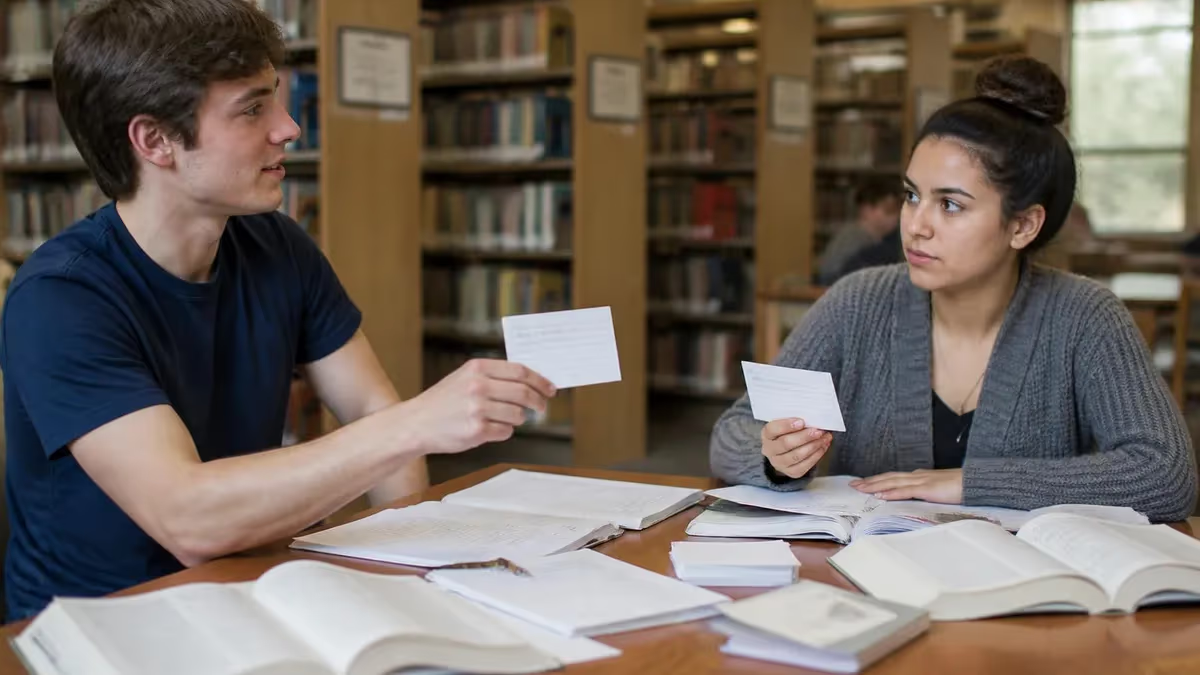
The college composition CLEP practice test is one of the most strategic exams a student can take in the CLEP College Board system. By passing this single exam, you can earn up to six college credits — equivalent to two full semesters of freshman composition — without sitting through a single class. For working adults, transfer students, and high school seniors looking to get ahead, that represents hundreds of dollars in tuition savings and an entire semester of academic time reclaimed. This guide walks you through everything you need to know to approach the exam with confidence.
CLEP tests are administered by the College Board, the same organization behind the SAT and AP exams. The College Composition CLEP exam is unique among CLEP tests because it includes an essay component, making it slightly more demanding than multiple-choice-only exams. There are actually two versions: College Composition and College Composition Modular. The standard version includes two timed essays graded by college faculty, while the Modular version replaces the essays with multiple-choice questions — individual schools decide which version satisfies their credit requirements, so always check with your institution first.
One of the most common questions students ask is what is CLEP and how does it actually work. The College-Level Examination Program (CLEP) allows test-takers to demonstrate mastery of college-level material and earn credit by scoring at or above a passing threshold — typically a scaled score of 50 out of 80. More than 2,900 colleges and universities accept CLEP credits, though acceptance policies vary by institution. Some schools grant credit for nearly every CLEP exam offered; others accept only a handful. Confirming your target school's policy before registering is the single most important logistical step you can take.
Preparing for the College Composition CLEP requires a clear understanding of the skill areas being tested: rhetorical analysis, argument construction, revision strategies, sentence-level grammar, mechanics, and effective use of source material. Unlike a literature survey course, this exam focuses on practical writing skills — the ability to analyze how writers make their arguments and to construct clear, well-organized essays yourself. Students who read widely, write regularly, and practice identifying rhetorical moves in published essays tend to find the exam more approachable than those who rely on rote memorization alone.
Modern States CLEP has become one of the most popular free preparation resources available. The nonprofit offers full online courses aligned to CLEP exams, including College Composition, completely at no cost to the student. After completing a Modern States course, qualifying students can apply for a free CLEP test voucher, essentially reducing the total cost of earning college credit to zero.
This makes CLEP testing an exceptionally high-value option for students who are willing to invest preparation time in exchange for tuition savings. If you have not explored Modern States yet, it should be your first stop after reading this guide.
CLEP courses and study materials range from free to moderately priced, and the best approach is usually to combine multiple resources. Official CLEP study guides published by the College Board provide the most accurate picture of what to expect on exam day. Supplementing that with spanish practice clep test and broader CLEP test preparation resources ensures you are not leaving any skill gaps unaddressed. Many test-takers also benefit from timed writing practice — setting a timer for 30 minutes and drafting a focused essay is a habit that pays enormous dividends when exam day arrives.
Throughout this guide, you will find a complete breakdown of the exam format, a week-by-week study schedule, detailed tips on essay writing and multiple-choice strategy, and answers to the most frequently asked questions about the College Composition CLEP exam. Whether you are a traditional student, a returning adult learner, or someone exploring CLEP testing for the first time, this resource is designed to give you the clearest possible path to a passing score.
College Composition CLEP by the Numbers
Key Facts at a Glance
| Item | Value | Details |
|---|---|---|
| Exam Fee | $93 | Per CLEP test in 2026 |
| Total Exam Time | 120 min | Includes essay sections |
| Max Credits Earned | 6 credits | Equivalent to two semesters of English |
| Passing Score | 50/80 | Standard passing threshold |

College Composition CLEP Exam Format
| Section | Questions | Time | Weight | Notes |
|---|---|---|---|---|
| Multiple Choice — Skills | 50 | 55 min | 55% | Grammar, mechanics, rhetorical analysis, revision |
| Essay 1 — Argumentative | 1 | 30 min | 22.5% | Construct an argument with evidence |
| Essay 2 — Argumentative/Expository | 1 | 35 min | 22.5% | Analyze or extend a provided argument |
| Total | 90 | 120 minutes | 100% |
The College Composition CLEP exam is organized into two distinct testing modes: the multiple-choice section and the essay section. The multiple-choice portion assesses your command of standard written English, including sentence structure, usage, mechanics, and your ability to identify effective rhetorical strategies in reading passages. Questions draw on real published essays and ask you to evaluate revision choices, identify errors, and select the most effective way to express an idea. This section rewards students who have internalized the conventions of formal written English rather than those who are merely familiar with grammar rules in the abstract.
The essay portion of the exam is what distinguishes College Composition from most other CLEP tests. You will write two essays within the exam session. The first essay is typically argumentative — you are given a prompt that presents a position or a question, and you must construct a clear, evidence-supported response.
The second essay is often analytical or expository — you may be asked to analyze a short passage, extend an argument, or compare two perspectives. Graders evaluate your essays on thesis clarity, organization, development of ideas, use of specific evidence, and command of standard written English at the sentence level.
Understanding the rhetorical concepts tested on the exam gives you a significant advantage. The exam expects you to recognize concepts like audience awareness, purpose, tone, diction, and rhetorical appeals (ethos, pathos, and logos) as they appear in real writing. When a multiple-choice question asks which sentence revision best serves the paragraph's purpose, or which transitional phrase most logically connects two ideas, you are being asked to think rhetorically — not just grammatically. Practicing rhetorical analysis on newspaper editorials, magazine essays, and published opinion pieces is one of the highest-return study activities available to you.
CLEP college algebra is an entirely different exam, but many students preparing for multiple CLEP tests find that the analytical thinking skills developed during composition prep transfer broadly. The ability to identify the structure of an argument, isolate assumptions, and evaluate evidence quality is useful across virtually every academic discipline. Students who take CLEP tests strategically — targeting exams aligned to their existing strengths while systematically addressing weak areas — consistently report higher overall pass rates and greater credit accumulation per hour of study invested.
The revision and editing questions on the multiple-choice section deserve special attention. These questions present you with a short draft or paragraph and ask you to identify the best revision to a specific sentence, the most logical ordering of sentences within a paragraph, or the most effective addition to a concluding section.
To perform well on these questions, practice reading like an editor: look for vague pronoun references, misplaced modifiers, weak topic sentences, illogical transitions, and sentences that undermine rather than support the paragraph's central claim. The more drafts you read and revise — even your own practice essays — the faster and more accurate your editorial eye becomes.
Many students are surprised to learn that the spanish clep exam practice resource page also contains links to official CLEP preparation materials covering a wide range of exam types. Exploring these resources early in your preparation helps you calibrate your existing skill level and identify which content areas require the most intensive review. Taking a full-length practice test under timed conditions during your first week of study is strongly recommended — the diagnostic data you get from that experience is far more useful than any amount of passive reading about the exam.
Sentence-level errors that the exam tests include comma splices, run-on sentences, sentence fragments, faulty parallelism, dangling modifiers, incorrect subject-verb agreement, and improper pronoun case. Reviewing these error categories systematically — spending two or three focused study sessions on each one — and then practicing identifying them in context is the most effective way to raise your multiple-choice score. Grammar rules learned in isolation rarely stick; grammar rules you have applied to real sentences and real writing samples become second nature quickly.
CLEP Testing: Study Strategies That Actually Work
Modern States Education Alliance offers free online courses specifically designed to prepare students for CLEP exams. Their College Composition course covers every testable skill area, including rhetorical analysis, essay writing, grammar review, and editing practice. The course is self-paced and includes video lectures, reading assignments, and practice quizzes — all at no charge. Completing the full course takes approximately 30 to 40 hours, which aligns well with a four-to-six-week preparation timeline for students who study seven to ten hours per week.
After completing a qualifying Modern States CLEP course, students can apply for a fee waiver voucher that covers the cost of one CLEP exam at an approved testing center. This voucher program has helped thousands of students earn college credit without paying the standard $93 exam fee. The application process requires completing the course, passing the course assessments at a qualifying score, and submitting a short application through the Modern States website. Vouchers are typically processed within a few business days, making it practical to plan your exam registration around voucher receipt.
Is the College Composition CLEP Worth Taking?
- +Earn up to 6 college credits with a single exam session
- +Save hundreds or thousands of dollars in tuition costs
- +Free preparation available through Modern States CLEP courses
- +Accepted at more than 2,900 US colleges and universities
- +Tests practical writing skills applicable across all academic disciplines
- +Flexible scheduling — test at your own pace, not on a semester timeline
- −Essay component requires more preparation than multiple-choice-only CLEP tests
- −Credit acceptance policies vary widely — not all schools accept this exam
- −Essays are graded by human faculty, introducing some scoring variability
- −Standard exam fee is $93 per attempt, plus any testing center fees
- −Time pressure (30 minutes per essay) is challenging for slower writers
- −Some competitive universities restrict or cap the number of CLEP credits they accept
CLEP College Composition Exam Prep Checklist
- ✓Verify your target school's CLEP credit acceptance policy and minimum passing score before registering.
- ✓Create a College Board account and register for the College Composition CLEP exam at your nearest testing center.
- ✓Enroll in the free Modern States College Composition course and apply for a fee waiver voucher.
- ✓Purchase or borrow the official College Board CLEP study guide for College Composition.
- ✓Take a full-length timed practice test in week one to establish your baseline score and identify weak areas.
- ✓Complete at least six timed practice essays (30-35 minutes each) before your exam date.
- ✓Review grammar and mechanics rules for comma splices, run-ons, modifiers, parallelism, and pronoun agreement.
- ✓Practice rhetorical analysis by reading and annotating published essays, editorials, and opinion pieces.
- ✓Study graded sample essays to understand what distinguishes high-scoring from mid-range responses.
- ✓Confirm your exam appointment, required ID, and testing center rules at least one week before your scheduled date.

Six Credits for $93 — The Math Is Hard to Beat
A single passing score on the College Composition CLEP exam can replace up to six credit hours of required English coursework. At the average US public university tuition rate of roughly $400 per credit hour, that represents $2,400 in savings — for a $93 exam fee. Even students who need two attempts spend far less than one semester of tuition costs.
Writing a strong argumentative essay on the College Composition CLEP exam requires more than knowing your grammar rules — it demands the ability to take a clear position and defend it with specificity and logic within a tight time window. The most common mistake test-takers make is spending too much time planning and not enough time writing. A brief two-to-three-minute outline is valuable; spending ten minutes outlining a 30-minute essay is not. Practice getting your outline onto the page in under three minutes, then spend the remaining time drafting and refining your actual paragraphs.
Your thesis statement is the engine of your CLEP essay. Graders are looking for a claim that is specific, arguable, and directly responsive to the prompt. A thesis like "Technology has both advantages and disadvantages" is too vague to earn full marks; a thesis like "While social media has expanded access to community and information for isolated individuals, its algorithmic design systematically prioritizes engagement over accuracy, making it a net harm to democratic public discourse" gives graders something concrete to evaluate and gives you a roadmap for your body paragraphs.
Practicing writing strong thesis statements on a variety of prompts is one of the highest-return activities in your preparation toolkit.
Body paragraph development is where many college composition essays lose points. Each body paragraph should open with a clear topic sentence that advances the thesis, develop a single coherent point, and include at least one specific piece of evidence — a real-world example, a statistic, a historical event, or a logical inference drawn from established fact.
Avoid the trap of restating the thesis in different words and calling it a body paragraph. Graders have read thousands of essays; vague, circular reasoning is immediately apparent to them and consistently earns lower scores than a tightly focused paragraph that genuinely advances the argument.
The analytical essay prompt — often the second essay — typically asks you to evaluate the reasoning or evidence in a short passage, extend an argument by applying it to a new context, or compare two positions on an issue. Approaching this type of essay requires close reading: before you begin writing, identify the author's main claim, the evidence they use to support it, any assumptions their argument rests on, and any counterarguments they ignore or dismiss.
Your essay should engage substantively with these elements rather than simply summarizing what the passage says. Demonstrating that you can think critically about someone else's argument is a key skill the exam is designed to assess.
Transitions and coherence matter more than many students realize. A high-scoring essay does not just contain good ideas — it connects them logically. Transitional phrases like "building on this point," "a counterexample that complicates this claim," and "taken together, these examples suggest" signal to graders that you are aware of the relationship between your ideas and are guiding the reader through your argument deliberately.
Choppy paragraphs that jump from point to point without logical connectors read as underdeveloped even when the underlying ideas are sound. Practice reading your timed essays aloud after writing them — places where the logic feels abrupt or unclear are places where transitions are missing.
Conclusion paragraphs on CLEP essays should synthesize rather than simply restate. A strong conclusion returns to the thesis but deepens it — it explains what the evidence you provided means in a broader context, or it gestures toward the implications of the argument you have made.
Avoid introducing new evidence in your conclusion (there is not enough time to develop it properly) and avoid the dreaded "In conclusion, as I have shown..." opener, which signals to graders that you are padding rather than thinking. A two-to-three-sentence conclusion that articulates the stakes of your argument is more effective than a longer conclusion that repeats your body paragraph points.
Finally, leave two to three minutes at the end of each essay for proofreading. You are not looking for a complete rewrite — you are hunting for surface errors that undermine your credibility: misspelled words, missing punctuation, pronoun agreement errors, and sentences that accidentally changed meaning mid-revision. A clean, error-free essay with solid content consistently outscores a more ambitious essay riddled with careless surface mistakes. Developing the discipline to stop writing two or three minutes early and shift into editing mode is a habit that takes practice but pays significant dividends on exam day.
Not all colleges accept the College Composition CLEP exam, and those that do may have different minimum score requirements, credit award amounts, or restrictions on which degree programs can apply the credits. Some schools require a score of 50 while others set the bar at 63 for full credit. Always confirm your institution's current CLEP policy in writing — ideally directly with your registrar's office — before registering for and paying for an exam.
Understanding how CLEP scores are calculated helps you set a realistic target and interpret your practice test results. The College Composition CLEP exam uses a scaled scoring system ranging from 20 to 80. The multiple-choice section accounts for 55 percent of your final score, and the two essays together account for the remaining 45 percent.
Essays are scored by trained college faculty on a scale of 1 to 6, with two graders scoring each essay independently; if their scores differ by more than one point, a third grader resolves the discrepancy. The multiple-choice raw score and the essay scores are then combined and converted to the 20-to-80 scale.
The standard passing score recommended by the American Council on Education (ACE) is 50, which corresponds to the grade of C or better that a student would typically need to earn college credit in a traditional course. However, individual institutions may set their own minimum score requirements above or below 50. Some highly selective institutions require a score of 63 or higher for credit, while community colleges and open-enrollment universities often accept the ACE-recommended minimum of 50. This variability is why confirming your specific school's policy is so important before you invest significant preparation time.
Credit award amounts also vary by institution. Most schools that accept the College Composition CLEP award three to six semester credit hours. Schools that award six credits are typically recognizing the exam as equivalent to both English Composition I and English Composition II — a significant benefit for students who would otherwise need to take both courses sequentially.
Schools that award only three credits may apply them to one of the two composition requirements and expect students to complete the other in a traditional classroom setting. Knowing exactly how many credits you stand to earn shapes how you prioritize the exam in your overall academic planning.
For students considering multiple CLEP exams, the College Composition exam pairs particularly well with CLEP exams in social sciences, humanities, and natural sciences. A student who passes College Composition, United States History I, Psychology, and Biology in a single academic year can potentially enter college as a sophomore — with a full year of general education requirements already satisfied. The clep spanish resource page provides additional information about how different universities structure their CLEP acceptance policies and which exam combinations tend to yield the most credit hours.
The financial case for CLEP testing is compelling, but the academic case is equally strong. Students who pass CLEP exams in subjects where they already have strong foundational knowledge enter college with more flexibility in their schedules — they can take upper-division courses earlier, pursue double majors more feasibly, or simply reduce their total time to degree completion. For students who are paying tuition out of pocket, cutting one full semester off their college career represents tens of thousands of dollars in savings beyond just the credit hours themselves.
Re-testing policies are also important to understand. CLEP rules require a three-month waiting period before you can retake any exam you have already attempted. This means that if you register for the College Composition CLEP before you are adequately prepared, a failed attempt does not just cost you $93 — it sets back your timeline by a full quarter.
This is another strong argument for taking a realistic practice test early in your preparation and being honest with yourself about whether your score is where it needs to be before you schedule the real exam. Better to wait two additional weeks and pass than to rush and need to wait three months to try again.
Students who want the most comprehensive preparation should also explore spanish clep test preparation resources, which provide organized links to free and low-cost study materials across all CLEP subject areas. Combining a structured course like Modern States with official College Board practice materials and consistent timed writing practice gives you a three-pronged preparation strategy that addresses knowledge gaps, familiarizes you with the exam format, and builds the writing fluency you need to perform well on the essay section under real time pressure.
In the final weeks before your College Composition CLEP exam, shift from content acquisition mode into performance mode. This means spending less time reading about grammar rules and more time applying them in timed conditions.
Write at least two complete practice essays per week, review your multiple-choice practice results to identify persistent error patterns, and spend focused sessions on the specific grammar or rhetoric categories where your accuracy is lowest. The goal in the final two weeks is not to learn new material — it is to sharpen and solidify what you already know so that it is reliably accessible under exam pressure.
Sleep, nutrition, and exam-day logistics are not trivial. Research consistently shows that sleep deprivation measurably impairs working memory and verbal fluency — two cognitive functions that are central to both effective essay writing and careful editing. In the week leading up to your exam, prioritize seven to eight hours of sleep per night over late-night cramming sessions. Arriving at the testing center rested and on time is genuinely more important than fitting in one more practice run the night before. Treat the day before your exam as a light review day, not an intensive study session.
On exam day, read every question carefully before answering. Multiple-choice questions on the CLEP College Composition exam often include answer choices that are almost correct — they fix one error in the original sentence but introduce a different problem, or they are grammatically acceptable but rhetorically weaker than the best option. Reading all four answer choices before selecting one prevents the common mistake of choosing the first option that seems acceptable rather than the option that is clearly best. This careful, deliberate approach slows you down slightly but substantially reduces the rate of avoidable errors.
For the essay section, begin by reading the prompt twice — once quickly to get the general idea, and once slowly to identify any specific requirements or constraints the prompt imposes. Some prompts require you to address both sides of an issue; others ask for a strictly one-sided argument.
Missing a requirement stated in the prompt is one of the fastest ways to limit your essay score regardless of how well-written your response is. After reading the prompt twice, spend two to three minutes outlining your response on the scratch paper provided, then begin writing with your remaining time. Do not skip the outline step even under time pressure — it consistently produces more organized, higher-scoring essays.
If you find yourself running short on time during an essay, prioritize your conclusion over polishing your body paragraphs. An essay without a conclusion feels incomplete to graders and typically receives a lower score than an essay with a brief but coherent closing paragraph, even if the body paragraphs are slightly less developed than you would like.
A two-sentence conclusion that restates your thesis and gestures at broader implications is far better than no conclusion at all. Time management during the essay sections is a learnable skill — practice it deliberately during your preparation, not for the first time on exam day.
After your exam, you will receive your score immediately for the multiple-choice section, but essay scores take approximately three weeks to process because they require human grading. Your final combined score — incorporating both the multiple-choice and essay components — is typically available within three to four weeks of your test date.
Once you have your score, you can request that it be sent to your target institution directly through the College Board's score reporting system. There is usually no additional charge for sending scores to schools you designate at the time of registration; additional score reports sent later may carry a small fee.
Students who pass the College Composition CLEP exam often describe it as one of the most satisfying academic accomplishments of their early college careers — not because it was easy, but because it required genuine skill development and rewarded the effort they put into preparation.
The writing and analytical skills you build during CLEP prep are not exam-specific; they are foundational academic competencies that will serve you across every course you take, every paper you write, and every professional document you produce for the rest of your career. Approaching your preparation with that broader context in mind transforms it from test prep into genuine learning — and that shift in perspective tends to produce better outcomes on both the exam and in everything that comes after it.
CLEP Questions and Answers

CLEP Exams 2026–2026 — Types of CLEP Tests, Cost, and How to Get College Credit

University of Central Florida CLEP: Complete Guide to Earning Credit by Exam at UCF

CLEP College Algebra: Exam Topics, Free Prep & Passing Score Guide

Modern States CLEP: Free College Credit & Test Voucher Guide
CLEP Marketing Exam
About the Author

Educational Psychologist & Academic Test Preparation Expert
Columbia University Teachers CollegeDr. Lisa Patel holds a Doctorate in Education from Columbia University Teachers College and has spent 17 years researching standardized test design and academic assessment. She has developed preparation programs for SAT, ACT, GRE, LSAT, UCAT, and numerous professional licensing exams, helping students of all backgrounds achieve their target scores.