
Korean Civil Service Exam: Complete Guide for US Residents and International Test Takers
Master the civil service exam process for Korean government jobs. Exam types, prep tips, salary data & practice tests. 🏆 Updated 2026 October.
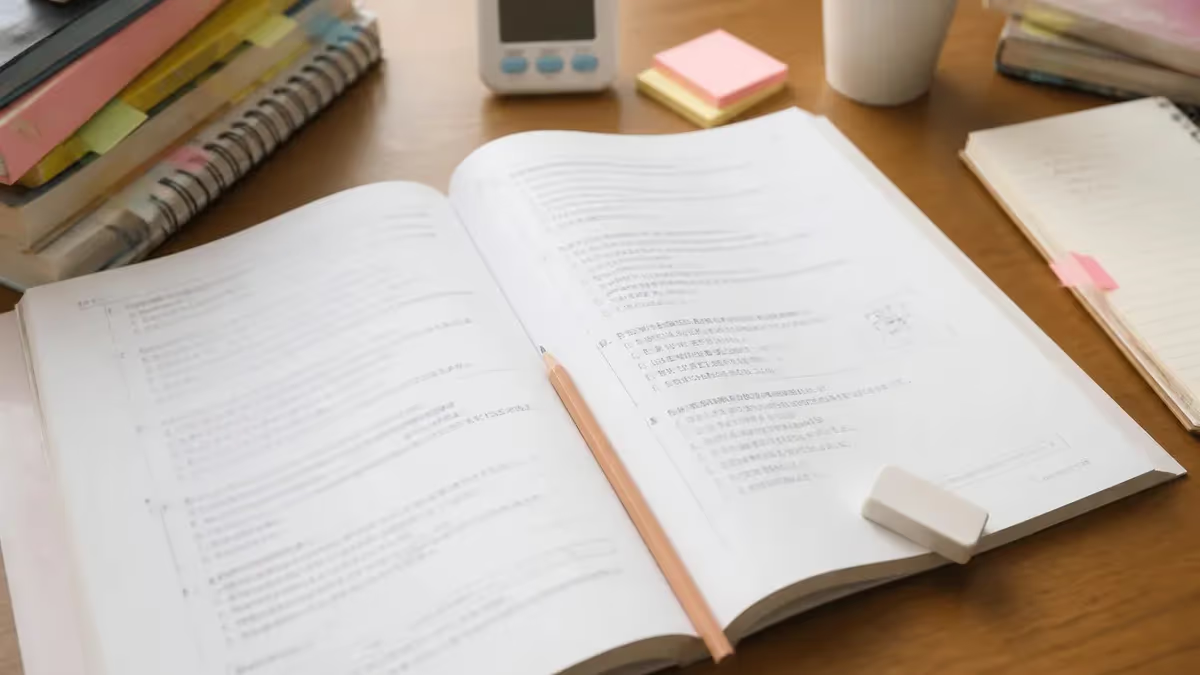
The civil service exam is one of the most competitive and rigorous standardized tests in the world, and the Korean civil service examination system is no exception. South Korea's national and local government positions attract hundreds of thousands of applicants every year, making the exam a defining challenge for anyone seeking stable, well-compensated government employment. Whether you are a Korean-American professional evaluating international career options, a student studying comparative government systems, or someone simply curious about how civil service test structures differ across nations, understanding the Korean civil service exam provides valuable context for navigating any government hiring process.
South Korea operates a tiered civil service examination system administered by the Ministry of Personnel Management (MPM). At the top sits Grade 5, which selects senior policy officers through an intensely demanding multi-stage process. Grade 7 and Grade 9 exams are open to a much broader applicant pool and fill the majority of public-sector roles across agencies ranging from tax administration to local government offices. Each tier demands a different level of academic preparation, and passing rates reflect exactly how selective the system truly is at every level.
For US residents comparing civil service systems, the Korean model shares several fundamental principles with American civil service jobs — merit-based selection, structured written testing, and protection from arbitrary dismissal. Agencies such as the US Office of Personnel Management (OPM) and state-level entities like NYS civil service or NJ civil service all emphasize objective examination scores as the primary hiring criterion. The core philosophy — that government jobs should be filled on the basis of demonstrated competence rather than political connections — runs through both systems and makes comparative study genuinely useful for exam preparation strategy.
The civil service examination process in Korea involves multiple subject areas tested simultaneously, including Korean language, English, Korean history, and specialized subjects relevant to a candidate's target agency or department. Preparation timelines are substantial: most successful Grade 7 candidates study for one to three years before passing, and Grade 5 candidates often spend even longer. Understanding the scope of this commitment is essential before registering, because the exam calendar is fixed annually and missing a cycle can set candidates back an entire year.
American civil service exams share several structural features with their Korean counterparts, including multiple-choice formats, time pressure, and subject-matter breadth. Resources like what counts as service and civil engagement provide helpful context for understanding how different countries define public-sector employment and what qualifies someone to pursue these roles. This comparative perspective sharpens your exam strategy regardless of which country's system you are preparing for.
Preparation resources for the Korean civil service exam have expanded significantly in recent years, with dedicated academies, online mock exams, and structured study programs available both in Korea and internationally. The term "civil services academy" specifically refers to the private cram schools — known in Korean as gosi academies — that prepare candidates intensively for national civil service exams. These academies operate in Noryangjin, Seoul's famous exam-prep district, and have spawned online equivalents that serve the global Korean diaspora preparing from abroad.
This guide breaks down everything you need to know: exam structure, subject requirements, preparation timelines, salary expectations, and how the Korean system compares to US civil service examinations at the federal, state, and county levels. Whether your interest is academic, professional, or practical, the information here will help you understand one of the world's most demanding government hiring systems and how to approach it strategically.
Korean Civil Service Exam by the Numbers

Korean Civil Service Exam Format by Grade
| Section | Questions | Time | Weight | Notes |
|---|---|---|---|---|
| Korean Language | 25 | 20 min | 20% | Mandatory for all grades |
| English Language | 25 | 20 min | 20% | Replaced by TOEIC at some levels |
| Korean History | 25 | 20 min | 20% | Required; tests from ancient to modern era |
| Elective Subject 1 | 25 | 20 min | 20% | Candidate chooses from approved list |
| Elective Subject 2 | 25 | 20 min | 20% | Second choice from approved subject list |
| Total | 125 | Varies by tier (typically 2–4 hours) | 100% |
Preparing for the Korean civil service exam demands a level of structured discipline that few standardized tests in the world can match. Most successful candidates begin by auditing their own academic background, identifying which elective subjects align with their prior knowledge base, and then designing a multi-year study plan that sequences subjects by difficulty and exam weight. The civil service test in Korea rewards sustained effort far more than last-minute cramming, because the breadth of tested material — spanning grammar, historical events, administrative law, and economics — simply cannot be absorbed in a short period.
The first phase of preparation typically involves enrolling in a structured program, either through a physical civil services academy or an online equivalent. Academies in Seoul's Noryangjin district offer intensive courses that run six to eight hours per day, six days a week, with mock exams scheduled monthly. Online platforms replicate this structure with video lectures, timed practice tests, and performance dashboards that show exactly how a candidate's scores compare to the broader applicant pool. Both formats have produced successful exam passers, and the choice often comes down to personal learning style and geographic access.
Subject prioritization is a critical strategic decision during Korean civil service exam preparation. Korean language tests are notoriously difficult even for native speakers because they assess advanced grammar, literary reading comprehension, and classical Chinese characters (hanja) that appear in formal government documents. Korean history is similarly demanding, covering over two thousand years of dynastic history, Japanese colonial administration, the Korean War, and contemporary political development. Most candidates allocate the largest share of study hours to these two mandatory subjects before even opening materials for their chosen electives.
Elective subject selection can make or break a candidate's overall score. Popular choices for Grade 9 exam takers include administrative law, public administration, social welfare, and economics. Each carries different difficulty curves and different return-on-investment ratios based on how quickly a candidate can reach scoring competency. Administrative law, for example, is densely conceptual and requires memorizing extensive case law and statutory provisions, while social welfare covers more discrete factual content that responds well to systematic flashcard study. Smart elective selection based on honest self-assessment gives candidates a meaningful competitive advantage.
Mock exams are the single most important preparation tool regardless of which subject combination a candidate chooses. Timed full-length simulations train the brain to operate under exam-day pressure, reveal time-management weaknesses before they become costly on the actual test date, and provide the most reliable data on current readiness. Korean civil service test candidates who complete at least twenty full-length mock exams before their first official attempt consistently report higher scores than those who rely on lecture and passive review alone. The data supports this: practice testing is the most evidence-backed study method in cognitive science research.
For candidates in the United States preparing from abroad, accessing Korean-language study materials requires deliberate effort. Major Korean bookstores in cities like Los Angeles, New York, and Chicago carry exam prep books published annually by Gosi publishers. Online platforms such as EduWill and Gosi.com offer international subscriptions with English-language navigation to help diaspora candidates access structured content. Understanding civil service meaning across different national contexts also helps candidates frame their motivation and stay focused through the long preparation arc that most successful applicants navigate.
Time management during the actual exam is as important as content mastery. Each subject block gives candidates twenty minutes to answer twenty-five questions — roughly forty-eight seconds per question. At that pace, there is no time to re-derive answers from first principles. Everything must be recalled quickly and accurately, which is why spaced-repetition memorization techniques are so widely used in civil services academy curricula. Candidates who build strong recall under timed conditions consistently outperform those who understand material conceptually but struggle to retrieve it quickly enough during the exam itself.
Civil Service Test Tips: Korean vs. US Approaches
The Korean national civil service examination is administered once or twice per year depending on grade, with registration windows opening several months before the test date. Candidates must select their elective subjects at registration and cannot change them afterward. The Ministry of Personnel Management publishes official sample questions annually, and these are considered the most authoritative study material available because they reflect actual item difficulty and format. Reviewing five to seven years of official past papers is standard practice at every serious civil services academy.
Score calculation for the Korean civil service test uses a weighted average across all five subjects, with each subject carrying equal weight at Grade 9. Minimum scores per subject — called cutlines — are set after each exam based on that year's applicant pool performance, which means the effective passing threshold shifts annually. Candidates who score in the top percentile on some subjects but fall below the cutline on any single subject are disqualified, making balanced preparation across all five areas essential rather than optional.

Is the Korean Civil Service Career Worth Pursuing?
- +Exceptional job security — Korean civil servants cannot be dismissed without cause and enjoy tenure protections similar to federal workers in the US
- +Competitive salary with guaranteed annual raises tied to seniority scales published by the Ministry of Personnel Management
- +Comprehensive benefits including government pension, medical coverage, and housing allowance supplements for qualifying positions
- +High social prestige — government employment remains one of the most respected career paths in South Korean culture
- +Clear promotion ladders with defined criteria for advancement from Grade 9 through Grade 5 and beyond
- +Generous leave allowances, including paid annual leave that increases with seniority and special leave provisions for family events
- −Extremely low pass rates — the Grade 5 PSAT equivalent accepts roughly two to four percent of applicants in competitive years
- −Multi-year preparation investment — most successful candidates spend one to three years studying full-time before passing
- −High opportunity cost — years spent in exam preparation delay entry into private-sector careers and earnings accumulation
- −Rigid seniority system — promotion speed is largely predetermined by grade entry point and years of service, limiting fast advancement
- −Geographic assignment constraints — successful candidates may be assigned to rural or remote postings far from their home city
- −Intense bureaucratic culture — Korean government agencies are known for hierarchical structures and limited individual autonomy at junior grades
Pros and Cons at a Glance
| Pros | Cons |
|---|---|
| Exceptional job security — Korean civil servants cannot be dismissed without cause and enjoy tenure protections similar to federal workers in the US | Multi-year preparation investment — most successful candidates spend one to three years studying full-time before passing |
| Competitive salary with guaranteed annual raises tied to seniority scales published by the Ministry of Personnel Management | High opportunity cost — years spent in exam preparation delay entry into private-sector careers and earnings accumulation |
| Comprehensive benefits including government pension, medical coverage, and housing allowance supplements for qualifying positions | Rigid seniority system — promotion speed is largely predetermined by grade entry point and years of service, limiting fast advancement |
| High social prestige — government employment remains one of the most respected career paths in South Korean culture | Geographic assignment constraints — successful candidates may be assigned to rural or remote postings far from their home city |
| Generous leave allowances, including paid annual leave that increases with seniority and special leave provisions for family events | Intense bureaucratic culture — Korean government agencies are known for hierarchical structures and limited individual autonomy at junior grades |
Civil Service Examination Preparation Checklist
- ✓Confirm exam eligibility requirements including age limits, citizenship or residency status, and education qualifications before registering
- ✓Select your elective subjects early and research pass-rate data for each combination to identify your most competitive option
- ✓Obtain at least five years of official past exam papers from the Ministry of Personnel Management website or a licensed academy
- ✓Build a weekly study schedule that allocates the most hours to your two weakest mandatory subjects: Korean language and Korean history
- ✓Enroll in a structured civil services academy program — online or in-person — to access expert instruction and structured mock exams
- ✓Complete at least one full-length timed mock exam per month during the six months leading up to your target exam date
- ✓Track your score trends across all five subjects using a spreadsheet to identify which areas need increased study time
- ✓Practice hanja (classical Chinese characters) daily — even twenty characters per day compounds into significant exam advantage over a year
- ✓Register for the exam as soon as the application window opens to avoid missing the deadline, which often closes four to six weeks before test day
- ✓Prepare your exam day documents including national ID, admission ticket, and approved pencils well in advance to eliminate day-of stress

The Cutline System Changes Everything
Unlike many standardized tests with fixed passing scores, the Korean civil service examination uses dynamic cutlines set after each exam based on that year's performance distribution. This means your raw score alone does not determine eligibility — your score relative to that year's applicant pool does. In highly competitive years, a score of 80 out of 100 may fall below the cutline in a strong cohort, while the same score easily qualifies in a weaker pool year. Always prepare to maximize every subject score, not just reach a fixed target.
The salary and benefits structure for Korean civil servants is one of the most frequently cited motivations for pursuing government employment, despite the demanding exam process. Entry-level Grade 9 positions start at approximately 18 to 20 million Korean won annually — roughly equivalent to $13,000 to $15,000 USD at current exchange rates — which appears modest but is supplemented by a comprehensive benefits package that effectively doubles the total compensation value.
Housing allowances, meal subsidies, transportation benefits, and performance bonuses are standard across most positions, and the government pension system provides retirement income equivalent to a meaningful percentage of final salary after twenty years of service.
Grade 7 positions command significantly higher base salaries, starting around 25 to 28 million won annually with the same supplement structure. Candidates who enter at Grade 5 through the competitive PSAT-equivalent examination — which tests economics, public administration, and administrative law at university level — begin at salaries in the 35 to 40 million won range with rapid promotion potential. The pay gap between grades reflects the enormous difference in exam difficulty and the policy-level responsibilities that Grade 5 officers carry from their first day of employment.
Comparing Korean civil servant compensation to US civil service jobs provides useful context. Federal GS-5 positions in the United States start at approximately $33,000 annually without locality adjustments, which climbs to $43,000 or higher in expensive metropolitan areas under the locality pay system.
State-level civil service jobs, such as those accessible through NYS civil service or NJ civil service, vary widely by title and location but generally offer salaries in the $40,000 to $75,000 range for entry-level professional positions. Korean civil servant compensation is lower in absolute terms but commands much higher social prestige domestically and comes with stronger job security provisions.
Career advancement in the Korean civil service follows a seniority-based promotion system with periodic performance evaluations that can accelerate or delay grade changes. Most Grade 9 employees reaching Grade 7 take five to eight years, while the path from Grade 7 to Grade 5 adds another seven to ten years.
Lateral transfers between ministries are possible and sometimes strategically pursued by ambitious civil servants seeking to broaden their policy experience before pursuing senior roles. The Ministry of Foreign Affairs, the Ministry of Finance, and the Ministry of Science and ICT are consistently the most competitive destination postings among mid-career civil servants.
Special examination pathways exist for candidates with advanced degrees or professional certifications. The Career Competitive Examination (경력경쟁채용) allows agencies to recruit directly based on demonstrated expertise in fields like cybersecurity, data science, architecture, and medicine, bypassing the standard written exam process entirely.
These pathways have expanded significantly since 2020 as the Korean government has prioritized recruiting technical specialists who would not normally compete through the traditional exam system. US readers familiar with the federal government's Schedule A hiring authority for people with disabilities or the Pathways Programs for students and recent graduates will recognize this general approach to supplementing merit-exam hiring with targeted recruitment.
The intersection of Korean and American civil service careers is increasingly relevant for Korean-Americans with dual citizenship or permanent residency status in both countries. Some Korean government positions have historically restricted eligibility to Korean nationals, but ongoing reforms have expanded access in certain technical and policy areas. Meanwhile, the US federal government actively recruits Korean-speaking professionals for roles in diplomacy, intelligence, and trade, where language fluency combined with civil services academy-level policy training represents a genuinely rare qualification set that commands premium placement on federal eligible lists and in agency interviews.
Understanding civil service jobs across both systems also illuminates how different governments balance meritocracy with demographic representation. Korea's exam system has faced criticism for perpetuating advantages for candidates from wealthier families who can afford years at private academies, paralleling debates in the US about whether written civil service exams create disparate impacts on protected groups. Both countries are actively reforming their hiring processes in response to these concerns, making this a live policy area that candidates following either system should monitor as they plan their exam strategy.
Korean civil service exam registration windows typically close four to six weeks before the test date, and late applications are not accepted under any circumstances. Missing the registration window means waiting an entire year for the next exam cycle. For US-based candidates, time zone differences and international mail processing times can create additional complications — mark the registration opening date on your calendar the moment the Ministry of Personnel Management publishes the annual exam schedule, typically in January each year.
The structural comparison between Korean and US civil service systems reveals both shared principles and important practical differences that candidates navigating either system should understand clearly. Both countries use merit-based examinations as the primary hiring mechanism for most government positions, rejecting the patronage-based appointment systems that dominated public hiring in both nations before the twentieth century. This shared philosophical foundation means that strategies developed for one system — systematic subject mastery, timed mock exam practice, strategic elective or specialty selection — transfer meaningfully to the other system even when the specific content areas differ substantially.
At the federal level in the United States, the civil service examination landscape changed dramatically with the abolition of the Professional and Administrative Career Examination (PACE) in 1982 and subsequent shifts toward agency-specific assessments. Today, most federal positions are filled through USA Jobs, which uses structured application reviews, occupational questionnaires, and category rating rather than traditional written exams. This contrasts sharply with the Korean model, which maintains rigorous written examinations as the definitive hiring mechanism and has resisted pressure to move toward the more subjective application-review models common in US federal hiring.
State and county civil service systems in the US more closely resemble the Korean model in their reliance on written competitive examinations. Exploring suffolk county civil service exams shows how jurisdictions like Suffolk County maintain active exam schedules covering dozens of job titles annually, with candidates ranked by score and hired in order from eligible lists.
Nassau County civil service and New York City civil service operate similar systems with their own examination schedules and title-specific tests. NJ civil service under the New Jersey Civil Service Commission likewise maintains written exams for most competitive positions, creating a level of merit-based transparency that parallels the Korean system's commitment to objective scoring.
The role of veterans' preference represents one of the clearest systemic differences between Korean and US civil service hiring. American civil service law grants five-point or ten-point bonuses to eligible veterans on competitive examination scores, which can substantially change eligible list rankings and ultimately determine who receives job offers. Korea's system does not include a comparable blanket preference, though it does have reduced age limits for applicants who served mandatory military service — a consideration that effectively delays most male candidates' entry into the exam pool by approximately two years compared to female candidates or those who receive exemptions.
Language requirements create another significant difference between the two national systems. Korean civil service positions naturally require Korean language proficiency, but the English requirement has evolved substantially in recent years. Many Grade 7 and Grade 9 positions now accept standardized English test scores — TOEIC, TEPS, or IELTS — in lieu of the traditional English subject exam, reducing pressure on candidates whose English skills are functional but not exam-optimized.
US civil service positions are generally conducted in English, though bilingual positions in languages including Korean, Spanish, and Mandarin carry language differentials that increase base pay by five to fifteen percent in qualifying jurisdictions.
Technology-related civil service positions are expanding rapidly in both countries as governments modernize their digital infrastructure. South Korea's Digital Government Initiative has created hundreds of new civil service examination slots specifically for software engineers, data scientists, and cybersecurity specialists who enter through the Career Competitive Examination pathway rather than the standard written test. In the United States, the federal government's Technology Modernization Fund and agencies like the US Digital Service have created similar specialized hiring paths, and many states are developing IT-specific civil service titles with distinct examination formats that test technical rather than administrative competencies.
For candidates researching nys civil service jobs, understanding how the Korean exam model differs from the New York State model clarifies both systems more effectively than studying either in isolation. New York State Civil Service Commission tests are position-specific and open competitive or promotional, with separate eligible lists maintained for each title in each geographic jurisdiction.
The scoring, veteran preference, and list certification processes operate under New York State Civil Service Law, which is distinct from federal civil service law and from the rules governing Nassau County or Suffolk County civil service exams, even though those county systems operate within the same state. This jurisdictional complexity is a defining feature of American civil service that has no equivalent in Korea's nationally unified system.
Building an effective final preparation strategy for the Korean civil service exam requires integrating everything you have learned about the exam structure, subject requirements, and scoring mechanics into a concrete daily plan for the last sixty to ninety days before test day. At this stage, new content learning should account for no more than twenty percent of study time, with the remaining eighty percent dedicated to retrieval practice, timed mock exams, and systematic error analysis. This ratio reflects the cognitive science research showing that retrieval practice produces far stronger long-term retention than passive re-reading or lecture review.
Error analysis is one of the most underutilized preparation tools among civil service exam candidates in both Korea and the United States. After every mock exam, spending thirty to forty minutes categorizing every wrong answer by error type — factual gap, misread question, time pressure mistake, or conceptual misunderstanding — produces targeted study priorities that are far more efficient than general review. A candidate who misses twelve Korean history questions but clusters eight of them in the Joseon dynasty period has identified a specific, fixable knowledge gap. That specificity is what separates a structured preparation program from unfocused studying.
Physical and mental health management during the preparation period is a topic that serious civil services academy programs now address explicitly, because burnout and test anxiety are measurably associated with underperformance on exam day relative to practice exam scores.
Korean exam culture has historically valorized extreme study hours — some candidates report studying sixteen to eighteen hours per day during final preparation periods — but research consistently shows that sleep deprivation impairs memory consolidation and cognitive performance. Candidates who sleep seven to eight hours per night, exercise at least three times per week, and take one full day off per week consistently perform closer to their true ability ceiling than those who sacrifice recovery time for additional study hours.
Test-day logistics management deserves more attention than most candidates give it during preparation. Arriving at the exam center thirty to forty-five minutes early eliminates the cortisol spike associated with travel uncertainty and gives candidates time to settle, review their notes one final time, and begin the exam in a calm mental state.
Korean exam centers require a specific national identification document and the official admission ticket printed from the registration portal — neither can be substituted. US civil service exams similarly require government-issued photo ID and, in some jurisdictions, the specific notice of examination. Preparing a physical checklist of required items and placing them in your exam bag the evening before eliminates this entire category of day-of risk.
Post-exam strategy matters as much as pre-exam preparation. After submitting your answers, resist the temptation to immediately score yourself against unofficial answer keys circulated online — these sometimes contain errors in the first hours after release and can generate unnecessary anxiety before official answers are published. Instead, take a genuine recovery period of one to two days before beginning to analyze your performance.
If results indicate a strong score, begin researching the agency assignment process and prepare for potential interviews or security clearance investigations. If results indicate a borderline or failing score, begin planning the next exam cycle immediately, because the most successful repeat candidates start their next preparation cycle within two weeks of receiving results rather than taking extended breaks.
Community and peer support dramatically improve long-term exam preparation success rates. Korean gosi candidate communities — both in-person study groups at academies and online forums — provide accountability, shared resources, and emotional support that help candidates sustain multi-year preparation arcs. US civil service exam candidates have access to similar communities through forums, local government employee associations, and test prep organizations. The shared experience of exam preparation creates bonds among candidates that often persist into government careers, forming professional networks that benefit newly hired civil servants throughout their careers.
Ultimately, the Korean civil service exam and US civil service test systems both reward the same core qualities: sustained effort, systematic preparation, strong recall under timed pressure, and the resilience to continue preparing through setbacks. Whether you are targeting a Grade 9 position in Seoul, a competitive title through NYS civil service, or a federal GS position through USA Jobs, the fundamental preparation principles apply across systems. Start early, practice consistently, analyze your errors honestly, and approach the exam with the confidence that comes from genuinely thorough preparation.
Sample Civil Service Exam Practice Questions
Try these questions from our free Civil Service Exam practice tests. The correct answer and an explanation follow each question.
Select the word that best completes: 'The committee's decision was _____ because all members voted in favor without any opposition.'
- A. controversial
- B. unanimous
- C. tentative
- D. arbitrary
Answer: B. unanimous
'Unanimous' means complete agreement from all members, matching the description.
A table shows 200 job applicants by qualification level: Below Minimum=30, Meets Minimum=65, Above Minimum=75, Highly Qualified=30. What percentage of applicants meet or exceed the minimum qualification?
- A. 70%
- B. 75%
- C. 80%
- D. 85%
Answer: D. 85%
Qualifying applicants = 65+75+30 = 170; 170 ÷ 200 × 100 = 85%.
Which word is most nearly OPPOSITE in meaning to 'transparent'?
- A. Clear
- B. Opaque
- C. Visible
- D. Obvious
Answer: B. Opaque
'Opaque' is the antonym of 'transparent' — it means blocking light or obscure/unclear.
Which of the following sentences demonstrates a grammatical error in subject-verb agreement?
- A. The committee, along with the advisors, submits its report annually.
- B. Either the manager or the team members are responsible for the final check.
- C. The collection of rare stamps and coins are on display at the museum.
- D. Each of the participants was given a certificate of completion.
Answer: C. The collection of rare stamps and coins are on display at the museum.
The subject of the sentence is 'collection,' which is a singular noun. Therefore, the verb should be singular ('is') to agree with the subject. The correct sentence should be: 'The collection of rare stamps and coins is on display at the museum.' The phrases 'of rare stamps and coins' are prepositional phrases and do not affect the subject.
Civil Service Questions and Answers

New York State Civil Service Jobs: Your Complete Guide to Landing a Government Career

Postal Service Civil Service Exam: Complete Training Guide & Requirements

Civil Service Employees: Everything You Need to Know About Government Jobs, Exams, and Careers

Civil Service Departments: A Complete Guide to Federal, State, and Local Government Agencies

How Do You Take the Civil Service Exam: Complete Step-by-Step Guide
About the Author

Public Administration Expert & Civil Service Exam Specialist
Harvard Kennedy SchoolDr. Margaret Chen holds a PhD in Public Administration and an MPA from Harvard Kennedy School. With 17 years of federal and state government experience and 8 years of civil service exam preparation coaching, she specializes in helping candidates navigate postal service exams, USPS assessments, government employment tests, and public sector civil service examinations.
Join the Discussion
Connect with other students preparing for this exam. Share tips, ask questions, and get advice from people who have been there.
View discussion (5 replies)