
Civic Literacy Essay: How the Florida Civic Literacy Exam Tests Writing Skills
Master the civic literacy essay for the Florida Civic Literacy Exam. Study tips, practice tests, and a complete 2026 prep guide. 💯
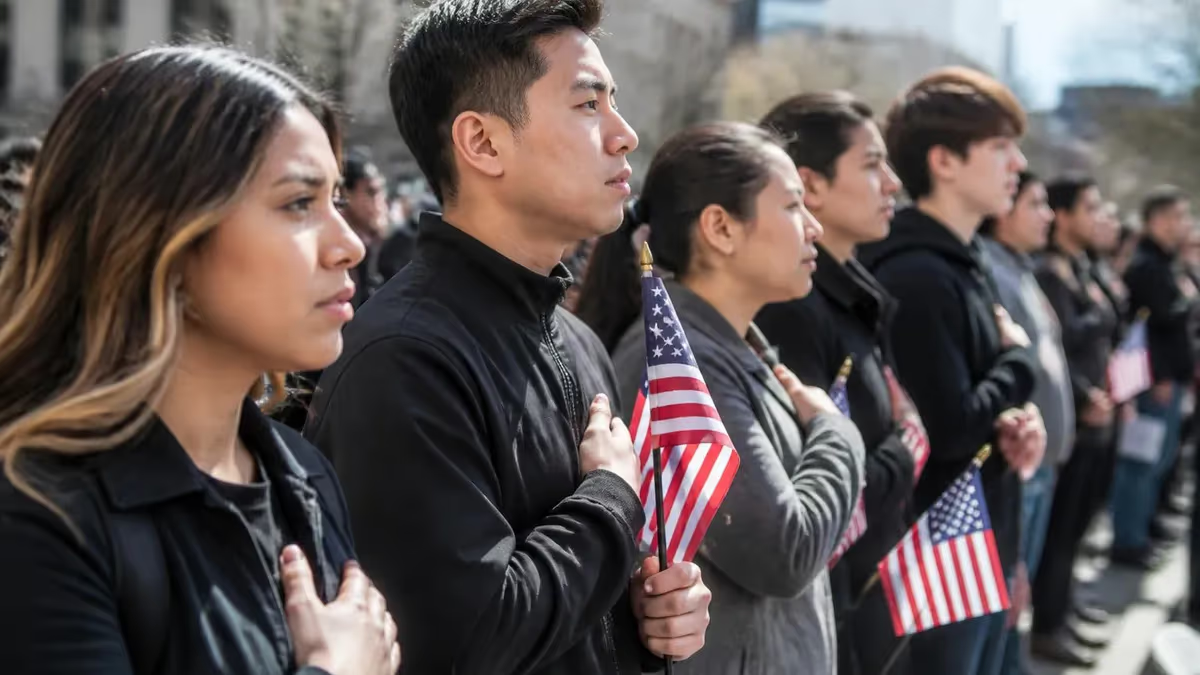
The civic literacy essay is one of the most discussed components among students preparing for the Florida Civic Literacy Exam, a mandatory graduation requirement for all students enrolled in Florida public universities and state colleges. This high-stakes assessment evaluates whether students possess the foundational knowledge of American government, constitutional principles, and democratic processes that informed citizenship demands. Understanding how essay-style reasoning intersects with the exam's multiple-choice format is essential for every test-taker hoping to demonstrate genuine civic competence in 2026.
Florida introduced mandatory civic literacy testing through legislation passed in 2021, responding to national concerns that college graduates lacked basic knowledge about how their government functions. The florida civic literacy exam covers a broad range of topics: from the founding documents and the Bill of Rights to the three branches of government, federalism, civil rights history, and the mechanics of elections. Students cannot simply memorize isolated facts — they must understand relationships between concepts, which mirrors the analytical thinking a strong civic essay requires.
Many students arrive at their first practice session surprised to discover that the official exam is entirely multiple-choice. The Florida Civic Literacy Exam does not include a formal written essay section. However, civic literacy essay skills — the ability to analyze a constitutional question, construct an argument, and support it with historical evidence — directly strengthen performance on the exam's reasoning-heavy questions. Instructors across Florida explicitly assign civic literacy essays as a preparation tool precisely because essay writing forces deeper engagement with the material than flashcard review alone can provide.
When you write a civic essay arguing, for instance, whether the system of checks and balances adequately prevents executive overreach, you must recall specific provisions of Articles I, II, and III of the Constitution, cite historical examples such as presidential vetoes or Supreme Court landmark decisions, and evaluate competing perspectives. That multi-layered cognitive process is exactly what the exam's harder questions demand. Students who practice civic essay writing consistently report feeling more confident when facing complex multiple-choice scenarios that require applying constitutional logic rather than simple recall.
Preparing for the civic literacy exam through essay practice also helps students identify gaps in their knowledge more efficiently than passive reading. If you cannot construct a coherent paragraph explaining the difference between civil liberties and civil rights, or struggle to name three landmark Supreme Court decisions and their significance, you have pinpointed precise study targets. This diagnostic power makes essay writing one of the highest-return preparation strategies available, even though the exam itself does not score written responses.
This guide walks through every dimension of civic literacy essay preparation as it relates to exam success: the key topics your essays should address, the structural frameworks that produce clear arguments, effective study schedules, common pitfalls, and how to translate essay-writing fluency into higher multiple-choice scores. Whether you are a first-generation college student navigating this requirement for the first time or a returning student who failed on a previous attempt, the strategies here will sharpen both your writing and your test performance in measurable ways.
The overlap between strong civic essay skills and strong exam performance is not coincidental — it reflects the same underlying competency. Civic literacy, at its core, means being able to reason about democratic systems, evaluate evidence about how those systems function in practice, and articulate informed positions. By treating your essay practice as integrated exam prep rather than a separate academic exercise, you build the exact mental models that translate into correct answers on test day.
Free Civic Literacy Exam Study Tools
Interactive Civic Literacy Exam resources on PracticeTestGeeks, free to start:
- Free Civic Literacy Question and Answers — 16 questions with instant scoring and answer explanations
- Civic Literacy Exam flashcards — review key terms and concepts card by card
- Civic Literacy Exam study guide — topic-by-topic overview of what the exam covers
- Civic Literacy Exam cheat sheet — one-page printable summary for last-minute review
Florida Civic Literacy Exam by the Numbers
Civic Literacy Exam: upcoming dates and official changes
- Dec 18, 2026 – May 28, 2027: The Florida Civic Literacy Examination has K–12 testing windows on November 2–December 18, 2026, and March 29–May 28, 2027. (Florida Department of Education)
Facts verified Oct 15, 2026 against Florida Department of Education. Dates that have passed are removed automatically.
- The Florida Civic Literacy Examination contains 80 multiple-choice questions. (Florida Department of Education)
- The K–12 Florida Civic Literacy Examination has one 160-minute session, with unfinished students permitted to continue working up to half a typical school day. (Florida Department of Education)
- The Florida Civic Literacy Examination passing score is 60 percent, equivalent to 48 correct answers out of 80. (Florida Department of Education)
- K–12 Florida Civic Literacy Examination candidates have two attempts per testing window and must wait 30 calendar days between attempts within a window. (Florida Department of Education)
- Postsecondary Florida Civic Literacy Examination retake policies are established by the institution, with the Department recommending 30 days between attempts. (Florida Department of Education)
- Florida Civic Literacy Examination scores used to satisfy the civic literacy assessment requirement are valid indefinitely. (Florida Department of Education)
- Students who meet the civic literacy competency requirement using the Florida Civic Literacy Examination as part of an earned degree do not need to meet that requirement again for another degree. (Florida Department of Education)
- The Florida Civic Literacy Examination is delivered through the computer-based Test Delivery System. (Florida Department of Education)
- Remote administration is not permitted for the K–12 Florida Civic Literacy Examination. (Florida Department of Education)
Facts verified Oct 15, 2026 against Florida Department of Education. Dates that have passed are removed automatically.
Civic Literacy Exam Exam at a Glance
| Item | Detail | Official source |
|---|---|---|
| Number of questions | 80 multiple-choice questions | Florida Department of Education |
| Time limit (K–12) | 160 minutes; unfinished students may continue up to half a typical school day | Florida Department of Education |
| Passing score | 60% correct (48 of 80) | Florida Department of Education |
| Retake policy (K–12) | Two attempts per window; 30 calendar days between attempts | Florida Department of Education |
| Retake policy (Postsecondary) | Institution sets retake policy; 30 days recommended | Florida Department of Education |
| Validity | Scores valid indefinitely | Florida Department of Education |
| Renewal (Postsecondary) | Requirement does not need repeating after completion as part of an earned degree | Florida Department of Education |
| Delivery | Computer-based | Florida Department of Education |
| Delivery (K–12) | Remote administration prohibited | Florida Department of Education |
| Delivery (Postsecondary) | Remote delivery only through CAI with approved college proctors | Florida Department of Education |
| Eligibility (K–12) | Grades 6–12 enrolled in United States Government | Florida Department of Education |
| Score release (K–12) | Immediately available to school and district staff | Florida Department of Education |
| Testing window (K–12) | November 2–December 18, 2026; March 29–May 28, 2027 | Florida Department of Education |
Facts verified Oct 15, 2026 against Florida Department of Education. Dates that have passed are removed automatically.

Florida Civic Literacy Exam Format
| Section | Questions | Time | Weight | Notes |
|---|---|---|---|---|
| American History & Founding Documents | 25 | ~22 min | 25% | Constitution, Declaration, Federalist Papers |
| Government Structure & Functions | 30 | ~27 min | 30% | Three branches, federalism, separation of powers |
| Rights, Liberties & Amendments | 25 | ~22 min | 25% | Bill of Rights, landmark civil rights legislation |
| Electoral Processes & Citizenship | 20 | ~18 min | 20% | Voting rights, civic participation, foreign policy |
| Total | 100 | 90 minutes | 100% |
Understanding the core content areas tested on the florida civic literacy exam practice test is the foundation of any effective essay preparation strategy. The exam organizes its content around four broad domains: American history and founding documents, government structure and functions, individual rights and liberties, and electoral and civic participation. A civic literacy essay that addresses any one of these domains must demonstrate both factual accuracy and the ability to connect historical events to contemporary democratic principles. Knowing which topics carry the most weight helps you prioritize your essay practice accordingly.
The founding documents domain encompasses the Declaration of Independence, the United States Constitution, the Bill of Rights, and the Federalist Papers. When writing a civic essay on this domain, you should be prepared to explain the philosophical roots of American democracy — including Enlightenment thinkers like John Locke, whose concept of natural rights directly influenced Jefferson's language in the Declaration. Essays on this topic should also address the debates between Federalists and Anti-Federalists, since understanding why the Bill of Rights was added as a compromise reveals how the constitutional system was designed to balance central authority with individual freedom.
Government structure questions on the exam focus heavily on the separation of powers and the system of checks and balances. A civic essay exploring this topic might examine a specific historical case where one branch overstepped its authority — such as President Franklin D. Roosevelt's court-packing plan in 1937 or the use of executive orders to implement major policy without congressional approval.
These essays require students to demonstrate that they understand not just how the three branches are organized, but why the framers designed them to limit and constrain each other as a safeguard against tyranny and the concentration of power.
Civil rights and civil liberties represent a domain where the distinction between the two concepts is itself a frequent source of confusion and therefore a rich essay topic. Civil liberties are protections against government action — the freedoms guaranteed by the Bill of Rights, such as free speech, free exercise of religion, and protection against unreasonable searches.
Civil rights, by contrast, are protections that ensure equal treatment regardless of race, gender, national origin, or other characteristics. A strong civic essay on this topic would trace the evolution of both concepts through landmark Supreme Court cases such as Marbury v. Madison, Brown v. Board of Education, and Obergefell v. Hodges.
Electoral processes and voting rights form the fourth major content domain, and civic essays in this area benefit from a chronological approach. Starting with the original Constitution's narrow franchise — limited largely to white, property-owning men — and tracing the expansions brought about by the 15th, 19th, 24th, and 26th Amendments gives your essay historical arc and demonstrates understanding of how American democracy has evolved over time. You should also be familiar with the Voting Rights Act of 1965, its provisions, and the Supreme Court's 2013 Shelby County v. Holder decision, which changed how portions of that law are enforced.
Foreign policy and international relations appear in the electoral and civic participation domain as well, and these questions often ask students to understand the constitutional division of foreign policy authority between the executive and legislative branches. The President serves as commander-in-chief and negotiates treaties, but the Senate must ratify those treaties by a two-thirds supermajority and Congress holds the power to declare war. Essays on foreign policy topics frequently benefit from discussing specific historical moments — the Senate's rejection of the Treaty of Versailles in 1919, for instance, illustrates the checks and balances dynamic in an international context.
Economic systems and the government's role in regulating markets round out the content that a well-prepared civic essay writer should understand. The exam tests knowledge of the differences between free-market capitalism, mixed economies, and command economies, as well as the constitutional basis for federal economic regulation under the Commerce Clause. Understanding landmark New Deal-era legislation and its constitutional challenges gives students the vocabulary to discuss economic governance intelligently — both on the exam and in civic essay form. This cross-domain knowledge, connecting economic history to constitutional interpretation, is what separates high-scoring students from those who merely memorize isolated definitions.
Civic Literacy Test Study Strategies by Topic
Begin your founding documents study by reading the actual primary sources rather than summaries alone. The Declaration of Independence is only about 1,300 words; the Constitution's original seven articles can be read in under an hour. Reading the original language trains you to recognize constitutional provisions in exam questions that paraphrase or lightly reword the text. As you read, annotate each section with a brief note about its purpose and which branch of government or principle it addresses, creating a personal reference sheet you can review in the final days before the exam.
Next, work through the Federalist Papers selectively — focus on Federalist No. 10 (factions and republican government), No. 51 (checks and balances and separation of powers), and No. 78 (judicial review and the role of the courts). These three essays are the most frequently referenced in civic literacy exam questions and provide the philosophical framework behind the constitutional structure. Writing a short civic essay summarizing each paper's central argument in your own words is an excellent way to verify that you truly understand the concepts rather than just recognizing key phrases on a practice test.

Civic Literacy Essay Practice: Benefits vs. Limitations
- +Forces active recall of constitutional facts rather than passive recognition
- +Reveals specific knowledge gaps you can target in focused study sessions
- +Builds analytical reasoning skills directly tested in harder exam questions
- +Improves ability to connect historical events to constitutional principles
- +Strengthens understanding of cause-and-effect relationships in American history
- +Prepares students for college-level civic discourse and academic writing requirements
- −Time-intensive compared to flashcard review or practice test drills
- −Does not directly mirror the multiple-choice format of the official exam
- −Requires access to feedback from an instructor to identify factual errors
- −Can create false confidence if essays contain uncorrected misconceptions
- −Essay topics may not align precisely with which content appears on your specific exam version
- −Students must balance essay practice with timed practice tests to build pacing skills
Civic Literacy Exam Prep Checklist
- ✓Read the full text of the U.S. Constitution and annotate each article and amendment.
- ✓Memorize all 27 amendments by number, core protection, and the historical problem each solved.
- ✓Study at least 15 landmark Supreme Court cases and their constitutional significance.
- ✓Complete a timed full-length civic literacy practice test under real exam conditions.
- ✓Write one civic essay per week on a different constitutional topic to build analytical fluency.
- ✓Review the Federalist Papers No. 10, No. 51, and No. 78 with detailed notes.
- ✓Create a timeline of voting rights expansions from 1787 through the Voting Rights Act of 1965.
- ✓Practice explaining the three branches of government and their specific checks on each other.
- ✓Study the Commerce Clause and its role in federal economic regulation with case examples.
- ✓Take at least three subject-specific practice quizzes covering civil rights, electoral processes, and foreign policy.
Essay Practice Boosts Multiple-Choice Scores by Targeting Deep Understanding
Research on civic education consistently shows that students who write analytical essays about constitutional topics score significantly higher on multiple-choice assessments than those who rely on flashcards alone. The reason is straightforward: essay writing requires you to retrieve, organize, and apply information — the same cognitive processes triggered by the Florida Civic Literacy Exam's most challenging questions. Treat every essay you write as a targeted study session that builds exactly the reasoning muscles test day demands.
Effective civic literacy essay writing follows structural frameworks that help you organize complex constitutional arguments clearly and efficiently. The most widely used framework in civic education is the claim-evidence-reasoning (CER) model, which organizes your essay around a central argument supported by specific historical or constitutional evidence, followed by explicit explanation of how that evidence supports your claim.
For example, if your essay argues that the system of checks and balances has successfully prevented the concentration of executive power, your evidence might include the Supreme Court's ruling in Youngstown Sheet & Tube Co. v. Sawyer (1952), which rejected President Truman's attempt to seize steel mills during the Korean War, and your reasoning would explain why this case demonstrates judicial checks functioning as the framers intended.
Another highly effective framework is the historical contextualization approach, which begins your essay by establishing the broader historical moment that gave rise to the constitutional principle you are analyzing. If you are writing about freedom of speech, contextualizing your essay with the experience of colonial-era censorship under British rule — including seditious libel laws that punished criticism of the Crown — immediately demonstrates why the First Amendment's drafters made free expression a foundational guarantee.
This kind of historical grounding signals to any evaluator that you understand not just what the Constitution says, but why it says it, which reflects genuine civic literacy rather than surface-level memorization.
The PEEL paragraph structure (Point, Evidence, Explanation, Link) works particularly well for civic essays that need to address multiple supporting arguments within a single coherent piece. Each body paragraph opens with a clear topic sentence stating the point, follows with specific historical or constitutional evidence, explains how that evidence supports the broader argument, and links back to the essay's central thesis.
This structure prevents the most common civic essay failure mode: presenting a list of facts without demonstrating how those facts connect to and support your argument. Examiners and instructors consistently reward essays that make explicit logical connections over those that simply accumulate relevant information without synthesizing it.
Counter-argument acknowledgment is a sophistication marker that distinguishes high-scoring civic essays from merely competent ones. Acknowledging the strongest objection to your position and then explaining why your argument holds despite that objection demonstrates the kind of balanced, critical thinking that civic literacy is fundamentally about. If your essay argues that the Electoral College should be preserved, acknowledging that it has produced outcomes where the popular vote winner did not become president — and then explaining why the framers' concerns about large-state dominance justify that trade-off — is more persuasive and intellectually honest than an essay that ignores the counterevidence entirely.
Precise vocabulary is another distinguishing feature of effective civic essays. Using exact constitutional terminology — enumerated powers, implied powers, the Supremacy Clause, due process, equal protection, judicial review — signals competence in a way that general language cannot replicate. However, precision requires that you use these terms correctly and in context.
A common error is conflating the Establishment Clause and the Free Exercise Clause of the First Amendment, or misattributing the power of judicial review to the Constitution itself rather than to Chief Justice John Marshall's interpretation in Marbury v. Madison (1803). Building a personal glossary of civic vocabulary terms with accurate definitions and example sentences is one of the highest-use preparation activities available.
Time management within the essay writing process itself mirrors the time management skills critical to exam success. Experienced test preparation instructors recommend spending the first five to eight minutes of any timed essay exercise on planning rather than writing. During this planning phase, identify your central argument, list three to four supporting pieces of evidence, note the strongest counterargument you will address, and sketch a brief outline of your paragraph structure.
Students who skip this planning phase frequently produce essays that meander, contradict themselves, or run out of space before fully developing their strongest arguments. The planning discipline built through essay practice directly translates into the focused, strategic approach that high-scoring exam takers use when working through complex multiple-choice scenarios.
Revision is the final stage of civic essay writing that many students skip due to time pressure, but it is where significant improvements happen. After completing a draft, read it specifically looking for: unsupported claims (arguments that lack a specific constitutional provision or historical example as evidence), vague language that could be replaced with precise civic vocabulary, logical gaps where you assumed a connection rather than explaining it, and factual errors that could undermine your credibility.
Even a single revision pass of five to ten minutes reliably produces stronger essays and, crucially, reinforces the habit of self-checking that prevents careless errors on the actual exam.
The official Florida Civic Literacy Exam is entirely multiple-choice — there is no written essay component on the actual test. Civic literacy essay practice is a highly effective preparation strategy, but it is not a test format you will face on exam day. Make sure you also complete timed multiple-choice practice tests to build the pacing and question-recognition skills the actual exam requires. Do not spend all your prep time on essay writing at the expense of format-specific practice.
Translating your civic essay preparation into higher scores on the actual Florida Civic Literacy Exam requires understanding how the exam's multiple-choice questions are constructed and what cognitive skills they are designed to measure. The exam does not reward rote memorization alone — many questions present a historical scenario or document excerpt and ask you to identify which constitutional principle it illustrates, or to select the outcome that best reflects how the system of checks and balances would apply. These application questions are where students who have practiced civic essay writing consistently outperform those who have only drilled vocabulary and dates.
One of the most effective bridges between essay practice and multiple-choice performance is practicing what test preparation experts call "source analysis." This involves reading a short primary source excerpt — a passage from the Federalist Papers, a paragraph from a Supreme Court opinion, or a section of historical legislation — and then answering questions about what principle it illustrates or what problem it was designed to address.
This is precisely the analytical process you rehearse every time you write a civic essay. The essay forces you to select evidence and explain its significance; source analysis questions test whether you can perform that same skill in the reverse direction, identifying the principle behind a given piece of evidence.
Pacing is a practical concern that civic essay practice does not automatically address. The Florida Civic Literacy Exam gives you 90 minutes for 100 questions, which means roughly 54 seconds per question. Students who have spent their preparation time primarily on essay writing sometimes find themselves reading multiple-choice questions too slowly, applying the deep analytical process their essay practice has trained them to use even on straightforward factual recall questions.
The solution is to stratify your approach: use your analytical skills on the 20 to 30 percent of questions that require application and reasoning, but move quickly through the 70 to 80 percent that test direct knowledge of constitutional provisions, historical events, and civic vocabulary.
Practice test diagnostics are essential for identifying which content areas need additional attention in the final weeks before your exam date. After completing each practice test, categorize every question you missed by content domain — founding documents, government structure, rights and liberties, or electoral processes — and by question type — recall, application, or analysis.
This two-dimensional diagnostic reveals whether your errors cluster in a specific content area (indicating a knowledge gap) or across multiple areas but only on application questions (indicating a reasoning skill gap that more essay practice would address). Targeted remediation based on accurate diagnostics is far more efficient than simply repeating general practice tests. You can find detailed resources and a complete civic literacy exam guide to supplement your practice test work.
Study group participation can significantly accelerate civic literacy preparation when structured around active discussion rather than passive review. Rather than reading notes aloud to each other, effective civic literacy study groups assign each member a different constitutional topic to teach to the group for ten minutes, then open the floor for questions.
The teaching experience forces the presenter to organize their knowledge coherently and address gaps in their understanding — which is essentially the same cognitive work that civic essay writing demands. Group members who ask questions reinforce their own learning by testing whether their understanding of the material is accurate enough to evaluate someone else's explanation.
In the final 72 hours before your exam, shift your preparation strategy away from learning new material and toward consolidating and reviewing what you already know. Review your essay notes, your annotated amendment chart, your landmark cases list, and your practice test mistake log. Take one final timed practice test under realistic conditions — no notes, no pauses, in a quiet environment — to calibrate your pacing and confidence.
Eat well, sleep adequately, and arrive at the testing center early enough to settle before the clock starts. The civic literacy knowledge you have built through weeks of essay practice, source analysis, and targeted review will be most accessible when you are well-rested and focused rather than rushed and anxious on test day.
The long-term value of civic literacy preparation extends well beyond the graduation requirement. The understanding of constitutional principles, government functions, and democratic processes that you develop through essay writing and exam study equips you to be a more informed and engaged citizen — to evaluate political claims critically, to understand your legal rights and civic responsibilities, and to participate meaningfully in the democratic processes that shape your community and your country.
The Florida Civic Literacy Exam is a threshold requirement, but the knowledge it tests is a lifelong asset. Approach your preparation with that broader purpose in mind, and the exam result will take care of itself.
Practical preparation for the civic literacy exam involves more than content review — it requires deliberately building the test-taking habits and mental frameworks that allow you to perform under pressure. One of the most important and underused strategies is active reading of primary source documents rather than secondary summaries.
When you read a Supreme Court opinion, a section of the Constitution, or a Federalist Paper in its original language, you develop the ability to recognize how constitutional language is structured, which makes exam questions that quote or paraphrase these sources significantly easier to parse correctly. Secondary sources are efficient for getting an overview, but primary source fluency is what separates high scores from adequate ones.
Spaced repetition is the memory science principle most directly applicable to civic literacy exam preparation. Rather than reviewing all your material in a single marathon session before the exam, spread your review across multiple shorter sessions over several weeks. Each time you return to material you have previously studied — the 27 amendments, the landmark court cases, the structure of the three branches — you are reinforcing memory traces and moving information from short-term to long-term storage.
Flashcard apps that implement spaced repetition algorithms, such as Anki, are particularly effective for the factual knowledge layer of civic literacy content, freeing your study sessions for the more complex analytical work of essay writing and source analysis.
Interleaved practice — mixing questions from different content domains rather than studying one topic exhaustively before moving to the next — produces better retention and transfer than blocked practice. If your practice session includes ten questions on constitutional amendments, then ten on government structure, then ten on civil rights history, and then ten on electoral processes, you are forcing your brain to actively retrieve and apply knowledge from multiple domains rather than staying in a single conceptual groove.
This interleaving mirrors the structure of the actual exam, which presents questions from different domains in no predictable order, and trains the flexible knowledge access that the exam's variety demands.
Error analysis is the practice technique that most consistently accelerates improvement for students who are already scoring in the passing range but want to push into higher score brackets. After any practice test, do not simply note which questions you got wrong — analyze why you got them wrong. Did you not know the fact? Did you misread the question? Did you know the correct answer but talk yourself out of it by second-guessing?
Did you confuse two similar concepts? Each error type requires a different remedy: knowledge gaps require more content study, misreading errors require slower and more deliberate question analysis, second-guessing patterns require building confidence through additional practice, and concept confusion requires more precise definitional study. Accurate error diagnosis is the difference between efficient preparation and wheel-spinning repetition.
Time-boxing your study sessions prevents the fatigue and diminishing returns that come from attempting to study for hours without breaks. Research on cognitive performance consistently shows that 50-minute focused study blocks separated by 10-minute breaks produce better learning outcomes than continuous multi-hour sessions. During each 50-minute block, work on a single preparation mode — essay writing, practice questions, primary source reading, or flashcard review — rather than switching between modes, which introduces switching costs that reduce efficiency. Use the 10-minute breaks for light physical activity, which has been shown to enhance memory consolidation, rather than passive scrolling through social media.
Partner quizzing is a high-use study technique for the civic vocabulary and historical facts layer of the exam. Working with a study partner, take turns quizzing each other on amendment provisions, landmark case names and outcomes, and definitions of constitutional terms. The social accountability of being quizzed by another person motivates more careful attention and honest self-assessment than solo flashcard review.
When you cannot answer your partner's question, the experience of struggling to recall creates a stronger memory trace for the correct answer than simply reading it would have done — a phenomenon cognitive scientists call the testing effect or retrieval practice benefit.
In the week before your exam, simulate the actual test conditions as closely as possible at least once. Find a quiet location with no distractions, set a 90-minute timer, put your phone away, and work through a full 100-question practice exam without stopping. This simulation serves two purposes: it gives you accurate data about your current performance level and timing, and it reduces test-day anxiety by familiarizing you with the experience of sustained focused performance.
Students who have completed at least one realistic full simulation before their actual exam consistently report feeling more composed during the real test, which translates directly into better performance on the questions that require calm analytical reasoning rather than anxious guessing.
Sample Civic Literacy Exam Practice Questions
Try these questions from our free Civic Literacy Exam practice tests. The correct answer and an explanation follow each question.
What was the ruling in New York Times Co. v. Sullivan (1964), and why is it significant for freedom of the press?
- A. Public officials must prove 'actual malice' to win a defamation lawsuit, providing broad protection for criticism of government
- B. Newspapers cannot be held liable for publishing truthful statements about public officials
- C. The government cannot obtain an injunction to prevent publication of classified information
- D. Reporters have an absolute privilege not to reveal their sources to government investigators
Answer: A. Public officials must prove 'actual malice' to win a defamation lawsuit, providing broad protection for criticism of government
In New York Times v. Sullivan, the Supreme Court held that the First Amendment protects newspapers from defamation claims by public officials unless the official can prove the publisher acted with 'actual malice' — knowing the statement was false or showing reckless disregard for its truth.
How did the Constitutional Convention proceed?
- A. The Constitution was written.
- B. A war broke out and the U.S. won.
- C. The Queen of England came to visit.
- D. Thomas Jefferson was appointed President.
Answer: A. The Constitution was written.
The Constitutional Convention, held in Philadelphia in 1787, was convened to revise the Articles of Confederation. Instead of merely revising, the delegates ultimately drafted an entirely new framework for the U.S. government, which became the United States Constitution. This document established the federal system of government still in use today.
What is the importance of Electoral Processes & Voting Rights in civic literacy?
- A. It is only relevant for historians.
- B. It is crucial for understanding and participating in the democratic process.
- C. It only applies to political science majors.
- D. It is irrelevant for most citizens.
Answer: B. It is crucial for understanding and participating in the democratic process.
Electoral processes and voting rights are fundamental to civic literacy because they are the mechanisms through which citizens exercise their sovereignty in a democracy. Understanding these processes enables informed participation, allowing individuals to choose their representatives and influence public policy. This knowledge is essential for maintaining a healthy and responsive democratic system.
13 initial states existed. List three.
- A. New Hampshire, Maryland, Georgia
- B. California, Maine, New Mexico
- C. North Dakota, Kentucky, Texas
- D. Canada, England, Mexico
Answer: A. New Hampshire, Maryland, Georgia
The United States began as thirteen colonies that declared independence from Great Britain, eventually becoming the original thirteen states. New Hampshire, Maryland, and Georgia were among these foundational states. Other examples include Massachusetts, New York, Virginia, and South Carolina.
Civic Literacy Questions and Answers




How this page was made: written with AI tools. Exam facts are checked against the official sources listed below. Not reviewed by a subject-matter expert. Editorial policy
Sources & references
Exam facts on this page (fees, format, dates, passing scores) are checked against these official sources; the date is our last check. Editorial policy
- cdn.fldoe.org — Test delivery, passing score, renewal, retake policy, score validity · verified Oct 2026
- fldoe.org — Test delivery, eligibility, test dates, exam format, retake policy, score release, time limit · verified Oct 2026