
Florida Civic Literacy Exam Complete Guide 2026
✍🏼 Pass your Florida Civic Literacy exam on the first attempt. Practice questions with detailed answer explanations, hints, and instant scoring.
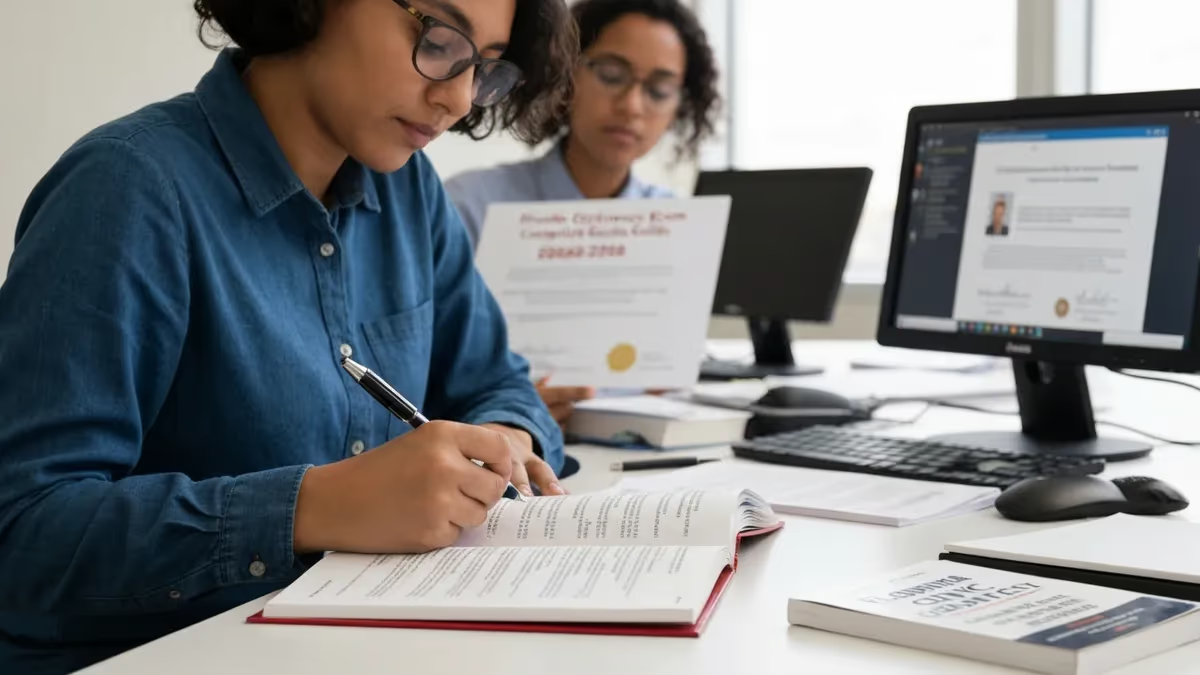
What Is the Florida Civic Literacy Exam?
The Florida Civic Literacy Exam (FCLE) is a state-mandated assessment of foundational civics knowledge required for graduation from Florida public colleges and state universities. The exam was established under Florida House Bill 233 (2026) and is designed to ensure that graduates of Florida's public higher education institutions have demonstrated understanding of American government, the Constitution, and civic principles.
The FCLE tests knowledge aligned with the content of the US Naturalization Civics Test — the same civics content required of immigrants applying for US citizenship. Florida is one of the first states to implement a civic literacy exam as a graduation requirement for college students at scale. The requirement applies to students pursuing associate or bachelor's degrees at Florida public colleges and universities.
For free preparation questions and study materials aligned to the FCLE format, visit our civic literacy exam practice page.
Who Must Take the Florida Civic Literacy Exam?
The FCLE requirement applies to students at Florida public colleges and state universities who are pursuing a degree. Specifically, the requirement applies to:
- Students earning an Associate in Arts (AA) degree at a Florida College System institution
- Students earning an Associate in Science (AS) or other associate degree at some institutions
- Students earning a bachelor's degree at a Florida State University System school
The exam must be passed before the degree is awarded. Students who do not pass can retake the exam. Most Florida institutions administer the FCLE through their testing centers and include information about scheduling in degree audit requirements.
Exemptions: Florida law includes provisions for certain exemptions, including for students who passed a relevant Advanced Placement (AP) Government exam with a qualifying score, students who passed a CLEP Government exam, or students who previously completed certain Florida civics coursework in high school. Check with your institution's registrar for specific exemption eligibility.
For detailed information on the exam structure and free preparation questions, see the florida civic literacy exam practice test resource with video answer explanations.

Florida Civic Literacy Exam Topics Covered
The FCLE is based on the content framework of the US Citizenship Naturalization Test. The 100-question exam draws from the following civics topic areas:
- American Government — Principles: Rule of law, representative democracy, separation of powers, checks and balances, federalism, the Bill of Rights and individual rights
- American Government — System of Government: The three branches of government (legislative, executive, judicial); powers and roles of each branch; how a bill becomes law; constitutional amendments process
- American Government — Rights and Responsibilities: Constitutional rights, voting rights history, responsibilities of citizens
- American History — Colonial Period and Independence: Causes of the American Revolution, the Declaration of Independence, the Constitutional Convention, the Federalist Papers
- American History — 1800s: Manifest Destiny, the Civil War and its causes, Reconstruction, abolition of slavery (13th Amendment)
- American History — Recent and Modern: World War I and II, the Cold War, Civil Rights Movement, major constitutional amendments of the 20th century
- Geography: US states and capitals, geographic features relevant to American history and government
- Symbols and Holidays: National symbols, the national anthem, major national holidays and their significance
The content heavily overlaps with the official civic literacy test questions used by USCIS for naturalization — studying those 100 civics questions is the most direct preparation path for the FCLE.
You can continue preparing with the florida civic literacy exam practice test, which includes answer explanations for every question.
FCLE Preparation Checklist
- ✓Study all 100 official USCIS naturalization civics questions — the FCLE content is directly aligned to this list
- ✓Read the full US Constitution including all 27 amendments — multiple FCLE questions test amendment content
- ✓Review the three branches of government: their powers, composition, and how they check each other
- ✓Know the key dates in American history: Declaration of Independence (1776), Constitution ratification (1788), Civil War (1861–1865), major 20th century events
- ✓Memorize US senators, their term lengths, and the structure of Congress (House vs Senate)
- ✓Study the Bill of Rights — the first ten amendments — and what each protects
- ✓Practice under timed conditions even though the FCLE has no official time limit — simulated testing improves retention
- ✓Contact your institution's testing center well before graduation to schedule your FCLE exam date

- +Industry-recognized credential boosts your resume
- +Higher earning potential (10-20% salary increase on average)
- +Demonstrates commitment to professional development
- +Opens doors to advanced career opportunities
- −Exam preparation requires significant time investment (4-8 weeks)
- −Certification fees can be $100-$400+
- −May require continuing education to maintain
- −Some employers may not require certification
Sample Civic Literacy Exam Practice Questions
Try these questions from our free Civic Literacy Exam practice tests. The correct answer and an explanation follow each question.
How many amendments are in the U.S. Constitution?
- A. 15.
- B. 27.
- C. 50.
- D. 13.
Answer: B. 27.
The U.S. Constitution has been amended 27 times since its ratification. These amendments reflect changes and developments in American society and governance over more than two centuries, adapting the foundational document to evolving needs and values. The first ten amendments are collectively known as the Bill of Rights.
Which clause of the U.S. Constitution establishes that federal law takes precedence over conflicting state law?
- A. Commerce Clause
- B. Due Process Clause
- C. Supremacy Clause
- D. Equal Protection Clause
Answer: C. Supremacy Clause
The Supremacy Clause (Article VI) declares that the Constitution and federal laws are the 'supreme Law of the Land,' overriding any conflicting state laws.
What distinguishes a 'democracy' from a 'republic'?
- A. A pure democracy allows direct citizen voting on laws; a republic uses elected representatives to make laws on behalf of citizens
- B. A democracy is governed by a monarch with popular support; a republic has no hereditary rulers
- C. A democracy requires unanimous agreement for decisions; a republic allows majority rule
- D. A democracy protects minority rights more than a republic, which gives majority preferences absolute priority
Answer: A. A pure democracy allows direct citizen voting on laws; a republic uses elected representatives to make laws on behalf of citizens
In a direct democracy, citizens vote directly on laws and policies. In a republic (representative democracy), citizens elect representatives who make decisions on their behalf. The United States is a constitutional republic with democratic elements.
What accomplished Martin Luther King Jr.?
- A. He helped others to become famous and powerful.
- B. He ran for President on a platform of peace and justice.
- C. He led violent protests against the U.S. government.
- D. He fought for civil rights
Answer: D. He fought for civil rights
Martin Luther King Jr. was a prominent leader in the American Civil Rights Movement, advocating for racial equality and an end to discrimination. He championed nonviolent civil disobedience to achieve legislative changes, such as the Civil Rights Act of 1964 and the Voting Rights Act of 1965. His efforts significantly advanced civil rights for African Americans.
Florida Civic Literacy Exam Questions and Answers
More Civic Literacy Resources
How this page was made: written with AI tools. Exam facts are checked against the official sources listed below. Not reviewed by a subject-matter expert. Editorial policy
Sources & references
Exam facts on this page (fees, format, dates, passing scores) are checked against these official sources; the date is our last check. Editorial policy
- cdn.fldoe.org — Test delivery, passing score, renewal, retake policy, score validity · verified Oct 2026
- fldoe.org — Test delivery, eligibility, test dates, exam format, retake policy, score release, time limit · verified Oct 2026