
How to Get a Chauffeur License in Michigan 2026 September
Get ready for your How to Get a Chauffeur License in certification. Practice questions with step-by-step answer explanations and instant scoring. 🏆
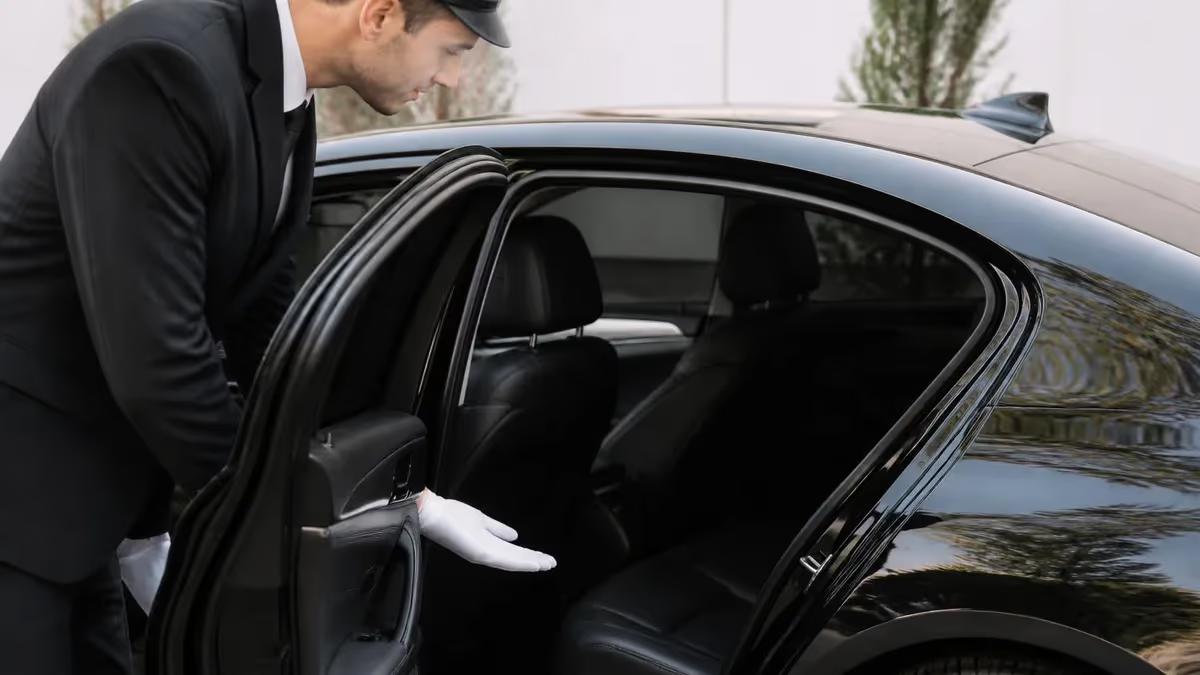
In Michigan, a chauffeur license is a specialized driving authorization required for anyone who drives a motor vehicle for compensation while transporting passengers. The Michigan Vehicle Code defines a chauffeur as a person who is employed for the primary purpose of operating a motor vehicle. This definition covers a wide range of transportation roles: taxi drivers, rideshare drivers (Uber, Lyft, and similar platforms), limousine operators, shuttle bus drivers, non-emergency medical transport drivers, and any other driver transporting passengers commercially.
The chauffeur license in Michigan is not a separate license but rather an endorsement added to your existing Michigan driver's license. You must already hold a valid Michigan Class O (standard passenger vehicle) driver's license before applying for the chauffeur endorsement. If you're moving to Michigan from another state and want to drive commercially, you must first obtain a Michigan driver's license, then apply for the chauffeur endorsement.
Michigan's chauffeur license requirement has been part of state law for decades. The state takes commercial passenger transportation seriously because drivers carrying members of the public bear a heightened responsibility for safety. The knowledge test for the chauffeur endorsement tests your understanding of Michigan traffic laws, vehicle operation, passenger safety, and the specific regulations that apply to for-hire transportation. Passing this test demonstrates that you have the knowledge base required to operate safely and responsibly as a professional driver.
There is often confusion about whether rideshare drivers (Uber, Lyft) need a Michigan chauffeur license. Michigan law requires the chauffeur endorsement for drivers who transport passengers for compensation. However, both Uber and Lyft maintain their own licensing frameworks that in some cases satisfy state requirements through corporate agreements. The safest approach for rideshare drivers in Michigan is to check directly with both the Michigan Secretary of State office and the specific rideshare platform about current requirements, as these have evolved over time as state and platform policies have been reconciled.
Not all Michigan commercial driving situations require the chauffeur endorsement. CDL holders operating commercial vehicles are subject to different regulations. School bus drivers need separate endorsements beyond the chauffeur license. The chauffeur endorsement specifically applies to for-hire passenger transportation in vehicles below CDL weight thresholds. If you're uncertain whether your specific driving situation requires the chauffeur endorsement, the Michigan Secretary of State's office can clarify the requirement based on the type of vehicle you'll operate and the nature of your compensation arrangement.
The Michigan chauffeur endorsement renews with your standard driver's license — no separate renewal test required as long as your license remains in good standing. Keep your driving record clean to protect both your personal license and your professional endorsement throughout your career.
The Michigan chauffeur knowledge test covers the same content as the standard driver's knowledge test — Michigan traffic laws, road signs, right-of-way rules — with additional questions specific to for-hire passenger transportation. Questions about passenger safety, professional conduct, vehicle inspection, and commercial driving regulations appear alongside standard traffic law questions. Candidates who have a strong grasp of Michigan's driver's manual plus additional knowledge of professional driving practices are well-positioned to pass.
Michigan's chauffeur license requirements reflect the state's broader commitment to ensuring professional standards in the for-hire transportation industry. The state has expanded its oversight of commercial passenger transportation in recent years, partly in response to the growth of rideshare platforms and the proliferation of non-emergency medical transport companies. The chauffeur endorsement requirement provides a baseline knowledge standard that all drivers transporting passengers for compensation must meet, regardless of which platform or company employs them.
Beyond the legal requirement, holding a Michigan chauffeur license signals to passengers and employers that you've taken your professional responsibilities seriously. Many commercial transportation employers — limousine companies, medical transport providers, corporate shuttle services — require the chauffeur endorsement as a hiring condition, even when employees are newer to the industry. Having the endorsement before you apply for these positions simplifies the hiring process and demonstrates professional readiness.
The chauffeur endorsement renewal process in Michigan follows the same schedule as the underlying driver's license. When your Michigan driver's license comes up for renewal, your chauffeur endorsement renews at the same time. There is no separate renewal test for the chauffeur endorsement unless your license has been suspended or revoked in the interim. Keeping your driving record clean throughout your career as a chauffeur protects both your regular license and your professional endorsement.
Michigan also offers resources through the Secretary of State's official website for reviewing commercial driving regulations, and staying familiar with these materials helps professional drivers maintain compliance throughout their careers. The endorsement is straightforward to obtain for qualified candidates, and the knowledge test is well within reach for anyone who prepares systematically using the Michigan Driver's Manual and practice test questions.

Michigan chauffeur license requirements for Uber and Lyft drivers have evolved over time. Both platforms and the state have modified requirements as the rideshare industry has grown. Always verify current requirements directly with the Michigan Secretary of State and your specific rideshare platform before assuming you do or do not need the endorsement.
The application process for a Michigan chauffeur endorsement begins at a Michigan Secretary of State branch office. You will need to present your valid Michigan driver's license, complete a brief application, pay the applicable fee, and pass the knowledge test. Some branch offices may require an appointment — check the Michigan SOS website for your local office's scheduling requirements before visiting.
The knowledge test for the Michigan chauffeur endorsement is administered on a computer at the Secretary of State office. The test is multiple choice. You must achieve a passing score (typically 70% or higher) to receive the endorsement. If you fail the test, you may retake it after a waiting period. Most candidates who study the Michigan Driver's Manual thoroughly and review chauffeur-specific regulations pass on their first attempt.
Study materials for the Michigan chauffeur knowledge test are primarily available through the Michigan Secretary of State. The Michigan Driver's Manual, available free online or at any SOS branch, covers traffic laws, road signs, and driving regulations that form the foundation of the knowledge test. Reviewing the manual carefully, with particular attention to sections covering commercial vehicles and passenger transportation, is the most important preparation step.
Practice tests are one of the most effective ways to prepare for the Michigan chauffeur knowledge test. Working through practice questions familiarizes you with the test format, identifies knowledge gaps before the real exam, and builds confidence. The practice questions mirror the types of questions on the actual test — multiple choice, covering traffic laws, road signs, and professional driving standards. Many candidates find that scoring consistently above 80% on practice tests predicts strong performance on the actual exam.
The fee for the Michigan chauffeur endorsement is modest and set by state regulation. Check the Michigan Secretary of State fee schedule for the current amount, as fees are subject to change. Payment is typically accepted at the SOS office by cash, check, or credit card. The endorsement is added to your existing Michigan license at the same time you receive your test results, so you'll leave the SOS office with your updated license status on the same day you pass.
Michigan's Secretary of State online scheduling system makes it straightforward to book a knowledge test appointment at your nearest branch. Appointments are often available within a few days to a week, depending on your region. High-traffic branches in metro Detroit or Grand Rapids may book out further ahead than rural branches. Scheduling your appointment before you begin studying — with a test date 2–3 weeks out — creates a productive deadline that keeps your preparation on track.
On the day of your knowledge test, bring two forms of identification if required by your local SOS branch. Standard requirements include your current Michigan driver's license plus any secondary ID. Check the Michigan SOS website for current identification requirements before your visit.
Arriving 10–15 minutes before your scheduled appointment time allows you to check in, settle in at the testing terminal, and begin the test without feeling rushed. Confirming all logistics before your test day — appointment time, identification needed, payment method accepted, parking at the SOS location — eliminates unnecessary stress and lets you focus entirely on performing well on the knowledge test itself.
Michigan Chauffeur License Requirements
| Section | Questions | Time | Notes |
|---|---|---|---|
| 🪪Valid MI Driver's License | — | — | Must hold a current Michigan Class O (standard) driver's license first |
| 🎂Minimum Age | — | — | Must be at least 18 years old for chauffeur endorsement |
| 📖Knowledge Test | — | — | Multiple-choice test covering Michigan traffic laws and professional driving |
| 🔍Driving Record | — | — | Clean driving record generally required; certain violations may disqualify |
| 💰Fee | — | — | State fee required; check current amount on Michigan SOS website |
| 🏢Application Location | — | — | Any Michigan Secretary of State branch office; appointment may be required |
The content areas covered on the Michigan chauffeur knowledge test align closely with the Michigan Driver's Manual, which is the primary study resource. The test draws heavily from traffic law chapters covering right-of-way, speed limits, signaling, following distance, and safe lane changes. Road signs — regulatory, warning, and guide signs — are consistently tested and should be memorized carefully. Common errors on sign recognition questions involve confusing similar-looking signs or misidentifying the meaning of specific shapes and colors.
Professional driving conduct and passenger safety topics are specific to the chauffeur endorsement and may not be covered as deeply in the general driver's manual. These questions test your understanding of responsibilities toward passengers: how to handle passenger disputes, what to do in an accident with passengers in your vehicle, vehicle inspection responsibilities before beginning a shift, and professional standards for commercial driving. Reviewing any supplementary materials your state's SOS provides specifically for the chauffeur endorsement covers these topics effectively.
Impaired driving questions are a consistent part of Michigan driver's knowledge tests, including the chauffeur endorsement test. Questions about blood alcohol limits, implied consent laws, penalties for operating while intoxicated (OWI), and the effects of drugs and alcohol on driving ability appear regularly. The legal BAC limit for commercial drivers in Michigan is lower than for personal vehicle drivers — this distinction is specifically important for chauffeur candidates and is commonly tested.
Questions about vehicle condition and pre-trip inspection expectations may appear on the chauffeur test. Commercial passenger carriers have responsibilities for vehicle safety that go beyond ordinary personal vehicle drivers. Knowing the basic categories of a vehicle safety inspection — lights, tires, brakes, mirrors, fluids — and understanding that drivers bear professional responsibility for ensuring their vehicle is roadworthy before transporting passengers reflects the elevated standards of the chauffeur role.
Traffic law questions on the chauffeur knowledge test include scenarios testing your judgment in complex driving situations, not just recall of rules. For example, questions about right-of-way at four-way stops, handling emergency vehicles, navigating construction zones, and responding to aggressive drivers all appear. These scenario-based questions reward candidates who understand the reasoning behind traffic laws — why right-of-way rules exist, what behaviors protect other road users — rather than those who merely memorized rules without understanding them.
Some knowledge test candidates are surprised to find questions about motorcycle safety, pedestrian right-of-way, and bicycle lane rules. These topics appear because chauffeurs encounter all types of road users and must know how to interact safely with vulnerable road users. Reviewing the sections of the Michigan Driver's Manual covering pedestrians, bicycles, and motorcycles ensures you're not caught off guard by these questions on test day.
Comprehensive preparation that covers all sections of the Michigan Driver's Manual — not just the sections you feel weakest in — is the most reliable strategy for achieving a strong score on the chauffeur knowledge test and beginning your professional driving career with confidence.

Michigan's BAC limit for commercial drivers is 0.04% — half the 0.08% limit for personal vehicle drivers. This distinction is specifically tested on the chauffeur knowledge exam. Driving a for-hire vehicle with a BAC between 0.04% and 0.08% is a violation for chauffeur drivers even though it would be legal for personal driving.
Effective preparation for the Michigan chauffeur knowledge test combines reading the Michigan Driver's Manual with completing multiple rounds of practice test questions. The manual is the authoritative source for all content tested — every answer on the knowledge test can be traced to content in the manual. Reading the entire manual carefully once, then rereading the sections most relevant to the chauffeur endorsement (commercial driving, traffic laws, impaired driving) is the recommended preparation approach.
Practice tests should be taken under realistic conditions: timing yourself, not looking up answers until after you've committed to a response, and reviewing all wrong answers immediately to understand the correct reasoning. Reviewing correct answers is equally important — understanding why correct answers are right reinforces your knowledge more deeply than just knowing what you got wrong. Consistent scores of 80%+ on practice tests before your real exam date indicate readiness.
Many candidates underestimate road sign questions because they feel intuitively obvious. In practice, sign questions that involve less common regulatory or warning signs catch unprepared candidates off guard. Spending time with the sign recognition section of the Michigan Driver's Manual — particularly for less common signs — prevents unexpected failures on what should be among the easiest questions on the test.
Test day preparation is straightforward. Bring your valid Michigan driver's license, payment for the endorsement fee, and arrive with time to settle in before your test session. The computer-based test interface is straightforward — answer each question, flag any you're unsure about, and review flagged questions before submitting. Don't spend too long on any single question; trust your preparation and move through the test at a steady pace.
The importance of the Michigan Driver's Manual as a preparation resource cannot be overstated. Every question on the chauffeur knowledge test is derived from content in the manual. Candidates who read the manual carefully — not just skim it — and then take practice tests to check their comprehension have the highest pass rates. The manual is comprehensive but readable; allowing yourself 3–4 hours to read it completely is a worthwhile investment that virtually guarantees adequate content preparation.
After receiving your Michigan chauffeur endorsement, maintain your professional knowledge by staying current with any Michigan traffic law changes. Michigan updates its driver's manual periodically, and new rules or regulations affecting commercial passenger carriers are announced through the SOS website. Professional drivers who stay informed about regulatory changes protect their endorsement and avoid inadvertent violations that could threaten their livelihood.
Following Michigan SOS communications and joining professional driver associations in your sector keeps you informed and connected to your industry. Building a career on this professional foundation — correct credentials, current knowledge, and ongoing commitment to safe driving — positions you for long-term success and trust with the passengers who depend on your service.
Michigan Chauffeur License Checklist
- ✓Confirm you hold a valid Michigan Class O driver's license
- ✓Verify you meet the minimum age requirement (18+)
- ✓Download and read the Michigan Driver's Manual from the SOS website
- ✓Pay special attention to sections on traffic laws, road signs, and commercial driving
- ✓Note the lower 0.04% BAC limit for commercial/chauffeur drivers
- ✓Complete multiple practice tests — aim for 80%+ before scheduling your exam
- ✓Check whether your local SOS branch requires an appointment
- ✓Bring your current Michigan driver's license and payment for the endorsement fee
- ✓On test day, flag uncertain questions and review before submitting
- ✓After passing, verify the endorsement appears correctly on your updated license
How Pros and Cons
- +How has a publicly available content blueprint — you know exactly what to prepare for
- +Multiple preparation pathways accommodate different schedules and budgets
- +Clear score reporting shows specific strengths and weaknesses
- +Study communities share current insights from recent test-takers
- +Retake policies allow recovery from a difficult first attempt
- −Tested content scope requires substantial preparation time
- −No single resource covers everything optimally
- −Exam-day performance can differ from practice test performance
- −Registration, prep, and retake costs accumulate significantly
- −Content changes between versions can make older materials less reliable
Michigan Chauffeur License Questions and Answers
About the Author
Licensed Driving Instructor & DMV Test Specialist
Penn State UniversityRobert J. Williams graduated from Penn State University with a degree in Transportation Management and has spent 20 years as a certified driving instructor and DMV examiner consultant. He has personally coached thousands of applicants through written knowledge tests, skills assessments, and commercial driver licensing programs across more than 30 states.