
Chauffeur License Michigan: Requirements, Test, and Application Guide
🆕 Pass the Chauffeur License Michigan: exam with confidence. Practice questions with detailed explanations and instant feedback on every answer.
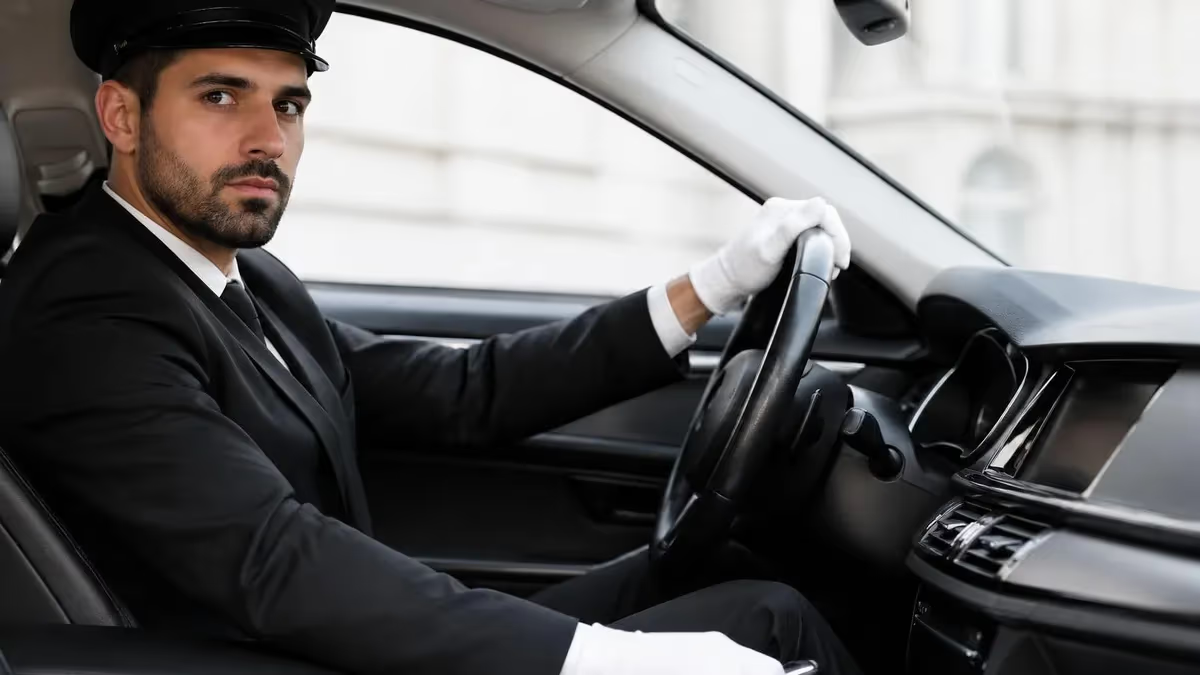
A chauffeur license in Michigan is required for anyone who drives a motor vehicle for hire — transporting passengers in exchange for compensation. This includes taxi drivers, rideshare drivers (Uber and Lyft both require a Michigan chauffeur license under state law), limousine and transportation company drivers, and other for-hire passenger services. If you're receiving payment to transport people in Michigan, you need a chauffeur's license in addition to your standard Michigan driver's license.
The Michigan chauffeur license is not the same as a Commercial Driver's License (CDL). The CDL covers commercial vehicles over 26,000 pounds or vehicles transporting 16 or more passengers. The chauffeur license applies specifically to non-commercial for-hire passenger transportation — the typical taxi, rideshare, or livery service scenario where you're driving a standard passenger vehicle for compensation. Many drivers operating TNCs (Transportation Network Companies) like Uber and Lyft are surprised to learn that Michigan law requires the chauffeur license even for app-based rideshare driving.
Getting a chauffeur's license in Michigan involves visiting a Secretary of State branch office, passing a written knowledge test, and meeting eligibility requirements including a clean-enough driving record and a background check. The process is more straightforward than obtaining a CDL but more involved than simply extending your regular driver's license. Understanding the requirements and what the knowledge test covers before you visit the Secretary of State office makes the process significantly faster.
Michigan's for-hire transportation industry spans a wide range of services — from app-based rideshare in Detroit to medical transport in rural counties, corporate shuttles in Grand Rapids, and resort area transportation in northern Michigan. All of these categories share the common legal requirement: before you accept a single paying passenger, you need that chauffeur endorsement on your Michigan driver's license. The state treats for-hire transportation as a professional activity that warrants an additional layer of licensing and knowledge verification beyond what a standard driver's license requires.
The fee and time investment are modest. Most applicants complete the entire process — visiting a Secretary of State office, passing the knowledge test, and having the endorsement added — in under two hours if they've scheduled an appointment. Compared to the CDL process (medical exams, skills tests, significantly higher fees), the chauffeur license is an accessible credential that opens the door to legitimate, well-regulated paid work. The knowledge test is the only hurdle that trips applicants who haven't prepared — the rest of the process is primarily paperwork and administrative steps.
This guide covers every requirement for obtaining a Michigan chauffeur license, what the written knowledge test covers, how to apply step by step, what Uber and Lyft specifically require beyond the basic chauffeur license, and how to keep the license current through renewal.
Michigan chauffeur license eligibility requires you to hold a valid Michigan driver's license (Class C for standard passenger vehicle operation), be at least 18 years old, and have an acceptable driving record. The driving record requirement means no suspensions or revocations in effect at the time of application, and no disqualifying major violations within the relevant lookback period. Michigan's Secretary of State evaluates your record at the time of application — violations that might have been outside the lookback window when you initially drove for hire may come back into play if you're renewing after a violation-filled period.
The written knowledge test for the Michigan chauffeur license covers content beyond standard traffic laws. Professional driving conduct, for-hire transportation regulations under Michigan law, passenger safety and handling procedures, insurance and liability requirements for commercial passenger carriers, emergency response basics, and professional communication standards are all tested. The test is administered at Secretary of State branch offices on computer terminals — it's not a paper exam. You must bring your current valid Michigan driver's license to the office for identity verification.
Driving record disqualifications for the Michigan chauffeur license michigan application include OWI (Operating While Intoxicated) or OWVI convictions within the past 3 years, reckless driving convictions within the past 3 years, and suspended or revoked license status. Accumulation of excessive points on the Michigan driving record can also affect eligibility — Michigan's point system penalizes moving violations, and drivers who've accumulated significant points within the past 2 years may face additional requirements or temporary ineligibility. Checking your driving abstract before applying confirms your current record status and avoids unexpected surprises at the Secretary of State office.
Professional for-hire drivers in Michigan — particularly those working for established transportation companies or fleet operators — should understand that employers may have additional insurance and background check requirements beyond what the Secretary of State requires for the chauffeur license itself. Transportation companies operating under FMCSA regulations, airport ground transportation permits, or local municipal taxi permits layer additional requirements on top of the base Michigan chauffeur license. Understanding the full regulatory landscape for your specific type of for-hire service prevents gaps between what the state requires and what your employer or the municipalities where you operate require.
Age matters in a nuanced way for chauffeur license applicants. The state minimum is 18, but many transportation companies set their own minimum driver age higher — commonly 21 or 25 — due to insurance cost factors. Young drivers under 25 typically pay significantly more for commercial or rideshare insurance endorsements, which affects the practical economics of for-hire driving even when the license itself is legally obtainable.
If you're 18 to 20 years old and planning to drive for a TNC or transportation company, confirm the company's own minimum age requirement alongside the state's before investing time in the licensing process.
First-time applicants sometimes underestimate how quickly the Secretary of State processes the chauffeur license once all requirements are met. In most cases, the C endorsement is added to your driver's license record immediately upon approval — you leave the office with a temporary credential (often a paper receipt) confirming the endorsement, and your updated physical license arrives by mail within a few weeks. This means you can legally begin driving for hire as soon as you walk out of the office with your temporary credential in hand.
The chauffeur license endorsement on your Michigan driver's license appears as a 'C' endorsement on the license itself. When law enforcement, Transportation Network Companies, employers, or customers ask to verify your for-hire credentials, you can show your Michigan driver's license — the C endorsement confirms your chauffeur license status. This integration with your standard driver's license makes the Michigan chauffeur license administratively convenient compared to states that issue a separate physical credential.

Michigan Chauffeur License: Key Topics
Traffic laws and safe driving: Michigan traffic laws, right-of-way rules, speed limits in commercial contexts, vehicle following distances, and driving in adverse weather conditions. The test reinforces that chauffeur drivers are held to a professional standard of traffic law compliance beyond what passenger drivers typically internalize.
For-hire transportation rules: Michigan regulations governing passenger transportation for compensation, including what requires a chauffeur license, prohibitions on transporting alcohol, rules for picking up and dropping off passengers safely, and documentation requirements. Specific Michigan statutory references appear on the test — understanding the legal framework, not just the practical rules, is tested.
Professional conduct and safety: Passenger handling procedures, emergency response basics, vehicle inspection requirements, insurance verification obligations, and professional communication standards. Questions about how to handle difficult passenger situations, emergency procedures, and safe vehicle operation in commercial contexts appear throughout the test.
Preparing for the Michigan chauffeur knowledge test requires more than reviewing the standard driver's license manual. The chauffeur license knowledge test specifically covers professional transportation topics that don't appear in the general Michigan driver's license exam. Studying chauffeur-specific content — including passenger handling, Michigan for-hire transportation regulations, insurance requirements for commercial passenger vehicles, and emergency response procedures — is the key preparation investment that separates candidates who pass on the first attempt from those who need to return for a second.
The Secretary of State's published chauffeur license study materials and the Michigan Commercial Driver License Manual both contain relevant preparation content. The CDL manual, even for candidates who don't need a CDL, covers general knowledge topics (vehicle inspections, cargo and passenger handling, emergency procedures) that overlap directly with chauffeur license test content. Reviewing both documents alongside dedicated practice questions is a more comprehensive preparation approach than either document alone. The michigan chauffeur license knowledge test is not significantly difficult for well-prepared candidates — the failure rate among candidates who study specifically for the test is low.
Practice tests matter more than passive reading when preparing for the knowledge test. Working through scenario-based questions about for-hire transportation situations — how to handle a passenger dispute, what to do when a vehicle has a mechanical issue mid-trip, what the insurance requirements are during different phases of a rideshare trip — builds the kind of applied knowledge the test expects. Rereading the manual without testing yourself creates false confidence; practice questions reveal which specific knowledge areas need additional focus before your Secretary of State visit.
Scheduling your Secretary of State visit strategically reduces wait times. Michigan's Secretary of State offices are notably busy in many metro areas, with same-day wait times frequently exceeding 90 minutes during peak hours (late morning on weekdays, all day on the last week of the month). Scheduling an appointment online through the MDOS portal guarantees a specific time and reduces wait time to near zero. If walk-in is your only option, arriving when the office opens (typically 9 AM) on a Tuesday or Wednesday morning minimizes wait time relative to peak periods.
For professional chauffeur drivers who work across multiple Michigan municipalities, understanding that local permit requirements vary city-by-city prevents compliance gaps. Detroit requires a separate city taxi or rideshare permit in addition to the state chauffeur license for operations within city limits. Grand Rapids, Lansing, and other major cities have their own permit structures for taxi and for-hire vehicles.
TNC drivers operating primarily through Uber and Lyft typically don't need these separate city permits — the TNC platforms operate under statewide MPSC (Michigan Public Service Commission) regulations that supersede local taxi ordinances for TNC activity specifically. Confirm whether your specific service type falls under TNC statewide rules or traditional for-hire vehicle local requirements before assuming compliance.
Candidates who fail the knowledge test on their first attempt can typically return to any Secretary of State office within a short window to retake it — usually after a waiting period of a few days. Failure isn't common among candidates who've prepared specifically with chauffeur-focused study materials, but it does happen when applicants underestimate the professional transportation content and study only the standard driver's manual. If you've read through the study materials once and feel uncertain about regulatory or passenger handling topics, add one more targeted review session before visiting the office.

- ✓Review the official Chauffeur License exam content outline
- ✓Take a diagnostic practice test to identify weak areas
- ✓Create a study schedule (4-8 weeks recommended)
- ✓Focus on your weakest domains first
- ✓Complete at least 3 full-length practice exams
- ✓Review all incorrect answers with detailed explanations
- ✓Take a final practice test 1 week before exam day
Michigan Chauffeur License vs. CDL Class B (Passenger)
- +Chauffeur license: lower cost and simpler process — single knowledge test at Secretary of State
- +Chauffeur license: no skills test (behind-the-wheel) required, unlike CDL
- +Chauffeur license: qualifies for standard passenger vehicles, taxis, rideshare — covers most for-hire work
- +CDL Class B: required for vehicles over 26,000 lbs or carrying 16+ passengers — higher earning potential
- +CDL: opens access to school bus, shuttle bus, and commercial passenger vehicle driving jobs
- −Chauffeur license: limited to standard passenger vehicles — can't drive large buses or commercial passenger carriers
- −Chauffeur license: doesn't satisfy CDL requirements for certain paratransit vehicles over size threshold
- −CDL Class B: significantly more complex and expensive to obtain (skills test, medical card, higher fees)
- −CDL: requires separate DOT physical medical examination and FMCSA clearinghouse registration
- −CDL: higher ongoing compliance burden (logbooks, HOS rules, drug testing in some cases)

Professionalism and passenger handling skills matter beyond just passing the knowledge test — they're central to success and income in the chauffeur profession. For-hire drivers who develop strong customer service habits, vehicle cleanliness standards, navigation proficiency, and consistent professionalism earn significantly higher tips and ratings on app-based platforms than those who treat driving as purely transactional. High ratings on Uber and Lyft platforms correlate with driver income: top-rated drivers access higher-paying ride types (Uber Black, Lyft Lux) and receive more requests in high-surge periods.
Special needs passenger handling is a required knowledge area for the chauffeur license knowledge test and a critical practical skill for professional for-hire drivers. The Chauffeur Passenger Handling and Special Needs practice tests cover ADA compliance basics, wheelchair securement, communication with passengers with disabilities, and proper assistance techniques. Understanding these requirements isn't just about passing the test — drivers who regularly serve passengers with mobility limitations, visual impairments, or cognitive disabilities find that specific training in these areas directly reduces incidents and improves passenger satisfaction.
Vehicle condition and maintenance practices distinguish professional chauffeur drivers from casual rideshare participants. Clean, well-maintained vehicles earn higher ratings, reduce mechanical incidents on trips, and in some cases satisfy vehicle inspection requirements more easily when municipalities or TNCs require periodic vehicle inspections. Professional chauffeurs typically develop consistent pre-trip inspection habits — checking fluid levels, tire condition, lighting, and interior cleanliness before every shift — that mirror the vehicle inspection protocols covered in the chauffeur knowledge test itself. This discipline creates safer passenger outcomes and reduces the kind of mid-trip vehicle failures that result in poor ratings and potential liability.
Insurance is among the most commonly misunderstood requirements for Michigan for-hire drivers. Standard personal auto insurance policies explicitly exclude coverage for for-hire passenger transportation in virtually every policy. Rideshare drivers who operate without rideshare-specific insurance endorsements or commercial auto insurance risk being personally liable for accidents that occur during fare-paying trips — their personal insurer can deny the claim.
Michigan's no-fault auto insurance system adds additional complexity. Consulting with an insurance agent who specializes in commercial auto or rideshare insurance before activating on any platform ensures you have continuous, valid coverage throughout the app lifecycle (offline, app on/waiting, matched, passenger in vehicle).
The chauffeur profession in Michigan has significant income potential for drivers who approach it professionally. Detroit's metro area generates strong rideshare and transportation demand; West Michigan's healthcare and manufacturing sectors support steady medical transport and corporate transport demand; resort and tourism areas like Traverse City and Mackinac Island generate seasonal high-demand periods. Drivers who obtain their Michigan chauffeur license and operate professionally — maintaining high ratings, understanding insurance, keeping the license current, and expanding service types over time — build sustainable income streams in Michigan's active for-hire transportation market.
The credential you earn by passing the Michigan chauffeur license knowledge test signals to employers, platforms, and passengers that you've cleared a standardized regulatory bar set by the state. It's a modest credential in the scope of professional licensing, but it matters: without it, every paying passenger ride puts you at legal risk. With it, you're operating within the framework that Michigan has established for professional for-hire transportation — and positioned to grow your driving career through higher-tier platform access, expanded service types, and eventually the transition to full CDL credentials if larger vehicle opportunities arise.
Chauffeur License Practice Test Questions
Prepare for the Chauffeur License exam with our free practice test modules. Each quiz covers key topics to help you pass on your first try.
Chauffeur License Chauffeur Customer Servi...
Chauffeur License Exam Questions covering Chauffeur Customer Service & Communication. Master Chauffeur License Test concepts for certification prep.
Chauffeur License Chauffeur Emergency Resp...
Free Chauffeur License Practice Test featuring Chauffeur Emergency Response & First Aid. Improve your Chauffeur License Exam score with mock test prep.
Chauffeur License Chauffeur Insurance & Li...
Chauffeur License Mock Exam on Chauffeur Insurance & Liability Requirements. Chauffeur License Study Guide questions to pass on your first try.
Chauffeur License Chauffeur Passenger Hand...
Chauffeur License Test Prep for Chauffeur Passenger Handling & Special Needs. Practice Chauffeur License Quiz questions and boost your score.
Chauffeur License Chauffeur Professional E...
Chauffeur License Questions and Answers on Chauffeur Professional Ethics & Conduct. Free Chauffeur License practice for exam readiness.
Chauffeur License Eligibility Requirements
Chauffeur License Mock Test covering Eligibility Requirements. Online Chauffeur License Test practice with instant feedback.
Chauffeur License Evaluation Process
Free Chauffeur License Quiz on Evaluation Process. Chauffeur License Exam prep questions with detailed explanations.
Chauffeur License Renewal and Maintenance
Chauffeur License Practice Questions for Renewal and Maintenance. Build confidence for your Chauffeur License certification exam.
Chauffeur License Training and Accreditation
Chauffeur License Test Online for Training and Accreditation. Free practice with instant results and feedback.
Chauffeur License Chauffeur Navigation & R...
Chauffeur License Study Material on Chauffeur Navigation & Route Planning. Prepare effectively with real exam-style questions.
Chauffeur License Chauffeur Safety Procedu...
Free Chauffeur License Test covering Chauffeur Safety Procedures & Practices. Practice and track your Chauffeur License exam readiness.
Chauffeur License Chauffeur Traffic Laws &...
Chauffeur License Exam Questions covering Chauffeur Traffic Laws & Regulations. Master Chauffeur License Test concepts for certification prep.
Chauffeur License Chauffeur Vehicle Inspec...
Free Chauffeur License Practice Test featuring Chauffeur Vehicle Inspection & Documentation. Improve your Chauffeur License Exam score with mock test prep.
Michigan Chauffeur License Questions and Answers
About the Author

Licensed Driving Instructor & DMV Test Specialist
Penn State UniversityRobert J. Williams graduated from Penn State University with a degree in Transportation Management and has spent 20 years as a certified driving instructor and DMV examiner consultant. He has personally coached thousands of applicants through written knowledge tests, skills assessments, and commercial driver licensing programs across more than 30 states.