
Michigan Chauffeur License Test: What to Study and How to Pass 2026 September
Prepare for the Michigan Chauffeur License certification. Practice questions with answer explanations covering all exam domains. 📗
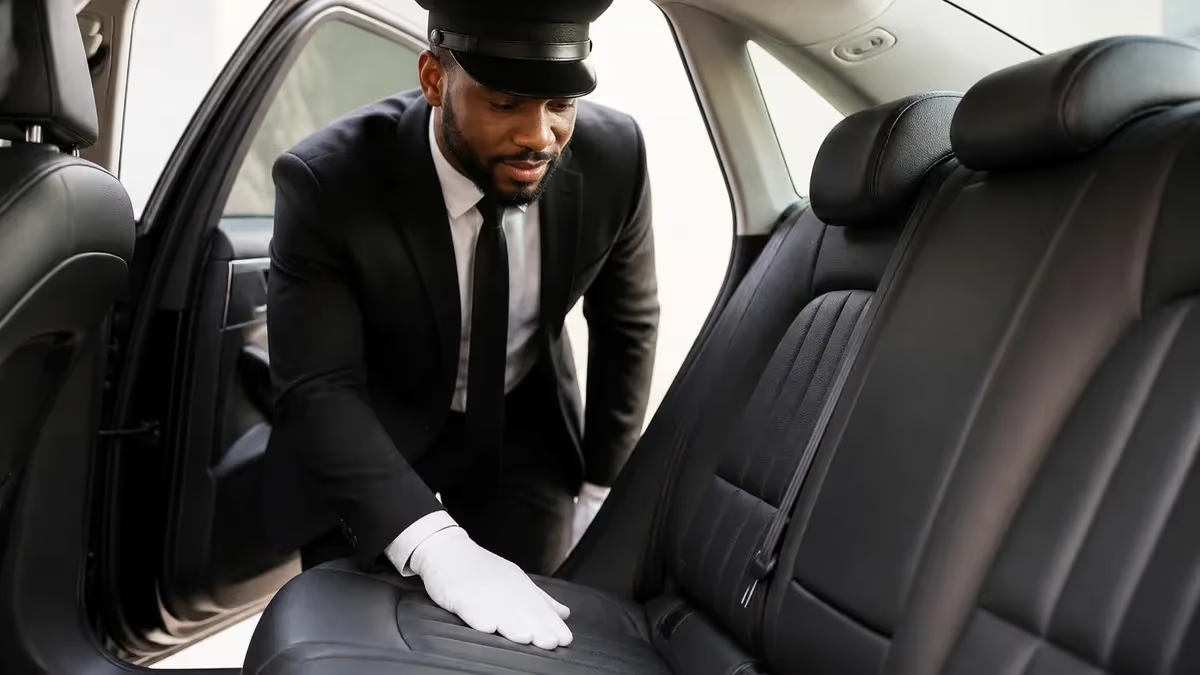
A Michigan chauffeur license is a class of driver's license that authorizes the holder to be paid to transport passengers in a motor vehicle. It is required for taxi drivers, limousine operators, rideshare drivers using commercial vehicle registrations, bus drivers, transportation network company (TNC) drivers operating specific vehicle types, and anyone transporting passengers for compensation. Michigan's chauffeur license requirements are separate from and in addition to any endorsements required for commercial driver's licenses (CDLs).
The written knowledge test for the chauffeur license evaluates whether the applicant understands the rules of the road as they apply to professional passenger transport. The test draws on the same Michigan Vehicle Code knowledge required for a standard driver's license, but also includes sections on the professional responsibilities of a chauffeur — safe passenger boarding and alighting, handling passengers with special needs, maintaining a professional demeanor, and understanding the legal obligations that apply to for-hire drivers in Michigan.
Passing the chauffeur license test requires preparation. While experienced drivers may be tempted to walk in without studying, the chauffeur test includes content beyond what most drivers think about in everyday driving — including specific sections on traffic laws that professional drivers are expected to know in more detail than typical motorists. Treating the test seriously and dedicating study time to the official Michigan study materials consistently produces better outcomes than relying on driving experience alone.
This guide covers the full scope of what the Michigan chauffeur license test assesses, the official study resources available, strategies for preparing effectively, and what to expect on test day at the Michigan Secretary of State office.
Michigan's chauffeur license system is governed by the Michigan Vehicle Code (MCL 257.1 et seq.) and the Motor Carrier regulations that govern commercial passenger transport. Drivers who provide transportation through app-based platforms, operate livery services, or work for transportation companies are required to understand both the state licensing requirements and any additional requirements imposed by the local municipality where they operate. Some Michigan cities, including Detroit, have historically maintained their own licensing systems for taxi operators in addition to the state chauffeur license — confirm local requirements in your operating area.
Unlike commercial driver's licenses, which have federal medical certification requirements and a formal skills test component, the Michigan chauffeur license is primarily a knowledge-based credential. Passing the written test demonstrates that you understand the rules and responsibilities that apply to professional passenger transport. The practical component — actually driving professionally — is evaluated by your employer through their own onboarding and training processes. This makes the path to a chauffeur license more accessible than the CDL process while still ensuring that professional drivers have a verified base of knowledge before they begin transporting paying passengers.
One aspect of the Michigan chauffeur license that applicants sometimes overlook is the insurance requirement. When you drive for hire, your personal auto insurance policy typically does not cover you — most personal policies explicitly exclude coverage when the vehicle is being used commercially.
For-hire operators and rideshare companies provide their own commercial insurance that covers drivers while they are actively engaged in a fare. Understanding the periods during which you are and are not covered by the company's insurance (and when a rideshare driver's personal insurance applies) is an important aspect of professional driver knowledge that may appear on the chauffeur test.
To qualify for a Michigan chauffeur license, applicants must be at least 18 years old and hold a valid Michigan driver's license in good standing. A standard Michigan Class O (regular) or Class D (18-20 years old) driver's license serves as the base license. Applicants with an out-of-state license must transfer it to Michigan before applying for the chauffeur endorsement. The chauffeur license is added as an endorsement to the existing driver's license rather than being a separate document.
Michigan does not require a separate medical examination for a chauffeur license (as opposed to a CDL, which has specific medical certification requirements for most endorsements). However, applicants must meet the standard visual acuity requirements for driving and must disclose any medical conditions that could affect safe operation of a motor vehicle. Certain medical conditions may require additional review or may affect eligibility.
A clean driving record is strongly advisable before applying. While Michigan does not specify a minimum point threshold for chauffeur license eligibility, a record with recent moving violations, suspended periods, or serious convictions can result in denial or additional scrutiny during the application review. If your driving record has issues, consider resolving them before applying for the chauffeur endorsement.
Background checks are not a standard part of the Michigan Secretary of State chauffeur license process. However, if you are being hired by a for-hire transportation company, rideshare platform, or public transit operator, that employer will typically conduct their own background check as part of their hiring process independent of the Secretary of State. Meeting the Secretary of State's licensing requirements does not guarantee that an employer will hire you — check the specific requirements of your intended employer as well.
Once you pass the written test, the Secretary of State will issue your updated license reflecting the chauffeur endorsement. If you are also required to obtain other endorsements for the type of vehicle you will operate — for example, a passenger endorsement on a CDL for driving buses — you must satisfy those requirements separately. The chauffeur license alone covers driving passenger vehicles for hire that do not require a CDL.
The application process for a Michigan chauffeur endorsement takes place at a Secretary of State office. You cannot complete the chauffeur endorsement application online — you must appear in person to take the written knowledge test and have your license updated. Bring your current Michigan driver's license, the application fee, and any supporting documentation if you have received prior license actions. Secretary of State branch offices are located throughout Michigan; some offer same-day appointments while others require advance scheduling through the SOS website.
Michigan applicants who have recently moved from another state and are converting an out-of-state chauffeur or for-hire driver credential should confirm with the SOS whether their out-of-state credential satisfies any portion of the Michigan requirements. Michigan does not have formal reciprocity agreements for chauffeur licenses with most other states, meaning you will need to pass the Michigan written test regardless of what credentials you held in another state. Having prior professional driving experience is valuable preparation, but it does not waive the testing requirement.
The chauffeur license fee in Michigan is relatively modest. Fees are periodically adjusted by the legislature, so confirm the current fee schedule with the Secretary of State before your appointment. Payment is typically accepted by cash, check, or card at SOS offices, though specific payment options may vary by location. Your chauffeur endorsement will appear on your Michigan driver's license — there is no separate wallet card issued for the endorsement alone.

The official study resource for the Michigan chauffeur license test is the Michigan Vehicle Code, supplemented by the Michigan Secretary of State's Driver's License Manual. The SOS provides a specific section in the driver's manual addressing chauffeur license requirements and the topics assessed on the chauffeur knowledge test. Reading this section thoroughly is the minimum preparation — many candidates also review the full traffic laws section to strengthen their knowledge of right-of-way rules, special driving situations, and vehicle operation requirements.
Beyond the official manual, practice tests are one of the most effective preparation tools available. Practice questions that simulate the format and content of the actual chauffeur knowledge test allow you to identify gaps in your knowledge before you sit for the real test. Focus particularly on questions about passenger safety, professional driver responsibilities, and specific Michigan traffic laws that differ from what you may be accustomed to from driving in other states. Michigan has specific rules about things like jaywalking, bicycle lane interactions, and school bus stop-arm laws that appear on professional driver knowledge tests.
Common knowledge gaps for chauffeur license candidates include: the rules for stopping to allow passengers to board or exit on specific road types, what to do when a passenger becomes ill or behaves disruptively, the seatbelt obligations for passengers in for-hire vehicles, and the consequences of accepting a fare without a valid chauffeur license. These topics are straightforward once studied but often unfamiliar to candidates who have only driven a personal vehicle.
The test is computer-administered at Secretary of State offices. You answer questions by selecting from multiple-choice options, and the test does not allow you to return to previous questions in most implementations. This means you must commit to an answer and move forward — there is no opportunity to review flagged questions at the end. Developing the habit of reading each question carefully and selecting your best answer before moving on is a valuable test-taking strategy to practice during your preparation sessions.
Scheduling your test appointment after a focused preparation period — at least one week of daily review and multiple full-length practice tests — gives you the best chance of passing on the first attempt. Michigan charges a fee for the license application whether you pass or fail, so retakes add cost. Preparing thoroughly enough to pass in one attempt is the most economical approach.
Several specific topic areas consistently appear in chauffeur license test feedback from Michigan applicants: school bus stop-arm laws (what to do when a school bus stops and extends its stop arm), construction zone driving rules (speed limits, fines, and right-of-way in work zones), and rules for driving in inclement weather (minimum following distances, headlight requirements during precipitation, and when to pull off the road). These are topics that appear on the standard driver's knowledge test as well, but the chauffeur test may present them in scenarios specific to professional driving contexts.
Test-takers who review the Michigan Driver's License Manual in its entirety — not just the chauffeur-specific section — consistently report higher pass rates. The manual is available free of charge through the Michigan Secretary of State website and as a free app download. Digital versions allow you to search for specific topics, bookmark sections, and review on a mobile device during commutes or downtime. Reading the manual once through and then reviewing the specific chauffeur sections multiple times is a practical study plan that takes most candidates between three and seven hours of total preparation time.
If you encounter study materials online that are marketed as "Michigan chauffeur license test prep," verify that they are based on the current Michigan Vehicle Code and SOS manual rather than generic CDL study materials. Some commercial test prep products mix CDL content with chauffeur content, which can confuse candidates about which requirements apply to their specific license type. Using the official Michigan SOS materials as your primary source, supplemented by practice tests that specifically target chauffeur knowledge content, is the most reliable preparation approach.
Once you pass the written knowledge test, the Secretary of State updates your driver's license to reflect the chauffeur endorsement. Your new or updated license will arrive by mail within a few days, or you may receive a temporary paper license at the office. Keep this document with you whenever you are operating a for-hire vehicle — law enforcement and passengers may ask to see your license, and operating without the proper endorsement is a civil infraction.
Maintaining your chauffeur endorsement in good standing requires keeping your base Michigan driver's license active and renewing it on schedule. Michigan driver's licenses are typically renewed every four years. If you allow your base license to expire, your chauffeur endorsement also expires, and you must pay the renewal fees and pass any required tests to restore both. Set a calendar reminder well before your license expiration date to ensure you renew on time.
Any traffic violations, accidents, or license actions — points on your record, suspensions, or revocations — that affect your base driver's license also affect your chauffeur endorsement. Professional drivers are held to high standards because they are transporting paying passengers whose safety depends on responsible driving. If you accumulate points on your license, consider attending a Michigan defensive driving course to reduce points and demonstrate your commitment to safe professional driving.
Many for-hire transportation operators — rideshare platforms, taxi companies, limo services — conduct regular ongoing background and driving record checks on their drivers in addition to the initial check done during hiring. Maintaining a clean driving record is not just a requirement for keeping your license but also for keeping the professional driving opportunities the license enables. The investment you make in passing the chauffeur test is only valuable if you maintain the professional standards the license represents.
If you plan to operate in multiple Michigan municipalities or plan to drive for multiple platforms, keep copies of all your licensing documents organized and accessible. Some rideshare platforms require you to upload your chauffeur license certificate directly through their driver app as part of compliance monitoring. Having a clear digital photo of your license stored in a secure folder on your phone makes it easy to provide documentation promptly when required by a platform's compliance team or a law enforcement officer during a roadside inspection or audit.

Michigan Chauffeur License Application Checklist
- ✓Verify you hold a valid Michigan driver's license (Class O or D)
- ✓Study the Michigan SOS Driver's License Manual chauffeur section
- ✓Complete multiple full-length practice tests covering traffic laws and passenger safety
- ✓Schedule a test appointment at your local Michigan Secretary of State office
- ✓Bring your current Michigan driver's license and any required fee payment
- ✓Pass the written knowledge test
- ✓Receive your updated license with the chauffeur endorsement



Chauffeur License: Pros and Cons
- +chauffeur license practice test mi — chauffeur License exam preparation strengthens your knowledge across all domains
- +Passing the exam proves competency to employers and clients
- +Study materials and practice tests are widely available
- +Exam-based credentials are portable across states and employers
- +Clear exam objectives help focus your study plan effectively
- −Exam anxiety can affect performance — practice tests help reduce it
- −Registration fees are non-refundable if you miss your test date
- −Limited retake opportunities may apply with waiting periods
- −Exam content updates periodically — use current study materials
- −Testing center availability may require advance scheduling
Chauffeur Questions and Answers
About the Author

Licensed Driving Instructor & DMV Test Specialist
Penn State UniversityRobert J. Williams graduated from Penn State University with a degree in Transportation Management and has spent 20 years as a certified driving instructor and DMV examiner consultant. He has personally coached thousands of applicants through written knowledge tests, skills assessments, and commercial driver licensing programs across more than 30 states.