
What Is a CST in Medical Terms? Surgical Tech Role Explained 2026 October
Pass the What Is a CST in Medical Terms? exam with confidence. Practice questions with detailed explanations and instant feedback on every answer. 🆕

What Does CST Mean in Medical Terms?
In a medical context, CST stands for Certified Surgical Technologist. It's a healthcare credential earned by passing the CST certification exam administered by the National Board of Surgical Technology and Surgical Assisting (NBSTSA). The credential identifies professionals who've demonstrated competency in the technical and procedural knowledge required to assist in surgical procedures.
You'll see the term used two ways: as a job title ("the surgical technologist" on a surgical team) and as a credential suffix ("Jane Smith, CST" after earning certification). The distinction matters — not everyone who works as a surgical tech holds the CST credential, though an increasing number of employers require it for hiring.
What Does a Certified Surgical Technologist Do?
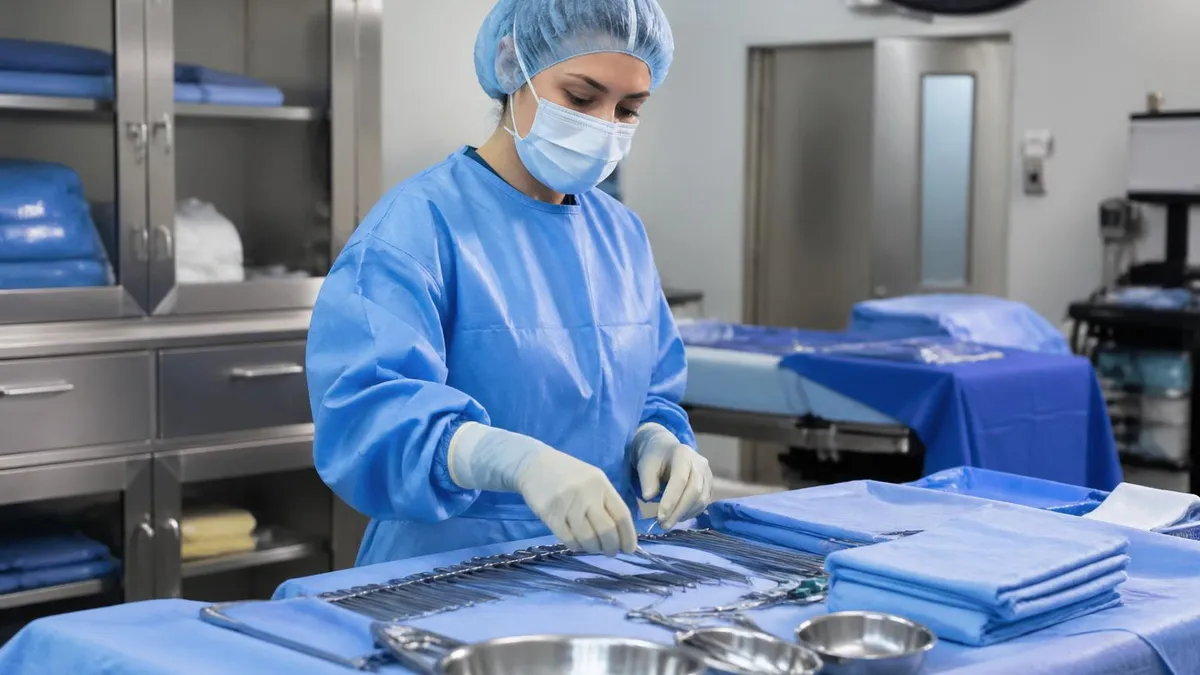
Surgical technologists — often called scrub techs or OR techs — are core members of the surgical team. They work directly in the operating room before, during, and after procedures. Their responsibilities fall into three phases:
Before surgery (preoperative phase):
- Preparing the operating room: setting up sterile fields, arranging instruments and equipment
- Sterilizing and organizing surgical instruments specific to the scheduled procedure
- Reviewing the surgeon's preference card and anticipating instrument needs
- Assisting with patient positioning and skin preparation
During surgery (intraoperative phase):
- Passing instruments, sutures, and other sterile items to the surgeon
- Maintaining the sterile field throughout the procedure
- Performing surgical counts (instruments, sponges, needles) with the circulating nurse
- Anticipating the surgeon's needs and adjusting quickly to unexpected developments
After surgery (postoperative phase):
- Assisting with wound closure and specimen handling
- Breaking down the sterile field and disposing of contaminated materials
- Cleaning and restocking the OR for the next procedure
- Documenting the procedure and instruments used
The role requires precision, focus under pressure, and detailed knowledge of anatomy, surgical procedures, and sterile technique. A wrong instrument at the wrong moment — or a break in sterile field — can affect patient outcomes directly.
Pro Tip: Focus your Certified Surgical Technologist study time on areas where you score lowest. Most exam questions test application of knowledge, not memorization.
Where Do Certified Surgical Technologists Work?
Most CSTs work in hospital operating rooms — but the role isn't limited to hospitals. You'll find certified surgical technologists in:
- Ambulatory surgery centers (ASCs) — a fast-growing sector as more procedures move outpatient
- Physician office surgical suites
- Military medical facilities
- Trauma centers
- Specialty surgical facilities (orthopedic, ophthalmologic, cardiac)
The shift toward outpatient surgery has significantly expanded the job market. Many surgical techs who start in hospital ORs move to ASCs for better hours and often comparable pay without the complexity of a large hospital system.
CST vs. Surgical Technologist: Is There a Difference?
Technically, "surgical technologist" is the job title. "CST" is the credential. Not all surgical technologists hold the CST — some are trained on the job without formal certification. But the credential increasingly matters:
- Many hospitals and ASCs require CST or CST eligibility for hiring
- CSTs typically command higher starting salaries
- The credential is portable across state lines — no separate state licensure in most states
- Specialty certifications (first assisting, central service) often require CST as a prerequisite
If you're entering the field or working toward advancement, the CST credential is worth the investment.
How to Become a Certified Surgical Technologist
Earning the CST requires meeting NBSTSA's eligibility criteria, then passing the certification exam. Here's the standard path:
- Complete an accredited surgical technology program — associate's degree (most common) or certificate program through an ARC-ST accredited school
- Verify eligibility with NBSTSA — current requirements include graduation from an accredited program or completion of a military surgical technology program
- Apply and sit for the CST exam — 175 questions, 4.5-hour time limit, passing score of 118
- Maintain certification — CST must be renewed every 4 years through continuing education or re-examination
The CST exam requirements page covers eligibility in detail, including the alternative pathway for surgical technologists with work experience who trained outside an accredited program.
CST Exam Overview
The CST certification exam tests across three primary content domains:
- Perioperative Care (~75% of exam): preoperative preparation, intraoperative procedures, postoperative procedures
- Ancillary Duties (~13%): equipment, administrative functions, supply management
- Basic Sciences (~12%): anatomy, physiology, microbiology, pharmacology
The exam is delivered at Pearson VUE testing centers. You'll see multiple-choice questions that test clinical reasoning and procedural knowledge — not just memorization of facts. A lot of questions are scenario-based: "The surgeon asks for X, you hand them Y — what went wrong?"
CST Salary and Job Outlook
According to the Bureau of Labor Statistics, the median annual wage for surgical technologists is approximately $60,000–$65,000, with experienced techs and those in high-demand markets earning $75,000 or more. The BLS projects job growth of 6–7% over the coming decade — faster than average across all occupations — driven primarily by an aging population requiring more surgical procedures.
Specializing in a high-demand surgical area (cardiovascular, neurosurgery, orthopedics) or earning the Certified Surgical First Assistant (CSFA) credential can significantly increase earning potential.

- +Industry-recognized credential boosts your resume
- +Higher earning potential (10-20% salary increase on average)
- +Demonstrates commitment to professional development
- +Opens doors to advanced career opportunities
- −Exam preparation requires significant time investment (4-8 weeks)
- −Certification fees can be $100-$400+
- −May require continuing education to maintain
- −Some employers may not require certification




Start Your CST Exam Prep Today
Whether you're a student in a surgical technology program, a working tech preparing for certification, or a career changer researching the field — the CST credential is the professional benchmark for the operating room.
The exam's scenario-based format rewards hands-on familiarity with surgical procedures and sterile technique. The best prep strategy combines content review (especially anatomy, pharmacology, and procedure-specific instrument knowledge) with timed practice questions that mirror the clinical reasoning the exam tests.
Our free Certified Surgical Technologist practice tests cover patient safety, surgical counts, wound closure, and more. Start now to see which domains you're strongest in — and where to focus before test day.
About the Author

Educational Psychologist & Academic Test Preparation Expert
Columbia University Teachers CollegeDr. Lisa Patel holds a Doctorate in Education from Columbia University Teachers College and has spent 17 years researching standardized test design and academic assessment. She has developed preparation programs for SAT, ACT, GRE, LSAT, UCAT, and numerous professional licensing exams, helping students of all backgrounds achieve their target scores.