
Certified Surgical Technologist (CST) Exam Guide 2026 June
Free Certified Surgical Technologist (CST) practice test with questions and answer explanations. 🗨️ Prepare for the 2026 June exam with instant scoring.
Certified Surgical Technologist (CST): Exam Guide and Career Overview
The CST credential — Certified Surgical Technologist — is the standard professional certification for surgical technologists practicing in the United States. The National Board of Surgical Technology and Surgical Assisting (NBSTSA) issues the CST after candidates pass a comprehensive examination demonstrating competency across the full scope of surgical technology practice. Most hospitals and surgical facilities either require or strongly prefer CST-certified surgical technologists, and earning the credential demonstrates a baseline of verified, tested knowledge that classroom training alone doesn't provide.
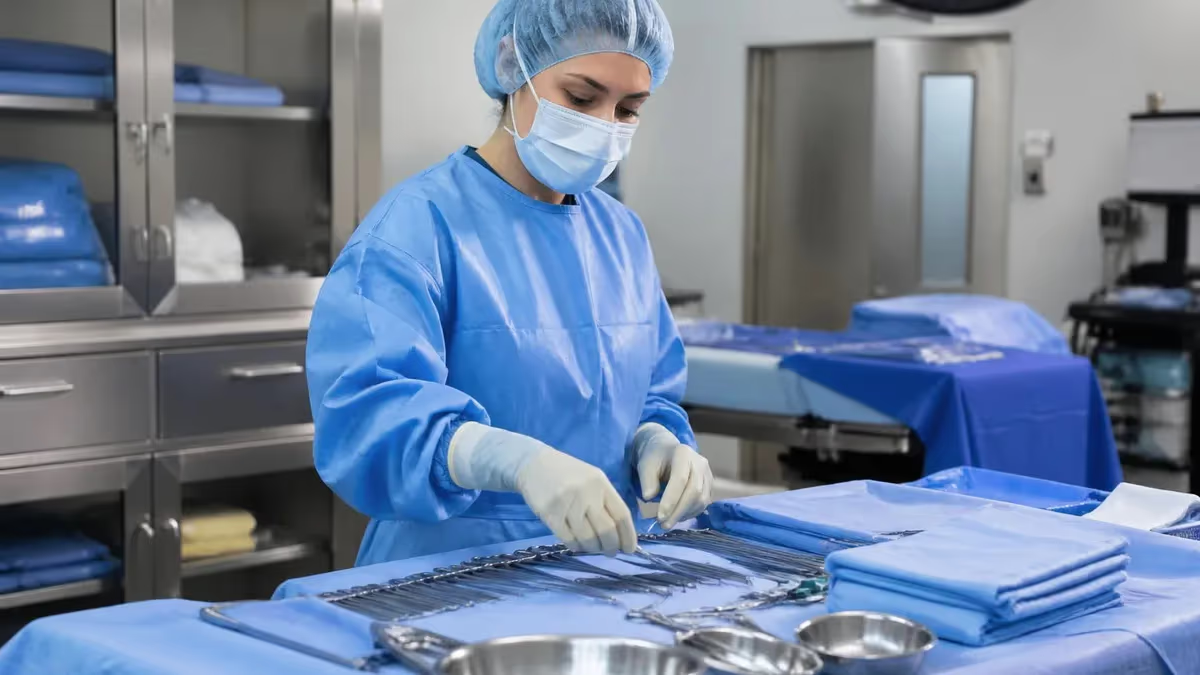
Surgical technologists work as part of the surgical team during operations — they prepare the sterile field, handle instruments, anticipate the surgeon's needs, and maintain the integrity of the sterile environment throughout each procedure. The CST exam measures whether a candidate understands how to perform these responsibilities correctly across a wide range of surgical specialties and clinical scenarios. It isn't testing manual dexterity — that's evaluated during clinical training. It's testing the cognitive knowledge underlying safe surgical practice: aseptic technique principles, instrument identification and function, anatomy relevant to surgical positioning and incisions, pharmacology for surgical settings, and the sequential steps of specific procedure types.
The NBSTSA CST exam contains 175 questions total, of which 150 are scored. The 25 unscored questions are pilot questions distributed throughout the exam — you won't know which questions are scored and which aren't. The three-hour time limit is manageable for most candidates who've prepared adequately, leaving roughly one minute per question on average. The passing score is criterion-referenced rather than norm-referenced, meaning the cutoff reflects a defined competency standard rather than performance relative to other test-takers. Candidates typically need to answer approximately 100 correct scored questions to pass, though the exact passing standard is determined through psychometric analysis and can shift slightly between exam versions. Starting exam preparation with a baseline set of cst practice questions and answers gives candidates an accurate gauge of their current knowledge level before building a structured study plan.
The four exam domains reflect the actual workflow of surgical technology practice. Perioperative Care (approximately 35% of scored questions) covers preoperative patient assessment and preparation, intraoperative responsibilities, and postoperative handoff procedures. Specialty Surgery (approximately 33%) covers the specific procedures, instruments, and considerations for general surgery, orthopedic surgery, obstetric and gynecologic surgery, neurological surgery, cardiovascular and thoracic surgery, and other specialty areas. Anatomy, Physiology, and Medical Terminology (approximately 19%) tests the biological and anatomical knowledge underlying surgical practice. Equipment, Sterilization, and Technology (approximately 13%) covers surgical instruments, sterilization methods, powered equipment, and endoscopic systems. The perioperative care domain is the largest, and candidates who practice with cst preoperative care questions and answers focused on patient prep, positioning, and draping protocols address the highest-weighted single area on the exam.
Eligibility for the CST exam requires graduation from a CAAHEP-accredited (Commission on Accreditation of Allied Health Education Programs) surgical technology program or a military training program equivalent. The NBSTSA no longer accepts the work experience pathway that was available to surgical techs grandfathered into the field before formal program requirements were established. New entrants to the field must complete an accredited program before sitting for the exam. CAAHEP-accredited programs are available as two-year associate degree programs at community colleges and as certificate programs at vocational and technical schools. The intraoperative portion of surgical tech training involves significant clinical time in operating rooms, and candidates typically take the CST exam near or shortly after completing their program while clinical knowledge is freshest. Preparing across all surgical specialty areas is essential — the specialty surgery domain covers a wide enough range of procedures that weak areas in specific surgical specialties can affect overall exam performance. Practice with cst intraoperative procedures questions and answers covering instrument passing, specimen handling, and count procedures builds the domain fluency that specialty surgery questions require.

CST Overview
- Perioperative Care (35%): Preoperative assessment, patient positioning, surgical draping, sterile field preparation, instrument counts, postoperative handoff
- Specialty Surgery (33%): General, orthopedic, OB/GYN, neurosurgical, cardiovascular/thoracic, urological, ophthalmic, and plastic surgery procedures
- Anatomy, Physiology & Medical Terminology (19%): Systemic anatomy, surgical approaches, wound classification, medical terminology relevant to OR practice
- Equipment, Sterilization & Technology (13%): Instrument identification, sterilization methods (steam, gas, chemical), powered surgical equipment, endoscopic systems, electrosurgical units
- ✓Confirm your exam appointment and location
- ✓Bring required identification documents
- ✓Arrive 30 minutes early to check in
- ✓Read each question carefully before answering
- ✓Flag difficult questions and return to them later
- ✓Manage your time — don't spend too long on one question
- ✓Review flagged questions before submitting

Preparing for the CST Exam: What the Best Candidates Do Differently
The CST exam covers a broad scope of surgical knowledge, and candidates who try to memorize everything equally tend to score lower than candidates who allocate study time proportional to domain weight. Perioperative care is 35% of the exam — it should get 35% of your study time, not equal time split five ways. Specialty surgery at 33% deserves nearly as much focus. Anatomy and physiology at 19% rewards targeted review of surgical anatomy rather than comprehensive anatomy study. Equipment and sterilization at 13% is the smallest domain but tests procedural knowledge where mistakes are costly during actual cases — and where getting questions right on the exam is achievable with systematic instrument and sterilization review.
Aseptic technique questions appear throughout multiple domains — they're not confined to the equipment section. Understanding the principles thoroughly pays dividends across the exam. The concept of sterile field integrity, what constitutes a breach, and the correct response to a contamination event all appear in perioperative care questions, intraoperative case scenario questions, and equipment handling questions. Mastery of aseptic technique principles rather than surface-level familiarity with the rules is the preparation approach that scores well. Practice with cst aseptic technique questions and answers that present contamination scenarios and ask for the correct response builds the decision-making fluency the exam rewards — not just recall of the rule but application of it in context.
Instrument identification and function is a consistently tested area that candidates either know cold or struggle with throughout the exam. The CST exam uses descriptive language and sometimes images to test instrument recognition — candidates must know the difference between a Kocher clamp and a Crile clamp, between a Metzenbaum scissors and a Mayo scissors, between a Richardson retractor and a Deaver. Working through cst surgical instrumentation questions and answers builds this recognition fluency, and candidates who can identify instruments by description and function gain a significant advantage on the equipment domain questions that draw on this knowledge directly.
Surgical technologists who earn the CST credential generally see better employment outcomes than uncertified technologists applying to the same positions. Hospitals with Magnet status or Joint Commission accreditation often require CST certification for surgical tech positions. The credential signals to employers that a candidate has passed a standardized, nationally recognized competency assessment rather than just completing a training program. In a field where the consequences of errors are immediate and serious, employers value that external validation. For experienced surgical techs who haven't yet pursued certification, the CST credential is the most direct way to document existing expertise in a form that hiring managers can quickly evaluate and compare across candidates from different programs and institutions.
The operating room environment rewards surgical technologists who don't just know the protocols but understand the reasoning behind them. Knowing that a wet sponge breaks the sterile barrier isn't enough — you need to understand moisture as a contamination pathway to recognize novel situations the protocols don't explicitly describe. This deeper conceptual understanding is what the CST exam actually tests through its scenario-based questions, and it's what separates surgical technologists who perform reliably under pressure from those who do fine in familiar situations but struggle when something unexpected happens during a case. Building this understanding — not just memorizing protocols — is the real goal of effective CST exam preparation and the foundation of a safe, competent career in surgical technology.
CST Pros and Cons
- +CST certification is required or preferred at most hospital surgical departments and ambulatory surgery centers
- +Nationally recognized credential that transfers across states and employment settings
- +Structured exam domains align directly with daily surgical technology responsibilities
- +CST holders typically earn more than uncertified surgical technologists — certification adds documented market value
- +Recertification through CE credits keeps credentials current without requiring retesting every cycle
- −Eligibility requires CAAHEP-accredited program completion — work experience pathway is no longer accepted
- −Exam covers a very broad range of surgical specialties — comprehensive preparation requires significant study time
- −Application and exam fee of $215 is significant for recently graduated candidates with student debt
- −Recertification every 4 years requires sustained CE credit accumulation throughout your career
- −CST credential is specific to surgical technology — doesn't cross over to other allied health credentialing pathways



Certified Surgical Technologist Questions and Answers
About the Author
Educational Psychologist & Academic Test Preparation Expert
Columbia University Teachers CollegeDr. Lisa Patel holds a Doctorate in Education from Columbia University Teachers College and has spent 17 years researching standardized test design and academic assessment. She has developed preparation programs for SAT, ACT, GRE, LSAT, UCAT, and numerous professional licensing exams, helping students of all backgrounds achieve their target scores.