
CPT Code for PPD Skin Test: What Phlebotomy Technicians Need to Know About Medical Billing Codes
Master the cpt code for ppd skin test & 99214 CPT code for your phlebotomy exam. Real billing examples, fee schedules & free practice questions. ✅

Understanding the cpt code for ppd skin test is a core competency for any Certified Phlebotomy Technician, and it connects directly to the broader world of medical billing that you will encounter every day on the job. The PPD (purified protein derivative) tuberculin skin test is administered routinely in clinics, hospitals, and public health settings across the United States, and knowing how to document and bill for it correctly can mean the difference between a clean claim and a costly denial.
CPT meaning, in this context, refers to Current Procedural Terminology — the standardized code set maintained by the American Medical Association that every healthcare provider uses to communicate with payers about the services rendered.
When phlebotomy students first encounter billing concepts, many are surprised to discover that blood draws and skin tests each carry their own distinct CPT codes. The 99214 cpt code is one of the most frequently tested evaluation and management codes on certification exams, representing a moderately complex office visit. While the PPD skin test codes sit in a different section of the CPT manual, understanding how E&M codes like 99213 and 99214 interact with procedure codes helps you see the complete billing picture that employers expect phlebotomy technicians to grasp before they ever touch a patient.
The CPT code for the PPD intradermal injection is 86580, while the reading and interpretation of the test result — typically performed 48 to 72 hours later — can be billed separately or bundled depending on payer rules. Colorado Medicaid's CPT fee schedule for Colorado lists specific reimbursement amounts for each of these codes, and those rates differ meaningfully from Medicare's national allowable rates. Technicians who understand fee schedules are better equipped to answer patient questions about out-of-pocket costs and to flag billing errors before they escalate into compliance problems.
The CPT code lookup process seems straightforward on the surface — you search by keyword or code number in a reference tool — but the nuance lies in understanding parent codes, add-on codes, and modifier requirements. A PPD administration, for example, may require modifier 25 when it is performed on the same day as a significant and separately identifiable evaluation and management service. Without that modifier, payers will bundle the two claims and reimburse only the higher-value service, leaving revenue on the table for your facility and creating documentation headaches for your supervisor.
Phlebotomy technician exams test CPT knowledge in several ways. You may see scenario-based questions asking which code applies to a specific procedure, or you may be asked to identify the correct E&M level — such as 99204 or 99213 — based on a brief clinical vignette. The 99204 cpt code represents a new patient office visit of moderate complexity, while the 99213 cpt code covers an established patient visit of low to moderate complexity. Recognizing these distinctions under timed exam conditions requires deliberate study and repeated practice with realistic questions.
Beyond the exam, real-world phlebotomy roles increasingly ask technicians to support billing departments by ensuring that requisition forms are completed accurately, that test orders match the patient's insurance authorization, and that any additional services — like a concurrent blood draw ordered at the same PPD visit — are captured on the encounter form. The 90837 cpt code, which covers a 60-minute psychotherapy session, illustrates how wildly different services can share the same billing system, reinforcing why phlebotomy professionals need a working literacy in CPT structure even when their own scope of practice is narrowly defined.
This article walks through everything a phlebotomy technician needs to know about CPT codes related to PPD skin testing, E&M levels, fee schedules, and exam preparation strategies. Whether you are studying for the ASCP, NHA, or AMT certification exam, or you are a working technician looking to sharpen your billing knowledge, the sections below will give you a structured, comprehensive guide to mastering this content area and approaching your practice tests with confidence.
CPT Codes & Phlebotomy Certification by the Numbers

How CPT Billing Works for a PPD Skin Test Visit
Step 1: Order Verification
Step 2: Intradermal Injection & CPT Capture
Step 3: 48–72 Hour Reading
Step 4: Claim Submission & Fee Schedule Lookup
Step 5: Posting & Compliance Review
Evaluation and management codes are among the most scrutinized codes in all of medical billing, and the 99214 cpt code sits near the top of that list. Representing a moderately complex office or outpatient visit for an established patient, CPT 99214 requires medical decision-making of moderate complexity or a total time threshold that has shifted significantly since the 2021 AMA revisions. Phlebotomy technicians who assist in clinical settings are expected to understand what documentation supports a 99214 versus a 99213, because auditors frequently ask front-line clinical staff to explain the records they helped create.
The cpt code 99214 and its neighbor 99213 represent the two most commonly billed E&M codes in outpatient medicine. The 99213 cpt code applies when medical decision-making is low complexity or when the encounter time reaches 20 to 29 minutes. The 99214, by contrast, requires moderate complexity MDM or 30 to 39 minutes of total time. These distinctions matter for phlebotomy certification exams because scenario questions will describe a patient encounter and ask you to identify the appropriate level, testing your ability to apply CPT logic rather than simply memorize code numbers.
New patient visits use a different code set: 99201 through 99205, though 99201 was deleted in 2021. The 99204 cpt code covers a new patient visit with moderate complexity medical decision-making, equivalent in complexity to a 99214 for established patients. Understanding this parallel structure helps you reason through unfamiliar scenarios on the exam: if you know what moderate complexity looks like for an established patient under 99214, you can apply the same framework to identify 99204 for a new patient. The 99204 cpt code page on our site provides additional practice scenarios to sharpen this skill.
The 90837 cpt code represents an entirely different domain — a 60-minute psychotherapy session — but it illustrates an important principle: CPT codes are organized into sections by service type, and a phlebotomy technician who understands the organizational logic of the CPT manual can navigate unfamiliar code ranges with confidence. The manual is divided into Evaluation and Management, Anesthesia, Surgery, Radiology, Pathology and Laboratory, and Medicine sections. The PPD skin test code 86580 falls in the Medicine section under immunology, while the blood draw code 36415 sits in the Surgery section under venipuncture.
Fee schedule knowledge is increasingly tested on phlebotomy certification exams, particularly questions related to the colorado medicaid cpt fee schedule colorado. Colorado's Medicaid program, known as Health First Colorado, publishes quarterly fee schedule updates that set maximum reimbursable amounts for each CPT code. For PPD testing, the allowed amount under Colorado Medicaid differs from the Medicare national allowable and from commercial payer contracted rates. Technicians working in federally qualified health centers or safety-net clinics in Colorado are especially likely to encounter Health First Colorado billing rules on the job.
The CPT code lookup process is a skill in itself. The AMA publishes the official CPT manual annually, but most healthcare workers access codes through electronic health record systems, billing software, or third-party lookup tools. When using a lookup tool, searching by keyword — for example, typing "tuberculin" to find PPD-related codes — is faster than browsing category by category.
However, technicians must verify that the code returned matches the specific service performed, because similar procedures often share adjacent code numbers with meaningfully different descriptions. The cpt code 99214 and neighboring codes are a good example of how a one-digit difference changes everything about reimbursement and documentation requirements.
Mastering E&M code logic also prepares phlebotomy technicians for cross-training opportunities in medical coding and billing, areas where demand is growing rapidly as healthcare systems digitize their revenue cycle operations. Many phlebotomy technicians discover that their hands-on clinical experience gives them a natural advantage when learning to audit charts for coding accuracy, because they understand the procedures from the inside out. Starting with a solid foundation in CPT structure — from the PPD skin test to the complexity levels of 99213, 99214, and 99204 — positions you for career advancement well beyond the phlebotomy draw station.
CPT Code Lookup: PPD, 99213, and 99214 Explained
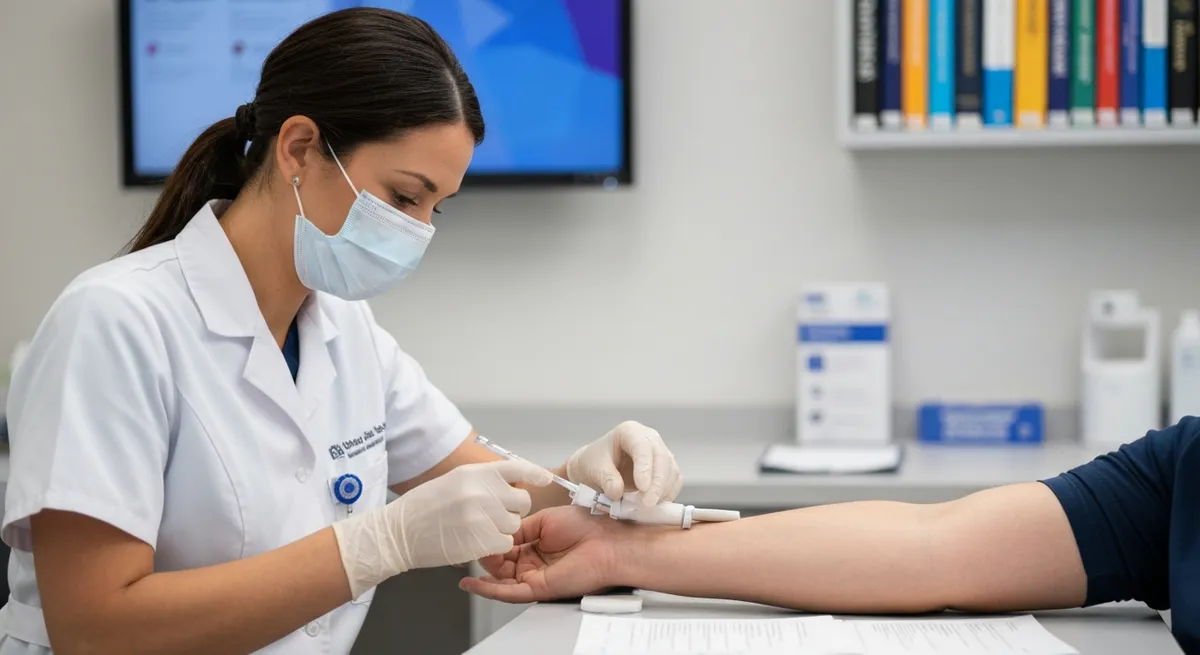
The primary CPT code for administering the PPD tuberculin skin test is 86580. This code covers the intradermal injection of purified protein derivative and applies when a trained healthcare worker — including a phlebotomy technician operating under a physician's order — places the antigen beneath the skin surface. The code does not include interpretation; rather, it captures the procedural act of administration. Payers reimburse 86580 at rates that vary by geography, payer type, and facility setting, with Colorado Medicaid rates typically listed in the quarterly Health First Colorado fee schedule updates.
Reading the PPD result 48 to 72 hours later may be billed under a separate E&M visit code, most commonly 99211 or 99212 for a nurse or medical assistant result-reading visit, or under a higher E&M code if a physician reviews the finding and makes clinical decisions. Some payers bundle the reading into the original 86580 payment; others allow separate billing. Always verify the specific payer's bundling rules before submitting a separate claim for the reading visit, and document the millimeter measurement of induration clearly in the medical record to support any billed service.

CPT Billing Knowledge: Advantages and Challenges for Phlebotomy Technicians
- +Increases your value to employers by enabling you to support billing and coding teams
- +Helps you answer patient questions about costs and insurance coverage accurately
- +Strengthens your phlebotomy certification exam performance on billing-related questions
- +Prepares you for cross-training into medical coding and revenue cycle roles
- +Reduces claim denials by ensuring accurate documentation at the point of care
- +Gives you a competitive edge when applying for supervisor or lead technician positions
- −CPT codes are updated annually, requiring ongoing education to stay current
- −Payer-specific rules vary widely, making it difficult to memorize universal billing guidelines
- −Modifier requirements add complexity that can lead to billing errors if misapplied
- −Colorado Medicaid and Medicare fee schedules differ, creating confusion in multi-payer environments
- −Bundling rules for PPD codes change across payer contracts and require regular verification
- −Time spent learning billing concepts competes with time available for clinical skill development
Pros and Cons at a Glance
| Pros | Cons |
|---|---|
| Increases your value to employers by enabling you to support billing and coding teams | CPT codes are updated annually, requiring ongoing education to stay current |
| Helps you answer patient questions about costs and insurance coverage accurately | Payer-specific rules vary widely, making it difficult to memorize universal billing guidelines |
| Strengthens your phlebotomy certification exam performance on billing-related questions | Modifier requirements add complexity that can lead to billing errors if misapplied |
| Prepares you for cross-training into medical coding and revenue cycle roles | Colorado Medicaid and Medicare fee schedules differ, creating confusion in multi-payer environments |
| Reduces claim denials by ensuring accurate documentation at the point of care | Bundling rules for PPD codes change across payer contracts and require regular verification |
| Gives you a competitive edge when applying for supervisor or lead technician positions | Time spent learning billing concepts competes with time available for clinical skill development |
CPT Code for PPD Skin Test: Exam Preparation Checklist
- ✓Memorize CPT code 86580 as the standard code for PPD tuberculin skin test administration
- ✓Learn the definition and MDM requirements for 99213, 99214, and 99204 CPT codes
- ✓Practice CPT code lookup using keyword searches for tuberculin, venipuncture, and immunology terms
- ✓Review the 2021 AMA revisions that shifted E&M code selection from history/exam to MDM or time
- ✓Understand when modifier 25 is required for same-day E&M and PPD procedure billing
- ✓Study the Colorado Medicaid CPT fee schedule to understand how reimbursement rates are structured
- ✓Compare Medicare national allowable rates with Colorado Medicaid rates for common phlebotomy codes
- ✓Practice identifying the correct E&M level from clinical vignettes under timed conditions
- ✓Review bundling rules for PPD administration and same-day reading visits across major payer types
- ✓Complete at least three full-length practice exams covering CPT billing, anatomy, and specimen handling
The PPD Code 86580 Is Just the Starting Point
Most phlebotomy certification candidates know CPT code 86580 for the PPD skin test injection, but the exam will also test your knowledge of modifiers, bundling rules, and E&M code selection for the same encounter. Candidates who study the full billing workflow — not just isolated code numbers — consistently outperform those who rely on memorization alone. Build your understanding around how codes interact, and the individual numbers will follow naturally.
One of the most common errors phlebotomy technicians make when learning CPT billing is conflating the code number with the concept it represents. For example, CPT 99214 is not simply a "level 4 visit" — it is a precisely defined service level with specific documentation requirements that changed substantially when the AMA revised E&M guidelines in 2021.
Before those revisions, level selection depended on the number of elements documented in the history, physical examination, and medical decision-making sections. After 2021, history and exam documentation no longer drive code selection; instead, clinicians choose the level based on total time or the complexity of MDM as defined by three components: number and complexity of problems addressed, amount and complexity of data reviewed, and risk of complications.
This shift has significant implications for phlebotomy technicians who document patient-reported information before the physician enters the room. If your facility uses a standard intake form where you record chief complaint, current medications, allergies, and vital signs, that documentation contributes to the medical record but no longer directly drives E&M code selection under the post-2021 framework. What matters now is what the physician documents about their decision-making. However, your accurate intake data still supports the physician's MDM by ensuring they have complete information about the patient's problem list, which indirectly affects code selection when the problem complexity component is evaluated.
The 90837 cpt code, which covers a 60-minute individual psychotherapy session, provides a useful contrast case for understanding CPT structure. Unlike E&M codes, which are driven by time or complexity, therapy codes are driven primarily by time thresholds. The 90837 requires that the session last at least 53 minutes; sessions between 38 and 52 minutes are billed under 90834 instead.
This time-based logic is similar to the time-based option for E&M codes introduced in 2021, where a 99214 can be selected if total encounter time reaches 30 to 39 minutes. Recognizing these parallel structures across different CPT sections helps you reason through unfamiliar code scenarios on certification exams.
Understanding CPT meaning at a structural level also helps you navigate the add-on code system. Add-on codes, marked with a plus symbol (+) in the CPT manual, are always billed in conjunction with a primary code and never alone. For phlebotomy, the add-on code for each additional blood draw order — when multiple tubes are drawn from the same venipuncture — follows this same logic. Recognizing that add-on codes exist and cannot stand alone prevents billing errors that trigger automatic claim rejections from payer systems designed to catch orphaned add-on code submissions.
The cpt code lookup skill becomes especially important when a physician orders a less common test that you have not seen before. Suppose a physician orders a Candida skin test alongside a PPD on the same patient. The Candida skin test has its own CPT code — 86485 — which you would identify through a keyword lookup in your facility's EHR or billing software.
Reporting both 86580 and 86485 on the same claim is appropriate because they represent two distinct antigens and two distinct intradermal injections. Knowing that each distinct antigen injection carries its own billable code prevents both underbilling (missing the second code) and overbilling (applying a single code twice when only one injection was performed).
Phlebotomy technicians working in Colorado have additional reasons to develop fee schedule literacy. The Colorado Medicaid CPT fee schedule for Colorado is a publicly accessible document, and reviewing it periodically gives you a concrete sense of the economic value assigned to each service you perform.
Seeing that a venipuncture (36415) reimburses at a different rate than a PPD injection (86580) reinforces why accurate code capture matters — each code represents real revenue that supports your facility's ability to staff clinical positions, purchase supplies, and serve patients. When you understand the financial consequences of documentation errors, accurate and complete record-keeping becomes a professional priority rather than an administrative chore.
Phlebotomy certification exams from the ASCP, NHA, and AMT all include billing and coding content, though the depth varies by exam. The NHA Certified Phlebotomy Technician (CPT) exam devotes a meaningful portion of its blueprint to healthcare systems content, which includes billing basics and CPT code familiarity.
Candidates who study this content area with the same rigor they apply to venipuncture technique and specimen handling consistently report higher scores on practice exams and greater confidence when they encounter billing scenario questions on test day. The time you invest in understanding CPT code structure pays dividends not just on your certification exam, but throughout your entire phlebotomy career.

The AMA updates the CPT code set every October for implementation the following January. Code numbers can be added, deleted, or revised, meaning that study materials published more than 12 months ago may contain outdated code information. Always verify that your practice exam resources reflect the current-year CPT manual, and check your certification board's published exam blueprint to confirm which code ranges are covered on the version of the test you will be taking.
Preparing for questions about CPT codes on your phlebotomy technician certification exam requires a strategy that goes beyond flashcard memorization. The most effective approach combines conceptual understanding with scenario-based practice. Start by learning the organizational structure of the CPT manual: Category I codes (the main procedural codes), Category II codes (supplemental tracking codes), and Category III codes (emerging technology codes). The PPD skin test code 86580 and the E&M codes 99213 and 99214 are all Category I codes, meaning they are fully established, widely used, and definitively valued in fee schedules.
Next, build your understanding of the key code families that appear on phlebotomy exams. The venipuncture codes (36415 for routine collection, 36416 for capillary), the immunology codes (86000–86849, which includes the PPD range), and the E&M codes (99202–99215 for office visits) are the three families most likely to generate exam questions.
For each family, understand what drives code selection: for venipuncture, it is the method of collection; for immunology, it is the specific antigen or antibody tested; for E&M, it is MDM complexity or total time. Organizing your knowledge by these driver categories is more efficient than trying to memorize hundreds of individual code descriptions.
Practice tests are indispensable for phlebotomy exam preparation, and they serve a dual purpose: they reinforce content knowledge and they build the timed test-taking stamina that certification exams require. Most phlebotomy certification exams allow approximately one minute per question, which is enough time if you have internalized the concepts but feels impossibly short if you are trying to reason from first principles on every question.
The goal of your study plan should be to move as many questions as possible from the "reason it out" category to the "recognize and confirm" category, leaving your limited exam time for the genuinely difficult scenario questions that require careful analysis.
When you encounter a CPT billing question on a practice exam, use a systematic elimination process. First, identify the type of service described: is it an E&M visit, a procedure, a laboratory test, or a combination? Second, identify the key variables: is the patient new or established, what is the complexity of the encounter, and are any modifiers indicated?
Third, match those variables to the code options provided. This three-step process works whether the question asks you to identify a PPD code, distinguish between a 99213 and a 99214, or recognize when modifier 25 is required. Consistent application of this framework prevents the careless errors that come from reading questions too quickly.
Phlebotomy technicians who aspire to leadership roles should also familiarize themselves with the Correct Coding Initiative (CCI) edits maintained by CMS. CCI edits define pairs of codes that cannot be billed together on the same date of service for the same patient by the same provider, unless a specific modifier overrides the edit.
For PPD billing, understanding which E&M codes are subject to CCI edits when billed alongside 86580 helps you anticipate claim denials and prepare the documentation needed to support a modifier 25 override. This knowledge is tested at the advanced level on some certification exams and is highly valued by healthcare employers interviewing phlebotomy candidates for lead or supervisory roles.
The relationship between phlebotomy practice and medical billing is likely to deepen as healthcare systems increasingly rely on clinical staff to support revenue cycle operations. Electronic health records now prompt phlebotomy technicians to confirm procedure codes at the point of order entry, and some facilities use technician-entered data to pre-populate billing claims.
In this environment, a phlebotomy technician who understands the difference between a PPD code and an E&M code — and who knows when a modifier is required — is not just performing a clerical function. They are serving as a first line of defense against billing errors that can trigger audits, recoupments, and compliance investigations. Understanding the 99213 cpt code in context is one of the most practical investments you can make in your phlebotomy career.
Finally, remember that CPT code literacy supports patient advocacy as well as billing compliance. When patients receive unexpected bills or confusing explanation of benefits statements, a phlebotomy technician who can explain what 86580 means — and why it appears separately from the office visit charge — provides genuine value that builds patient trust and reduces billing-related complaints.
This patient-facing dimension of CPT knowledge is rarely emphasized in certification exam study guides, but it is consistently cited by experienced phlebotomy professionals as one of the most practically useful skills they developed early in their careers. Investing in this knowledge now will pay returns at every stage of your professional journey.
With your certification exam date approaching, the final weeks of preparation are the most important — and the most commonly mismanaged. Many phlebotomy candidates spend these weeks re-reading their textbooks from cover to cover, an approach that feels productive but delivers diminishing returns compared to active recall practice.
Active recall means testing yourself without looking at the answer first: close the book, write down what you remember about the CPT code for a PPD skin test, then check your answer. This retrieval effort, even when imperfect, strengthens long-term memory far more effectively than passive re-reading of material you have already encountered.
Spaced repetition is the companion strategy to active recall. Instead of cramming all your CPT billing review into a single long study session the night before the exam, distribute your review across multiple shorter sessions spread over days or weeks. Review E&M code definitions on Monday, PPD codes and modifiers on Wednesday, and fee schedule concepts on Friday.
Then revisit all three topics the following week, but in a different order, and again a week after that. This spaced approach exploits the way human memory consolidates during sleep and rest, producing retention that holds up under exam pressure rather than evaporating the moment stress rises.
Practice exams should simulate actual test conditions as closely as possible. Sit at a quiet desk, set a timer for the number of minutes your certification exam allows, turn off your phone, and work through the questions without pausing to look anything up.
After you finish, review every question you got wrong — not to memorize the correct answer, but to understand why the correct answer is correct and why your answer was wrong. Was it a conceptual gap, a misread question, or a careless error? Each category of mistake calls for a different remediation strategy, and recognizing the pattern in your errors is the fastest way to eliminate them.
For CPT billing questions specifically, pay close attention to the clinical details embedded in the question stem. Exam writers craft these scenarios deliberately, including details about patient status (new vs. established), encounter duration, and the number and type of services performed. Each of these details maps to a specific billing rule.
A new patient receiving a PPD injection during a moderate-complexity visit will be billed differently from an established patient receiving the same injection during a low-complexity visit — and both will be billed differently from a patient who is receiving only the injection with no physician encounter. Training yourself to extract the billing-relevant details from a scenario description is the core skill that exam questions are designed to test.
Study groups can accelerate your preparation if structured correctly. The most effective study group sessions involve members taking turns presenting a clinical scenario and challenging the group to identify the correct CPT code or E&M level before revealing the answer. This approach combines active recall with social accountability and exposes you to a wider variety of scenario framings than you might encounter working alone. If your group includes members who work in clinical settings where billing codes are used daily, their real-world examples will enrich your understanding in ways that textbook scenarios cannot replicate.
On the day of the exam, manage your time deliberately. If you encounter a CPT billing question that stumps you, mark it and move on rather than spending five minutes trying to reason through it. Return to flagged questions after you have answered everything else. Often, a question later in the exam will trigger a memory or provide a clue that helps you answer an earlier question you found difficult. This looping strategy prevents you from running out of time on questions you know well because you spent too long on questions you found hard.
After you pass your certification exam, commit to annual CPT code review as part of your continuing education plan. The AMA's October updates are publicized broadly in healthcare trade publications and through your certification board's continuing education announcements. Setting a calendar reminder each November to review the new CPT changes takes less than an hour and ensures that your billing knowledge stays current as code sets evolve.
This ongoing commitment to professional development is what separates phlebotomy technicians who advance in their careers from those who plateau — and it starts with the foundational knowledge you are building right now by mastering the CPT code for PPD skin test and the E&M code landscape that surrounds it.
Sample Certified Phlebotomy Technician Exam Practice Questions
Try these questions from our free Certified Phlebotomy Technician Exam practice tests. The correct answer and an explanation follow each question.
What type of tube with what color top should be drawn if the test calls for serum rather than plasma?
- A. Green
- B. Purple
- C. Red
- D. Blue
Answer: C. Red
A red-top tube typically contains no anticoagulant or gel separator, allowing the blood to clot naturally. After centrifugation, the clotted blood separates, yielding serum, which is plasma without the clotting factors. Serum is required for many chemistry, serology, and immunology tests.
Which organization accredits phlebotomy training programs and certifies phlebotomy technicians in the US?
- A. OSHA and the FDA
- B. ASCP, NHA, and NCCT among others
- C. The Joint Commission exclusively
- D. CMS and the CDC jointly
Answer: B. ASCP, NHA, and NCCT among others
Several organizations — including ASCP (American Society for Clinical Pathology), NHA (National Healthcareer Association), and NCCT — offer nationally recognized phlebotomy certification examinations.
A phlebotomist is performing a capillary puncture on a healthy adult's finger to collect specimens for a blood smear, a CBC, and a serum chemistry test. What is the correct order for collecting these specimens?
- A. Serum tube, EDTA tube, blood smear
- B. Blood smear, EDTA tube, serum tube
- C. EDTA tube, serum tube, blood smear
- D. Blood smear, serum tube, EDTA tube
Answer: B. Blood smear, EDTA tube, serum tube
For capillary collections, the order of draw is different from venipuncture to minimize the effects of clotting. Blood smears are made first from the fresh drop of blood. Next, EDTA tubes (for CBC) are collected to prevent platelet clumping. Lastly, serum tubes are collected, as they are intended to clot.
What is the correct response when a needle accidentally punctures the phlebotomist's skin?
- A. Apply a bandage and continue working
- B. Immediately wash the site, report to a supervisor, and follow exposure protocol
- C. Apply antiseptic and monitor for symptoms at home
- D. Stop working for the day without reporting
Answer: B. Immediately wash the site, report to a supervisor, and follow exposure protocol
Needlestick protocol requires immediate washing, incident reporting, and follow-up per the facility's exposure control plan.
Take the full Certified Phlebotomy Technician Exam practice test
Certified Phlebotomy Technician Questions and Answers

CPT Code for Cesarean Section: What Phlebotomy Technicians Need to Know About Medical Billing

Nerve Conduction Study CPT Code: What Phlebotomy Technicians Need to Know About Medical Billing Codes
CPT Infection Control, Safety & Compliance Test Video Answers
Phlebotomy Practice Test PDF 2026: Free CPT Exam Questions
Phlebotomy Certification Requirements by State: 2026 Guide
About the Author

Educational Psychologist & Academic Test Preparation Expert
Columbia University Teachers CollegeDr. Lisa Patel holds a Doctorate in Education from Columbia University Teachers College and has spent 17 years researching standardized test design and academic assessment. She has developed preparation programs for SAT, ACT, GRE, LSAT, UCAT, and numerous professional licensing exams, helping students of all backgrounds achieve their target scores.