
Phlebotomy Certification Requirements by State: 2026 September Guide
⏳ Get ready for your Phlebotomy Certification Requirements certification. Practice questions with step-by-step answer explanations and instant scoring.
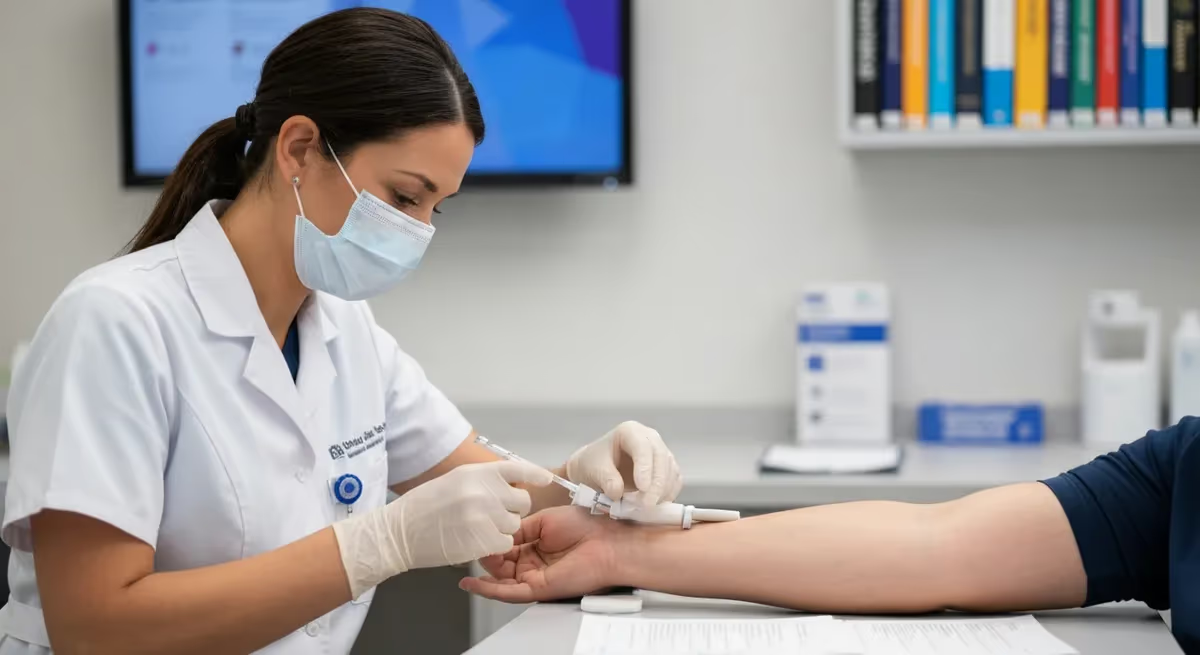
Phlebotomy certification requirements include a high school diploma or GED, completion of an accredited training program, and passing a national exam. A key component is documented clinical experience, which often requires performing a minimum of 30 successful venipunctures and 10 skin punctures to be eligible for certification.
Advanced nursing candidates can reinforce their specialty knowledge and critical reasoning with our ASCP phlebotomy exam 2026, aligned to national certification standards.
Advanced nursing candidates can reinforce their specialty knowledge and critical reasoning with our CPT phlebotomy technician exam 2026, aligned to national certification standards.
Phlebotomy Certification Requirements by State
Understanding the phlebotomy certification requirements by state is the first critical step in your career journey. The regulatory landscape for phlebotomists in the United States is not uniform; requirements are determined at the state level, not federally. While most states do not mandate certification for employment, a select few have established specific legal standards for licensure or certification that all technicians must meet to practice.
Below is a comprehensive breakdown of the states that have official mandates versus those that do not. Even if your state does not legally require certification, virtually all healthcare employers will require it for hiring, making it an essential career credential nationwide.
States with Mandatory Phlebotomy Certification/Licensure
As of 2026, four states have specific phlebotomy certification requirements or licensure laws that you must follow to work as a phlebotomy technician:
- California
- Louisiana
- Nevada
- Washington
States Without Mandatory Phlebotomy Certification/Licensure
The other 46 states and the District of Columbia do not currently have state-level laws mandating certification. However, employer standards in these states almost always require national certification to ensure competency and patient safety.
| Alabama | Alaska | Arizona | Arkansas |
| Colorado | Connecticut | Delaware | District of Columbia |
| Florida | Georgia | Hawaii | Idaho |
| Illinois | Indiana | Iowa | Kansas |
| Kentucky | Maine | Maryland | Massachusetts |
| Michigan | Minnesota | Mississippi | Missouri |
| Montana | Nebraska | New Hampshire | New Jersey |
| New Mexico | New York | North Carolina | North Dakota |
| Ohio | Oklahoma | Oregon | Pennsylvania |
| Rhode Island | South Carolina | South Dakota | Tennessee |
| Texas | Utah | Vermont | Virginia |
| West Virginia | Wisconsin | Wyoming |
In states without legal mandates, employers establish their own hiring standards, which serve as de facto phlebotomy certification requirements. To be a competitive job applicant, you must obtain certification from a recognized national agency. Passing your exam is the best way to prove you have the necessary skills. Prepare yourself by taking our free phlebotomy practice tests to build your knowledge and confidence.
New Jersey residents applying for state and local government jobs can prepare with our free new jersey civil service — covering verbal ability, numerical ability, and civil service knowledge.
Texas licensed professionals also prepare with our real estate exam practice test 2026 to reinforce state licensing procedures and regulatory compliance.
- ✓Confirm your exam appointment and location
- ✓Bring required identification documents
- ✓Arrive 30 minutes early to check in
- ✓Read each question carefully before answering
- ✓Flag difficult questions and return to them later
- ✓Manage your time — don't spend too long on one question
- ✓Review flagged questions before submitting
Phlebotomy Training Programs and Costs
What types of phlebotomy training programs are available?: Programs vary in length and depth. Common options include Certificate or Diploma programs (4-12 months), which focus specifically on phlebotomy skills, and Associate's Degree programs (2 years), which provide a broader healthcare education alongside phlebotomy.
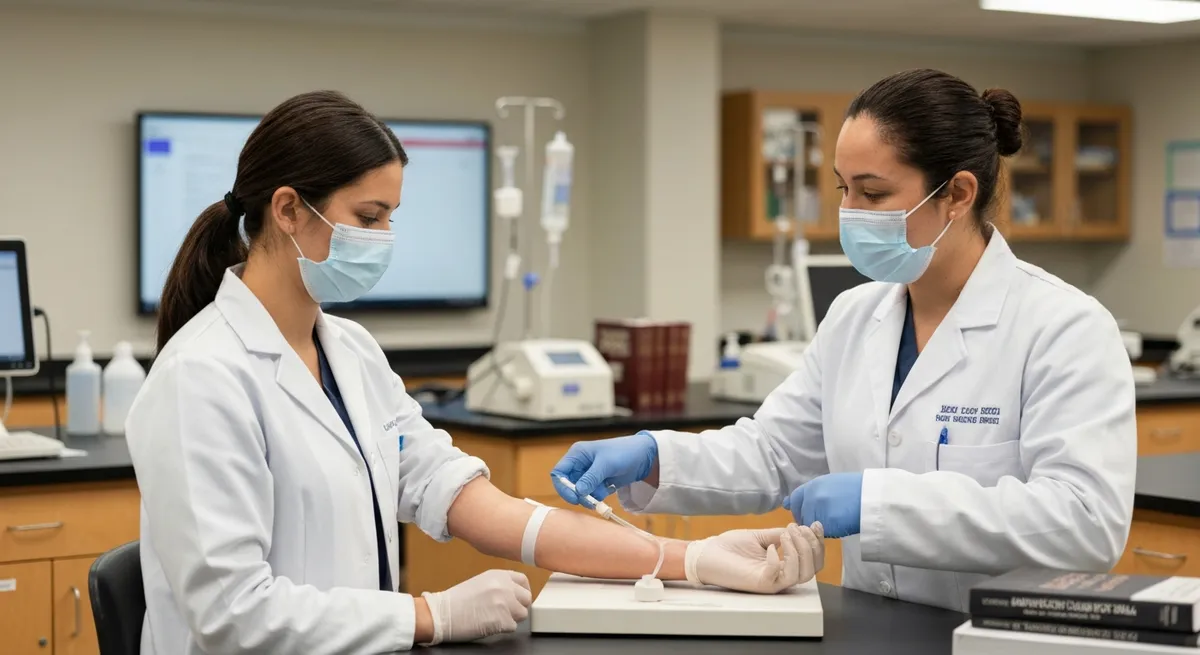
What is the difference between didactic and clinical training?: Didactic training is the classroom-based portion, covering anatomy, physiology, safety protocols, and collection procedures. Clinical training, or an externship, is the required hands-on practice in a real healthcare setting where students perform venipunctures under supervision to meet practical phlebotomy certification requirements.
Are online-only phlebotomy training programs valid?: No, 100% online programs are not recognized for certification. While hybrid programs with online didactic coursework exist, all legitimate programs require in-person, supervised clinical practice to develop the necessary hands-on skills for safe and effective blood collection.
Phlebotomy Career and Salary Guide
Medical Assistant (MA)
Perform administrative and clinical tasks in outpatient settings. Phlebotomy is a core skill, making this a natural career progression.
Medical Laboratory Technician (MLT)
Work in a lab setting, performing tests on blood and other specimens. This role builds directly on the sample collection skills of a phlebotomist.
Licensed Practical Nurse (LPN/LVN)
Provide basic nursing care under the supervision of RNs and doctors. This path involves more direct patient care and expanded clinical duties.
Registered Nurse (RN)
A significant career step involving an associate's or bachelor's degree, leading to comprehensive patient care, administration of medication, and treatment planning.
Clinical Laboratory Scientist (CLS)
An advanced laboratory role requiring a bachelor's degree. CLSs perform complex analyses, ensure quality control, and often supervise MLTs.
Phlebotomy Certification Pros and Cons
- +Certified certification is recognized across employers as evidence of verified competency, often required for specific roles
- +Certification provides a structured framework for professional knowledge that benefits daily work, not just the credential itself
- +Many certified professionals report salary increases of 10–20% compared to non-certified peers in the same role
- +Certification maintenance requirements create ongoing professional development that keeps knowledge current
- +The certification credential differentiates candidates in competitive hiring processes and promotion decisions
- −Certified certification fees can be substantial — exam costs, study materials, and renewal fees add up over a career
- −Certification requirements change over time; candidates who delay testing may face updated content requirements
- −Not all employers or markets equally value or require certification — the salary return varies significantly by geography and industry
- −Exam preparation requires significant time investment alongside existing work and personal responsibilities
- −Certification does not guarantee competency in practice — it validates knowledge at a point in time, not ongoing performance
CERTIFIED PHLEBOTOMY TECHNICIAN EXAM Questions and Answers

About the Author

Medical Laboratory Scientist & Clinical Certification Expert
Johns Hopkins UniversityDr. Sandra Kim holds a PhD in Clinical Laboratory Science from Johns Hopkins University and is certified as a Medical Technologist (MT) and Medical Laboratory Scientist (MLS) through ASCP. With 16 years of clinical laboratory experience spanning hematology, microbiology, and molecular diagnostics, she prepares candidates for ASCP board exams, MLT, MLS, and specialist certification tests.