
CDL Types: Classes, Endorsements, & Restrictions Complete Guide 2026 October
🟢 CDL types explained: Class A, B, C, six federal endorsements (H, N, P, S, T, X), restriction codes, age limits, and how to upgrade from B to A.

A Commercial Driver's License (CDL) is not a single credential — it is a tiered licensing system created by the Federal Motor Carrier Safety Administration (FMCSA) to match the driver to the vehicle. The class of CDL you hold dictates what you can drive, while endorsements unlock specialised cargo and passenger groups, and restrictions trim back what your license is allowed to do. Get the combination right and you open up a serious career; get it wrong and you may find yourself sidelined at a DOT inspection.
Understanding the differences between Class A, Class B, and Class C is the foundation. Layered on top are the six federal endorsements (H, N, P, S, T, X) and a long list of restriction codes that can creep onto your license if you skip a particular test, drive an automatic, or fail to certify your air-brake skills. This guide walks through every layer of the system so you know exactly which credential you need before you walk into the testing station.
Whether you are an 18-year-old eyeing an intrastate hauling job, a 21-year-old planning to run interstate freight, or a school-bus aspirant adding both passenger and school-bus endorsements, the rules below shape your route. Read carefully — small distinctions (like 26,001 lbs versus 26,000 lbs, or "tow" versus "haul") have outsized consequences on the road.
One detail worth flagging up front: every CDL applicant since February 2022 must complete federally approved Entry-Level Driver Training (ELDT) before testing, and every state issues its own physical license on top of the federal framework. So even though the classes, endorsements, and restriction codes you read about here are nationwide, the order of operations — written tests, ELDT, skills test, medical card — varies slightly state by state. Use this guide as the federal blueprint, then cross-check with your state DMV for local quirks.
CDL System at a Glance
The Three CDL Classes Explained
FMCSA defines CDL classes by Gross Vehicle Weight Rating (GVWR), Gross Combination Weight Rating (GCWR), and what the truck is carrying. The thresholds matter — a single pound over 26,000 lbs flips you from a non-CDL pickup into Class B territory.
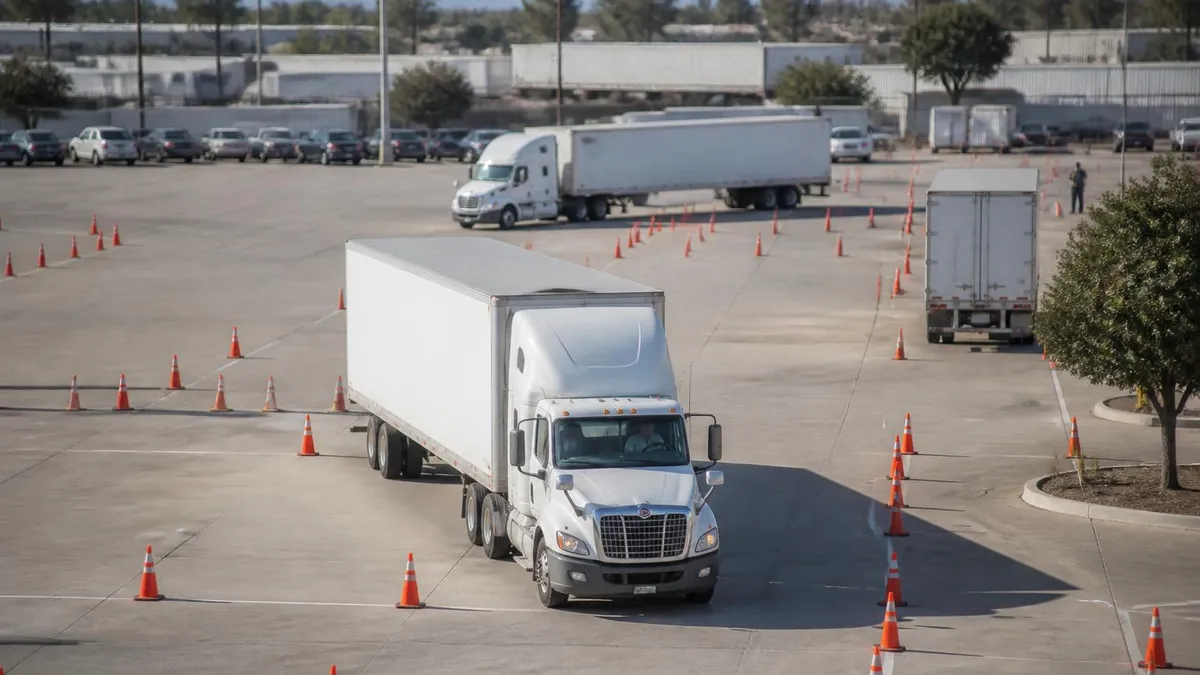
Class A is the broadest credential. It allows you to operate any combination vehicle with a GCWR of 26,001 lbs or more, provided the trailer being towed weighs over 10,000 lbs. Tractor-trailers, tankers in combination, livestock haulers, and flatbeds all fall under Class A. With the right endorsements, a Class A driver can also operate vehicles covered by Class B and Class C.
Class B covers single vehicles with a GVWR of 26,001 lbs or more — straight trucks, dump trucks, large delivery rigs, city buses, and segmented buses. You can tow a trailer, but only if that trailer is under 10,001 lbs. Class B holders can also operate Class C vehicles with the appropriate endorsement.
Class C is the narrowest CDL. It applies to vehicles that do not meet Class A or B thresholds but either carry 16 or more passengers (including the driver) or transport hazardous materials in placardable quantities. Think small shuttle buses, certain limousines, and HazMat vans.
GVWR (Gross Vehicle Weight Rating) is the maximum loaded weight of a single vehicle. GCWR (Gross Combination Weight Rating) covers a truck plus trailer. A Class A CDL is required when GCWR exceeds 26,001 lbs and the towed unit alone is over 10,000 lbs. Miss either part of the test and you actually need a Class B — not Class A.
Class A: The Most Versatile CDL
Drivers chasing the highest pay almost always pursue a Class A. With it, you can run long-haul freight, double or triple trailers (with the T endorsement), tankers, and combinations exceeding 80,000 lbs gross. Most over-the-road carriers will not even consider drivers without Class A because their freight model depends on 53-foot trailers.
Training schools typically run Class A programmes for four to seven weeks. You will need to pass the General Knowledge, Air Brakes (if applicable), and Combination Vehicles written tests, along with a three-part skills exam: pre-trip inspection, basic vehicle control, and on-road driving.
Class B: Single Heavy Vehicles
Class B is the right path for box-truck drivers, garbage-truck operators, cement mixers, and city transit drivers. The credential is faster to earn than Class A, and many employers (utilities, municipalities, school districts) hire Class B holders directly.
A Class B holder cannot legally drive a tractor pulling a 53-foot trailer, even if individually licensed to do so. To do that, they must upgrade to Class A.
Class C: Hazmat and Small Passenger Vehicles
Class C is a frequently misunderstood category. Many states use "Class C" for a standard passenger-car license, but at the federal CDL level it specifically means a vehicle that does not meet A or B thresholds yet still requires CDL handling — either because of passenger count or hazardous cargo.
An easy way to remember the hierarchy: Class A is about combinations, Class B is about single heavy vehicles, and Class C is about cargo or passenger count requiring special handling on otherwise smaller equipment. Federal law lets a higher-class CDL drive lower-class vehicles, but it does not work in reverse. A Class A holder with the right endorsements can drive almost anything; a Class C holder cannot legally jump into a 53-foot tractor-trailer no matter how skilled they are.
CDL Classes Side by Side
GCWR of 26,001 lbs or more with a trailer over 10,000 lbs. Authorises tractor-trailers, doubles, triples, large tankers, and combination livestock or flatbed rigs. Highest pay potential, broadest privileges, and the foundation for all advanced hybrid credentials (Tanker, Doubles/Triples, HazMat combinations). Training typically four to seven weeks.
Single vehicle with a GVWR of 26,001 lbs or more. Covers straight trucks, dump trucks, cement mixers, garbage trucks, large delivery rigs, city buses, and segmented buses. Can tow trailers under 10,001 lbs. Faster to earn than Class A (two to three weeks of training), strong fit for municipal, utility, and local hauling work.
Vehicles that do not meet Class A or B thresholds but either carry 16+ passengers (including the driver) or transport hazardous materials in placardable quantities. Common examples: shuttle buses, HazMat vans, certain limousines, and small placardable propane delivery vehicles. Narrowest scope of the three CDL classes.
Class B with a P endorsement layered on top. Authorises operation of single-chassis buses designed for 16+ passengers — city transit buses, articulated transit buses, school activity buses, and motorcoaches. Adds a written passenger exam plus an on-board skills test in a representative bus.
The Six Federal Endorsements
Endorsements expand what a CDL holder can transport or carry. Each requires its own written knowledge test, and a few require skills tests, background checks, or medical paperwork. The six endorsements recognised across every state are H, N, P, S, T, and X.
H — Hazardous Materials. Required when you haul materials in placardable amounts. Beyond the knowledge test, applicants must clear a Transportation Security Administration (TSA) background check — fingerprints, photo, biographical screening. Plan for four to six weeks of processing.
N — Tank Vehicle. Needed for any vehicle hauling liquid or gas in a permanently mounted tank (over 119 gallons individually, 1,000 gallons aggregate). The N endorsement focuses heavily on surge dynamics and liquid load shifting.
P — Passenger. Mandatory for any commercial vehicle designed to transport 16 or more passengers (including the driver). It involves both a written exam and a skills test in a representative passenger vehicle.
S — School Bus. Required in addition to the P endorsement for anyone driving a school bus that carries pupils between home and school. Most states layer on a federal criminal history check and a state-specific behind-the-wheel certification.
T — Doubles/Triples. Authorises operation of vehicles pulling two or three trailers. Written test only at the federal level, though many carriers require additional in-yard training.
X — Combination of Hazardous Materials and Tank Vehicle. Issued when a driver completes both H and N requirements. Common for fuel-tanker drivers.
Endorsements do not expire on the same schedule as the underlying CDL. Most renew alongside the license at four to eight years depending on the state, but H specifically must be renewed every five years (or every four years in a handful of states) with a fresh TSA threat assessment. Plan for a 30-to-60-day TSA processing window when renewing H — letting it lapse means a temporary suspension of HazMat driving privileges until the new background check clears.
For a fuller set of questions on this topic, see our printable cdl practice test resource.
For a fuller set of questions on this topic, see our air brakes practice test resource.
Endorsement Deep Dive
Hazardous Materials. Required for placardable HazMat loads — explosives, flammables, gases, oxidisers, toxic substances, radioactive material, corrosives, and miscellaneous hazards under DOT class definitions. Process includes TSA background check (fingerprints, biographical screening, photo), one written knowledge test, and a TSA threat assessment fee on top of the state endorsement fee. Renewal every four to five years depending on the state; allow 30 to 60 days for the TSA re-screen to clear before your existing H expires.
CDL Restriction Codes: What Limits Your License
Restrictions are the opposite of endorsements — they shrink what you can legally drive. Most appear automatically based on the vehicle you tested in. If you took your skills test in a truck without air brakes, you will receive an L restriction. Pass your road test in an automatic, you earn an E. Restrictions cannot be removed in the field; they require a return trip to the testing station.
The ten most common restrictions you will encounter are:
L — No air-brake equipped CMV. Applied when the driver fails or does not take the air-brake knowledge test. Z — No full air brakes. Driver tested on hydraulic-over-air or air-over-hydraulic instead of full air. E — No manual transmission. Driver tested in an automatic. O — No tractor-trailer with a fifth-wheel coupling (combination vehicle restriction). Driver tested with pintle or non-fifth-wheel hitch.
M — Class A passenger limited to Class B or C buses only. N — Class A or B passenger limited to Class C buses only. V — Medical variance documented in the driver's record. K — Intrastate only. Driver under 21 or with a medical waiver limited to operations inside one state. X — No cargo in CMV tank vehicle. Driver passed the N test on an empty tank. P — No passengers in a CMV bus other than fleet/maintenance personnel.
An E restriction (automatic only) can disqualify you from manual-shift fleets that pay 10-15% more. An L restriction shuts you out of nearly every Class A job. If you can take the road test in a manual, air-brake-equipped truck — do it. Otherwise plan to come back and re-test once you have practice hours.
Hybrid Classifications: Mixing Class and Endorsement
The CDL system gets interesting when classes and endorsements combine. A Class B Passenger driver, for example, is licensed to operate a single-chassis bus carrying 16+ passengers — common for city transit and motorcoach operators. A Class A Tanker driver runs liquid loads in combination, while a Class B Tanker hauls smaller fuel trucks or municipal water tankers.
Other typical hybrids include Class A Doubles/Triples (linehaul freight), Class B School Bus + Passenger (district school buses), and Class C HazMat (small placardable HazMat vans). Each hybrid stacks the underlying class restrictions with the endorsement-specific tests. You cannot, for example, hold a Class A Tanker without first passing the General Knowledge, Combination Vehicles, Air Brakes, and Tanker knowledge tests.
Some carriers actively recruit hybrid-credentialed drivers because flexibility translates into dispatch options. A Class A driver with H, N, T, and X can move between freight, fuel, double pulls, and chemical tanker work — and that scarcity drives pay premiums of 10-20% versus a basic Class A holder.
Choosing the Right CDL Combination
- ✓Confirm the GVWR or GCWR of the vehicles you intend to drive — this dictates Class A vs B vs C
- ✓Determine whether you will tow trailers heavier than 10,000 lbs, which forces a Class A credential
- ✓Decide if you will haul placardable HazMat — that adds the H endorsement and a TSA background check
- ✓Decide if you will carry 16 or more passengers (including the driver) — that adds the P endorsement
- ✓If you will pull multiple trailers, plan to add the T (Doubles/Triples) endorsement
- ✓Considering school bus work? Add the S endorsement on top of P, plus state-specific certifications
- ✓Hauling tank vehicles or fuel? Add the N or, combined with H, the X endorsement
- ✓Train and skills-test in a manual transmission, air-brake equipped truck to avoid E and L restrictions
- ✓Verify that your DOT medical card is current and filed with the state licensing agency before testing
- ✓Confirm your age — interstate freight requires 21+ unless you qualify for the FMCSA SDAP apprenticeship
- ✓Verify your CDL training provider is on the federal Training Provider Registry (TPR) for ELDT credit
- ✓Decide on the highest realistic class you need now to avoid an expensive upgrade in 12 months

Age Restrictions: 18 vs 21
FMCSA rules tie CDL eligibility to age and the geography of your driving. Intrastate operation (driving entirely within one state) is open to 18-year-olds with a CDL. Interstate operation — crossing any state line, hauling federally regulated freight, or carrying HazMat — requires drivers to be 21 or older.
The federal Safe Driver Apprenticeship Pilot (SDAP) Program, launched as part of the 2021 Infrastructure Investment and Jobs Act, allows specific 18-to-20-year-olds to operate interstate after completing 400 hours of probationary driving with mentor oversight. Carriers must register with FMCSA and meet strict safety thresholds. As of 2026, fewer than 50 carriers participate, so the practical interstate age remains 21.
Practically, if you are 18 and want to drive long haul, you have two paths: take an intrastate job until you turn 21, or apply to an SDAP-participating carrier. HazMat endorsements (H, X) are also age-gated by some states — most refuse to issue H to drivers under 21 because of the interstate component.
Upgrading from Class B to Class A
If you started with Class B and want to step up, the upgrade is straightforward but not automatic. You will need to pass the Combination Vehicles written test (already on the menu for Class A applicants) and take a new skills test in a Class A vehicle — pre-trip, basic control, and road driving. Most upgrade programmes run two to three weeks at a local training school.
If you already hold a passenger endorsement, you do not lose it when you upgrade. The class changes, the endorsements stay attached to your record. The same applies to N and H — endorsements travel with you up and down the class ladder.
Class A vs Class B: Which Should You Pursue?
- +Class A unlocks the highest-paying long-haul and over-the-road freight jobs in North America
- +Class A automatically includes Class B and Class C operating privileges with the right endorsements
- +Tanker, Doubles/Triples, and HazMat hybrid credentials stack cleanly on top of a Class A foundation
- +More job openings nationally — roughly 80% of CDL postings require Class A
- +Stronger upward mobility into specialty hauling like flatbed, oversize loads, and heavy haul
- −Class A training takes four to seven weeks versus two to three weeks for Class B
- −Class B local routes generally mean home every night, while Class A over-the-road work often does not
- −Class A road test is significantly tougher because it includes combination skills and trailer coupling
- −Class B tuition is roughly half the cost of Class A programmes at most accredited driving schools
- −Class A medical certification standards are stricter for sleep apnea and blood-pressure thresholds
When to Add Each Endorsement
Timing matters. Adding an endorsement before you have the underlying job lined up means paying for tests you may not use. But waiting too long can cost you a contract. The rough rule: add knowledge-only endorsements (T, N) when you sign with a carrier that needs them; add background-checked endorsements (H, S) at least 60 days before the start date to allow TSA and state agencies to process.
Passenger (P) is the exception — most school districts and transit agencies will pay for the endorsement during onboarding, including the skills test rental. Confirm with the employer first to avoid duplicating costs. Likewise, fuel-tanker carriers regularly reimburse the cost of the H and N tests once you complete a 90-day probationary period, so do not be shy about asking during your interview.
If you are between jobs and weighing endorsements as a personal investment, lean toward T. The doubles/triples knowledge test is roughly $25 in most states, requires no skills component, and signals to carriers that you are serious about flexible dispatch work. Passenger and school-bus endorsements are best handled with employer support because the skills tests require renting a representative vehicle from a third-party school — out of pocket, that can run several hundred dollars.
Final Word on CDL Tiers
Pick the highest class you realistically need, plan the endorsements that match your target job, and avoid restrictions wherever possible by testing on the right equipment. The CDL system rewards flexibility — drivers who hold Class A with multiple endorsements consistently earn more, get first pick of routes, and weather industry downturns better than narrowly credentialed peers.
Spend the extra week training on a manual transmission. Pay the extra fee for the H endorsement if you have any inclination toward fuel or chemical hauls. Knock out the T endorsement while you are already at the testing station — the marginal cost is low, but the door it opens to doubles/triples work pays for itself in your first paycheck. Above all, treat the CDL not as a single license but as a stack of credentials you build over a career.
One more piece of practical advice: keep digital copies of every test result, medical card, and training certificate. When you switch carriers, the new employer needs to verify endorsements and DOT medical status before scheduling your first run. Drivers who keep a tidy paperwork folder spend days, not weeks, between jobs. The CDL itself is just a card; the real credential is the documented history behind it.
Finally, do not underestimate the value of an Entry-Level Driver Training (ELDT) certificate. Since February 2022, FMCSA requires ELDT for anyone obtaining a Class A or B CDL for the first time, upgrading from B to A, or adding an H, P, or S endorsement. Make sure your training provider is on the Training Provider Registry (TPR) before you pay tuition — a non-TPR school cannot certify ELDT completion, and without it the state will refuse to schedule your skills test no matter how much money you spent on training.
CDL Questions and Answers
About the Author

Licensed Driving Instructor & DMV Test Specialist
Penn State UniversityRobert J. Williams graduated from Penn State University with a degree in Transportation Management and has spent 20 years as a certified driving instructor and DMV examiner consultant. He has personally coached thousands of applicants through written knowledge tests, skills assessments, and commercial driver licensing programs across more than 30 states.
Join the Discussion
Connect with other students preparing for this exam. Share tips, ask questions, and get advice from people who have been there.
View discussion (7 replies)