
CDL Illinois: Complete Requirements and Licensing Guide 2026 September
Get your CDL Illinois fast. Classes A/B/C, age rules, CLP, ELDT, fees ($60 CLP/$50 CDL), endorsements, road test scheduling and more. ❓
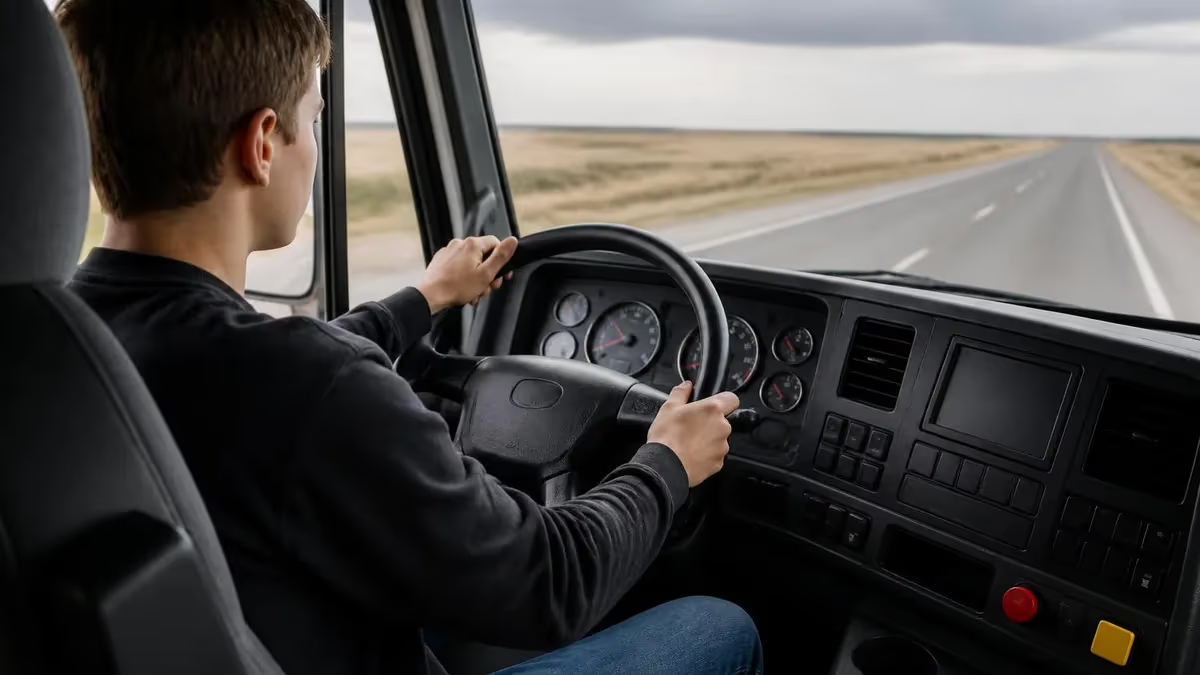
Earning a CDL Illinois drivers a real career — and it doesn't have to be confusing. The Illinois Secretary of State (SOS) administers commercial driver licensing across the state, and you'll deal with SOS facilities for every step: paperwork, the knowledge tests, the skills test, and the actual license card. That's different from many states where the DMV handles things. Here, the SOS is the boss. You can be 18 to drive intrastate (only inside Illinois) or 21 for interstate hauls and hazmat.
Either way, you'll need a valid Illinois driver's license, proof of residency, cdl m to read road signs and talk to officers, and a current DOT medical card. Some folks already have most of that. Others need a few weeks to gather documents. Either way — it's doable. The trucking industry needs you. Carrier recruiters at companies like Schneider, Werner, JB Hunt, and Roehl actively chase Illinois graduates, and starting pay for new CDL Class A drivers has climbed past $60,000 a year in most freight lanes. Specialty operators — tanker, flatbed, hazmat — pay considerably more.
The process moves in clear stages. First, study the Illinois CDL Manual (it's free online from the SOS). Then pass the general knowledge test and any endorsement tests you need, which makes you eligible for a Commercial Learner's Permit (CLP). Hold the CLP for at least 14 days. Complete federally required Entry-Level Driver Training (ELDT) through a registered provider. Schedule and pass the three-part skills test.
Pay your fees. Walk out with a CDL. We'll cover each step in detail below, including endorsements (H, P, S, T, N, X), Chicago-area third-party testers, Illinois-specific hours-of-service quirks, and how REAL ID changes the documents you bring to the counter. By the end of this guide you'll know exactly what to bring, what to study, what each test looks like, and roughly what it'll cost — no surprises at the SOS window.
CDL Illinois Key Numbers
Key Facts at a Glance
| Item | Value | Details |
|---|---|---|
| CLP Application Fee | $60 | |
| CDL License Fee | $50 | |
| Minimum CLP Hold Period | 14 Days | |
| Skills Test Sections | 3 Parts |
Illinois recognizes three CDL classes, and choosing the right one matters because the wrong class blocks the truck or bus you want to drive. Class A covers any combination of vehicles with a gross combination weight rating (GCWR) of 26,001 pounds or more, provided the towed vehicle weighs over 10,000 pounds. Think semi-tractor with a loaded trailer. Class B is for a single vehicle of 26,001 pounds or more, or any such vehicle towing a trailer under 10,000 pounds — straight trucks, dump trucks, large buses.
Class C is for vehicles under 26,001 pounds that either carry 16 or more passengers (including the driver) or transport hazardous materials requiring placards. Most rookie drivers go straight to Class A because it opens every door. Class B is fine if you're locked into local work like waste collection or city buses. Class C is narrower — usually shuttle drivers and small hazmat operators. Don't pick based on what your buddy has. Pick based on the actual job you want.
Your class choice also affects which knowledge tests you sit. A Class A applicant takes the general knowledge test plus combination vehicles and air brakes. Class B candidates skip combination but still need air brakes for most rigs. Class C applicants take general knowledge plus whichever endorsement matches their work. Get it wrong and you'll pay testing fees again. Read the manual carefully before you commit.
One more wrinkle — Illinois issues restrictions on CDLs based on what vehicle you tested in. Test in a truck with an automatic transmission? You get the 'E' restriction (no manual transmission allowed). Test in a tractor without air brakes? You get the 'L' restriction. These restrictions stick with you until you re-test in the proper equipment. Schools that train exclusively on automatics save tuition costs but lock graduates out of older manual-transmission fleets.
Intrastate vs Interstate Age Rule
At 18, you can get an Illinois CDL but only for intrastate driving — meaning all your routes start and end inside Illinois. You can't cross into Indiana, Wisconsin, or Missouri with cargo. At 21, you unlock interstate driving, hazmat endorsements, and passenger-for-hire across state lines. If you're 18–20, plan accordingly. Many fleets won't hire intrastate-only drivers because most loads cross state lines.
Eligibility is where most applications stumble. You need to be an Illinois resident with proof — a utility bill, lease, mortgage statement, or official mail dated within 90 days. You need a valid Illinois driver's license that's not suspended, revoked, or expired. Out-of-state license? Transfer it first. You need to demonstrate English proficiency because federal rules require commercial drivers to read signs, read shipping papers, and speak with safety officials.
SOS examiners will assess this informally during your visit. And you need a Department of Transportation (DOT) medical certificate, often called a med card, signed by a certified medical examiner from the FMCSA National Registry. Find one near you on the FMCSA website. The exam costs $80–$150 in most Illinois cities, takes about an hour, and remains valid for up to two years — sometimes less if the examiner flags conditions like uncontrolled blood pressure, sleep apnea, or insulin-treated diabetes.
Self-certification trips people up. When you apply, you'll tell SOS which category of driving you do: non-excepted interstate, excepted interstate, non-excepted intrastate, or excepted intrastate. Pick correctly — it determines whether SOS keeps your med card on file. Wrong category? Your CDL can go into 'not certified' status and get downgraded. That's a nightmare to fix. If you're unsure, ask the SOS clerk or your trucking school instructor.
Disqualifying issues are worth knowing in advance. A DUI conviction in the past three years, a felony involving a commercial vehicle, suspended driving privileges, or major moving violations within the past two years can either block your CDL outright or stretch the process by months while you appeal. Pull your driving record from SOS before applying. Surprises kill timelines.
CDL Classes in Illinois
Tractor-trailers and heavy combinations over 26,001 lbs GCWR with trailers exceeding 10,000 lbs. Best for long-haul freight, owner-operators, and most national carrier jobs.
Single heavy vehicles over 26,001 lbs — dump trucks, straight box trucks, large transit buses, garbage trucks. Common for local delivery, municipal, and construction roles.
Lighter vehicles under 26,001 lbs but carrying 16+ passengers or placarded hazmat. Used by shuttle drivers, small bus operators, and certain delivery niches.
Commercial Learner's Permit — your training license. Required for at least 14 days before the skills test. Lets you drive a commercial vehicle on public roads with a CDL holder seated beside you.
The Commercial Learner's Permit is your first real milestone. To get one, gather your documents, head to a CDL-issuing SOS facility (not every location handles CDLs — check the SOS website list), and bring identity proofs, residency proofs, Social Security verification, your current Illinois driver's license, and your med card. With REAL ID now standard, Illinois may ask for slightly different documents than five years ago.
Two proofs of residency, one proof of SSN, one proof of written signature, and one document showing full legal name. If your name doesn't match across documents — a married name, a hyphen, a Jr./Sr. — bring marriage certificates or court orders. Sort this out before you arrive. Lines at busy Chicago-area facilities (Chicago West, Joliet, Aurora) can swallow your morning.
You'll pay the $60 CLP application fee and sit for knowledge testing. The general knowledge test runs 50 questions. Combination vehicles is 20 questions. Air brakes is 25 questions. Each endorsement you want adds another exam. You need 80% to pass. The questions are pulled directly from the Illinois CDL Manual, and the manual is shockingly comprehensive — if you actually read it, you'll pass.
Inside the Illinois CDL Skills Test
Multiple-choice exams covering general knowledge (50 questions), combination vehicles (20 questions for Class A), and air brakes (25 questions). Each endorsement adds another test. Pass mark is 80%. Tests are computer-based at SOS facilities. You can retake — but each attempt costs a fee, and excessive failures within a short window can require mandatory waiting periods before re-testing. Study materials are all in the free Illinois CDL Manual.
Once your CLP is in hand, the 14-day clock starts. Federal rule, not Illinois choice — you cannot take the skills test before day 15. Use the time wisely. The CLP also has restrictions worth knowing: no passengers in the cab except your CDL-holder trainer, no hazardous loads even if you have the H endorsement on your permit, and the CDL holder must be physically beside you (not in the sleeper) whenever the truck moves on a public road. Most candidates enroll in a registered ELDT (Entry-Level Driver Training) program.
Since February 2022, ELDT is federally required for first-time Class A or Class B applicants, anyone upgrading from Class B to Class A, and anyone getting Passenger (P), School Bus (S), or Hazmat (H) endorsements for the first time. The training has two parts: theory (classroom) and behind-the-wheel. There's no minimum hour count for theory or BTW — instead, providers must teach the full curriculum and certify proficiency. Your provider must be listed on the FMCSA Training Provider Registry. Without that listing, your training doesn't count and SOS won't let you take the skills test.
Pick your school carefully. Costs in Illinois range from about $3,500 at community-college programs to $7,500+ at private truck driving schools. Many large carriers — Schneider, Werner, CRST, USA Truck — offer paid training that bonds you to drive for them for a year or two. The deal works for plenty of new drivers. Just read the contract before you sign.
If you started the CDL process before February 7, 2022, you may be grandfathered. Everyone else must complete ELDT through an FMCSA-registered Training Provider before the SOS will schedule your skills test. No exceptions, no workarounds. Confirm your school appears on the FMCSA Training Provider Registry at tpr.fmcsa.dot.gov before paying tuition. Schools that aren't registered cannot transmit your training certificate, and SOS will turn you away.
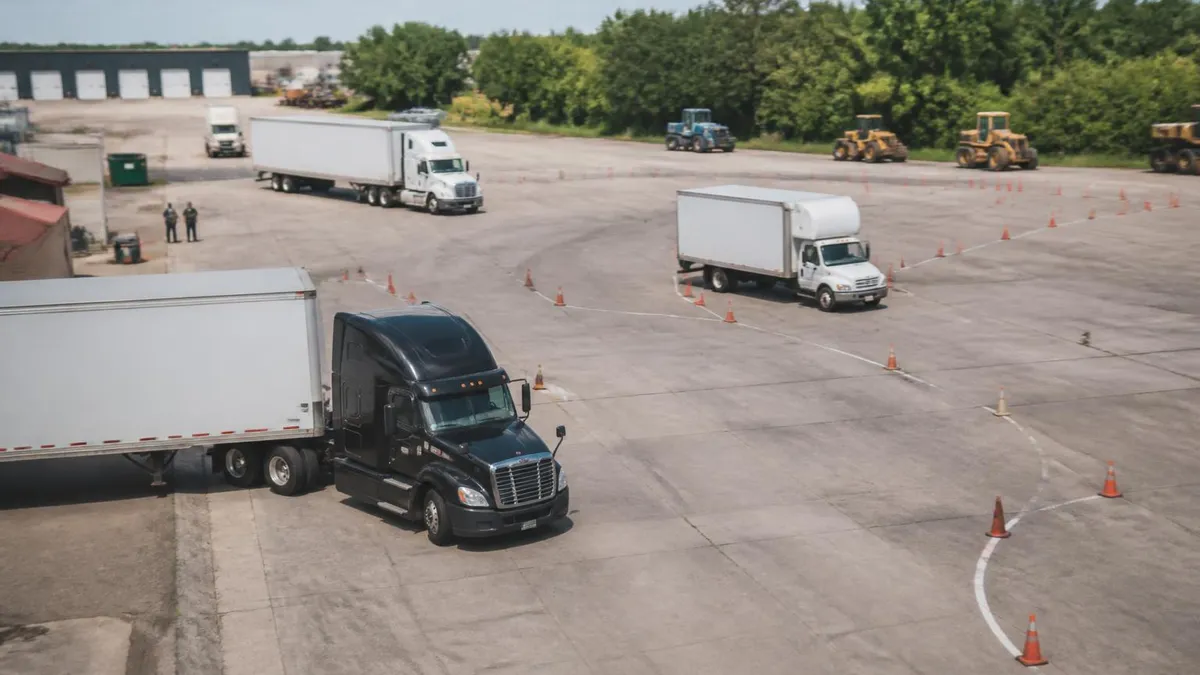
Scheduling the road test is where Illinois shows its quirks. SOS facilities offer the skills test but slots fill up fast — particularly at Chicago-area locations like Plaza Verde, Bridgeview, and Naperville. You might wait three or four weeks for an SOS appointment. The workaround? Third-party testers. Illinois licenses private companies to administer the full CDL skills test.
They cost more — typically $150–$300 — but you can often book within a week. Popular third-party testers serve Cook, DuPage, Will, Lake, and Kane counties. Your CDL school may have its own third-party examiner on staff, which removes another logistics headache. The pass/fail standard is identical to SOS. Same scoring sheet, same maneuvers, same federal rules.
You'll bring your own truck — or the school's truck — to the skills test. The vehicle must match the class of CDL you're seeking. Show up in a Class B straight truck and you cannot earn a Class A. Show up without air brakes and you'll be restricted from any truck with air brakes for life until you re-test. The examiner will check the truck's registration, insurance, and DOT inspection sticker before you start. A truck that fails the pre-test vehicle check is an automatic disqualification — you'll forfeit your appointment fee and re-book.
Illinois CDL Application Checklist
- ✓Valid Illinois driver's license (regular Class D), not suspended or revoked
- ✓Current DOT medical certificate from FMCSA-certified examiner
- ✓Proof of identity, Social Security number, written signature, and legal name
- ✓Two documents proving Illinois residency dated within 90 days
- ✓ELDT completion certificate from FMCSA-registered Training Provider
- ✓Passing scores on general knowledge, combination, and air brakes tests
- ✓CLP held for at least 14 days before skills test attempt
Endorsements expand what you can legally haul or whom you can carry. Each requires a separate knowledge test, and some require additional skills testing. The big six: H (Hazardous Materials) requires the hazmat knowledge test plus a TSA Threat Assessment background check — fingerprints, $86.50 fee, four to six weeks of processing. Plan ahead. P (Passenger) lets you carry more than 15 people for hire; you'll add the passenger knowledge test and a passenger skills test in an appropriately sized bus.
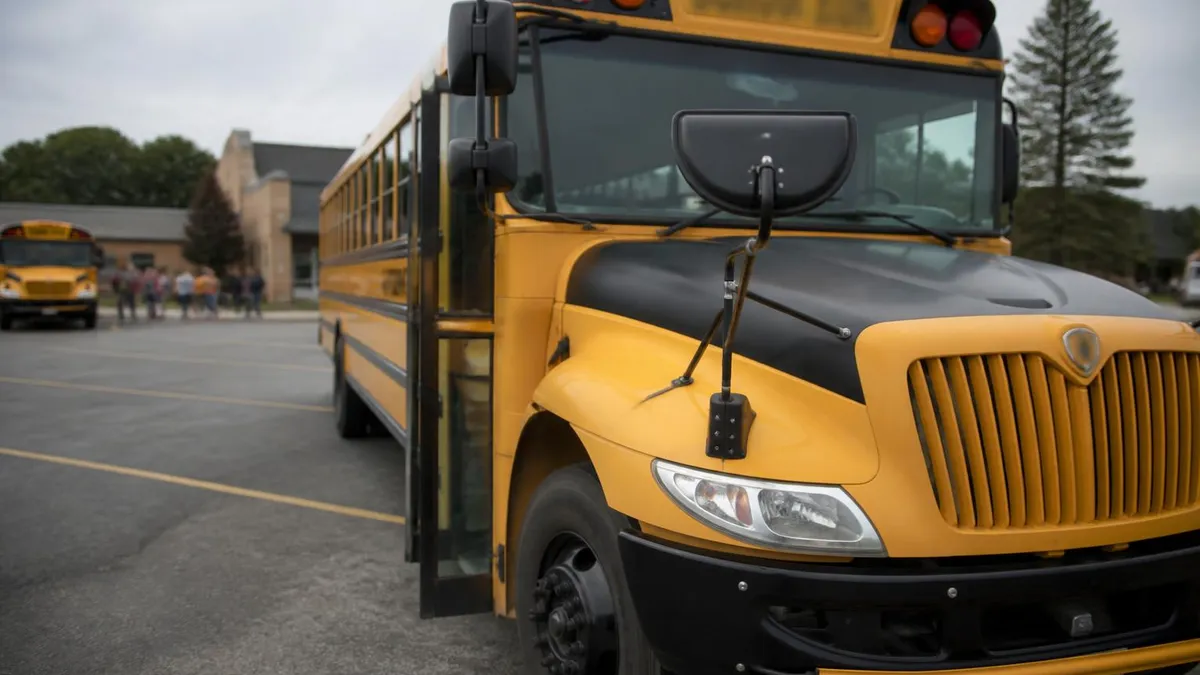
S (School Bus) layers on top of P with a school bus knowledge test and skills test in a school bus, plus you'll undergo Illinois background and physical checks beyond the federal med card. T (Doubles/Triples) lets you pull multiple trailers — knowledge test only, no extra skills test. N (Tank Vehicle) qualifies you for tankers carrying liquid or gaseous loads over 1,000 gallons — knowledge test only. X is the combined Tank + Hazmat endorsement, which most flatbed and fuel haulers eventually pursue together.
You can add endorsements when you apply or after you hold your CDL. Adding later means a return trip to SOS, a fee, and the test. Most drivers add H, T, and N together if they plan a freight career. School bus drivers get P plus S in a single coordinated visit. Each endorsement costs an additional fee — typically $5 per endorsement for the testing layer plus the broader license fee adjustment.
Illinois CDL Pros and Cons
- +Illinois CDL is recognized in all 50 states and Canadian provinces
- +SOS offers more testing locations than most neighboring states
- +Third-party testers cut scheduling delays dramatically in Chicago metro
- +ELDT requirements are clear and uniformly enforced — no guesswork
- +Fees are reasonable ($60 CLP + $50 CDL is well below states like California or New York)
- −Chicago-area SOS facilities have long wait times for skills test appointments
- −Required documents have shifted with REAL ID rollout — verify list before visiting
- −Self-certification mistakes can downgrade your CDL months later
- −Winter testing weather can cause cancellations and rebooking delays
- −Hazmat endorsement adds 4-6 weeks for TSA background processing
Illinois follows federal Hours-of-Service (HOS) rules for interstate commercial drivers — 11-hour driving limit, 14-hour on-duty window, 10-hour off-duty reset, 30-minute break after 8 cumulative hours of driving, and a 60-hour/7-day or 70-hour/8-day cycle. Intrastate drivers in Illinois benefit from a slightly more flexible rule set: up to 12 hours of driving within a 16-hour on-duty window, and a 70-hour/7-day or 80-hour/8-day cycle. The catch?
Intrastate flexibility only applies while you're inside Illinois borders. The moment you cross into a neighboring state, federal HOS applies. Most drivers run ELDs (electronic logging devices) that automatically switch rule sets based on GPS, but you're still responsible for understanding both. ELD violations are a hot enforcement target — falsifying logs, sharing logins, or driving with a malfunctioning ELD will get you parked and cited at a roadside inspection.
One more Illinois wrinkle: weight enforcement is aggressive. Illinois State Police operate weigh stations on every major interstate and many state highways. Overweight fines start around $65 per 500 pounds over the limit and escalate fast — a single load 4,000 pounds over can cost more than $1,000 in fines plus a DOT violation that follows you for years. Get scaled before you leave the yard. Adjust axle weights with your fifth wheel and tandems.
It's not glamorous but it pays. Drug and alcohol testing matters too. Illinois CDL holders are subject to the FMCSA Drug & Alcohol Clearinghouse — a federal database that tracks every positive test, refusal, or violation. Carriers query the Clearinghouse before hiring and annually thereafter. One positive screen can shut you out of trucking for years until you complete return-to-duty steps. Stay clean. The career depends on it.
One detail that catches almost everyone — your CDL and REAL ID aren't the same document, but they interact. A CDL automatically meets REAL ID standards because the documentation Illinois requires for CDL issuance exceeds the federal REAL ID baseline.
So if you hold a current Illinois CDL, you can use it to board domestic flights and enter federal buildings without a separate REAL ID. Convenient. But if you let your CDL lapse and revert to a regular driver's license, you'll need to obtain REAL ID separately. Worth thinking about if you're considering letting your CDL expire after a career change.
Renewal cycles in Illinois are typically four years for CDL holders. You'll renew at any SOS facility, present an updated med card, and pay the renewal fee. If your med card lapses between renewals, your CDL drops to 'not certified' status and you cannot legally drive commercially until you update it. Set calendar reminders 60 days before your med card expires. Then 30 days. Then 14 days. The clerks will thank you.
That's the entire roadmap — eligibility, documents, CLP, ELDT, knowledge tests, skills test, endorsements, fees, HOS, and renewal. Tens of thousands of Illinoisans earn their CDL every year. You can too. Start with the Illinois CDL Manual, sketch a timeline, and pick a school. Six to eight weeks from your first study session, you can be hauling freight or driving a bus. Below, we've answered the questions that come up most often.
CDL Questions and Answers
About the Author

Licensed Driving Instructor & DMV Test Specialist
Penn State UniversityRobert J. Williams graduated from Penn State University with a degree in Transportation Management and has spent 20 years as a certified driving instructor and DMV examiner consultant. He has personally coached thousands of applicants through written knowledge tests, skills assessments, and commercial driver licensing programs across more than 30 states.
Join the Discussion
Connect with other students preparing for this exam. Share tips, ask questions, and get advice from people who have been there.
View discussion (7 replies)