
CCHT Certified: Complete Guide to Becoming a Certified Clinical Hemodialysis Technician in 2026
Become CCHT certified in 2026. Complete guide with practice tests, ✅ exam format, salary data, study schedule, and verification steps for new and
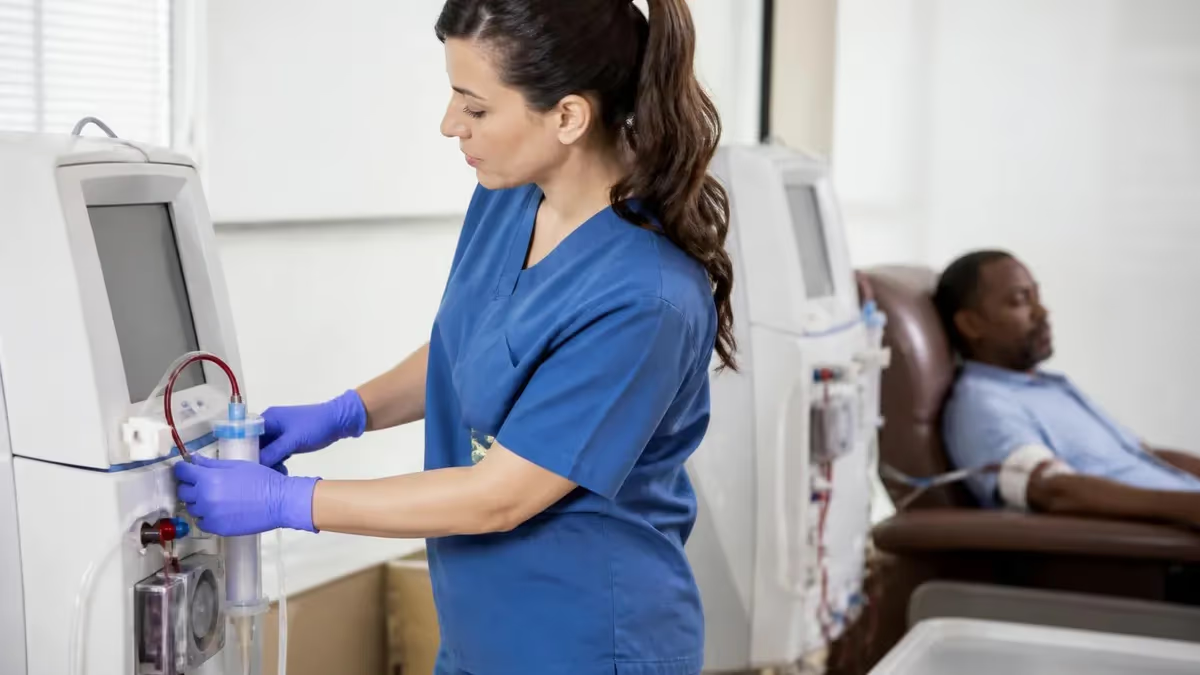
Becoming ccht certified is one of the smartest career moves a dialysis technician can make in 2026, opening doors to higher pay, travel assignments, and supervisory roles inside outpatient clinics and hospital renal units. The Certified Clinical Hemodialysis Technician credential, issued by the Nephrology Nursing Certification Commission (NNCC), validates that you can safely deliver hemodialysis treatments, troubleshoot equipment, and protect patients with end-stage renal disease from the most common complications encountered during a four-hour run. Practice with the free CCHT - Certified Clinical Hemodialysis Technician practice test on PracticeTestGeeks (11 questions with answer explanations).
The path to ccht certification is structured but demanding. Candidates must complete a state-approved training program, log at least 1,000 clinical hours within an 18-month window, and then pass a 150-question computer-based exam administered through Prometric testing centers nationwide. With a first-time pass rate hovering around 54 percent, preparation matters more than raw clinical experience, and most successful candidates spend 10 to 14 weeks reviewing equipment operation, water treatment, infection control, and patient assessment before sitting for the test.
The ccht meaning is simple at the surface but rich underneath: Certified Clinical Hemodialysis Technician means you are trusted to operate dialysis machines, monitor vital signs every 30 minutes, respond to alarms, and document treatment data accurately. That trust is earned through the exam, but it is maintained through 30 continuing education credits every three years and adherence to the NNCC code of conduct. Employers across DaVita, Fresenius, U.S. Renal Care, and hospital systems use the credential as a hiring gate.
Salaries reflect this professional weight. According to BLS data and the National Kidney Foundation 2025 workforce survey, ccht certified technicians earn an average of $48,200 per year, with experienced techs in California, New York, and Massachusetts pulling in $62,000 or more. Travel ccht jobs add another dimension entirely, paying $1,800 to $2,400 per week on 13-week contracts, plus stipends for housing and meals. These contract roles are competitive and almost always require valid certification plus two years of bedside experience.
This guide walks you through every milestone of the credentialing journey: eligibility paperwork, application timing, exam content distribution, recommended study resources, the ccht practice test routine that separates pass-first-time candidates from retakers, and the renewal mechanics that keep your credential active. We pull directly from the NNCC 2024 candidate handbook, real test-taker feedback from the past 12 months, and current Prometric reporting protocols so your prep aligns with what you will actually face on test day.
Whether you are a brand-new patient care technician finishing your initial training, a seasoned tech finally formalizing your skills, or a nurse exploring a lateral move into dialysis, this hub gives you the roadmap. We also cover ccht verification for employers, the difference between CCHT and CCHT-A (advanced), and how to handle a failed first attempt without losing your eligibility window. Read straight through, or jump using the table of contents to the section that solves your immediate problem.
Free CCHT - Certified Clinical Hemodialysis Technician Study Tools
Interactive CCHT - Certified Clinical Hemodialysis Technician resources on PracticeTestGeeks, free to start:
- Free CCHT Clinical Test 1 — 11 questions with instant scoring and answer explanations
- CCHT - Certified Clinical Hemodialysis Technician flashcards — review key terms and concepts card by card
- CCHT - Certified Clinical Hemodialysis Technician study guide — topic-by-topic overview of what the exam covers
- CCHT - Certified Clinical Hemodialysis Technician cheat sheet — one-page printable summary for last-minute review
- The CCHT exam contains 150 questions. (Nephrology Nursing Certification Commission)
- The CCHT exam must be completed in three hours. (Nephrology Nursing Certification Commission)
- The CCHT exam fee is $225 with standard processing (about 4 weeks), and it includes a $50 non-refundable application processing fee. (Nephrology Nursing Certification Commission)
- Optional Fast Track processing for the CCHT application costs an extra $75 and takes 1-3 business days. (Nephrology Nursing Certification Commission)
- CCHT recertification every three years requires 3,000 hours of work as a dialysis technician plus either 30 contact hours of continuing education (at least 10 in nephrology) or re-examination. (Nephrology Nursing Certification Commission)
- Once the CCHT application is cleared, candidates are registered with PSI, NNCC's computer-based testing partner, and schedule the exam through an emailed link. (Nephrology Nursing Certification Commission)
- CCHT applicants need at least a high school diploma or equivalent and must have completed a clinical hemodialysis technician training program. (Nephrology Nursing Certification Commission)
- CCHT computer-based exam scores are available immediately upon completion of the exam. (Nephrology Nursing Certification Commission)
Facts verified Oct 25, 2026 against Nephrology Nursing Certification Commission. Dates that have passed are removed automatically.
CCHT Exam at a Glance
| Item | Detail | Official source |
|---|---|---|
| Number of questions | 150 questions | Nephrology Nursing Certification Commission |
| Time limit | 3 hours | Nephrology Nursing Certification Commission |
| Exam fee | $225 standard processing | Nephrology Nursing Certification Commission |
| Exam fee (Fast Track) | $75 expedited processing | Nephrology Nursing Certification Commission |
| Renewal | 3-year cycle: 3,000 work hours + 30 CE hours (10 nephrology) | Nephrology Nursing Certification Commission |
| Delivery | Computer-based testing with PSI | Nephrology Nursing Certification Commission |
| Eligibility | HS diploma/GED + hemodialysis technician training program | Nephrology Nursing Certification Commission |
| Score release | Immediately on completion | Nephrology Nursing Certification Commission |
| Testing window | 90 days from permit issue | Nephrology Nursing Certification Commission |
Facts verified Oct 25, 2026 against Nephrology Nursing Certification Commission. Dates that have passed are removed automatically.
CCHT Certification by the Numbers

CCHT Exam Format & Content Breakdown
| Section | Questions | Time | Weight | Notes |
|---|---|---|---|---|
| Clinical | 51 | 60 min | 34% | Patient assessment, complications |
| Technical | 35 | 45 min | 23% | Machine operation, water treatment |
| Environment | 24 | 30 min | 16% | Infection control, safety |
| Role Responsibilities | 15 | 20 min | 10% | Ethics, professional conduct |
| Education/Development | 25 | 25 min | 17% | Patient teaching, growth |
| Total | 150 | 3 hours | 100% |
A structured study plan is the difference between sitting confidently in the Prometric chair and second-guessing every answer. Most ccht certified candidates who pass on the first attempt commit to 10 to 14 weeks of deliberate preparation, splitting their time between content review and timed ccht practice test sessions. The 50-50 split sounds simplistic, but it works because the CCHT exam rewards application of knowledge, not memorization of isolated facts, and only repeated testing reveals which scenarios still trip you up.
Start with the NNCC Detailed Content Outline, available as a free PDF on nncc-exam.org. This document lists every cognitive domain the exam measures and the approximate question weight for each. The technical operations section, for example, accounts for 23 percent of scored items and covers reverse osmosis water systems, dialysate proportioning, conductivity monitoring, and machine alarm response. Highlighting your weakest sub-domains here gives every study session a clear target instead of vague review.
Core textbooks remain the AMGEN Core Curriculum for the Dialysis Technician (sixth edition) and the Review of Hemodialysis for Nurses and Dialysis Personnel by Judith Z. Kallenbach. The AMGEN book is densely written but maps almost perfectly to NNCC content domains, while Kallenbach offers cleaner illustrations of vascular access pathology and dialyzer membrane chemistry. Read one chapter, then test yourself with 20 questions on that topic before moving forward. Skipping the test step is the most common preparation mistake.
Free online resources include the National Kidney Foundation's KDOQI guidelines, the CDC Dialysis Safety pages, and the AAMI water treatment standards summary. These primary sources will appear on the exam in disguised form. A question about chloramine breakthrough, for example, traces directly to AAMI ST/RD52, while a question about hepatitis B isolation comes from CDC infection control recommendations updated in 2023. Reading the originals once removes the mystery from any rephrased version on test day.
Many candidates underestimate the value of clinical immersion during the study period. Even if your 1,000 hours are complete, ask your unit manager to rotate you through reuse, water treatment monitoring, and orientation of new patients. Walking through a chloramine test or a bicarb concentrate change with your own hands cements knowledge that pure reading cannot. If you have not yet logged hours, document each shift with specific procedures performed, because some employers want this log during your application review.
Build in two full practice exams during the final three weeks: one diagnostic at the start, one rehearsal at the end. Use 180 minutes, no breaks, no phone, and grade only after completion. Aim for at least 75 percent on the rehearsal exam, because real CCHT scoring uses a scaled passing point near 70 percent of items answered correctly, and the cushion absorbs test-day anxiety. If your rehearsal score is below 70, postpone your exam date rather than gambling on a $225 retake fee.
Finally, do not neglect sleep, nutrition, and a test-site rehearsal. Drive to your Prometric location at least once before exam day to confirm parking, check-in procedures, and the surrounding food options. The exam is mentally exhausting and you will get a short break midway, so plan a protein-forward meal beforehand and pack water and a quick snack for the locker.
CCHT Practice Test Questions
Prepare for the CCHT - Certified Clinical Hemodialysis Technician exam with our free practice test modules. Each quiz covers key topics to help you pass on your first try.
CCHT Practice Test Strategy That Actually Works
In your first week of prep, take a full 150-question diagnostic exam under timed conditions. Do not look up answers, do not pause, and do not skip. Grade the result by NNCC domain, not just by overall percentage, because a 70 percent overall score can hide a 40 percent in water treatment that would tank you on test day.
The diagnostic identifies your three weakest sub-domains. Build your first six study weeks around those areas exclusively. Most candidates discover that environment and technical operations sting harder than clinical care, because bedside experience builds patient instincts but not memorized machine specs or AAMI numeric thresholds.

Becoming CCHT Certified: Worth the Investment?
- +Adds $4,000 to $8,000 to typical annual salary versus uncredentialed techs
- +Required by most major dialysis employers including DaVita and Fresenius for advancement
- +Unlocks travel ccht jobs paying $1,800 to $2,400 per week with full benefits
- +Transferable across all 50 states with no additional licensing required
- +Demonstrates measurable clinical competency to nephrologists and renal nurses
- +Provides a clear stepping stone to CCHT-A advanced certification or RN bridge programs
- −Total preparation, application, and exam costs run $400 to $700 out of pocket
- −Requires 1,000 clinical hours before you can even sit for the test
- −First-time pass rate is only 54 percent, meaning many candidates need a retake
- −Renewal demands 30 contact hours every three years plus a $190 renewal fee
- −Application paperwork must be notarized and verified by your training program
- −Eligibility window expires 18 months after training, forcing tight scheduling
CCHT Exam Day Checklist
- ✓Bring two forms of government-issued ID, one with a photograph
- ✓Arrive at the Prometric testing center at least 30 minutes before your scheduled time
- ✓Empty your pockets completely; only a locker key is allowed inside the testing room
- ✓Eat a protein-rich meal 60 to 90 minutes before the exam to avoid energy crashes
- ✓Use the optional 10-minute break to hydrate, stretch, and reset focus
- ✓Read every question stem twice before glancing at the four answer options
- ✓Flag any item you spend more than 90 seconds debating and return at the end
- ✓Eliminate two obviously wrong distractors before choosing between the final two
- ✓Trust your first instinct on patient-care items; second-guessing rarely improves clinical scores
- ✓Confirm your unofficial pass or fail result on the Prometric screen before leaving the center

The Water Treatment Trap
Roughly one in five failed attempts cite water treatment questions as the deciding factor. AAMI standards, chloramine testing intervals, and product water conductivity ranges appear on virtually every exam form. Spend at least one full study week on the water room, including a walkthrough with your unit's biomed technician if possible.
The financial case for becoming ccht certified is stronger in 2026 than at any point in the past decade. The U.S. dialysis workforce shortage, accelerated by post-pandemic attrition and a growing end-stage renal disease population now exceeding 800,000 patients, has pushed wages up across every market. According to the Bureau of Labor Statistics and Indeed compensation data pulled in March 2026, the median ccht certified technician now earns $23.18 per hour, with experienced techs in metropolitan California, New York, and Massachusetts breaking $30 per hour on staff schedules.
Travel ccht jobs occupy the highest tier of the compensation pyramid. Agencies including Aya Healthcare, Cross Country, and Triage Staffing routinely post 13-week contracts paying $1,800 to $2,400 per week, broken into a modest taxable hourly rate plus generous untaxed stipends for housing, meals, and travel. A typical traveler who works two contracts per year and takes scheduled breaks can clear $90,000 to $110,000 annually, which exceeds many entry-level registered nurse salaries. The catch: you need a clean license, two years of bedside experience, and the willingness to live somewhere new every quarter.
Geographic premiums matter enormously. The same ccht certified credential pays $19 per hour in rural Texas and $34 per hour in San Francisco, and that gap widens once shift differentials, weekend pay, and on-call stipends are layered on. New York City techs in hospital outpatient units routinely report base pay above $35 per hour, plus union benefits including pension contributions. If you can relocate during the first three years of your career, the long-term financial impact is substantial.
Within a single market, advancement comes through specialization. Reuse technicians, charge techs, and biomed-track techs can each add $2 to $5 per hour over baseline. Becoming CCHT-A (advanced) through additional examination and 3,000 hours of experience opens supervisory and trainer roles that often include salary positions in the $58,000 to $72,000 range. Many techs also use the CCHT as a stepping stone to nursing school, where their clinical hours and physiology background accelerate entry into ABSN programs.
Benefits packages should not be ignored when comparing offers. DaVita and Fresenius both offer tuition reimbursement, retirement contribution matches, and clear internal career ladders that reward ccht certified employees with quarterly bonuses tied to clinic quality scores. Smaller independent dialysis units may pay slightly higher hourly rates but lack the structured advancement and education benefits. Read the full benefits summary before assuming the higher hourly wage produces the higher total package.
Renewal cycles affect lifetime earning too. The CCHT credential renews every three years through 30 hours of approved continuing education, most of which can be completed online for free through provider-sponsored courses. Letting your certification lapse forces a full re-examination, which typically costs you a pay band at your employer until the credential is restored. Set calendar reminders 12 months and six months before your expiration date to stay ahead of the deadline.
Finally, document your contributions throughout each year. Saved emails from grateful patients, records of new tech mentoring, and any quality improvement projects you participated in become powerful evidence at performance reviews and during travel agency interviews. Many ccht certified techs underestimate how much these soft contributions accelerate raises, particularly in larger corporate dialysis chains where formal annual reviews influence the standard 2 to 5 percent merit increases.
You can continue preparing with the ccht study guide, which includes answer explanations for every question.
Your 1,000 clinical hours must be completed within 18 months of finishing your initial training program, and you must apply for the CCHT exam before that window closes. Miss the deadline and you will need to repeat the training course before applying again. Set a calendar alert at the 12-month mark to confirm your application is in motion.
Once you receive your passing score, the formal credentialing happens fast. NNCC mails a paper certificate within four to six weeks and updates the online registry within 10 business days, allowing employers to perform ccht practice exam reviews and ccht verification through the public lookup tool at nncc-exam.org. Verification is free for both employers and self-checking technicians, and the registry confirms your name, certification number, issue date, and expiration date. Bookmark the verification page; many new hires need to provide the URL to their HR onboarding team.
Maintaining your credential requires planning, not heroics. The NNCC requires 30 hours of continuing education during each three-year cycle, with at least 10 hours classified as nephrology-specific content. Free CE webinars from the American Nephrology Nurses Association, the National Kidney Foundation, and DaVita Academy fulfill the vast majority of these hours, but you must keep certificates of completion in your personal records for at least three years past the renewal date in case of audit.
The renewal application opens 90 days before your expiration date. Submit it as early as possible to avoid scrambling. The renewal fee is $190 for NNCC members and $260 for non-members, and there is a $50 late fee if you submit within 30 days after expiration. Beyond 30 days, the credential lapses and you must complete a full re-application, including a current employer attestation and a new exam attempt. Almost all lapses are preventable with a single calendar reminder.
CCHT-A (Advanced) is the next logical credential for techs who have at least 5,000 logged hours and want to step into trainer or charge roles. The CCHT-A exam contains 75 questions focused on leadership, advanced patient assessment, and policy interpretation, and it carries its own $225 application fee. Many large dialysis organizations require CCHT-A for promotion to clinical coordinator or biomedical liaison positions, and the credential often comes with an immediate $2 to $4 per hour pay bump.
If you ever change names, addresses, or employers, update your NNCC profile within 30 days. The registry data is the single source of truth for ccht verification, and outdated information can delay travel contract paperwork, license endorsements in additional states, or even your own renewal process. The online portal at nncc-exam.org allows updates at any time and confirms changes with a verification email.
Should the worst happen and you fail the exam, you can retake it after a 90-day waiting period for the first retake and a 180-day waiting period for the second retake. There is no lifetime limit on attempts, but each sitting requires a fresh $225 fee. Most retakers succeed on their second attempt by focusing specifically on the domains where their first score report flagged a deficiency. Request the official score breakdown when you fail; it is the most valuable diagnostic tool you will receive during the entire process.
Finally, build a community around your credential. Local AANNA chapters, dialysis-focused Facebook groups, and the NNCC certificant directory all provide networking that turns into job referrals, study buddies for renewal CE, and clinical mentors when difficult cases arise. The CCHT community is small, supportive, and surprisingly close-knit, and most veteran techs are eager to help newcomers succeed.
Practical exam-week habits separate the candidates who pass the ccht practice test questions and the real test from those who flame out late on Saturday morning. The single best move is taking the entire week before the exam off intense studying and shifting to light review, hydration, and sleep discipline. Cramming on Friday night raises cortisol and impairs the recall of exactly the kind of nuanced clinical scenarios the CCHT loves to test. Trust the work you did in weeks two through ten.
Pack your test-day bag the night before. Two government IDs, the Prometric confirmation email printed or saved offline, your locker key tucked into a pocket, and a single bottle of water and a banana or granola bar for the optional break. Wear layers because Prometric centers tend to run cold, and choose shoes that you can slip off if seated for three hours becomes uncomfortable. Small comforts have outsized effects on cognitive endurance.
During the exam itself, pace yourself by the on-screen clock. The 150 scored items plus 20 unscored pilot items mean 170 questions in 180 minutes, or roughly 60 seconds each. Use the first 15 minutes to settle into a rhythm by answering the easy clinical questions, then return for technical and environment items that demand more thought. Flag any question you cannot resolve within 90 seconds and revisit it during your final review pass.
The optional break appears around question 85. Take it. Walk to the locker, drink water, eat your snack, splash water on your face, and breathe deeply for two full minutes before returning. Candidates who skip the break to save time consistently underperform on the second half of the exam, where fatigue compounds errors. The clock pauses during the break, so there is no time penalty for using it.
Pay attention to question framing. The CCHT exam favors NCLEX-style stems where every word matters: BEST, FIRST, MOST IMPORTANT, INITIAL, and PRIORITY are not interchangeable. A question asking the FIRST action during a hypotensive event has a different correct answer than a question asking the MOST IMPORTANT action. Underline these qualifiers in your head before reading the answer choices, and you will avoid the most common careless errors.
When you have eliminated two distractors and are torn between the remaining two, choose the answer that best protects the patient. The CCHT scoring rubric consistently rewards safety-first decisions, even when efficiency or comfort would seem to favor a different choice. This single heuristic resolves a surprising number of close calls and aligns with the broader patient-safety mission the NNCC built the exam around.
After the exam ends, you will see an unofficial pass or fail message on the Prometric screen. If you pass, celebrate quietly and resist the urge to tell your unit until the official letter arrives, because score reports occasionally adjust during NNCC quality review. If you fail, request the domain-level score breakdown the moment you exit, and start mapping a focused retake plan within 72 hours so the material stays fresh. Either way, you have completed one of the most respected entry-level clinical credentials in American healthcare.
Sample CCHT - Certified Clinical Hemodialysis Technician Practice Questions
Try these questions from our free CCHT - Certified Clinical Hemodialysis Technician practice tests. The correct answer and an explanation follow each question.
In the event of a power failure during hemodialysis, what is the priority action for the hemodialysis technician?
- A. Manually run the blood pump to complete the treatment
- B. Immediately clamp all lines and prepare to return blood using manual techniques
- C. Wait for the backup generator to restore power before taking action
- D. Increase the heparin dose to prevent clotting in the circuit
Answer: B. Immediately clamp all lines and prepare to return blood using manual techniques
During a power failure, the blood pump stops and blood in the extracorporeal circuit is at risk of clotting. The priority is to clamp all lines and prepare for manual blood return using gravity or a hand-crank pump to return the patient's blood safely.
What is the immediate action a hemodialysis technician should take if a blood leak is detected in the dialysate circuit?
- A. Increase the ultrafiltration rate to compensate
- B. Clamp the blood lines and notify the nurse immediately
- C. Replace the dialysate bag and continue treatment
- D. Flush the bloodlines with saline and resume treatment
Answer: B. Clamp the blood lines and notify the nurse immediately
Detection of a blood leak (blood crossing from the blood compartment into the dialysate) requires immediate clamping of blood lines and notification of the nurse. Treatment must be stopped because blood loss and potential dialysate contamination pose serious risks to the patient.
If a patient has refused to participate in education, asks no questions, and shows no interest in learning about hemodialysis, the best approach for the technician is to _____________.
- A. talk through all the steps in the procedures
- B. continue to ask if the patient has questions
- C. tell the patient that learning is important
- D. stop attempts to teach the patient
Answer: A. talk through all the steps in the procedures
Even if a patient shows no overt interest, consistently talking through the steps of the procedure provides passive education. This allows the patient to absorb information at their own pace and may spark questions or understanding over time, without pressuring them to actively participate. It ensures that essential information is still conveyed, fulfilling the technician's role in patient care and safety.
During hemodialysis, a patient complains of severe headache and nausea 2 hours into treatment. Their blood pressure is 185/110 mmHg. What complication should the technician suspect?
- A. Hypoglycemia
- B. Dialysis disequilibrium syndrome or hypertensive emergency
- C. Catheter infection
- D. Phosphate binder toxicity
Answer: B. Dialysis disequilibrium syndrome or hypertensive emergency
Severe headache and nausea with hypertension during dialysis suggests either dialysis disequilibrium syndrome (from rapid urea and osmolality shifts causing cerebral edema) or a hypertensive emergency. Both require immediate nursing and physician evaluation.
Take the full CCHT - Certified Clinical Hemodialysis Technician practice test
CCHT Questions and Answers


How this page was made: written with AI tools and published by Nathan Beja, founder of Practice Test Geeks, who is responsible for its content. Exam facts are checked against the official sources listed below. Not reviewed by a subject-matter expert. Editorial policy
Sources & references
Exam facts on this page (fees, format, dates, passing scores) are checked against these official sources; the date is our last check. Editorial policy
- nncc-exam.org — Test delivery, fees, renewal, score release, test dates, eligibility, exam format, time limit · verified Oct 2026