
RN to BSN Accredited Schools: Complete Guide to Choosing and Applying in 2026 September
Find the best RN to BSN accredited schools in 2026 September. Compare CCNE & ACEN programs, costs, timelines, and admission requirements. 🎓 Start here.
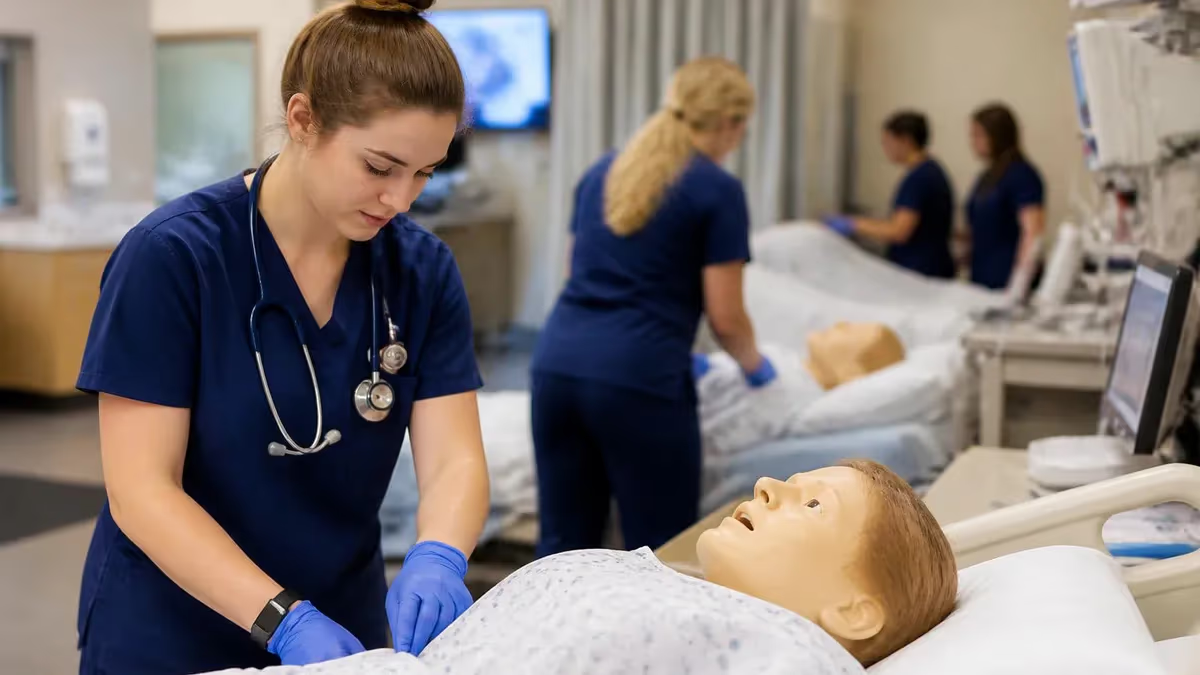
Choosing among RN to BSN accredited schools is one of the most consequential decisions a working nurse will make. Accreditation by the Commission on Collegiate Nursing Education (CCNE) or the Accreditation Commission for Education in Nursing (ACEN) signals that a program meets rigorous national standards for curriculum depth, faculty qualifications, and student outcomes.
Without that seal, your employer may not reimburse tuition, graduate schools may reject your transcript, and certain specialty certifications could be out of reach entirely. Understanding what separates an accredited program from an unaccredited one is the essential first step before you compare tuition rates or course schedules.
The growth of online education has dramatically expanded access to bridge programs for associate-degree nurses. Today, more than 700 CCNE- or ACEN-accredited RN-to-BSN options exist across the United States, ranging from large state flagship universities to smaller regional colleges with deep community ties. Many of these programs are fully asynchronous, meaning you set your own schedule around 12-hour shifts and family obligations. Completion timelines typically run 12 to 24 months when pursued full-time, or up to 36 months part-time, so the path to a bachelor's degree is realistic even for nurses juggling demanding clinical schedules.
Employers are paying close attention to educational credentials in a way they never did two decades ago. The Institute of Medicine's landmark 2010 report — later reaffirmed by its successor, the National Academy of Medicine — called for 80 percent of the nursing workforce to hold a BSN by 2025.
While that target was not fully met, the directional pressure is unmistakable: Magnet-designated hospitals now routinely require BSN credentials for promotion into charge nurse and manager roles, and several states have introduced or proposed legislation mandating BSN completion within ten years of initial licensure. Selecting an accredited program positions you squarely ahead of that regulatory curve.
Financial considerations matter just as much as prestige. Public in-state programs at regional universities frequently charge between $8,000 and $18,000 for total program completion, while private nonprofit programs average $20,000 to $35,000. For-profit institutions often fall on the higher end without offering commensurately better outcomes. Tuition reimbursement from hospital systems can offset $3,000 to $10,000 annually, making employer partnerships a critical factor when comparing programs. Many nurses also qualify for federal Title VIII nursing workforce grants or state-specific scholarship programs that further reduce out-of-pocket costs at accredited institutions.
Transfer credit policies are another underappreciated differentiator. Most CCNE-accredited programs grant full credit for your existing nursing coursework and accept your active RN license as validation of clinical competency, eliminating the need for additional clinical hours. Some programs cap transfer credits at 60 semester hours; others accept up to 90, dramatically reducing the number of courses remaining before graduation. Reviewing each school's articulation agreements before applying can save you both time and thousands of dollars in unnecessary coursework.
If you plan to continue your education beyond the BSN — toward a nurse practitioner, clinical nurse specialist, or nursing leadership role — accreditation becomes even more critical. Graduate nursing programs universally require an accredited BSN as a prerequisite. Explore the broader landscape by reading about rn to bsn accredited schools and how a BSN credential opens doors to advanced practice tracks. Selecting a CCNE- or ACEN-accredited RN-to-BSN program today is not merely about earning a degree; it is about building a scalable career infrastructure for the next 20 to 30 years of professional nursing practice.
This guide walks you through everything you need to know: how accreditation works, what the top program types look like, which factors to weigh when comparing schools, how to navigate the application process, and how to prepare academically for the coursework ahead. By the end, you will have a clear, evidence-based framework for selecting the program that best fits your career goals, schedule, and financial situation.
RN to BSN Accredited Schools by the Numbers

Types of Accredited RN-to-BSN Programs
Courses are recorded and self-paced, with no required log-in times. Ideal for nurses working rotating shifts. Schools like Western Governors University and Indiana State University offer this format with full CCNE accreditation and competitive per-credit pricing.
Core theory courses are delivered online while select labs or seminars meet in person monthly or quarterly. Hybrid formats suit nurses who want human interaction without commuting weekly. Many regional state universities use this model to serve local hospital system partners.
Traditional on-campus formats with scheduled class meetings. Best for nurses who thrive in structured learning environments or live near a university. Some campus programs offer evening and weekend cohorts specifically designed around nursing shift schedules.
Developed in partnership between hospital systems and universities, these programs often feature direct tuition sponsorship, cohort-based enrollment, and coursework tailored to the sponsoring institution's clinical priorities. Magnet hospitals frequently operate these programs.
Designed for RNs who want to finish in 12 months or fewer. Accelerated tracks require full-time enrollment and feature condensed eight-week courses. Admission is competitive, and students must be prepared for a high-intensity academic pace alongside clinical work.
Admission requirements across RN-to-BSN accredited programs are more consistent than many applicants expect, but subtle differences can make a significant impact on your timeline and total investment. Nearly every CCNE- or ACEN-accredited program requires an active, unrestricted registered nurse license in the state where you will complete any clinical or community health components. Your license is not just documentation — it is the credential that allows programs to waive additional clinical hours and grant advanced standing from the moment you enroll. Make sure your license is current and has no pending disciplinary actions before submitting applications.
Minimum GPA thresholds vary by program selectivity. Public university programs commonly require a cumulative GPA of 2.5 to 3.0 on a 4.0 scale from your associate degree or diploma program. Competitive private programs may set the bar at 3.0 or higher. If your GPA falls below a program's minimum, some schools allow submission of a personal statement explaining extenuating circumstances, or they consider upward GPA trends — for example, a 2.3 overall but a 3.2 in the final two semesters of your ADN program. Always call the admissions office to discuss your specific situation before ruling out a school.
Prerequisite coursework requirements differ more substantially between programs. Most RN-to-BSN programs require a statistics course completed within the past five to seven years, since evidence-based practice — a cornerstone of BSN education — depends on the ability to read and interpret research data. Some programs additionally require English composition, microbiology, anatomy and physiology, or nutrition. These prerequisites are typically satisfied by your ADN coursework, but programs in different states may not accept courses older than 10 years. Request an official transcript evaluation early so prerequisite gaps do not delay your start date.
Letters of recommendation are required by roughly half of all accredited programs, typically two to three letters from nursing supervisors, clinical preceptors, or faculty. Strong recommenders speak directly to your clinical judgment, professional communication skills, and capacity for academic rigor — not just your personality or work ethic. Give recommenders at least four to six weeks of lead time and provide them with a brief summary of your career goals and the specific program you are applying to so their letters feel tailored and credible.
Personal statements or essays are an increasingly important component of applications, even for programs that do not require letters of recommendation. Admissions committees use essays to assess your written communication ability, your clarity of professional purpose, and your understanding of what a BSN adds to your existing RN credential.
A strong personal statement articulates a specific career milestone you want to reach — charge nurse, public health nursing, NICU leadership — and explains how the BSN is the bridge to get there. Generic statements about wanting to be a better nurse rarely impress evaluators who read hundreds of applications each cycle.
Work experience requirements are less common than GPA or prerequisite thresholds, but some programs favor or require a minimum of one to two years of clinical experience post-licensure. Programs with hospital system partnerships may require employment at an affiliated facility. That said, most programs accept newly licensed RNs who just passed NCLEX, recognizing that educational momentum and lower workload may actually produce better academic outcomes than waiting years before returning to school. If you are a new grad RN, look for programs that explicitly welcome early-career applicants.
Understanding these requirements in detail before you apply prevents the costly mistake of enrolling in a program that does not fully credit your prior learning. If you ultimately plan to pursue graduate education, you should also investigate whether a potential BSN program's accreditation status is recognized by the graduate schools on your list. Most NP and DNP programs state clearly in their admissions materials which accrediting bodies they accept, and a quick check now saves a frustrating rejection letter later.
Comparing RN-to-BSN Program Options: Online, Hybrid, and Campus
Fully online RN-to-BSN programs offer the greatest scheduling flexibility, allowing nurses to complete coursework between shifts, on rest days, or during slower overnight hours. Programs at institutions like the University of Texas at Arlington, Penn State World Campus, and Western Governors University have enrolled tens of thousands of RNs nationwide with consistent NCLEX and CCNE outcome benchmarks. Asynchronous delivery means no mandatory video conference sessions, making time zone differences irrelevant for travel nurses or those who relocate mid-program.
The trade-off with fully online programs is reduced peer interaction and the self-discipline required to meet weekly discussion board deadlines without a physical classroom holding you accountable. Students who struggle with self-directed study often report falling behind during high-census periods at their hospitals. Most programs assign academic advisors and offer tutoring services to counteract isolation, but the burden of managing pace rests primarily on the student. Look for programs with low student-to-advisor ratios — ideally under 40:1 — when evaluating online options.

Pros and Cons of Enrolling in an Accredited RN-to-BSN Program
- +Employer tuition reimbursement is almost universally restricted to accredited programs, making your net cost significantly lower
- +Graduate nursing schools — NP, CNS, DNP — require an accredited BSN as a non-negotiable prerequisite
- +Magnet hospital career ladders and charge nurse promotions increasingly specify BSN as a minimum credential
- +CCNE and ACEN accreditation ensures curriculum rigor, qualified faculty, and student success metrics are independently verified
- +Many accredited programs offer generous transfer credit policies that honor your existing ADN coursework in full
- +Completing an accredited BSN signals commitment to evidence-based practice, which resonates with hiring managers in specialty areas
- −Tuition costs range from $8,000 to $35,000 even after employer reimbursement, representing a real financial commitment
- −Balancing 12-hour nursing shifts with weekly course deadlines creates significant stress and requires disciplined time management
- −Not all accredited programs accept transfer credits from every institution, so some nurses must repeat courses unnecessarily
- −Program quality varies considerably even among accredited schools — accreditation sets a floor, not a ceiling
- −Some programs require community health clinical hours in a specific geographic region, which complicates enrollment for travel nurses
- −The return on investment timeline can stretch 5 to 10 years before BSN-related salary gains fully offset tuition costs
RN-to-BSN Application Checklist: 10 Steps Before You Submit
- ✓Verify your RN license is active, unrestricted, and will remain valid through the program's projected end date.
- ✓Request official transcripts from every institution where you earned college credits, including non-nursing prerequisites.
- ✓Confirm the program holds current CCNE or ACEN accreditation by checking the official accreditor website directly.
- ✓Calculate your cumulative GPA from your ADN or diploma program and compare it to each target school's minimum threshold.
- ✓Complete any missing prerequisite courses — especially statistics — before your intended application deadline.
- ✓Identify two to three professional references and contact them at least six weeks before submission to allow preparation time.
- ✓Draft a personal statement that connects your specific clinical experience to a concrete post-BSN career goal.
- ✓Review each program's transfer credit policy and request a preliminary credit evaluation if the school offers one.
- ✓Investigate employer tuition reimbursement eligibility and confirm whether your employer requires a specific accreditation type.
- ✓Compare total program costs including tuition, fees, textbooks, and technology requirements across your top three program choices.
Always Verify Accreditation Directly — Not Just on the School's Website
A school listing itself as accredited on its own marketing pages is not sufficient verification. Always confirm current accreditation status on the CCNE website (ccneaccreditation.org) or the ACEN website (acenursing.org) using the official program search tools. Accreditation can lapse or be placed on probation without immediate removal from a school's marketing materials, and enrolling in a lapsed-accreditation program can disqualify you from employer tuition reimbursement and graduate school admission retroactively.
The total cost of an RN-to-BSN program at an accredited school varies by institution type, residency status, and the number of transfer credits you bring into the program. At public in-state universities, per-credit tuition rates for RN-to-BSN courses typically range from $175 to $450, translating to total program costs between $8,000 and $18,000 for the 30 to 45 credit hours most nurses need to complete. Out-of-state tuition at public universities can double that figure, although many online programs offer flat-rate tuition that applies equally to in-state and out-of-state students — a significant equalizer for nurses outside a school's geographic footprint.
Private nonprofit universities generally charge more per credit than public institutions, with per-credit rates commonly falling between $400 and $900. However, private universities also tend to offer more institutional scholarship money, and some have direct relationships with hospital systems that result in negotiated group tuition rates significantly below the published sticker price. If your employer has a formal educational partnership with a specific university, the discounted rate through that arrangement often makes the private school the more affordable option in practice, even when list prices suggest the opposite.
For-profit institutions occupy a complicated position in the RN-to-BSN landscape. Some hold genuine CCNE or ACEN accreditation and produce graduates who succeed in practice and graduate school. However, research from the National Student Clearinghouse and the Department of Education consistently shows that for-profit graduates carry higher average debt loads and have lower completion rates than their public or nonprofit counterparts. The combination of higher tuition, more aggressive credit transfer restrictions, and occasional accreditation vulnerabilities makes thorough due diligence essential when evaluating any for-profit program — regardless of how prominently it markets itself.
Federal financial aid is available at all accredited institutions for eligible students. The Free Application for Federal Student Aid (FAFSA) unlocks access to unsubsidized Stafford Loans, Graduate PLUS Loans for students pursuing a second bachelor's degree, and Pell Grants for those who meet income thresholds. Many nurses overlook the fact that a second bachelor's degree still qualifies for federal loan programs, assuming their previous undergraduate enrollment exhausted their eligibility. This is not necessarily the case — lifetime loan limits apply, but most RN-to-BSN students have substantial remaining eligibility from their first enrollment period.
State scholarship programs specifically targeting nursing students exist in nearly every state, though awareness of these programs remains low among practicing nurses. The federal Nurse Corps Scholarship Program and HRSA Nursing Workforce Diversity Grants provide funding to students from disadvantaged backgrounds or underrepresented groups. State boards of nursing and state hospital associations maintain updated lists of nursing-specific scholarships, and many have application windows in the fall that most nurses miss simply because they are not searching early enough. Bookmark your state's nursing scholarship page and set a calendar reminder to check it each September.
Employer tuition reimbursement remains the single largest non-loan funding source for most RN-to-BSN students. Hospital systems that hold Magnet designation or are pursuing Magnet status typically offer the most generous reimbursement packages — commonly $3,000 to $5,250 per year, with some systems offering full tuition coverage for nurses who commit to a two-year employment agreement after graduation. Community health centers funded through HRSA Section 330 grants sometimes offer loan repayment in exchange for service commitments rather than direct tuition reimbursement, which can be equally valuable depending on your loan balance and career plans.
Tax considerations add another dimension to the cost calculation. The IRS Lifetime Learning Credit allows eligible students to claim up to $2,000 per year in tuition tax credits, and employer-provided educational assistance up to $5,250 annually is excluded from your taxable income under Section 127 of the tax code.
Together, these provisions can reduce your effective annual cost meaningfully — though you should consult a tax professional familiar with educational benefit rules to maximize your specific situation. Total-cost-of-attendance calculations that account for all available financial resources often reveal that an accredited BSN is significantly more affordable than the published tuition figures suggest.

CCNE and ACEN conduct periodic reaccreditation reviews, and programs can receive probationary status or lose accreditation between your initial research and actual enrollment. Always verify accreditation status on the accreditor's official website within 30 days of submitting your application — never rely solely on a school's own claims. Enrolling in a program that loses accreditation after you begin courses can jeopardize employer reimbursement, graduate school eligibility, and in some states, advanced practice licensure requirements.
Once you have selected and enrolled in one of the many accredited RN-to-BSN programs available today, the challenge shifts from comparison to execution. BSN coursework builds substantially on your clinical foundation, but it demands a different kind of intellectual engagement than the procedural and pharmacological focus of your ADN program.
Courses in nursing theory, healthcare policy, informatics, population health, and evidence-based practice require sustained reading, analytical writing, and integration of research literature — skills that feel unfamiliar to nurses whose ADN programs emphasized clinical simulation over academic writing. Expect a transition period of four to eight weeks before the new academic rhythm feels manageable.
Evidence-based practice (EBP) courses are a universal component of every CCNE- and ACEN-accredited RN-to-BSN curriculum, and they are frequently the area where working nurses feel most out of their depth. EBP requires you to formulate searchable clinical questions using the PICO framework (Patient/Population, Intervention, Comparison, Outcome), search peer-reviewed databases like CINAHL and PubMed, critically appraise the quality of research studies, and apply findings to a real clinical problem at your workplace.
This is exactly the skill set that distinguishes a BSN-prepared nurse in the eyes of Magnet evaluators and evidence-based quality improvement committees, so investing effort here pays dividends well beyond the grade.
Community and public health nursing is another cornerstone of BSN education that surprises many acute care nurses with its breadth and conceptual richness. Rather than focusing on individual patients, community health nursing zooms out to populations, examining how social determinants — income, housing, education, and access to care — shape health outcomes at scale.
Most RN-to-BSN programs require a community health practicum involving 40 to 90 hours of supervised experience at a public health department, school district, community health center, or similar setting. These placements often become the most professionally transformative experiences in the entire program, introducing acute care nurses to dimensions of health care they have rarely encountered in hospital settings.
Leadership and management courses equip RN-to-BSN students with frameworks for understanding organizational behavior, change management, conflict resolution, and staffing models. These are not abstract concepts — they directly connect to your ability to advocate for your unit, support junior nurses, navigate difficult conversations with physicians, and participate in shared governance initiatives. Many nurses who initially resist leadership coursework as tangential to direct patient care report that it is the content they draw on most heavily within the first two years after graduation, particularly as they move into informal or formal charge roles.
Healthcare informatics has emerged as a rapidly evolving BSN curriculum area, reflecting the central role of electronic health records, data analytics, and telehealth in modern nursing practice. Informatics courses cover the principles of clinical decision support systems, nursing-sensitive quality indicators, data integrity, and the ethical implications of patient data use. Nurses who develop informatics competency are increasingly sought after for roles on EHR implementation teams, quality improvement committees, and population health management initiatives — roles that offer schedule flexibility and salary premiums compared to direct bedside care.
Writing-intensive courses challenge many practicing nurses who have not written a formal academic paper since their ADN program, sometimes a decade or more ago. Most accredited BSN programs offer writing center support, and some provide dedicated writing modules at program orientation.
Building the habit of writing regularly — even journal entries or reflective notes on clinical experiences — during the months before your program starts significantly reduces the adjustment challenge once courses begin. The APA citation style used in nursing academic writing follows consistent rules that become second nature with practice, so dedicating a weekend early in your program to mastering APA fundamentals pays dividends across every subsequent written assignment.
If you are considering advancing to a nurse practitioner or clinical nurse specialist role after completing your BSN, understanding the graduate admissions landscape now will help you make smarter choices during your RN-to-BSN program. Review the path from BSN to advanced practice by exploring what comes after accredited BSN completion — the career trajectory, specialty options, and admissions timelines for graduate nursing programs are well documented and worth mapping before you finish your bachelor's degree.
Building relationships with faculty advisors in your BSN program is also strategically important: faculty letters of recommendation and mentorship carry substantial weight in graduate nursing admissions, and those relationships take time to develop organically through coursework and office hour engagement.
Succeeding academically in an RN-to-BSN program while maintaining full-time clinical employment requires deliberate time management strategies that go beyond good intentions. Most nurses who struggle in bridge programs report the same root cause: they underestimated the weekly time commitment before enrollment and did not build a sustainable schedule until they were already behind.
A realistic baseline is 15 to 20 hours per week of focused study time for a two-course load, in addition to clinical shifts. Mapping that time onto your actual work schedule before the first class starts — not after — is the most important preparatory step you can take.
Creating a dedicated study environment at home significantly improves academic outcomes for distance learners. This does not require a separate room or expensive furniture — even a consistent chair, desk surface, and pair of noise-canceling headphones signals your brain that it is time to shift into learning mode.
Cognitive psychology research on context-dependent memory consistently shows that studying in the same environment where you will write papers and complete exams improves retention and performance. If you work rotating nights, scheduling study blocks immediately after your sleep anchor — not immediately before a shift — preserves cognitive capacity for the most demanding academic work.
Study groups composed of fellow RN-to-BSN students are underutilized by most nurses who assume online programs are inherently solitary experiences. Many programs facilitate peer connections through discussion boards, cohort Facebook groups, or virtual office hours, and the nurses who build these connections early consistently outperform their more isolated peers on group projects and overall program satisfaction metrics. Peer accountability — even an informal commitment to post weekly check-ins with a classmate — reduces procrastination substantially and surfaces study strategy tips from colleagues who are navigating the same clinical schedule demands you face.
Reading nursing research efficiently is a skill in itself, and most BSN students spend far more time on research articles than necessary because they read them linearly, word by word. Learning to read research critically and efficiently — starting with the abstract, methods, results, and then the discussion in that order — allows you to assess article relevance and quality in under 15 minutes rather than the hour a linear read-through requires.
Most university libraries provide free access to CINAHL, PubMed, and the Cochrane Database of Systematic Reviews, along with free interlibrary loan services for articles behind paywalls. Setting up a citation manager like Zotero early in your program saves hours of formatting time across every assignment.
Capstone projects are a culminating requirement in most accredited BSN programs and deserve more than last-minute attention. Typical capstone formats involve identifying a quality improvement problem in your clinical setting, conducting a literature review, proposing an evidence-based intervention, and presenting findings to faculty and sometimes to hospital leadership.
Nurses who choose capstone topics aligned with genuine workplace problems — not generic topics they think will be easy — produce stronger projects, earn better grades, and often see their interventions actually implemented on their units. Starting to identify your capstone topic during the first semester of your program gives you time to gather baseline data and build the faculty relationships needed for meaningful guidance.
Time management during high-census periods at your hospital requires a contingency plan, not just a default schedule. Most accredited programs offer some form of incomplete or hardship withdrawal that preserves your academic standing during genuine crises — a surge at your ICU, a family emergency, or your own illness.
Knowing those policies before you need them, and communicating proactively with faculty advisors at the first sign of falling behind, consistently produces better outcomes than silence followed by a missed submission deadline. Faculty members across nursing programs uniformly report that the students who reach out early receive far more accommodation than those who disappear and resurface at the end of a semester.
Finally, keeping your professional momentum visible to your employer throughout the program builds the case for tuition reimbursement renewals, schedule accommodations, and promotion consideration upon graduation. Share course milestones with your nurse manager — completing your evidence-based practice course, finishing your community health practicum, or reaching the halfway point — and connect what you are learning to unit-level quality metrics.
Nurses who make their BSN education visible as an organizational asset rather than a personal project are far more likely to receive the professional support that makes program completion sustainable over 12 to 24 months of concurrent clinical work and academic study.
BSN Questions and Answers

BSN to NP: Bachelor of Science in Nursing to Nurse Practitioner Career Path 2026

ADN to BSN Online: Bridge Programs and Costs Complete Guide

Accelerated BSN Programs by Location: Complete US Guide With Canada Comparison for 2026

Accredited BSN Programs: Complete Guide to CCNE and ACEN Nursing Degrees in 2026

BSN RN: What It Is, Salary, and Why It Matters in 2026
About the Author

Registered Nurse & Healthcare Educator
Johns Hopkins University School of NursingDr. Sarah Mitchell is a board-certified registered nurse with over 15 years of clinical and academic experience. She completed her PhD in Nursing Science at Johns Hopkins University and has taught NCLEX preparation and clinical skills courses for nursing students across the United States. Her research focuses on evidence-based exam preparation strategies for healthcare certification candidates.