
Cheapest Online RN to BSN Programs: Complete Guide to Affordable Bridge Degrees
Find the cheapest online RN to BSN programs in 2026 October. Compare tuition, requirements, and timelines to earn your BSN affordably. 🎓
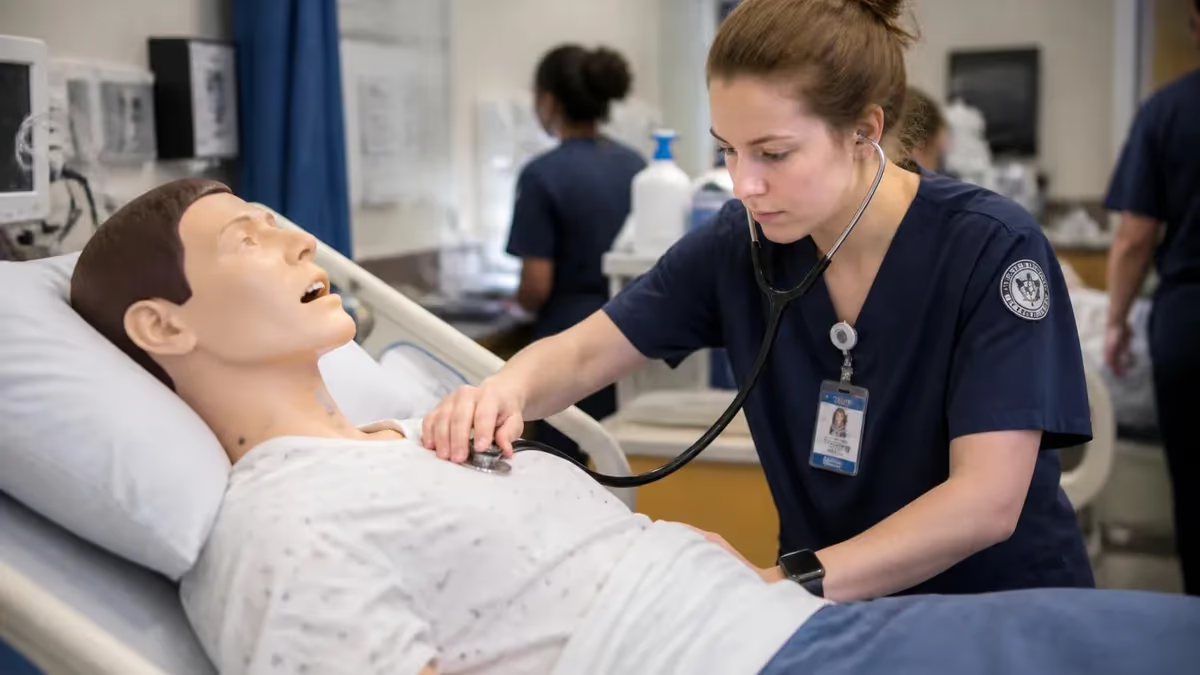
If you are a working registered nurse looking to advance your career without breaking the bank, finding the cheapest online RN to BSN programs is one of the most important decisions you will make. The good news is that hundreds of accredited universities now offer fully online bridge programs specifically designed for working RNs, with tuition rates that can be as low as $150 to $300 per credit hour. Over a typical 30-credit program, that translates to a total cost between $4,500 and $9,000 — a fraction of what traditional on-campus programs charge.
The demand for BSN-prepared nurses has never been higher. The American Nurses Credentialing Center's Magnet Recognition Program requires that hospitals demonstrate a growing percentage of BSN-educated nurses, and many healthcare systems now make a BSN a condition of employment or promotion. Earning your BSN online while continuing to work full-time allows you to avoid income gaps and maintain clinical experience, making the investment even more valuable over a long nursing career.
Tuition is only one piece of the cost puzzle. Affordable RN to BSN programs also factor in fees, textbooks, clinical practicums, and technology requirements. The best budget-friendly programs offer flat-rate tuition models, competency-based education tracks, or employer-partnership discounts that can slash your out-of-pocket expenses dramatically. Some state university systems lock in low in-state rates for online students regardless of where they live, opening up affordable options nationwide.
Accreditation is non-negotiable when evaluating cheap online BSN programs. You need a program accredited by the Accreditation Commission for Education in Nursing (ACEN) or the Commission on Collegiate Nursing Education (CCNE). A degree from a non-accredited school will not qualify you for many advanced nursing roles, graduate programs, or military positions. Price should never come at the cost of quality and recognition — and fortunately, many of the most affordable programs carry full accreditation.
Completion timelines at budget-friendly programs vary widely. Some programs allow motivated nurses to finish in as few as 12 months, while others are designed for a more relaxed pace of 18 to 24 months. Many programs offer rolling admissions, meaning you can start in any semester without waiting for a fall or spring cohort. Asynchronous coursework gives you the flexibility to study during off-hours, whether you work night shifts, rotating schedules, or irregular hours.
Financial aid availability dramatically changes the net cost of any program. Federal Pell Grants, institutional scholarships, employer tuition reimbursement, and nursing-specific grants can reduce your actual out-of-pocket cost to near zero at some schools. Before ruling out any program as too expensive at first glance, always investigate the full financial aid picture, because sticker price and net price can differ by thousands of dollars.
This guide breaks down everything you need to know to identify, compare, and enroll in the most affordable online RN to BSN program that fits your schedule, career goals, and budget. From the lowest-cost public universities to employer-partnership programs with no out-of-pocket tuition, we cover all the angles so you can make a confident, informed decision about your nursing education.
Online RN to BSN Programs by the Numbers

Cheapest Online RN to BSN Programs in the US
WGU offers a competency-based RN to BSN program at approximately $3,755 per six-month term. Self-paced learning means highly motivated students can finish in under a year, making the total cost among the lowest of any accredited option nationally.
UTA's RN to BSN online program charges around $300 per credit hour for out-of-state students, totaling roughly $9,000 for 30 credits. Strong regional reputation and CCNE accreditation make this one of the best-value flagship university programs available.
ISU offers online RN to BSN tuition at approximately $250 per credit hour, with a 30-credit program totaling around $7,500. Fully asynchronous coursework and rolling admissions make scheduling simple for working nurses on any shift.
FHSU's RN to BSN program costs around $185 per credit hour — one of the absolute lowest rates for an accredited, regionally recognized program in the US. Total program cost can fall below $6,000 with no required campus visits.
Mercy offers competitive per-credit pricing with strong transfer credit policies that allow many RNs to complete the program in under 12 months. Substantial employer-partnership discounts reduce net cost further for nurses at affiliated healthcare systems.
Understanding the admission requirements for affordable online RN to BSN programs is the essential first step before you begin comparing tuition rates. Nearly every program requires that you hold a valid, unencumbered Registered Nurse license in your state. You must also have graduated from an accredited associate degree in nursing (ADN) or diploma nursing program. A few programs accept international nursing credentials, but most focus on domestic ADN or diploma graduates who are already working in US healthcare settings.
Minimum GPA thresholds are common. Most programs require a cumulative undergraduate GPA of at least 2.0 on a 4.0 scale, and some of the more competitive programs set the bar at 2.5 or higher. However, many of the cheapest online programs have open or near-open admissions policies that prioritize accessibility over selectivity, meaning a nursing license and a high school diploma or equivalent may be all you truly need to get started on your degree.
Transfer credit policies make a dramatic difference in the total cost of an RN to BSN program. Many programs award 30 or more transfer credits simply for holding an active RN license, recognizing prior nursing education and clinical experience. This can effectively cut the required coursework in half. The more generous a program's transfer credit policy, the fewer credit hours you pay for — which is why this factor matters just as much as the per-credit-hour rate when calculating true program cost.
Clinical hour requirements are another key admission and completion factor. Most online RN to BSN programs require community-based practicum hours — typically 90 to 120 hours — that can be completed at your current workplace or an approved community health site. Unlike pre-licensure nursing programs, you are not placed in a hospital clinical by the school. Instead, you self-arrange the practicum at an approved site, which is almost always possible to complete without leaving your current employer.
Prerequisite courses sometimes add hidden costs to otherwise affordable programs. Common prerequisites include Statistics, English Composition, and Anatomy and Physiology. If you completed these during your ADN program, they will typically transfer. If not, completing them at a community college before applying — where costs can be as low as $100 per credit — is far more economical than paying university-level prices through the BSN program itself.
Technology requirements for online programs are generally modest. A reliable broadband internet connection, a laptop or desktop computer, and standard word-processing software are typically all you need. Some programs require proctored online exams, which may need a webcam and compatible browser. A few programs use simulation software, but most affordable options rely on video lectures, discussion boards, written assignments, and virtual case studies rather than expensive proprietary platforms.
If you want to explore cheapest online rn to bsn programs that offer accelerated completion timelines alongside low tuition rates, several schools combine both advantages — letting motivated nurses finish in under a year while keeping total program costs well under $10,000. Researching these options early helps you build a short list of schools that match both your budget and your timeline before you invest time in full applications.
Comparing Online RN to BSN Program Types
Competency-based education (CBE) programs like Western Governors University allow you to progress by demonstrating mastery rather than sitting through a fixed number of class hours. This model is ideal for experienced RNs who already possess strong foundational knowledge and want to move quickly through material they already understand. CBE programs charge by the term rather than by the credit, so the faster you demonstrate competency, the lower your total tuition bill becomes — sometimes dramatically so.
The financial upside of CBE is significant: a highly motivated nurse who passes multiple competencies per term could complete a 30-credit BSN equivalent in a single six-month term for a total cost under $4,000. However, CBE requires strong self-discipline and independent study habits. Without a fixed class schedule and instructor-led pacing, some students struggle to maintain momentum. Budget-conscious nurses who are also highly self-directed will find CBE programs to be the most cost-effective path available anywhere in the US.

Online RN to BSN: Is an Affordable Online Program Right for You?
- +Complete your degree while maintaining full-time RN income and benefits
- +Tuition as low as $4,500 to $9,000 total at the most affordable accredited programs
- +Fully asynchronous formats accommodate night shifts and rotating schedules
- +Generous transfer credit policies reduce required coursework by up to 50 percent
- +Open or near-open admissions at many budget programs means accessible entry
- +Employer tuition reimbursement can eliminate out-of-pocket costs entirely
- −Requires strong self-discipline without in-person instructor support
- −Clinical practicum hours must be self-arranged at an approved community site
- −Hidden fees (technology, clinical, graduation) can add $500 to $2,000 to listed tuition
- −Some cheapest programs have limited alumni networks or career services
- −Employer-partnership programs may require multi-year service commitments
- −CBE programs demand highly independent study habits that do not suit all learners
Pros and Cons at a Glance
| Pros | Cons |
|---|---|
| Complete your degree while maintaining full-time RN income and benefits | Requires strong self-discipline without in-person instructor support |
| Fully asynchronous formats accommodate night shifts and rotating schedules | Clinical practicum hours must be self-arranged at an approved community site |
| Open or near-open admissions at many budget programs means accessible entry | Some cheapest programs have limited alumni networks or career services |
| Employer tuition reimbursement can eliminate out-of-pocket costs entirely | Employer-partnership programs may require multi-year service commitments |
Application Checklist for Affordable Online RN to BSN Programs
- ✓Verify your RN license is active, unencumbered, and in good standing in your state.
- ✓Request official transcripts from every college or university you have previously attended.
- ✓Confirm the program holds CCNE or ACEN accreditation before applying.
- ✓Calculate total program cost including fees, textbooks, and clinical costs — not just tuition.
- ✓Check the school's transfer credit policy to determine how many credits your ADN will cover.
- ✓Complete the Free Application for Federal Student Aid (FAFSA) to determine your aid eligibility.
- ✓Contact your HR department to ask about employer tuition reimbursement or partnership programs.
- ✓Research nursing scholarships from the American Association of Colleges of Nursing and state nursing associations.
- ✓Identify a community health site near you where you can complete practicum hours before enrolling.
- ✓Compare program completion timelines to choose a pace that fits your work schedule and personal obligations.
Net Price Is What You Actually Pay — Always Look Beyond Sticker Tuition
The advertised per-credit-hour rate is rarely what you will actually pay. After accounting for employer tuition reimbursement, federal financial aid, institutional scholarships, and transfer credit reductions, many nurses complete an RN to BSN program for less than $3,000 out of pocket — even at schools with higher sticker prices. Always request a net price estimate and compare it to the gross tuition before choosing between programs on cost alone.
Maximizing financial aid is the single most powerful lever you can pull to reduce the real-world cost of an online RN to BSN program. Start with the FAFSA, which opens eligibility for federal Pell Grants (up to $7,395 per year for qualifying students), subsidized federal loans, and work-study arrangements. Even nurses who assume they earn too much to qualify are often surprised to find partial grant eligibility, particularly those with dependents or significant education-related expenses.
Institutional scholarships offered directly by the nursing school are often underutilized. Many universities set aside significant scholarship funds specifically for RN to BSN students and award them based on applications that are separate from the FAFSA process. These awards range from a few hundred dollars to full tuition waivers and are frequently left unclaimed simply because students do not apply. Spending two hours completing a scholarship application could yield thousands of dollars in awards — one of the highest-return investments of time available to any nursing student.
Professional nursing organizations offer scholarships and grants that many working nurses overlook. The American Association of Colleges of Nursing (AACN), the National Black Nurses Association, the American Association of Critical-Care Nurses, and many state nursing associations maintain scholarship programs with awards ranging from $1,000 to $10,000. Specialty nursing organizations — for oncology nurses, perioperative nurses, emergency nurses, and others — also fund education awards for members. Many of these scholarships have relatively modest applicant pools, meaning your odds of winning are considerably higher than for general academic scholarships.
Employer tuition reimbursement is a critical but underutilized resource. A majority of large hospital systems offer some form of tuition assistance, typically ranging from $2,500 to $5,250 per year — the IRS tax-exclusion threshold for employer-provided educational assistance. Some systems, particularly those pursuing Magnet designation, offer higher reimbursement or full-tuition coverage specifically for BSN completion. Check your employee handbook, speak with HR, and ask your nurse manager whether any specific programs or schools are preferred partners that offer enhanced benefits.
State-funded nursing education grants exist in many states, though they are often invisible to nurses who do not specifically search for them. States like Texas, California, New York, Florida, and Georgia have funded nursing workforce development programs that provide direct grants to RNs pursuing BSN degrees, with award amounts sometimes exceeding $5,000. These programs are typically administered through state workforce boards, community colleges, or state nursing workforce centers and require separate applications from the FAFSA.
VA education benefits apply to veterans and active-duty service members pursuing RN to BSN degrees. The Post-9/11 GI Bill covers tuition and fees up to the in-state public school rate, plus a monthly housing allowance and book stipend. The MyCAA scholarship program covers up to $4,000 in tuition for qualifying military spouses. These benefits can effectively make an online RN to BSN program entirely free for eligible military-connected nurses, making this category of aid critical for that population to investigate thoroughly before enrolling.
Combining multiple funding sources is the strategy most successful at minimizing costs. A nurse who receives $3,000 in employer reimbursement, qualifies for a $2,000 institutional scholarship, and earns a $1,500 state nursing grant has effectively covered more than half of a $12,000 program before taking out a single dollar of loans. Creating a systematic funding search — tracking applications, deadlines, and award statuses — makes it much more likely that you will capture the full range of available support rather than relying on a single source.

Not every inexpensive online nursing program is accredited by CCNE or ACEN. Degrees from non-accredited programs may not be recognized by graduate nursing schools, the US military, VA health system, or employers in states with BSN-preferred hiring policies. Always verify accreditation status directly on the CCNE or ACEN websites before submitting any application or enrollment deposit to an online RN to BSN program.
The career and salary outcomes associated with a BSN degree make even the most expensive online programs a sound financial investment — and at the cheapest programs, the return on investment is extraordinary. According to the US Bureau of Labor Statistics and multiple hospital compensation surveys, BSN-prepared nurses earn between $5,000 and $15,000 more annually than ADN-prepared RNs in comparable roles, with the gap widening in specialty areas, management tracks, and Magnet-designated facilities. A $7,500 investment in a low-cost online BSN program can pay for itself within a single year of increased earnings.
Job security is another compelling reason to pursue your BSN. The Institute of Medicine's landmark report recommending that 80 percent of the nursing workforce hold a BSN by 2020 has driven sustained policy pressure across healthcare systems. While that 80 percent goal has not yet been universally achieved, many major health systems — particularly those pursuing or maintaining Magnet status — actively require BSN credentials for new hires in many clinical departments. Having a BSN eliminates this barrier entirely and keeps your career options as wide as possible.
Graduate school access is a major long-term benefit of earning a BSN that is easy to underestimate when you are focused on near-term cost calculations. Virtually every Master of Science in Nursing (MSN) and Doctor of Nursing Practice (DNP) program in the United States requires a BSN for admission. Paths to becoming a nurse practitioner, certified registered nurse anesthetist, clinical nurse specialist, or nurse midwife all begin with the BSN. By completing your bridge degree now, you preserve optionality for these highly lucrative and professionally rewarding advanced practice roles later.
Leadership and management opportunities in nursing are disproportionately accessible to BSN graduates. Charge nurse, nurse supervisor, nurse manager, and director of nursing roles increasingly require or strongly prefer BSN credentials at competitive health systems. Nurses with BSN degrees are more likely to be considered for committee appointments, shared governance roles, and quality improvement leadership positions — all of which contribute to higher compensation and greater job satisfaction over time.
Military and federal employment often directly ties pay grades and assignment options to educational credentials. For nurses employed by the Department of Veterans Affairs, the Army Nurse Corps, Navy Nurse Corps, or Air Force Nurse Corps, BSN completion can unlock promotions, specialty assignments, and higher base pay that ADN-only nurses cannot access. Veterans and active-duty nurses who use VA education benefits to fund a cheap online BSN essentially receive both free tuition and a career upgrade simultaneously.
Community health and public health nursing roles — a rapidly growing employment sector driven by population aging and expanded community-based care models — frequently require a BSN as a minimum credential. School nursing, occupational health nursing, home health case management, and public health department positions commonly specify BSN in their job postings. These roles often offer regular hours, predictable schedules, and strong work-life balance, making them attractive to nurses ready for a change from shift work in acute care settings.
For nurses evaluating their options across the full spectrum of bridge education pathways, comparing costs, timelines, and outcomes across cheapest online rn to bsn programs alongside traditional on-campus options confirms what the data consistently shows: fully online, asynchronous programs at accredited public universities deliver equivalent educational quality and employer recognition at a fraction of the cost, making them the rational choice for the overwhelming majority of working nurses ready to earn their BSN.
Succeeding in a cheap online RN to BSN program requires a proactive, strategic approach to time management that goes well beyond simply logging into a learning management system when assignments are due. The most successful online nursing students treat their BSN coursework like a part-time job with non-negotiable scheduled hours. Block specific study windows each week in your calendar — even two hours on Tuesday and Thursday mornings before a day shift can be enough to stay current in a well-paced online program — and protect those windows as seriously as you protect your shifts.
Reading assignments and discussion board participation are the backbone of most online RN to BSN programs, and both reward consistent engagement over last-minute cramming. Discussion boards in particular are typically graded on both initial posts and peer responses, meaning you need to show up early in the week, post your initial response, and then return mid-week to engage with classmates. Nurses who post everything at the last minute before the deadline consistently earn lower participation grades, which can meaningfully affect your GPA in courses where participation accounts for 20 to 30 percent of the grade.
Building peer relationships in an online program takes more intentional effort than in a physical classroom, but the connections you make are valuable both academically and professionally. Most online programs assign group projects, and the quality of your group experience depends heavily on establishing clear communication norms from the first meeting. Create a group text thread, agree on response time expectations, and divide responsibilities explicitly. Nurses who invest in these relationships early typically complete group work with less stress and produce stronger projects.
The practicum or community health fieldwork component of an RN to BSN program is often the piece students worry most about, yet it is frequently the most manageable in practice. Most programs allow you to complete practicum hours at your current employer in a community or population health capacity — for example, working with a diabetes education program, a school health clinic, or a community vaccination drive. Start identifying your practicum site in the first week of the program, not the last, so you have plenty of time to arrange preceptor agreements and scheduling before the deadline arrives.
Writing skills matter more in a BSN program than many nurses expect. The emphasis on evidence-based practice, nursing theory, and population health requires academic writing that cites peer-reviewed literature and follows APA format. If your ADN program did not require substantial writing, invest a few hours reviewing APA 7th edition basics and using your university's free writing center services before your first major paper is due. Strong writing dramatically reduces revision time and grade anxiety throughout the program.
Time management during high-census periods or mandatory overtime seasons at work is the most common challenge that causes online nursing students to fall behind or withdraw. Build a cushion into your schedule by working slightly ahead of deadlines during quieter work periods, so that an unexpectedly busy clinical week does not immediately translate into missed academic deadlines. Most online BSN programs have clear late-work policies and some flexibility for healthcare workers, but communicating proactively with your professor before a deadline is always more effective than asking for an extension after the fact.
Finally, take advantage of every free academic resource your university provides. Library database access, free tutoring, statistical software licenses, citation managers, and writing consultations are all typically included in your student fees. Using these resources regularly not only improves the quality of your work but also reduces the time you spend on research and formatting — time you can reinvest in clinical practice, family, or rest. Nurses who graduate from online RN to BSN programs consistently report that the degree was worth every hour of effort, and a strategic approach to the coursework makes the journey significantly smoother.
Sample BSN - Degree Bachelor of Science in Nursing Practice Questions
Try these questions from our free BSN - Degree Bachelor of Science in Nursing practice tests. The correct answer and an explanation follow each question.
A nurse is caring for a patient with preeclampsia who is receiving IV magnesium sulfate. Which assessment finding indicates magnesium toxicity?
- A. Respiratory rate of 10 breaths/min and absent deep tendon reflexes
- B. Blood pressure of 148/94 mmHg
- C. Urinary output of 35 mL/hr
- D. Mild headache and visual blurring
Answer: A. Respiratory rate of 10 breaths/min and absent deep tendon reflexes
Respiratory depression and loss of deep tendon reflexes are signs of magnesium toxicity requiring immediate discontinuation of the infusion.
Which stage of Erikson's psychosocial development corresponds to the conflict of 'Intimacy vs. Isolation'?
- A. Adolescence (12–18 years)
- B. Early adulthood (18–40 years)
- C. Middle adulthood (40–65 years)
- D. Late adulthood (65+ years)
Answer: B. Early adulthood (18–40 years)
Erikson placed Intimacy vs. Isolation in early adulthood, where the developmental task is forming close, committed relationships.
A nurse is using therapeutic communication with a patient who says, 'I don't know what to do about my marriage.' Which response best demonstrates the technique of reflection?
- A. 'It sounds like you're feeling confused about your marriage.'
- B. 'Have you thought about seeing a marriage counselor?'
- C. 'Tell me what the specific problems in your marriage are.'
- D. 'Many couples go through difficult times; you're not alone.'
Answer: A. 'It sounds like you're feeling confused about your marriage.'
Reflection restates the emotional content of the patient's message back to them, encouraging further exploration of feelings.
A patient with a serum potassium of 2.9 mEq/L is prescribed IV potassium chloride. Which nursing action is essential?
- A. Administer the infusion via IV push over 2 minutes
- B. Infuse no faster than 10–20 mEq/hour via an infusion pump
- C. Mix the KCl in a 10 mL saline flush and give rapidly
- D. Administer only through a central line at any rate
Answer: B. Infuse no faster than 10–20 mEq/hour via an infusion pump
IV potassium must never be given as a bolus; rates exceeding 20 mEq/hour risk fatal cardiac dysrhythmias.
Take the full BSN - Degree Bachelor of Science in Nursing practice test
BSN Questions and Answers




About the Author

Registered Nurse & Healthcare Educator
Johns Hopkins University School of NursingDr. Sarah Mitchell is a board-certified registered nurse with over 15 years of clinical and academic experience. She completed her PhD in Nursing Science at Johns Hopkins University and has taught NCLEX preparation and clinical skills courses for nursing students across the United States. Her research focuses on evidence-based exam preparation strategies for healthcare certification candidates.