
BSN Nursing Program: Complete Guide to Bachelor of Science in Nursing Degrees in 2026 September
🔎 BSN nursing program guide covering admission requirements, coursework, clinicals, costs, and career outcomes for aspiring registered nurses in 2026 September.
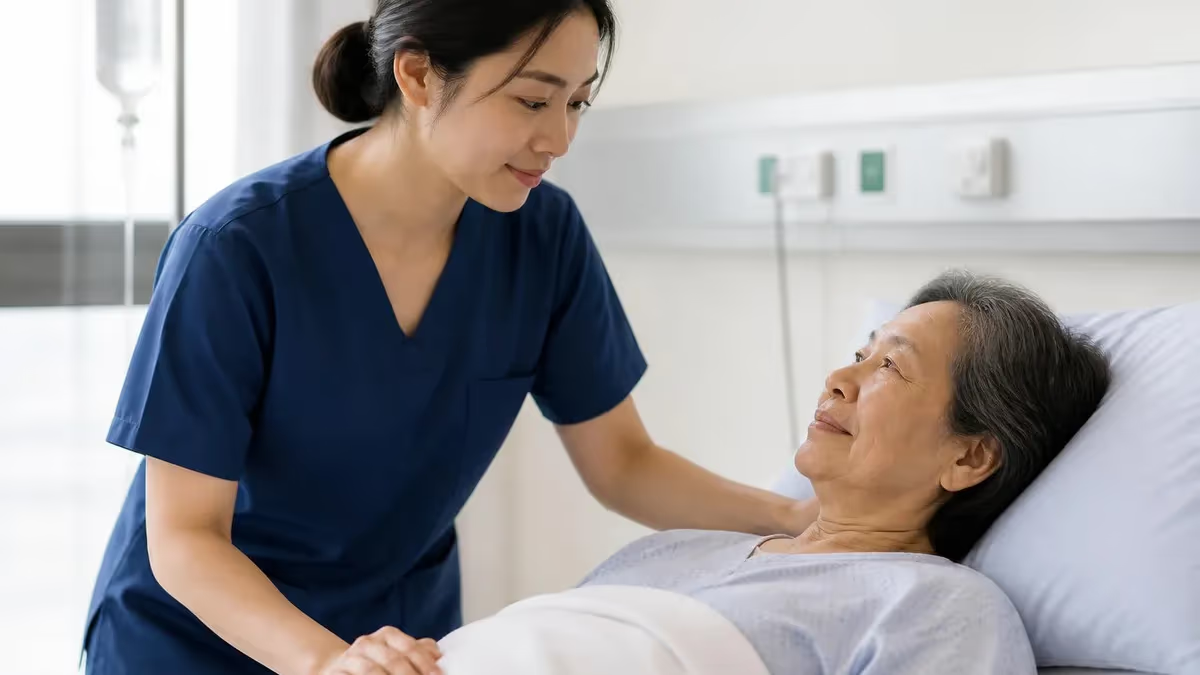
Choosing a BSN nursing program is one of the most consequential decisions an aspiring registered nurse can make, and the landscape in 2026 looks dramatically different than it did even five years ago. A Bachelor of Science in Nursing degree has shifted from being a preferred credential to an effective baseline expectation at most magnet hospitals, with employers like Kaiser Permanente, NYU Langone, and the Cleveland Clinic favoring BSN-prepared nurses for staff positions, residencies, and leadership tracks. Understanding what a modern BSN program actually contains will help you pick the right school.
The traditional BSN takes four academic years to complete and combines lower-division liberal arts coursework with upper-division nursing science, pathophysiology, pharmacology, and supervised clinical rotations. Most programs require somewhere between 120 and 130 credit hours, of which roughly 60 to 70 are nursing-specific. You will rotate through medical-surgical floors, psychiatric units, pediatric wards, obstetric services, and community settings while also completing simulation labs that recreate emergencies you might not encounter naturally during clinicals.
For students who already hold an associate degree or a non-nursing bachelor's, the picture is broader. ADN to BSN online bridge programs let working RNs finish the degree in 12 to 18 months without leaving their jobs, while accelerated second-degree BSN tracks compress the full nursing curriculum into 12 to 16 months for adults who already have a baccalaureate in another field. The path you choose should match your starting point, your budget, and how much clinical immersion you want.
Accreditation is the single most important factor when comparing schools. Programs accredited by the Commission on Collegiate Nursing Education (CCNE) or the Accreditation Commission for Education in Nursing (ACEN) meet the rigorous standards required for graduate study, military commissioning, and most residency programs. An unaccredited BSN is functionally worthless because graduates cannot sit for the NCLEX-RN in most states and cannot transfer credits if they later pursue a master's or doctoral degree.
Cost varies enormously. A traditional four-year BSN at an in-state public university typically runs $40,000 to $80,000 in tuition over the full program, while private universities and accelerated programs can exceed $120,000. Online RN-to-BSN bridge programs at public institutions remain the most affordable route, with several state systems offering completion at under $10,000 total. Financial aid, employer tuition reimbursement, and federal nursing scholarships dramatically reduce out-of-pocket costs for many students.
Outcomes justify the investment. The Bureau of Labor Statistics projects registered nursing employment to grow 6 percent between 2024 and 2034, adding roughly 197,000 jobs annually when retirements are included. The median RN salary nationally now exceeds $86,000, and BSN-prepared nurses in California, Massachusetts, and Washington routinely earn six figures within five years of graduation. Pursuing a BSN is not just an academic credential — it is the entry ticket to the broadest possible range of nursing careers.
This guide walks through every major dimension of choosing and completing a BSN program: admission requirements, curriculum structure, clinical expectations, accreditation, cost, NCLEX preparation, and the post-graduation career pathways that open up once you hold the degree. Whether you are a high school senior planning your first college application or a working LPN looking to advance, the information below is designed to help you make the choice with full visibility.
BSN Nursing Programs by the Numbers
BSN Admission Requirements
Most BSN programs require a minimum 3.0 GPA with completed prerequisites in anatomy, physiology, microbiology, chemistry, statistics, and psychology — usually with grades of B or higher in each science course.
Many programs require the TEAS (Test of Essential Academic Skills) or HESI A2 entrance exam. Competitive applicants score in the 80th percentile or higher, particularly in the reading and science sections.
While not always required, 100+ hours of patient-facing work as a CNA, EMT, medical assistant, or hospital volunteer strengthens applications significantly and demonstrates commitment to the field.
Criminal background check, drug screening, immunization records (MMR, hepatitis B, varicella, Tdap, annual flu, COVID-19), CPR certification, and proof of health insurance are required before clinicals begin.
Two to three letters of recommendation from science faculty or healthcare supervisors, plus a 500-750 word personal statement explaining your motivation, are standard components of competitive applications.
The BSN curriculum is structured to develop both scientific competence and clinical judgment, and understanding its shape will help you anticipate the academic intensity ahead. The first two years focus on general education and prerequisite sciences — anatomy, physiology, microbiology, organic chemistry, lifespan psychology, nutrition, and statistics. These courses are the foundation on which all upper-division nursing science is built, and weak performance here is the single strongest predictor of struggle in junior and senior year nursing courses.
Upper-division coursework begins with health assessment, where students learn the head-to-toe physical examination, documentation standards, and clinical interviewing. This is typically paired with foundational nursing skills lab work covering vital signs, medication administration, sterile technique, IV insertion, Foley catheterization, and wound care. Pathophysiology and pharmacology then run concurrently or sequentially, building the disease-process knowledge that justifies every nursing intervention you will perform on a real patient.
The medical-surgical sequence is the backbone of any BSN program and usually spans two or three semesters. Students learn to care for adult patients with cardiac, pulmonary, renal, gastrointestinal, endocrine, neurological, hematologic, and oncologic disorders. This is where many students first feel the cognitive demand of nursing: you must synthesize anatomy, pharmacology, lab values, assessment findings, and prioritization frameworks within minutes of meeting a new patient. Compare this to the broader scope discussion in our RN vs BSN comparison.
Specialty rotations follow med-surg and typically include pediatrics, obstetrics, psychiatric-mental health, and community health. Each rotation pairs didactic lectures with clinical hours on a hospital unit or in a community setting. Pediatric clinicals expose you to developmental assessment and family-centered care; OB rotations cover labor support, postpartum recovery, and newborn assessment; psych rotations teach therapeutic communication and de-escalation; community health emphasizes population-level interventions and social determinants of health.
BSN programs distinguish themselves from associate-degree nursing through three additional content areas: nursing research and evidence-based practice, nursing leadership and management, and community-public health nursing. These courses build the analytical and organizational skills that hospitals look for in charge nurses, clinical educators, and care coordinators. They also satisfy prerequisites for graduate study in nurse practitioner, nurse anesthetist, nurse-midwife, and nursing administration programs.
The capstone or practicum experience occurs in the final semester and is the most intensive clinical experience of the program. Students are typically paired one-to-one with an experienced RN preceptor for 120 to 200 hours of supervised practice on a single unit. The goal is to bridge the gap between student nurse and practicing professional by managing increasing patient assignments under guided supervision. By the end, most students are running four to six patients largely independently.
Throughout the program, simulation lab time supplements traditional clinicals. High-fidelity manikins programmed to display realistic vital signs, breath sounds, and disease progressions allow students to manage scenarios — sepsis, postpartum hemorrhage, anaphylaxis, code blue — that are too dangerous or too rare to guarantee in a hospital rotation. Most programs require 50 to 150 simulation hours, which the National Council of State Boards of Nursing has shown can substitute for up to 50 percent of traditional clinical time without harming NCLEX outcomes.
BSN Practice Test Questions
Prepare for the BSN - Degree Bachelor of Science in Nursing exam with our free practice test modules. Each quiz covers key topics to help you pass on your first try.
BSN Community and Public Health Nursing
BSN Exam Questions covering Community and Public Health Nursing. Master BSN Test concepts for certification prep.
BSN Maternal-Newborn and Women's Health Nu...
Free BSN Practice Test featuring Maternal-Newborn and Women's Health Nursing. Improve your BSN Exam score with mock test prep.
BSN Medical-Surgical Nursing
BSN Mock Exam on Medical-Surgical Nursing. BSN Study Guide questions to pass on your first try.
BSN Mental Health and Psychiatric Nursing
BSN Test Prep for Mental Health and Psychiatric Nursing. Practice BSN Quiz questions and boost your score.
BSN Pharmacology and Medication Administra...
BSN Questions and Answers on Pharmacology and Medication Administration. Free BSN practice for exam readiness.
BSN BS-Nursing General
BSN Mock Test covering BS-Nursing General. Online BSN Test practice with instant feedback.
BSN Program Types Compared
The traditional pre-licensure BSN is the most common pathway for high school graduates and transfer students entering nursing for the first time. Programs span eight semesters across four academic years, beginning with general education and prerequisite sciences before moving into clinical nursing courses in the junior and senior years. Tuition typically runs $40,000 to $120,000 depending on whether you attend public in-state, public out-of-state, or private institutions.
This route offers the most thorough academic immersion and the strongest professional networking opportunities. Students join campus chapters of the National Student Nurses Association, build long-term relationships with faculty mentors, and complete more than 800 clinical hours across multiple specialty areas. Most graduates enter their first RN role with a wide range of clinical exposures and the analytical depth that graduate programs and magnet hospitals look for in candidates.

Is a BSN Program Worth It?
- +Higher starting salaries averaging $5,000-$10,000 more than ADN-prepared nurses
- +Eligibility for magnet hospitals, residency programs, and specialty units like ICU and ED
- +Required prerequisite for all graduate nursing degrees including NP, CRNA, and CNS
- +Improved patient outcomes — studies link BSN staffing to lower mortality and readmission
- +Access to leadership tracks including charge nurse, clinical educator, and management
- +Broader career flexibility into public health, research, informatics, and government roles
- +Competitive advantage in tight job markets and during hospital hiring freezes
- −Higher upfront tuition and longer time commitment than associate degree pathways
- −Demanding prerequisite science sequence that screens out many initial applicants
- −Limited summer break and high stress during junior and senior clinical semesters
- −Significant unpaid clinical hours that prevent full-time outside employment
- −Application is highly competitive with acceptance rates below 30% at top schools
- −Background check and immunization requirements add cost and time to enrollment
- −Burnout risk is real for accelerated and second-degree students managing intense schedules
BSN Nursing Program Application Checklist
- ✓Confirm the program is accredited by CCNE or ACEN before applying
- ✓Complete all prerequisite science courses with grades of B or higher
- ✓Take the TEAS or HESI A2 entrance exam and aim for the 80th percentile
- ✓Earn 100+ patient-care hours as a CNA, EMT, or hospital volunteer
- ✓Request two to three letters of recommendation from science faculty or healthcare supervisors
- ✓Draft a 500-750 word personal statement explaining your motivation for nursing
- ✓Submit the FAFSA early to qualify for federal aid and institutional scholarships
- ✓Complete background check, drug screening, and required immunization series
- ✓Obtain BLS-level CPR certification through the American Heart Association
- ✓Apply to at least four programs to maximize chances of acceptance
Prerequisite GPA matters more than overall GPA
Admissions committees weight the prerequisite science GPA (anatomy, physiology, microbiology, chemistry) more heavily than overall GPA at most BSN programs. A 3.7 prerequisite GPA paired with a 3.3 overall is often more competitive than a 3.6 overall with a 3.2 in sciences. If your science grades are weak, retaking one or two courses to raise the prerequisite GPA is usually the highest-leverage step you can take before applying.
Clinical rotations are the heart of any BSN nursing program, and understanding what to expect on the floor will help you maximize the experience. Most programs require 800 to 1,000 supervised clinical hours, distributed across multiple specialties and settings. Clinical days typically run 8 to 12 hours and begin as early as 6:30 a.m. when you arrive on a hospital unit to receive shift report, review assigned patients, and prepare medications. The pace is fast, the expectations are high, and the learning curve is steep.
First-semester clinicals usually focus on fundamentals — vital signs, bed baths, ambulation assistance, basic assessments, and observation. The patient assignment is typically one or two stable medical-surgical patients, and you are closely supervised by both your clinical instructor and the unit's staff nurse. Your goal in this phase is not to perform advanced skills but to become comfortable with hospital workflow, professional communication, electronic charting, and the rhythm of bedside care.
By the second and third semesters, the complexity scales rapidly. You will administer oral and IV medications, perform sterile dressing changes, insert urinary catheters and nasogastric tubes, assist with bedside procedures, and develop care plans for patients with multiple comorbidities. Clinical instructors expect you to know each patient's diagnoses, medications, lab trends, and plan of care before the shift begins — meaning preparation the night before often runs two to four hours per clinical day.
Specialty rotations introduce new clinical environments. Pediatric clinicals usually occur in a children's hospital or pediatric outpatient setting; obstetric rotations cover labor and delivery, postpartum, and newborn nursery; psychiatric rotations may be on an inpatient behavioral health unit or in community mental health centers; community health takes you into schools, health departments, and home visits. Each rotation has its own competency checklist, written care plan requirements, and post-conference reflection sessions.
Simulation experiences run alongside clinicals throughout the program. In a typical simulation lab, students manage a high-fidelity manikin programmed to deteriorate — a postpartum hemorrhage, a pediatric asthma exacerbation, a septic shock progression. Faculty debrief the team afterward, reviewing decision-making, communication, and missed cues. Research from the National Council of State Boards of Nursing has shown that well-structured simulation produces NCLEX outcomes equivalent to traditional clinical hours, and most state boards now allow up to 50 percent simulation substitution.
The senior practicum is the capstone clinical experience and looks different from earlier rotations. Instead of rotating in a group of 8 to 10 students under a clinical instructor, you are paired one-to-one with a staff nurse preceptor for 120 to 200 hours on a single unit. By the end of the practicum, you are expected to function nearly independently with a full patient assignment of four to six adults, demonstrating prioritization, delegation, and time management at the level of a new graduate RN ready to enter practice.
Clinical performance is graded on competency, professionalism, and clinical judgment, not just task completion. Showing up prepared, asking thoughtful questions, accepting feedback gracefully, and demonstrating safe practice are weighted more heavily than the number of skills you perform. Students who treat clinicals as a job interview — because for many, it leads directly to job offers from preceptors and unit managers — consistently report stronger post-graduation outcomes and faster career advancement.

State boards of nursing require graduation from a CCNE- or ACEN-accredited program to sit for the NCLEX-RN. Enrolling in an unaccredited or recently-launched program without provisional accreditation can leave you unable to obtain licensure, with no credit transferability and no eligibility for graduate study. Always verify accreditation status directly on the CCNE or ACEN website before paying tuition deposits.
Career outcomes after a BSN nursing program are among the strongest of any undergraduate degree in the United States. The Bureau of Labor Statistics projects 6 percent employment growth for registered nurses from 2024 through 2034, with about 197,000 annual openings nationwide when retirements and turnover are included. The median annual wage exceeded $86,000 in 2024, with BSN-prepared nurses earning a notable premium over ADN-prepared peers in most metropolitan markets and significantly higher pay in California, Massachusetts, Oregon, and Washington.
New graduates typically enter the workforce through hospital residency programs, which are 6- to 12-month structured transitions designed to bridge nursing school and independent practice. These programs are intensely competitive at academic medical centers and magnet hospitals — many require a BSN, a minimum 3.0 GPA, and a strong clinical recommendation. Successful residency completion often comes with a 2- to 3-year employment commitment but provides specialty training in ICU, emergency, oncology, labor and delivery, or pediatrics that would otherwise take years to acquire.
Beyond bedside roles, BSN graduates have access to a wide variety of nursing careers. School nursing, public health nursing, occupational health, telemetry, dialysis, hospice, infusion therapy, case management, utilization review, clinical research coordination, and pharmaceutical sales all hire BSN-prepared RNs. Each pathway has its own pace and trade-offs, and many nurses move between specialties multiple times across a career as life circumstances and interests shift. For working RNs upgrading credentials, our RN to BSN online programs guide details the fastest paths.
Magnet hospitals — facilities that have earned the American Nurses Credentialing Center's highest designation for nursing excellence — strongly prefer or require BSN-prepared nurses. As of 2025, magnet status increasingly serves as the de facto baseline credential at large urban academic medical centers, and many institutions have set internal targets of 80 percent or higher BSN staffing among RNs. Working at a magnet hospital generally means better staffing ratios, stronger professional development support, and faster access to specialty certifications.
Graduate study is the other major pathway opened by a BSN. Nurse practitioners, certified registered nurse anesthetists, clinical nurse specialists, nurse-midwives, nursing administrators, and nursing faculty all require graduate-level degrees that begin with a BSN. The Doctor of Nursing Practice (DNP) is now the terminal practice degree for advanced practice nurses, and most DNP programs require a BSN plus one to two years of bedside experience for admission. CRNA programs in particular look for ICU experience as a prerequisite.
Salary trajectory for BSN-prepared nurses follows a predictable pattern. New graduates typically earn $70,000 to $90,000 depending on geography. Within five years, base salaries often reach $95,000 to $115,000, with shift differentials, overtime, and certifications adding 10 to 25 percent. Charge nurses, clinical educators, and unit managers commonly earn $110,000 to $140,000. Advanced practice nurses with master's or doctoral degrees average $125,000 to $215,000, with nurse anesthetists at the top of the scale at $215,000 to $250,000 median nationally.
Long-term job security is among the strongest in the labor market. Nursing is consistently ranked among the most resilient occupations during recessions, healthcare hiring tends to continue even when other sectors contract, and travel nursing offers high-paying mobility for nurses willing to relocate every 13 weeks. The combination of strong wages, mobility, advancement pathways, and societal impact makes a BSN one of the highest-return undergraduate investments available in 2026.
Succeeding in a BSN nursing program requires more than intelligence or motivation — it requires deliberate study habits, time management, and self-care discipline that you build from the first semester. Students who thrive treat nursing school like a full-time job: they schedule study blocks in advance, attend every lecture, complete assigned readings before class, and review notes within 24 hours of each lecture. Cramming, which may have worked in high school or earlier college, fails almost universally in nursing programs where content is cumulative.
Active study strategies outperform passive ones by wide margins. Practice questions are the single most effective preparation tool — both for course exams and the NCLEX. Aim to complete at least 50 NCLEX-style questions per week starting in your first nursing course, increasing to 100 to 150 per week by senior year. Each question should be reviewed with attention to the rationale, not just the answer, because the reasoning is what transfers to new clinical scenarios on exam day and the NCLEX.
Concept mapping helps students integrate pathophysiology, pharmacology, and nursing interventions across systems. Rather than memorizing isolated facts about heart failure, build a map that connects the pathophysiology to expected assessment findings, lab abnormalities, prescribed medications, nursing interventions, and patient teaching priorities. This approach mirrors the clinical reasoning the NCLEX tests and the cognitive work nurses do at the bedside every shift, and it produces dramatically better long-term retention.
Clinical preparation deserves dedicated time the night before each clinical day. Review each patient's chart for medical history, current diagnoses, surgical interventions, scheduled medications, allergies, and most recent lab results. Look up any unfamiliar medications or diagnoses, identify the top three nursing priorities, and prepare to articulate them when your instructor asks during pre-conference. Students who consistently arrive prepared receive stronger evaluations and better job recommendations from preceptors and clinical instructors.
NCLEX preparation should begin no later than the second semester of nursing courses, not after graduation. Commercial review programs like UWorld, Kaplan, ATI, and Hurst provide question banks, content reviews, and predictor exams that align with the current NCLEX test plan. Most successful test-takers complete 2,500 to 4,000 practice questions before sitting for the exam and consistently score above 65 percent on practice tests in the final weeks. Programs with strong NCLEX outcomes typically integrate ATI or HESI testing throughout the curriculum.
Self-care is not optional. Nursing school is associated with measurable rates of anxiety, depression, and burnout, particularly in accelerated programs. Sleep deprivation degrades clinical judgment in measurable ways, increases medication-error risk during clinicals, and harms exam performance. Aim for seven to eight hours of sleep nightly, maintain regular exercise, and protect at least one day per week as a non-study day. Counseling services on campus are confidential and free at most universities — use them without hesitation.
Finally, build your professional network from day one. Join your school's chapter of the National Student Nurses Association, attend specialty conferences when possible, connect with clinical preceptors on LinkedIn, and stay in touch with classmates who will become your colleagues for the next 30 to 40 years of your career. The relationships built in nursing school often lead directly to job offers, residency placements, graduate school recommendations, and lifelong friendships that sustain you through the most demanding parts of a clinical career.
BSN Questions and Answers


About the Author

Registered Nurse & Healthcare Educator
Johns Hopkins University School of NursingDr. Sarah Mitchell is a board-certified registered nurse with over 15 years of clinical and academic experience. She completed her PhD in Nursing Science at Johns Hopkins University and has taught NCLEX preparation and clinical skills courses for nursing students across the United States. Her research focuses on evidence-based exam preparation strategies for healthcare certification candidates.