
BSN Degree Classes: Complete Guide to Every Course You'll Take 2026 October
BSN degree classes explained — prereqs to clinicals, core nursing courses, and how to prepare. Full curriculum guide for 2026 October. 📚
Understanding bsn degree classes before you enroll can mean the difference between thriving in a demanding program and feeling blindsided by the workload. A Bachelor of Science in Nursing typically spans four years and includes a carefully sequenced mix of science prerequisites, foundational nursing theory, clinical specialty courses, and hands-on practicum hours. Each layer builds on the last, and nursing programs design that sequence deliberately so students develop the critical thinking skills required at the bedside.
Most accredited BSN programs in the United States follow guidelines set by the Commission on Collegiate Nursing Education (CCNE) or the Accreditation Commission for Education in Nursing (ACEN). These bodies require programs to cover a broad range of competency areas — from anatomy and pharmacology to community health and nursing leadership. Understanding what those competency areas look like as actual course titles prepares you to plan your four-year schedule intelligently and avoid surprises in registration.
The first two years of a typical BSN curriculum are dominated by prerequisite sciences and general education requirements. You will take courses like Human Anatomy and Physiology I and II, Microbiology, Chemistry, Statistics, English Composition, and Developmental Psychology before you ever set foot in a clinical setting. These courses exist because nursing school faculty know that a student who struggles to interpret a blood-gas panel or calculate a drug dosage will be dangerous in a hospital. Every science prerequisite feeds directly into a later nursing course.
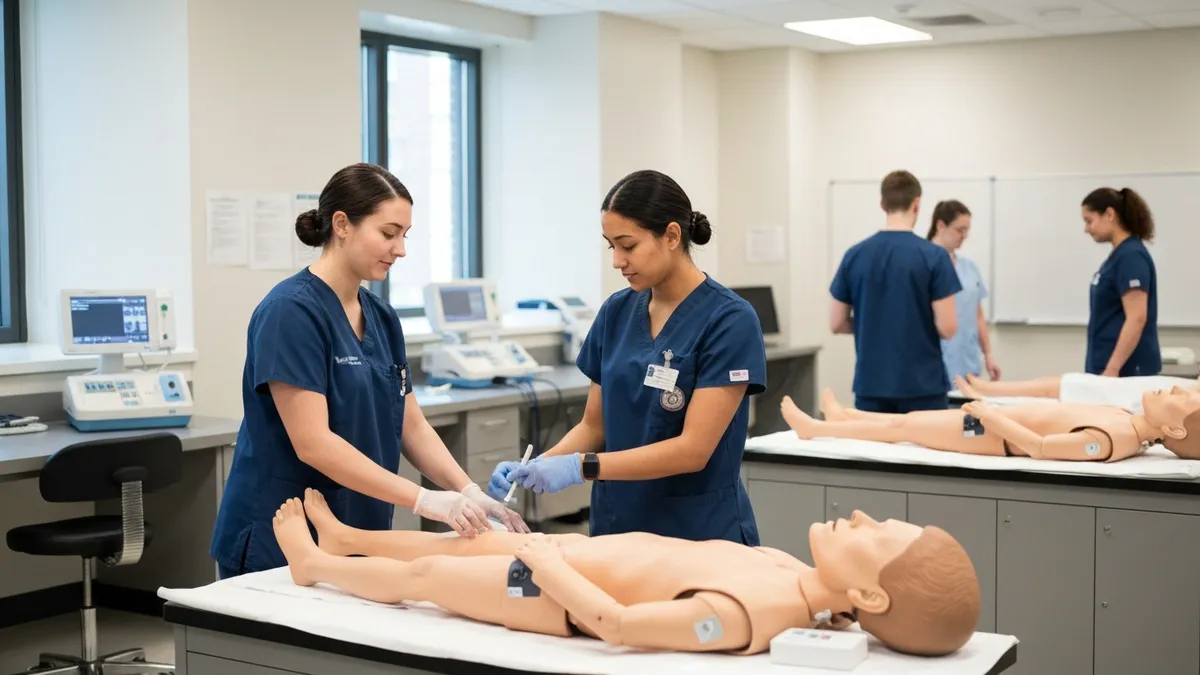
By the third year, the curriculum shifts heavily toward nursing-specific content. You enter courses with names like Fundamentals of Nursing Practice, Health Assessment, Pathophysiology, and Pharmacology for Nurses. These classes combine lecture hours with simulation lab time, where you practice skills like IV insertion, sterile technique, and physical assessment on high-fidelity mannequins before practicing on real patients. Simulation labs are a defining feature of modern BSN education and can account for up to 25 percent of total clinical hours at some programs.
The fourth year brings specialty rotations and capstone experiences. You will rotate through medical-surgical units, pediatrics, maternal-newborn settings, psychiatric units, and community health sites. Each rotation is paired with a co-requisite seminar course where you discuss cases, review evidence-based practice, and connect clinical experience to nursing theory. Many programs also require a senior capstone or leadership practicum where you shadow a charge nurse or nurse manager for a concentrated block of time.
Elective and upper-division courses round out the BSN experience. Depending on your program, you might choose electives in transcultural nursing, palliative care, emergency nursing, informatics, or global health. These electives allow you to deepen knowledge in areas that align with your career goals — whether that means working in a Level I trauma center, a rural public health clinic, or a pediatric oncology unit. Some programs offer formal concentration tracks so your electives tell a coherent story to future employers.
The NCLEX-RN licensing exam looms at the end of your BSN journey, and the good news is that a well-designed BSN curriculum maps almost perfectly to the exam's test plan. Understanding how your coursework connects to NCLEX content categories — health promotion, safety and infection control, physiological adaptation, psychosocial integrity — helps you study smarter throughout all four years, not just in the frantic weeks before your exam date.
BSN Degree Classes by the Numbers
Key Facts at a Glance
| Item | Value | Details |
|---|---|---|
| Credit Hours | 120–130 | Typical BSN total |
| Clinical Hours | 800+ | Required for most programs |
| Program Length | 4 Years | Traditional BSN track |
| Pharmacology Credits | 3–5 | Standalone drug calc course |

BSN Curriculum Structure: Four Core Phases
Anatomy, Physiology, Microbiology, Chemistry, and Statistics form the scientific backbone of nursing education. These courses must typically be completed with a C+ or better before you can progress to nursing-specific coursework. Many students take 1–2 years to complete all prerequisites.
Courses like Fundamentals of Nursing, Health Assessment, and Nursing Theory introduce the discipline's core frameworks. Simulation labs become central here, allowing students to practice clinical skills in controlled environments before entering actual patient care settings.
Medical-surgical nursing, pediatrics, maternal-newborn, psychiatric-mental health, and community health rotations happen in this phase. Each 6–12 week rotation is paired with a seminar course that connects real patient cases to evidence-based nursing literature.
Senior-level courses in nursing leadership, informatics, research methods, and quality improvement prepare graduates for professional practice. A capstone preceptorship of 120–200 hours with a practicing RN bridges academic training and independent clinical judgment.
The core nursing courses that appear across virtually every accredited BSN program share a common purpose: transforming a student who understands biology and chemistry into a nurse who can apply that science safely to living, breathing patients. Health Assessment is typically the first course that feels unmistakably like nursing school. You learn to perform a head-to-toe physical assessment, interpret abnormal findings, and document your observations using standardized nursing language — skills you will use every single shift for the rest of your career.
Pathophysiology is often described by nursing students as the hardest course in the pre-clinical sequence, and for good reason. It requires you to understand not just what diseases are, but how they alter normal physiological processes at the cellular, organ, and system level. A student who truly understands the pathophysiology of heart failure — why fluid backs up into the lungs, why the kidneys retain sodium, why cardiac output falls — will recognize decompensation in a patient long before it appears on a monitor. This course is the backbone of clinical reasoning.
Pharmacology for Nurses is a different beast from a general pharmacology course taught in a pre-pharmacy or biology program. BSN pharmacology focuses on drug classes, mechanisms of action, nursing-specific considerations (monitoring parameters, patient education, common adverse effects), and safe dosage calculation. Many programs embed drug calculation competency exams throughout the course, requiring a score of 90 percent or higher to progress — a reflection of how high the stakes are when you are drawing up medications at the bedside.
Nursing Research and Evidence-Based Practice is a course that surprises many students because it feels academic rather than clinical. However, it is arguably one of the most important courses in the curriculum. Modern nursing is not about doing things the way they have always been done — it is about asking whether the current practice is supported by the best available evidence and knowing how to find, critically appraise, and apply that evidence. This course teaches you to read a randomized controlled trial, evaluate its methodology, and determine whether its findings should change how your unit cares for patients.
Mental Health Nursing is a course that changes how students see every patient they will ever care for, not just psychiatric patients. You learn therapeutic communication techniques, how to conduct a mental status examination, crisis intervention, and the unique ethical challenges of caring for patients who may lack decision-making capacity. The stigma reduction component of this course has lasting value — nurses who understand mental illness provide better care in every specialty, from oncology to orthopedics, because almost every patient you care for has some psychological dimension to their illness experience.
Community and Public Health Nursing stands apart from other BSN courses because it shifts the unit of care from the individual patient to populations. You study epidemiology, social determinants of health, health disparities, disease surveillance, and health promotion at the community level. Clinical time in this course is spent in public health departments, school health clinics, community mental health centers, and home health settings rather than hospitals. For many students, this rotation reveals entire career paths they had not previously considered.
Leadership and Management in Nursing is a capstone-level course that prepares you to function in the professional role of a registered nurse rather than just as a direct care provider. Topics include delegation to unlicensed assistive personnel, conflict resolution, staffing and scheduling principles, quality improvement frameworks like PDSA cycles, and the legal and ethical dimensions of nursing management. The clinical component typically involves a preceptorship with a charge nurse where you shadow all aspects of unit leadership during a full shift, not just patient care tasks.
Clinical Specialty BSN Classes In Depth
Medical-surgical nursing is the largest and most demanding clinical specialty course in a BSN program, typically spanning two semesters. Students care for adult patients with a wide range of acute and chronic conditions — post-operative patients, those with cardiac and respiratory diseases, endocrine disorders like diabetes, and neurological conditions including stroke. The sheer variety of patient presentations in med-surg builds the clinical reasoning flexibility that makes a new graduate nurse competent across any hospital unit.
The paired clinical rotation places students on general medical or surgical hospital units for at least 90–120 hours per semester. Students begin by managing one or two patients and gradually increase their assignment to three or four patients as the semester progresses, simulating real-world staffing ratios. Weekly post-conference sessions — where the clinical group debriefs on cases, near-misses, and clinical decision points with their instructor — are where much of the deep learning actually happens in this course.

BSN Degree Classes: Rigorous Curriculum — Worth It?
- +Comprehensive science prerequisites build genuine clinical reasoning skills from the ground up
- +Simulation labs provide a safe environment to make and learn from mistakes before caring for real patients
- +Specialty rotations expose you to 6–8 different nursing environments, helping you choose a career focus
- +Evidence-based practice courses prepare you for ongoing professional development throughout your career
- +Leadership coursework develops management skills that accelerate advancement to charge nurse or supervisor roles
- +BSN curriculum aligns closely with NCLEX-RN test plan, giving you a structural advantage on licensing exam
- −Science prerequisite sequence can add 1–2 years to total program length for students entering without a science background
- −Heavy credit load of 15–18 credits per semester leaves little time for part-time work or other commitments
- −Pathophysiology and Pharmacology courses have high failure rates and may require retaking, delaying graduation
- −Clinical rotations require day, evening, and weekend availability that conflicts with other jobs and family responsibilities
- −Research and theory courses feel abstract to many students and can be demotivating compared to clinical coursework
- −Total tuition cost for 4-year BSN programs averages $40,000–$100,000, creating significant student loan burden
How to Succeed in BSN Degree Classes: 10 Action Steps
- ✓Build a weekly study schedule during Week 1 of each semester and protect those hours like clinical time.
- ✓Join or form a study group of 3–4 students for Pathophysiology and Pharmacology — peer teaching deepens retention.
- ✓Use active recall and spaced repetition tools like Anki for drug classes and disease processes instead of passive re-reading.
- ✓Attend every simulation lab session fully prepared by completing the pre-lab readings and skills practice beforehand.
- ✓Visit your clinical instructor during office hours after your first rotation shift to get early feedback on your assessment technique.
- ✓Practice NCLEX-style questions weekly starting in Semester 1 to build test-taking stamina and clinical reasoning habits early.
- ✓Read your ATI, HESI, or Kaplan review materials in parallel with your course textbook rather than only before exams.
- ✓Take careful notes during post-clinical conference — real patient cases discussed there appear frequently on course exams.
- ✓Seek out extra simulation time if your program offers open lab hours, especially before high-stakes skills check-offs.
- ✓Talk to your academic advisor each semester to confirm your course sequence aligns with graduation and NCLEX eligibility requirements.
Your Clinical Hours Count Toward NCLEX Eligibility
Most state boards of nursing require verification of both completed coursework AND a minimum number of supervised clinical hours before they will authorize you to sit for the NCLEX-RN. Falling below the clinical hour threshold — even by a few hours due to absences — can delay your licensing exam by an entire semester. Track your clinical hours in writing every week and notify your clinical coordinator immediately if illness or emergency causes you to miss a rotation shift.
Breaking the BSN curriculum down year by year reveals a logical progression that becomes clearer when you see it mapped out. In Year 1, most students spend both semesters completing prerequisites or, if they enter a traditional four-year university, mixing prerequisites with general education requirements in English, social sciences, and humanities. The Anatomy and Physiology sequence alone demands 8–10 hours of weekly study outside of class if you want to earn competitive grades that satisfy program admission requirements.
Year 2 marks the transition into the professional nursing curriculum for most traditional BSN students. Fall semester typically begins with Nursing Fundamentals — a course covering the theoretical foundations of nursing practice along with essential skills like vital signs, medication administration, catheter insertion, wound care, and mobility assistance. The spring semester often introduces Health Assessment, where you learn to perform a complete physical examination, and begins your introduction to nursing theory and conceptual frameworks that will recur in every subsequent course.
Year 3 is when the BSN program feels most like its popular image — full of clinical rotations, demanding coursework, and the constant challenge of connecting theory to practice at the bedside. Students in Year 3 are typically taking three to five nursing-specific courses simultaneously while completing clinical rotations in at least two specialty areas. The semester credit load during Year 3 is often the heaviest in the entire program, sometimes reaching 18–20 credits when simulation lab hours are counted alongside traditional lecture credits.
Year 4 focuses on synthesis and professional development. Courses in nursing research, health policy, leadership, and informatics are paired with a substantial preceptorship experience that places you with a staff nurse for an extended block of time — often 120 to 200 hours concentrated in the final semester. This preceptorship is explicitly designed to bridge the gap between student nurse and independent practitioner, giving you responsibility for a full patient assignment under the mentorship of an experienced RN before you graduate.
Many BSN programs also embed a community health or public health rotation in either Year 3 or Year 4, and this rotation looks very different from hospital-based rotations. You may spend time in a county health department conducting disease surveillance, in a school running health screenings, in a community mental health center supporting case management, or in a home health agency visiting homebound elderly patients. These community experiences broaden your conception of what nursing practice looks like beyond the hospital walls and are increasingly emphasized as healthcare shifts toward population health management.
Accelerated BSN programs compress this four-year sequence into 12–18 months by accepting students who already hold a bachelor's degree in another field and have completed all prerequisite science courses. The coursework is identical in content and required clinical hours — it is simply delivered at a pace of 15–20 credits per 8-week block rather than per 16-week semester. Accelerated students often describe the experience as drinking from a fire hose, but cohort-based formats and intensive faculty support can make the pace sustainable for highly organized, motivated students.
RN-to-BSN bridge programs, by contrast, are designed for working nurses who already hold an associate degree in nursing and an active RN license. These programs grant credit for prior nursing knowledge and clinical experience, allowing students to skip most foundational nursing courses and focus on upper-division BSN content — community health, leadership, research, and informatics. RN-to-BSN students typically complete 30–60 additional credits over 12–24 months, often entirely online, while continuing to work as RNs throughout the program.
Most BSN programs require a minimum grade of C+ (approximately 77%) in every nursing course to progress to the next semester. A grade below this threshold — even in a single course — typically results in dismissal from the nursing program rather than a simple retake. Some programs allow one remediation attempt, but readmission is competitive and not guaranteed. Know your program's progression policy before the semester begins, not after your first exam.
Preparing for the NCLEX-RN after completing your BSN degree classes is the final step before you can legally practice as a registered nurse, and the transition from student to exam-taker requires a deliberate shift in how you study. During nursing school, you are learning content — disease processes, pharmacology, assessment techniques, nursing interventions. NCLEX preparation is different: the exam tests clinical judgment and prioritization, not content recall. Understanding this distinction changes everything about how you should approach your final weeks of study.
The NCLEX-RN uses a format called Next Generation NCLEX (NGN), which was updated in 2023 to include a broader range of item types beyond traditional multiple-choice questions. You will encounter case studies with multiple related questions, extended drag-and-drop items, matrix grids where you select which assessments and interventions are appropriate for a given clinical scenario, and trend questions where you interpret changes in a patient's status over time. These new item types reward students who practiced clinical reasoning throughout their BSN program rather than memorizing lists of facts.
The Kaplan Decision Tree and the NCLEX Clinical Judgment Measurement Model (CJMM) are two frameworks that many nursing graduates find useful for structuring their NCLEX preparation. The CJMM describes six cognitive skills: Recognize Cues, Analyze Cues, Prioritize Hypotheses, Generate Solutions, Take Action, and Evaluate Outcomes. If you map each step of your clinical decision-making to these six skills while answering practice questions, you build the precise cognitive habit the exam is designed to measure.
Timing your NCLEX registration strategically matters more than most new graduates realize. The NCLEX can be scheduled as soon as you receive your Authorization to Test (ATT) from your state board of nursing, which typically arrives 2–4 weeks after graduation. Most nursing education research suggests that candidates who sit within 45–60 days of graduation have the highest pass rates, because the content is still fresh and the study momentum from senior year has not dissipated. Waiting more than 90 days without active structured review significantly increases the risk of content decay.
Practice question banks from providers like UWorld, Kaplan, and ATI remain the gold standard for NCLEX preparation, and the data consistently shows that students who complete 2,000 or more practice questions before the exam have meaningfully higher pass rates than those who complete fewer. However, quantity without quality review is ineffective. The most important habit is reading the rationale for every question — both the ones you get wrong and the ones you get right. Understanding why an answer is correct trains your clinical reasoning; simply checking whether you got it right does not.
Sleep, nutrition, and stress management in the weeks before the NCLEX deserve as much attention as your study schedule. Research on exam performance consistently shows that acute sleep deprivation impairs the prefrontal cortex function needed for complex clinical reasoning — the exact cognitive skill the NCLEX tests most heavily. Students who maintain a consistent sleep schedule, limit caffeine to morning hours, and schedule deliberate rest days during their NCLEX prep period consistently outperform those who cram 12-hour sessions every day in the final two weeks.
After passing the NCLEX and receiving your RN license, the learning does not stop — it accelerates. Most new BSN graduates enter a hospital residency or orientation program lasting 12–24 weeks, during which you are paired with a preceptor and gradually take on a full patient assignment independently.
Many hospital systems have moved to structured nurse residency programs accredited by the ANCC that include didactic learning, simulation, and reflective practice alongside the clinical preceptorship. These programs are specifically designed to bridge the gap between BSN graduate and confident, independent RN — and taking them seriously sets the trajectory of your nursing career.
Choosing elective courses within a BSN program is one of the most underutilized opportunities students have to differentiate themselves in a competitive job market. While most students default to whichever electives fit their schedule, intentional elective selection can signal genuine commitment to a specialty area when you apply for your first RN position. For example, a student targeting a pediatric oncology position who completes electives in Palliative Care Nursing and Transcultural Nursing demonstrates awareness of the psychosocial complexity of that patient population beyond the technical clinical skills.
Nursing informatics has grown from an obscure elective to a near-essential competency for new graduates entering health systems that rely on sophisticated electronic health record platforms like Epic or Cerner. An informatics elective teaches you not only how to navigate these systems efficiently but also how to think critically about data quality, clinical decision support alerts, and the nursing workflow implications of technology implementation. Nurses who can bridge clinical expertise and informatics knowledge are disproportionately valuable to healthcare organizations that are constantly optimizing their EHR configurations.
Global health and transcultural nursing electives are particularly valuable for students planning to practice in diverse urban communities or pursue international nursing opportunities. These courses go well beyond learning to use interpreter services — they teach you about health belief models, culturally specific illness explanations, the impact of historical trauma on healthcare engagement in marginalized communities, and how to perform a genuinely culturally competent assessment. The cultural humility framework introduced in these courses becomes more important as the United States becomes more diverse and as disparities in health outcomes by race and ethnicity remain persistent and measurable.
Many BSN programs also offer directed study or independent study options that allow you to pursue a focused project under the mentorship of a nursing faculty member. These experiences are particularly valuable if you aspire to graduate school, because they give you experience with nursing scholarship and can result in a faculty recommendation letter grounded in direct experience with your intellectual capabilities rather than just your performance on exams. A well-executed directed study project can also become a poster presentation at a regional nursing conference, a meaningful line on your CV that most new graduates cannot match.
The relationship between your BSN coursework and your first nursing job is more direct than many students expect. When nurse managers interview new graduates, they are not just evaluating clinical competence — they are assessing whether you can articulate the reasoning behind your clinical decisions, whether you can communicate effectively with interdisciplinary team members, and whether you demonstrate the professional values their unit culture requires. The communication, ethics, and leadership courses in your BSN curriculum are directly preparation for those interview conversations, not just abstract academic requirements.
Financial planning for BSN education deserves serious attention before you begin the program. The average BSN graduate carries approximately $30,000–$50,000 in student loan debt, though this varies enormously by institution type — a community college-to-university bridge program might cost $15,000 total, while a private university BSN can exceed $120,000. Many hospital systems offer loan forgiveness or tuition reimbursement programs for nurses who commit to working for the organization for a defined period after graduation, and investigating these opportunities before choosing a program can dramatically alter the financial calculus of your BSN decision.
Professional nursing organizations such as the American Nurses Association, the National Student Nurses' Association, and specialty organizations like the Association of Women's Health, Obstetric and Neonatal Nurses (AWHONN) offer student membership at reduced rates, and joining during your BSN program provides access to networking opportunities, scholarships, continuing education, and early exposure to the professional culture of your chosen specialty. Many BSN faculty encourage — and some require — student membership in the NSNA as part of professional development coursework, recognizing that professional identity formation during school shapes nurses who lead and advocate throughout their careers.
Sample BSN - Degree Bachelor of Science in Nursing Practice Questions
Try these questions from our free BSN - Degree Bachelor of Science in Nursing practice tests. The correct answer and an explanation follow each question.
Which nursing intervention takes priority when caring for a patient in sickle cell crisis?
- A. Encourage activity and ambulation
- B. Apply cold packs to painful areas
- C. Administer IV fluids and opioid analgesics as ordered
- D. Restrict fluid intake to prevent fluid overload
Answer: C. Administer IV fluids and opioid analgesics as ordered
Hydration reverses sickling and restores blood flow, while opioids manage the severe vaso-occlusive pain of a sickle cell crisis.
When performing a head-to-toe assessment, the nurse auscultates bowel sounds and hears high-pitched, gurgling sounds every 5–15 seconds. How should the nurse document this finding?
- A. Hypoactive bowel sounds
- B. Absent bowel sounds
- C. Hyperactive bowel sounds
- D. Normal bowel sounds
Answer: D. Normal bowel sounds
Normal bowel sounds occur every 5–30 seconds and are described as high-pitched, gurgling sounds.
A patient who is getting oxygen through a nasal cannula at a flow rate of 6 L/min complains of nasal passage irritation, the nursing assistant informs you. What course of action might you recommend to enhance the patient's comfort in light of this issue?
- A. Suggest that the patient be provided with an extra pillow.
- B. Suggest that the patient sit up in a chair at the bedside.
- C. Suggest that a simple face mask be used instead of a nasal cannula.
- D. Suggest that the patient's oxygen be humidified.
Answer: D. Suggest that the patient's oxygen be humidified.
The mucous membranes may dry out when the oxygen flow rate exceeds 4 L/min. The best course of action is to upgrade the oxygen delivery system with humidification. For patients who need high-flow oxygen systems for longer than 24 hours or who complain of upper airway irritation owing to dryness, it is permissible to utilize humidified oxygen. It can also be beneficial to apply a water-soluble jelly to the nares to lessen mucosal irritation. None of the alternative solutions will address the issue.
The nursing assistant takes the patient's vital signs after the respiratory therapist suctions an intubated patient. Which vital sign value needs to be reported right away to the licensed nurse by the nursing assistant?
- A. Blood pressure of 168/90 mm Hg
- B. Tympanic temperature of 101.4ºF (38.6ºC)
- C. Heart rate of 98 beats/min
- D. Respiratory rate of 24 breaths/min
Answer: B. Tympanic temperature of 101.4ºF (38.6ºC)
The risk of infection for a patient undergoing mechanical breathing never goes away. Bypassing the body's natural air-filtering systems, the endotracheal tube gives bacteria and viruses a direct path to the lower respiratory system.
Take the full BSN - Degree Bachelor of Science in Nursing practice test
BSN Questions and Answers

Accelerated BSN Programs: Requirements, Cost, and Timeline
ADN to BSN Online: Bridge Programs and Costs Complete Guide

Accelerated BSN Programs by Location: Complete US Guide With Canada Comparison for 2026

Accredited BSN Programs: Complete Guide to CCNE and ACEN Nursing Degrees in 2026

BSN RN: What It Is, Salary, and Why It Matters in 2026
About the Author

Registered Nurse & Healthcare Educator
Johns Hopkins University School of NursingDr. Sarah Mitchell is a board-certified registered nurse with over 15 years of clinical and academic experience. She completed her PhD in Nursing Science at Johns Hopkins University and has taught NCLEX preparation and clinical skills courses for nursing students across the United States. Her research focuses on evidence-based exam preparation strategies for healthcare certification candidates.